Category: Latest Articles

  • Ecommerce Mobile App Buyer’s Guide: How to Choose the Right App, Build Approach, and Vendor for Your Brand (2026)

    Mobile is now the dominant surface in ecommerce. Adobe Digital Insights pegged mobile at 51.4% of US online spend in October 2025, up 11.6% year over year, on track to keep climbing through 2026.

    And with mobile driving most of your traffic, the case for launching a dedicated mobile app keeps getting stronger.

    The path you pick for ecommerce mobile app development locks in your cost structure, time-to-market, and team workload for years, so picking it the right way matters more than picking it fast.

    There are four real decisions to make, in order:

    1. What type of app does your brand need? Fully native, hybrid, PWA, or a native app powered by your existing website?
    2. What build approach fits your team? In-house engineering, an agency, a DIY app builder, or a fully managed website-powered service?
    3. What does the path cost over three years, not just at launch?
    4. Which specific vendor or agency should you engage inside the category you’ve picked?

    Each section below answers one of those decisions. By the end, you’ll have a solid understanding of how ecommerce mobile apps get built, what you want yours to look like, and the best way to get there.

    The Different Types of Mobile App

    A “mobile app” can be multiple, meaningfully different products. 

    This is important to know before you start building your app may save you a lot of wasted time and money.

    Fully native

    These are separate iOS and Android codebases written in platform-native languages (Swift, Kotlin). Native apps have the best possible performance and full access to every native device feature, though two codebases mean more work to build, higher cost, and a lot more work to maintain.

    Cross-platform

    Cross-platform apps have a single shared codebase that compiles to both iOS and Android. The dominant frameworks are React Native and Flutter. When a brand says “we built a native app from scratch,” they almost always mean a React Native or Flutter app. It’s faster and cheaper than fully native; with small performance trade-offs on heavy interactions. Most modern custom ecommerce apps fall in this category.

    WebView

    A basic native shell wrapped around the brand’s website. Cheap, fast to build, but Apple specifically scrutinizes WebView-only apps and routinely rejects them under App Store Review Guideline 4.2. What the customer downloads doesn’t feel native, and the App Store presence is fragile. 

    Template native apps

    This is what you get with most SaaS app builders. The codebase is usually something like React Native under the hood, but the apps are assembled from templates rather than built feature by feature. Fast to launch and inexpensive to start, but the nature of these apps means limitations you have to work with.

    Hybrid apps

    Hybrid apps are apps that utilize web code alongside native app code. Your app ships as a real, fully-functioning mobile app, but a lot of the design and features are carried over from your existing web codebase.

    Progressive Web Apps (PWAs)

    A PWA is a website built to feel more like an app, and is installable to the home screen (albeit not a one-click install), with some access to push notifications. PWAs aren’t real native apps, and not a realistic substitute for the kind of app you find in the App Store, but it is a solid first step if you want to provide a better mobile user experience.

    The Four Most Common Ways to Build an Ecommerce Mobile App

    It’s important to know the difference between native, cross-platform, PWA, etc – but the real decision is in the kind of vendor you’re going to go with.

    In this sense, there are generally four different ways your mobile app gets built. And the investment, payback period, end result and recurring overhead can be very different, depending on which you choose.

    In-house development

    In-house means your brand hires mobile engineers and ships the app from inside the company.

    It treats the app as a permanent product the team owns, with everything that implies: roadmap ownership, release cycles, on-call coverage for production issues, and the headcount to support it.

    The realistic team is two or more mobile engineers, sometimes a backend lead and a designer, a project manager or product manager, and QA capacity. 

    It’ll likely take six to twelve months to launch v1 of your app, if everything goes well. You’ll also need to keep your team in place to maintain the app, and keeping your app and website in sync means coordination between your web and app teams has to be on point.

    “When you develop an app you can’t just have one person. When we built the app, the maintenance became very heavy. To keep a platform like this in-house I feel like you’d probably need around six people.”
    — Kenneth Chan, Founder & CEO, Tobi

    Agency or dev shop

    It’s a lot more common for brands to hire an agency or mobile development shop to build their app.

    It could be a full-stack agency or a specialist mobile firm. This is the common path when a brand wants a custom build but doesn’t want to hire engineers permanently.

    This can be costly. ScienceSoft’s published software development cost calculator estimates a moderate-complexity cross-platform mobile app at $30,000-$70,000 and a native app for a regulated sector at $150,000-$250,000. 

    Specialty mobile agencies for ecommerce typically come in higher: a custom branded ecommerce mobile app from an established agency commonly costs $150,000 to $500,000+ for a launched v1, plus a maintenance retainer or hourly rates afterward.

    It is generally more cost-effective than hiring an in-house team (as you don’t need to worry about hiring, and all the extras that come with having staff on the payroll). But it’s still, honestly, overkill for most ecommerce mobile apps. 

    DIY no-code app builder

    A DIY app builder is a SaaS platform that converts your storefront into a mobile app via a drag-and-drop editor. The brand owns the configuration; the vendor owns the codebase. 

    Builders are faster than an agency, cheaper than in-house, and don’t require engineers. And realistically, a much better way to build an ecommerce app.

    Cost-wise, you’re looking at a recurring subscription of anywhere from $200-$1500 per month (with the cost of your team’s time on top of that; potentially somewhere in the range of 40 hours per month).

    That’s a much better deal than a mid-six figure bill, plus the recurring overhead, for a native app from an agency. The difference in quality (real, but marginal) from a custom native build is not worth the difference in what it costs you.

    Vendrux

    Vendrux builds and maintains a native iOS and Android app powered by your existing web platform. 

    It’s basically a category of its own. You get a custom app, with app-exclusive experiences and features – yet without a separate codebase, no compatibility issues with your website (everything from your website works in the app automatically), and without the cost and time investment of “native” development.

    The cost is comparable to that of most app builders, but the effort required from your team is less, because Vendrux’s team does virtually everything for you.

    Brands like Jack & Jones, John Varvatos, Kiokii, and Pharmazone are a few examples of brands that shipped apps with Vendrux. Our partners see app users routinely contribute 20-30% of their total online revenue (and up to 60% for top performers, like Pharmazone) – proving their apps really resonate with their audience.

    “We couldn’t find another company that could offer the same features at the same price point, same time to market, and make it as easy as Vendrux could.”
    — Svend Hansen, Product Owner at Bestseller

    “Vendrux keeps this whole thing simple and streamlined. No more juggling two different platforms, no more wasted time on maintenance.”
    — Eric Lowe, Director of Ecommerce at XCVI

    It’s essentially an agency, except you get more control over the app (you manage the bulk of the experience though your web platform), and it’s nowhere near the cost and complexity of an agency maintaining a separate codebase.

    Ecommerce Mobile App Vendors and Agencies Compared

    Now let’s get practical. Let’s look at some of the actual companies operating in the ecommerce mobile app space, helping ecommerce brands go live with branded mobile apps.

    We’re not going to go too deep into the pros and cons of each – that would be dishonest, since we haven’t worked with all of them hands-on. And regardless, most of the upsides/downsides are shared across the category.

    Use this as a starting point for your vendor search, then go out and research each one in more detail, based on what seems like the best fit for your needs.

    DIY Shopify-focused builders

    Most DIY app builders are built specifically for Shopify. You’ll find and install the app from the Shopify App Store, sign up, (usually) compile the app yourself, and manage the day-to-day of the app yourself as well.

    Some of the popular names here include:

    • Tapcart
    • Shopney
    • Superfans
    • SimiCart
    • OneMobile
    • MageNative

    All up, there are nearly 100 apps on the Shopify App Store in the “mobile app builder” category; so you’re not short of choice.

    Tapcart (widest reach; one of the oldest tools in the category), Shopney (over 700 reviews on the app store), Superfans (over 800 reviews – formerly known as Vajro) are probably the most widely used.

    You’ll want to do your own research here. But before you do, consider the other options, and whether there’s a more efficient way to get to the app you want.

    Multi-platform app builders

    The bulk of the DIY app builder ecosystem targets Shopify merchants.

    The reason is that template-driven tools use platform APIs to sync up with your store’s product and order data. Most tools focus on building and maintaining only an integration with Shopify, since that’s the biggest market.

    Brands on other platforms typically have a much smaller market to choose from, if they’re looking for a DIY app builder.

    Some options that work for non-Shopify brands include:

    • JMango360
    • Twinr
    • AppMySite
    • BuildFire

    JMango360 is an API-driven app builder, supporting a few different platforms (Magento, BigCommerce, and Salesforce Commerce Cloud included). 

    Twinr and AppMySite are both built around webviews, which lets them convert websites from various platforms into mobile apps.

    BuildFire is more general-purpose, with a plugin marketplace and broader use cases, but it isn’t built specifically for ecommerce, so its integrations with the major platforms aren’t as deep as the alternatives.

    As with the Shopify-focused category, do your own research before picking one. But before you do, consider whether one of the other categories fits your situation better.

    Ecommerce development agencies

    There are thousands of development agencies across the world, most of whom could build you a good mobile app.

    Whether it’s the best option or not is up for debate – we covered that above. If you are looking for a custom “from scratch” build, here are some mobile app development companies to look at:

    The best tip to find a development agency is to head to Clutch and look through the options, look at reviews, and narrow the choices down.

    It’s important to do your due diligence before signing a contract here, as you’re looking at a mid-five figures cost (at the bare minimum), so the cost of choosing the wrong partner is significant.

    Vendrux

    Vendrux is really in a category of its own: the cost of an app builder, but the attention, care and flexibility of an agency.

    Vendrux has worked with 2,000+ brands including Jack & Jones, Bestseller, John Varvatos, Tadashi Shoji, Kiokii, and Pharmazone.

    Some of the apps built with Vendrux

    Some concrete outcomes:

    • Pharmazone runs 63% of online revenue through its app and sees 15x revenue per app user
    • Tadashi Shoji sees 10x ARPU and 18% of total online revenue from the app
    • John Varvatos has done close to $1M in app sales with 10x revenue per user
    • Kiokii gets close to 40% of total online revenue through the app from a small fraction of total users. 

    It’s the best option if you want an app that builds on top of your existing systems, not parallel to them, and you don’t want to be limited by templates, platform APIs, and the lag times of a native dev team.

    A native iOS and Android app powered by your existing website. Around 30 days to launch. Flat subscription, no revenue share. We handle the build, the App Store, and ongoing maintenance.

    See what your store looks like as a real native app, before you commit to anything.

    Get a Free App Preview

    How to Choose: A Decision Framework for Ecommerce Brands

    The best development approach can end up being different from brand to brand.

    The right approach for your business depends on revenue band, ecommerce platform, internal dev capacity, customization needs, and business model. 

    Here’s a rough breakdown:

    • If you want a managed solution, with relatively low overhead, low operational lift, that builds on top of your existing website (and works with any ecommerce platform): choose Vendrux.
    • If you want to manage and iterate on the app yourself; perhaps you’re in a lower revenue band (Tapcart.
    • If you want the same, but you’re not on Shopify: consider a general-purpose app builder like AppMySite or JMango360.
    • If you need heavy app-specific customizations, heavy native device integrations (and you have the budget): look for a custom development agency.

    Alternatively, if you’re not sure about launching an app yet? Don’t rush into it. Consider shipping a PWA first, perhaps gather some intel on mobile app vendors, but don’t jump in and launch an app just because you think you’re supposed to have one.

    Take your time, map out the business case – then come back to our guide once you’re comfortable it’s time to launch your app.

    Final Thoughts

    A mobile app could be the best investment you make for your brand. But like any investment, it depends on what you put in.

    If you overpay, or build an app that takes too much time, effort and money to run, your investment won’t look so good.

    Same thing goes if you build an app that doesn’t provide the kind of experience your users expect – you’ll end up with few users, minimal revenue, and an investment that provides very little return.

    We can’t tell you the best option for your specific business, your tech stack, your requirements.

    We can, however, present Vendrux as the best ecommerce mobile app solution for the widest range of brands – from Shopify to Magento, from luxury fashion to automotive parts brands.

    If you want to see what Vendrux is capable of, and discuss your options in-depth with our app experts, get in touch and get a free preview of your app.

    We’ll walk you through the process, and give an honest assessment on the best long-term approach for your app.

  • The Real Cost of Maintaining a Mobile App for an Ecommerce Brand

    When you scope a mobile app for an ecommerce brand, the conversation almost always centers on the build cost. 

    An agency might quote you $100K for a custom React Native project. You might compare that against a DIY or service-driven app builder and the monthly or yearly subscription on their pricing table. You might weigh these two costs against each other, to estimate the ROI potential of your mobile app over time.

    You might, on the basis of the quotes you’ve been given, see the “one-time cost” of a custom project as a preferable option to an ongoing subscription that bills every month.

    But here’s what you’re missing: the upfront cost of a mobile app is far from the end of the billing picture.

    The real cost of owning a mobile app shows up after launch. Maintenance costs, OS updates, new features, fixes, updates to follow design or branding updates on your website.

    It’s a job that never ends. And failing to understand the long-term cost of a mobile app is the biggest mistake we see ecommerce companies make.

    Read on and learn everything you need to know about the long-term maintenance costs of mobile apps, and how to make sure these costs don’t come back to bite you.

    What Mobile App Maintenance Includes

    Mobile app maintenance isn’t a small bucket of bug fixes. It’s a regular, full-time job.

    “We had [an app] in 2014 and found that it was too much to maintain. To keep a platform like this in-house I feel like you’d probably need around six people.”
    — Kenneth Chan, Founder & CEO, Tobi

    For an ecommerce app, the ongoing work falls into five buckets:

    Platform updates

    Apple ships a major iOS release every year, plus several point releases. Google does the same with Android. Each release deprecates APIs, changes permissions, tightens privacy rules, and occasionally breaks behavior your app depended on. 

    Apps that don’t keep up get warnings, then rejections, then get pulled from the App Store. Staying compliant with these rules is non-negotiable.

    Third-party SDK or API updates

    Every integration your app uses – analytics, push, payment, attribution, reviews – has its own code, and its own SDK or API used to make it work in your app.

    Each one publishes updates. Each one occasionally breaks.

    If a push provider or an analytics tool updates their API, they’re not going to personally call you and make sure the new version works in your app. That’s on you.

    Website parity

    Most ecommerce websites aren’t static. They’re constantly moving, getting refreshed.

    You add a new reviews widget, a product configurator. You change the hierarchy on your PDPs. You update your homepage, add a new collection.

    All this work needs to be replicated in your app, or your app and web experiences quickly drift apart, and end up looking like two different stores.

    Bug fixes and regressions

    Bugs are inevitable in software.

    It could be an edge case that wasn’t caught in testing. It could be a new integration. It could be one of the SDK or API updates mentioned above, which breaks your implementation.

    And the important thing about bugs is that one bug is easy to fix. But once you let multiple bugs accumulate, it’ll start to look as if the only way to fix them all is to tear down your code and start again.

    Performance and security

    You’ll (hopefully) acquire more and more users over time. That can add new problems that didn’t exist when you first launched the app.

    Apps that worked fine at 5,000 monthly active users start showing strain at 50,000. You get more crash reports, memory issues surface, and you may need to roll out patches to keep your app functioning well.

    What It Costs to Keep Up

    The industry rule of thumb for native mobile app maintenance is 15-25% of the original build cost per year.

    Realistically, we’ve found this to be a conservative estimate.

    Based on this, a $100K app will cost $15,000-$25,000 per year to maintain. A $150K app will cost $22,500-$37,500.

    But this typically assumes everything goes well, the only maintenance is routine maintenance, and there are no major feature additions or website parity updates required.

    Even if we assume the best, it’s still a recurring cost, like a tool subscription, which you can’t get away from.

    Why the Operational Tax Hurts More Than the Maintenance Bill

    The 15-25% maintenance cost estimate leaves out one important part.

    This cost is the pure dev hours – X hours, billed at $100 per hour (or however much you’re paying your mobile devs).

    That’s the visible cost. The hidden cost is the operational tax.

    Operational tax is the time your ecommerce team spends managing two different systems. Every meeting where someone says “and what about the app?” Every CRO experiment that wins on the website and doesn’t make it into the app. Every homepage refresh that ships on the web in three weeks and lands in the app eight weeks later. Every integration vendor your team chooses based partly on which ones the app supports.

    These are the patterns we consistently see and hear from ecommerce teams running a custom-built mobile app:

    Decision lag

    Once you have two surfaces to think about, every product, marketing, and merchandising decision brings additional questions. 

    • Should this run only on the web?
    • Only in the app? Both? When? 

    It makes procurement processes longer, and rules out some moves that seem perfect but for the mobile app question.

    Feature drift

    Let’s say you put the app question to the side. You say, “let’s add the feature; we’ll work it out in the app later.”

    Six months after launch, your website has 8-12 new features the app doesn’t have. Twelve months in, that gap is 20+ features. 

    The app starts feeling stale. Customers notice – they switched to the app expecting a better experience and got a thinner one. Now your best customers are upset they’re being served a weaker version of your website.

    Talent dependency

    Quick, cheap maintenance depends on having the right developers readily available.

    You need people who know the code, who can ship fixes without breaking other areas of the app.

    If you rely on freelancers, the same people might not be available right away. If you use an agency, there might be a lag time between the bug report and implementation.

    If you hire developers in-house, you have HR and all the associated costs of having employees to worry about. And then there’s still the risk that the person who knows everything about the codebase leaves, and no one else knows what does what under the hood.

    Opportunity cost

    Because of the extra work it takes to keep your app in line with your website, you start making decisions based on what’s easiest, not what’s best for the brand.

    You decide not to build a new product configurator tool, because it’s going to take 2x as long to build it for both website and app. You don’t integrate with a new personalization tool because it’s not compatible with your app. You decide against an overdue website redesign, because that means you need to redesign your app as well.

    This is the biggest hidden cost, because it’s literally hidden. It doesn’t show up on your expense report. It’s not money lost, it’s value you could have realized, but didn’t, because the operational tax holding you back.

    A Year in the Life of a $30M Brand With a Custom Mobile App

    Picture a $30M Shopify Plus apparel brand. In early 2025, they scoped a custom React Native app with a specialist mobile agency. 

    Build cost: $400,000. Build time: 8 months. The agency stayed on for a Year 2 maintenance retainer at $80,000 a year. Launch went well. The app is clean, fast, real native components, in the App Store.

    Q1

    iOS 19 ships. The agency spends three weeks bringing the app into compliance with two deprecated APIs and a tightened permissions model. The brand’s internal team doesn’t see the work – the agency is paid for it out of the retainer. So far, so good.

    Q2

    The brand’s CRO team turns on AI-driven product recommendations on the website – a Nosto / Rebuy integration the web team adds in a single sprint. 

    Category pages, PDPs, and cart all start surfacing personalized “you might also like” modules. The app keeps showing its hand-built static product carousels because the app’s recommendation logic was custom-coded at launch, not wired to the recommendation engine. 

    The agency quotes four weeks to connect it. For those four weeks (and the conversion lift the website is already logging), app users get the old static carousels.

    Q3

    Marketing wants a homepage refresh for fall. The website ships the new homepage in three weeks. The app version takes another seven weeks because the new homepage uses content blocks the app can’t render. The brand ships the fall campaign with two homepages live for two months.

    Q4

    The reviews widget vendor updates their mobile SDK. The app build that pulls in the new SDK ships with a crash on Android 14. The agency rolls back to the previous version. The crash is fixed three weeks later in a hotfix. The brand’s app reviews drop from 4.7 to 4.4 in the meantime.

    —-

    Across the year, the agency bill stays at $80,000. The internal cost – ecommerce manager time on app coordination, marketing time on dual-launch logistics, support time fielding bug reports – runs another six to ten hours a week across two senior team members. 

    Conservatively, that’s another $40,000-$60,000 in opportunity cost.

    The Year 2 cost of operating this app sits somewhere between $120,000 and $140,000, before counting any new feature work. The app, meanwhile, is now behind the website on at least a dozen features. 

    The team is starting to talk about a “Year 3 modernization,”, which really means rebuilding the app and relaunching it on a new listing, without the negative reviews it’s been accumulating.

    Learn more about the cost to build a Shopify mobile app.

    How to Scope Total Cost Before You Commit

    If you’re scoping a mobile app and the only number in front of you is the build cost, you’re missing half of the picture.

    You don’t need the upfront cost – you need the Total Cost of Ownership (TCO).

    Here are some things you need to take into account:

    Year 2-5 maintenance

    Apply the 15-25% rule to your build estimate. Multiply by four years. Compare that number to the build cost. 

    For most custom apps, the four-year maintenance figure is larger than the build by Year 4, meaning the build number you’re staring at is less than half of what you’ll pay over the life of the app.

    Operational hours

    Estimate how many hours per week your ecommerce, marketing, and customer experience teams will spend coordinating between web and app. Multiply by loaded hourly cost. Multiply by 50 weeks. That’s the operational tax line item, and it’s usually larger than people assume.

    Drift risk

    Ask the vendor or your internal team how feature parity between web and app gets maintained over time. If the answer is “every feature gets built twice,” realize that you’re building a second storefront to manage.

    How Vendrux Simplifies Mobile App Maintenance

    A large reason Vendrux exists is the maintenance cost and operational lift of running a mobile app.

    The traditional model, running a mobile app as a separate surface, with a separate codebase, is impractical for ecommerce brands, whose focus is typically on marketing and merchandising, not tech.

    With Vendrux, the operational tax doesn’t exist.

    Vendrux ships custom apps that are fully synced with your website. Everything on your site works in the app, and updates instantly when you update it on your site.

    If an integration changes their API, if you update your homepage, add a new feature to your PDPs, that reflects instantly in your app, with no additional development needed.

    Our team handles all the technical app maintenance and regular updates for you. We are your app team, letting your team’s focus remain on what drives the business forward.

    You’ll likely spend a few hours per month on the app – not 40 hours a week. Your maintenance bill is a flat subscription, not a costly retainer or inflated dev hours every time you need a fix or a feature update.

    Brands like John Varvatos, BESTSELLER, Tadashi Shoji, and Pharmazone all ship and maintain mobile apps on this approach without dedicated in-house mobile teams. The apps run on the web stacks each brand already uses, and simplifies what it takes for these brands to provide a native mobile app for their best customers.

    Some of the high-revenue ecommerce apps built with Vendrux. See more examples here

    It’s a better way to ship a custom mobile app for an ecommerce brand.

    Want to see what’s possible? Get in touch and get a free app preview, and you’ll see what your site could look like as an app, as well as a walkthrough from our app team of how we’ll help you build, launch and maintain the perfect mobile app.

  • The Ecommerce Platforms Powering Enterprise Brands in 2026

    The Ecommerce Platforms Powering Enterprise Brands in 2026

    The platforms running Adidas, Heinz, and L’Oréal’s online stores are not the platforms running your favorite Shopify boutique or streetwear brand.

    The enterprise commerce stack lives in its own world. It’s a world where Shopify isn’t the obvious leader, where Salesforce and SAP still quietly power more of the world’s largest retailers than most observers realize, and where the top 10 retailers on the planet often run no commercial platform at all.

    Here’s what powers enterprise commerce in 2026:

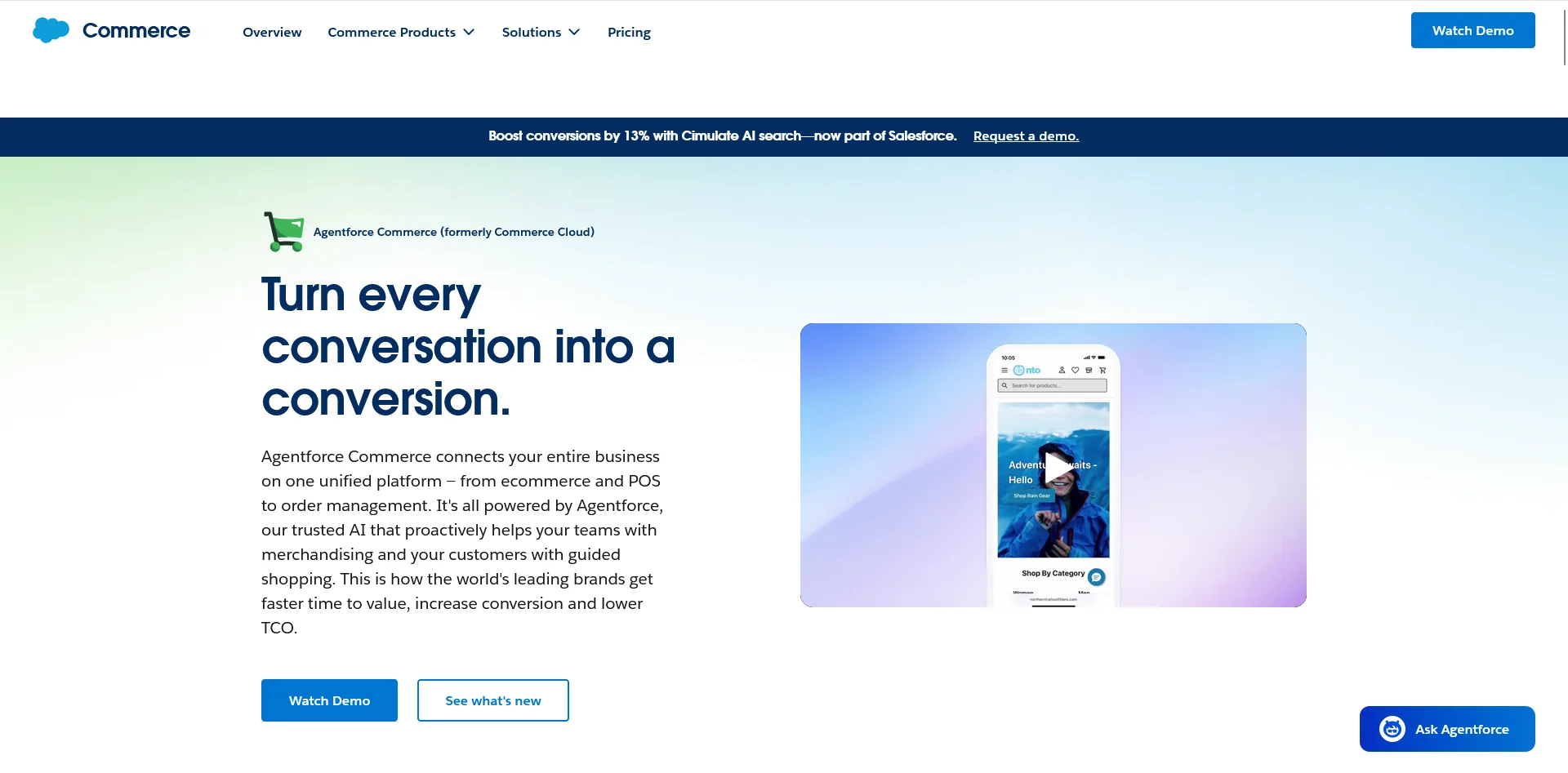
    • Salesforce Commerce Cloud runs much of global apparel, footwear, and beauty (Adidas, Puma, Lululemon, L’Oréal, Cole Haan, Columbia, Lacoste).
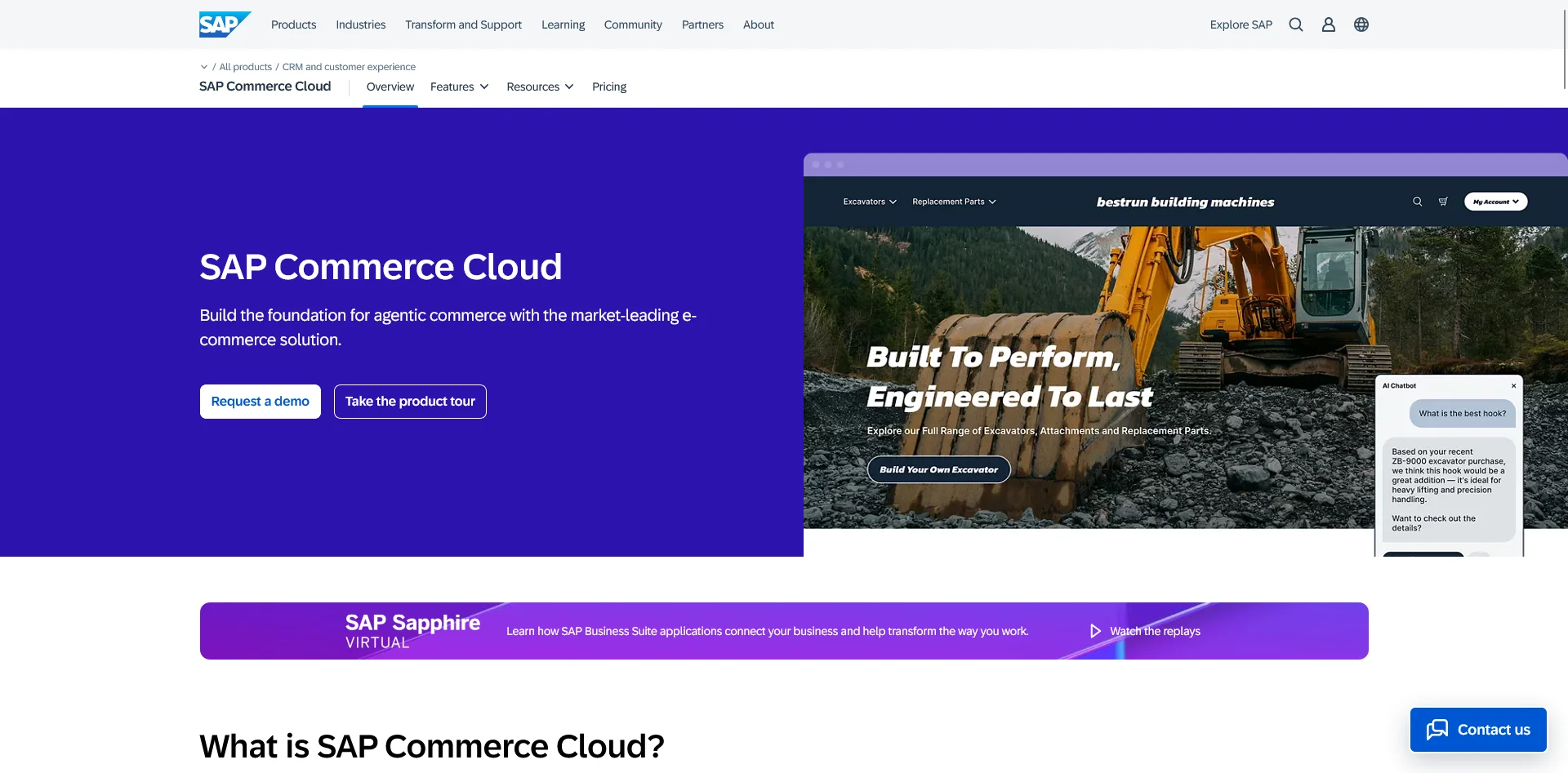
    • SAP Commerce Cloud runs the industrial and B2B end of the spectrum (Bosch, Siemens, 3M, General Electric, Levi Strauss, Nikon, Johnson & Johnson).
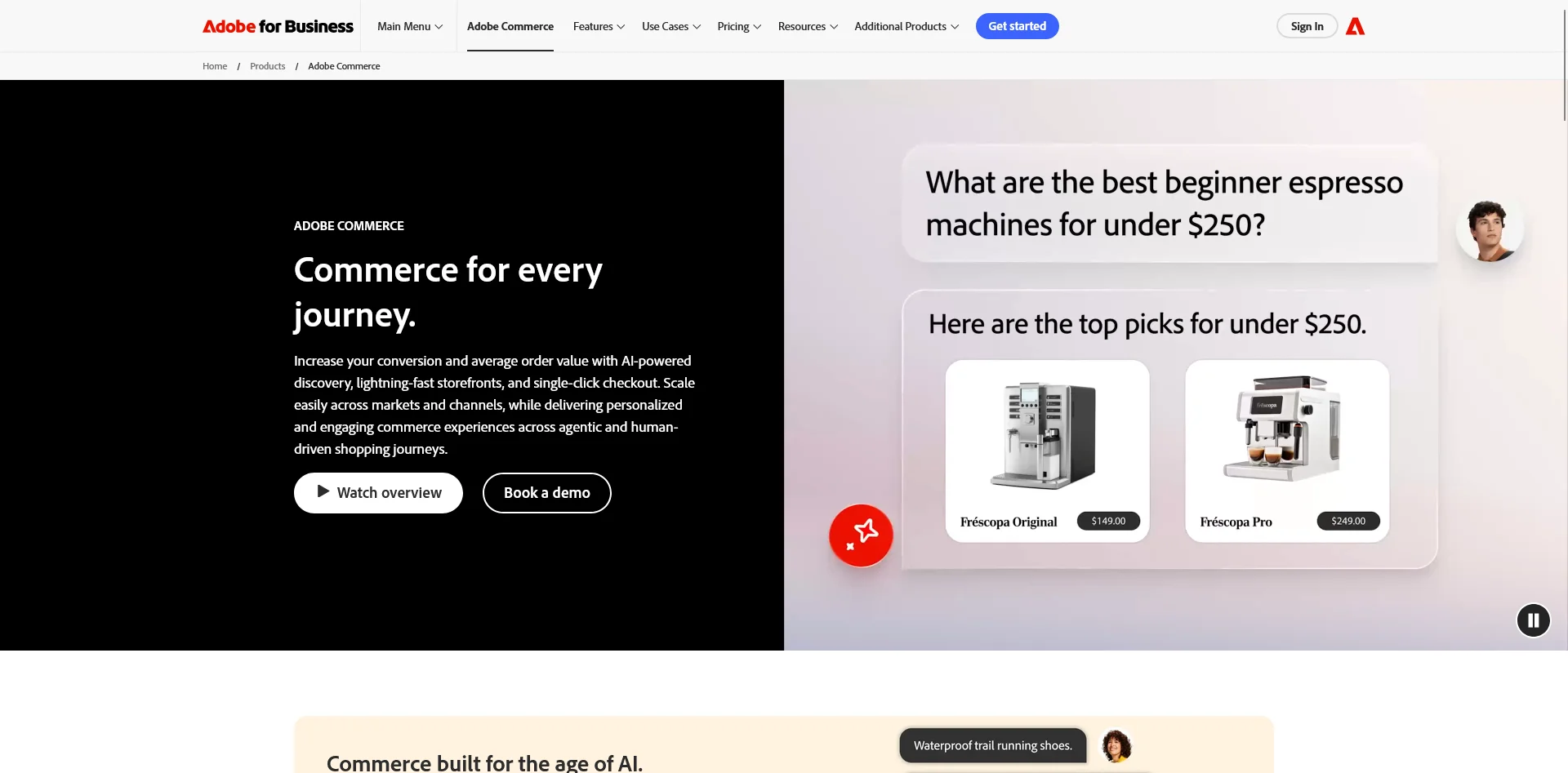
    • Adobe Commerce runs customization-heavy retailers and franchise operators (HanesBrands, Alshaya Group, Mitsubishi Motors, AkzoNobel, Krispy Kreme).
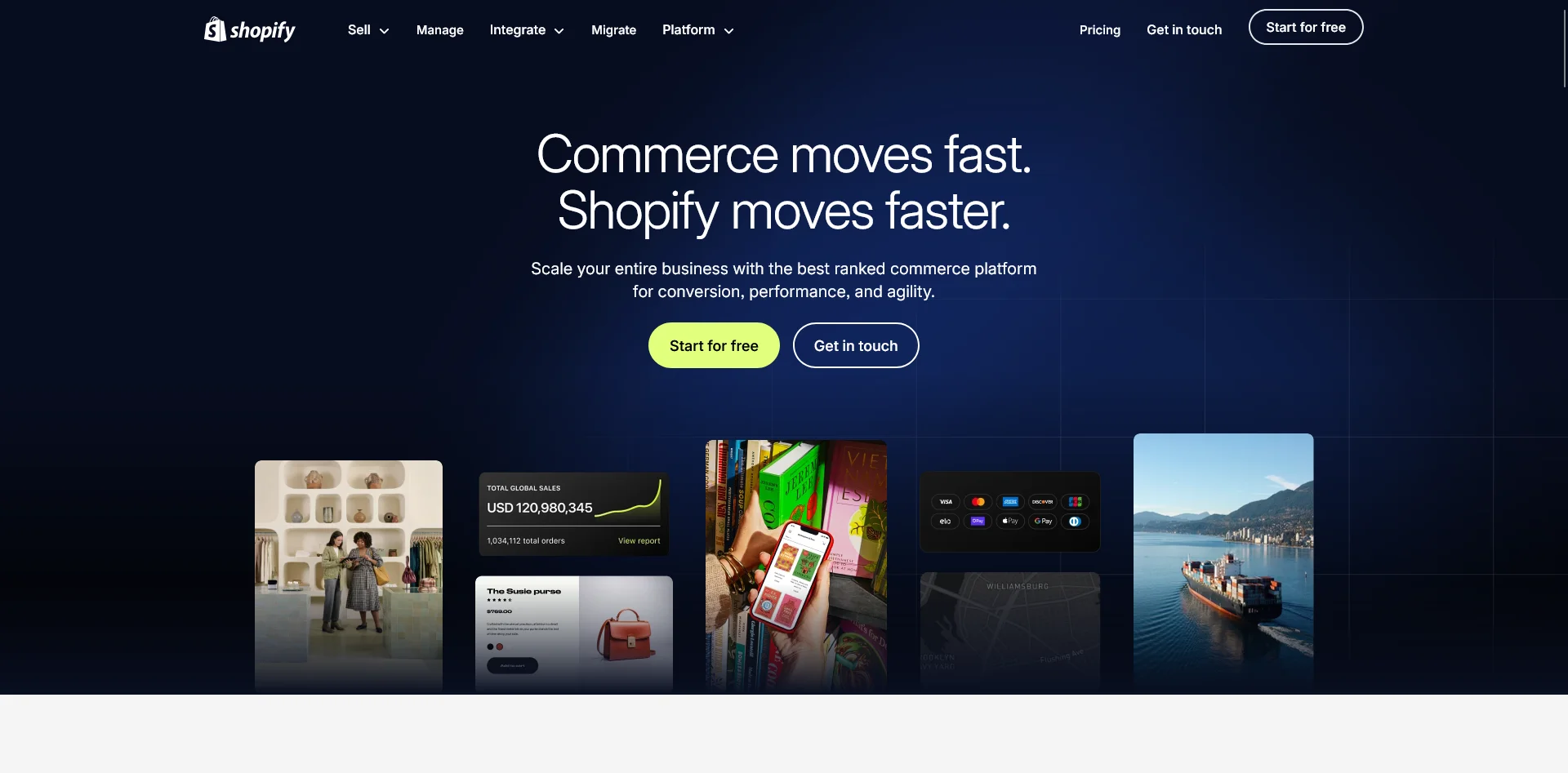
    • Shopify Plus runs the modern direct-to-consumer wave (Allbirds, Gymshark, SKIMS, Kylie Cosmetics) and a growing list of legacy CPG brands (Heinz, Mattel, Bombas).
    • commercetools, VTEX, and Spryker are the composable and headless challengers (Audi, Ulta Beauty, Whirlpool, Carrefour, Hilti, Aldi).
    • The very top of the market (Amazon, Walmart US, Apple, Target) runs custom infrastructure, not commercial platforms.

    That summary covers most of the enterprise commerce landscape today. The rest of this article walks platform by platform: what each one is, what kind of brand it tends to attract, and what the verified customer list looks like.

    The Biggest Enterprise Ecommerce Platforms At A Glance

    The data below on enterprise commerce share, and the most notable enterprise brand examples, comes from two primary sources: BuiltWith’s Top 10,000 most-trafficked sites, which filters out the millions of SMB stores that distort the broader market, and the 2025 Gartner Magic Quadrant for Digital Commerce, the industry’s standard ranking of enterprise platforms by capability and execution.

    We used that to put together the following list of the top ecommerce platforms used by enterprise companies today:

    Platform Gartner 2025 Typical brand profile
    Salesforce Commerce Cloud Leader (10th year) Global B2C apparel, footwear, beauty, omnichannel
    SAP Commerce Cloud Leader (11th year) Industrial, B2B, manufacturing, SAP ERP shops
    Adobe Commerce Leader Multi-brand B2C, franchise retail, customization-heavy
    Shopify Plus Leader Modern DTC, CPG sub-brands, fast retail
    commercetools Leader (6th year) Composable, API-first, headless-first enterprises
    Oracle NetSuite SuiteCommerce Niche player NetSuite ERP customers, mid-enterprise B2B
    BigCommerce Visionary Multi-store retail, mid-enterprise B2B
    VTEX Visionary LATAM-led globals, multinational CPG
    Spryker Visionary B2B manufacturers, industrial commerce
    Elastic Path Niche player Composable specialists, telecom
    Custom / in-house n/a Amazon, Walmart, Apple, Target, Inditex

    A note on the BuiltWith data. BuiltWith captures technology it can detect from a storefront’s HTML, so it systematically undercounts headless backends like Salesforce Commerce Cloud, SAP, and commercetools that sit behind custom or third-party frontends. Their real enterprise footprint, measured by Fortune 500 customer count and Gartner placement, is much larger than raw BuiltWith share suggests. 

    The opposite is also true: a frontend CMS like Amplience shows up at 11.1% of the Top 10K, but it’s not a commerce backend at all. It sits on top of one.

    With that caveat in mind, let’s dive deeper into each platform, breaking down what it is, and the notable brands running their digital operations on each one.

    Salesforce Commerce Cloud (Now Agentforce Commerce)

    Salesforce Commerce Cloud is the platform that defines enterprise B2C commerce in 2026. It began life as Demandware in 2004, was acquired by Salesforce in 2016 for $2.8 billion, and now sits at the center of Salesforce’s broader CRM and commerce stack. 

    The 2025 Gartner Magic Quadrant marked Salesforce’s 10th consecutive year as a Leader in digital commerce, tied with SAP for the longest tenure in the category.

    The customer list is the giveaway. According to Salesforce’s own 2016 launch announcement, early Commerce Cloud customers included Cole Haan, Puma, and Suitsupply. Adidas has been a Demandware customer since 2011 and now sits on the full Salesforce stack. 

    Puma has a published Salesforce case study documenting its global replatform. L’Oréal, Lululemon, Columbia Sportswear, and Lacoste are all widely documented Commerce Cloud customers across multiple industry analyses. 

    There’s a consistent pattern: global apparel, footwear, and beauty brands with sophisticated omnichannel requirements default to SFCC.

    What makes Commerce Cloud the default for that segment, as much as the commerce engine itself, is the surrounding Salesforce ecosystem. 

    If a brand already runs Sales Cloud, Service Cloud, and Marketing Cloud, Commerce Cloud is the only platform that shares the customer data model by default. For a global apparel brand managing tens of millions of profiles across dozens of countries, that integration is worth a lot.

    Further reading: Mobile App Development for Salesforce Commerce Cloud Brands

    SAP Commerce Cloud

    SAP Commerce Cloud is the platform you’ve heard the least about and seen the most in real life. It originated as Hybris, a German commerce platform acquired by SAP in 2013 for $1.5 billion. It has now been a Gartner Leader for 11 consecutive years, the only vendor positioned in the quadrant every year since the category began in 2014.

    The customer list reflects its industrial center of gravity. According to the Wikipedia entry on Hybris, confirmed customers across the platform’s history have included General Electric, ABB, 3M, Levi Strauss, Nikon, Johnson & Johnson, Procter & Gamble, Thomson Reuters, and West Marine. 

    AppsRunTheWorld’s vendor database adds Reliance and Tata (India’s two largest conglomerates), Qantas Airways, Henkel, Amway, Haier, and Nestlé. Bosch and Siemens are widely cited SAP Commerce customers in industry analyses.

    The center of gravity here is industrial manufacturing, B2B distribution, and large multinationals with deep SAP investments in their back office. When the same vendor runs commerce, inventory, billing, and financial consolidation, the brittle middleware layer between commerce and the rest of the business disappears. 

    For a manufacturer with hundreds of regional pricing books, complex tax requirements, and SKUs running into the millions, that single data model is hard to give up.

    Adobe Commerce (Magento)

    Adobe Commerce is the most flexible platform in the enterprise tier. It started as Magento, an open-source commerce platform launched in 2008. Adobe acquired it in 2018 for $1.68 billion and folded it into Adobe Experience Cloud. 

    The platform is a 2025 Gartner Leader and one of the most-deployed commerce platforms across the BuiltWith Top 10K.

    The customer base, verified through Adobe’s own published case studies, tells a different story than Salesforce’s. 

    • HanesBrands runs Adobe Commerce for its Australasia operation and credits the platform with a 41% lift from behavioral data personalization. 
    • Alshaya Group, the 130-year-old Middle Eastern franchise operator behind regional Starbucks, Pottery Barn, and Victoria’s Secret stores, runs its digital retail transformation on Adobe Commerce. 
    • Mitsubishi Motors uses it to manage product configurations and accessories online. AkzoNobel manages thousands of branded websites on the platform. 
    • Krispy Kreme runs its Australia and New Zealand ecommerce on Adobe Commerce. 
    • ASUS chose it for B2B. 
    • OTTO, the German retailer, uses Adobe Commerce as part of its broader Adobe stack.

    The reason Adobe Commerce attracts that crowd is customization. The platform exposes its codebase in a way that Salesforce and SAP don’t, which means agencies can build deeply distinctive storefronts. 

    It also offers genuine multi-store administration, which suits multi-brand retail conglomerates that want one back office running ten storefronts. Adobe’s broader Experience Cloud integrations are stronger than anyone else’s at content-and-commerce.

    Related: Mobile App Development for Adobe Commerce & Magento Brands

    Shopify Plus

    Shopify Plus is the most interesting story in enterprise commerce right now. The 2025 Gartner Magic Quadrant put Shopify in the Leaders quadrant, and according to Kasama Digital’s analysis of the report, Shopify and Salesforce are now “neck and neck” at the top of the chart. 

    That’s a remarkable position for a platform that didn’t exist as a serious enterprise option a decade ago.

    The Shopify Plus customer list has shifted substantially in the past five years. The modern direct-to-consumer side is still the core. Gymshark is the canonical example: it grew from a UK fitness brand to a £128 million DTC operation on Shopify Plus, and its migration from Adobe Commerce is one of the most-cited replatforms in the industry. 

    Allbirds, SKIMS, Kylie Cosmetics, Fashion Nova, MVMT, Bombas, and Rebecca Minkoff all run on Shopify Plus as well.

    The legacy side has expanded faster. 

    • Heinz migrated to Shopify Plus during the pandemic. 
    • Mattel runs Barbie, Hot Wheels, and Mattel Creations on it. 
    • Spanx, BBC merchandise, and Staples Canada have all replatformed onto Shopify Plus from older systems. 

    The brands moving onto the platform now are no longer the boutique DTC stories of 2018. They’re CPG giants and Fortune 500 sub-brands.

    What makes the platform work at this tier is speed. Shopify Plus implementations launch in weeks rather than quarters. The merchant admin is genuinely friendly, which matters for brands that want their ecommerce team (not their engineering team) launching the next campaign, and the Hydrogen framework gives engineering teams a clean path to custom frontends when they want one.

    Further reading: The Complete Guide to Shopify Plus Mobile App Development

    commercetools

    commercetools is the platform that defined the composable commerce movement. Founded in Berlin in 2012, hosted on Google Cloud, and now a Gartner Leader for the 6th consecutive year

    It’s the platform brands choose when their competitive advantage is the frontend experience and they want a backend that gets out of the way.

    The customer list, drawn from commercetools’ own published case studies, reflects that positioning. 

    • Audi runs commercetools for parts of its commerce stack. 
    • Bang & Olufsen unified its global brands on the platform. 
    • NBCUniversal built its shoppable-TV marketplace on commercetools with Mirakl. 
    • Ulta Beauty committed its entire business to a headless and MACH architecture on commercetools. 
    • Kmart Australia migrated to microservices on the platform. 
    • Woolworths used commercetools to launch its on-demand grocery service MILKRUN. 
    • Interflora UK, Zoro.com, Tekton, PetSmart, and Wild Fork Foods are all named customers.

    The architecture is what makes commercetools interesting. There’s no built-in storefront. The platform exposes a clean set of REST and GraphQL APIs, and the customer’s team builds the frontend, the merchant admin, and the orchestration on top. 

    That sounds like a lot of work because it is. The trade-off is total flexibility: the same backend serves web, mobile app, in-store kiosks, voice, and social commerce, each updating on its own schedule.

    VTEX

    VTEX is the LATAM enterprise leader with a growing global footprint. Founded in Brazil in 1999 and now operating across 44 countries with around 2,200 customers and 3,100 online stores, the platform has built its position on a headless API-first architecture and deep native support for the regulatory and payment complexity of emerging markets.

    The customer list is global but anchored in LATAM. According to VTEX’s own press disclosures and the INSEAD case study on the company, VTEX runs Whirlpool (across 15 countries), Sony, Carrefour, Walmart Argentina, Coca-Cola Andina, AB InBev, Stanley Black & Decker, Motorola, Nestlé, Colgate, Mondelez, Electrolux, Unilever (regional), Panasonic, and Xiaomi (Peru). 

    In beauty, the platform powers Natura, Avon, and The Body Shop, all now under Natura & Co. Magalu, Brazil’s largest non-Amazon retailer, runs its marketplace on VTEX.

    The strongest pitch here is for multinationals that need a single backend across very different regional commerce environments. 

    Brazil’s tax code is famously complex. Argentina’s payment systems are unlike anywhere else. VTEX handles both natively. A US-built platform like Salesforce or Adobe handles neither without expensive middleware.

    Spryker

    Spryker is the B2B specialist of the group. Founded in Germany, it’s headless and API-first like commercetools, but explicitly designed for the complexity of business-to-business commerce: hierarchical buyer accounts, negotiated contracts, master agreements, multi-step approval workflows, and dealer-network management.

    The customer list is heavy on industrial and B2B. According to Spryker’s published partner materials, the platform is “trusted by brands such as Aldi, Siemens, Hilti, and Ricoh.” 

    Toyota is also publicly named as a Spryker customer (typically interpreted as Toyota Material Handling, given the platform’s commerce positioning). 

    The brand-name density is lower than the consumer-focused platforms because the buyer is procurement, not retail.

    Oracle NetSuite SuiteCommerce, BigCommerce, and Elastic Path

    Three more platforms occupy smaller but meaningful slices of the enterprise market.

    Oracle NetSuite SuiteCommerce is the storefront layer on top of NetSuite ERP. Oracle acquired NetSuite in 2016 for $9.3 billion. It’s not a Gartner Leader, but it’s deeply embedded in mid-enterprise B2B. 

    The customer base is less consumer-visible than the others: thousands of mid-market manufacturers, wholesale distributors, professional services firms, and resellers running NetSuite as their core operating system extend naturally into commerce here.

    BigCommerce sits in the Visionaries quadrant. It started as a mid-market alternative to Shopify, has invested heavily in moving upmarket, and now occupies a real but smaller slice of the enterprise segment, particularly strong in multi-store retail and mid-enterprise B2B.

    Elastic Path is the smaller composable-commerce specialist, headquartered in Vancouver and founded in 2000. Its highest-profile published customer is T-Mobile, whose Cerberus initiative case study is featured prominently on the Elastic Path site. 

    It plays in the same conceptual space as commercetools but positions itself as more aggressively modular.

    Custom And In-House Platforms

    At the very top of the enterprise market, brands aren’t building on top of any commercial platform. As you can imagine, for businesses doing billions in annual turnover, these brands build custom.

    • Amazon runs entirely custom infrastructure and licenses pieces of it out as AWS Commerce services. 
    • Walmart US runs substantially custom, including the technology it inherited from its 2016 Jet.com acquisition.
    • Target, Costco, and Best Buy run custom or heavily customized legacy systems. 
    • Alibaba and JD.com run custom marketplaces. 
    • Apple runs the Apple Online Store as a fully proprietary system. eBay is custom by definition. 
    • Inditex (Zara) and H&M run substantially custom systems, often layered on top of selected enterprise components.

    For these companies, it just makes more sense to build your own platform, where you control every part of the code and aren’t reliant on a third-party vendor or software.

    What’s Changing in Enterprise Ecommerce

    How does the current state of enterprise ecommerce reflect ongoing trends or changes in the industry?

    First, composable commerce has moved from aspirational to mainstream at enterprise

    commercetools, VTEX, and Spryker now have the enterprise customer count and Gartner credibility to be taken seriously by buyers. The question is no longer whether to go composable, but which existing platform will let you do it without re-platforming. 

    Salesforce, SAP, and Adobe have all responded with headless deployment options of their own.

    Second, Shopify is genuinely competing at the top. The 2025 Gartner Magic Quadrant put it neck and neck with Salesforce, and the customer wins are now CPG giants and Fortune 500 sub-brands, not just modern DTC startups. 

    The Fortune 500 industrial segment still defaults to Salesforce, SAP, and Adobe. The Fortune 500 consumer brand DTC arm increasingly defaults to Shopify Plus.

    Third, custom is still winning at the very top, and that isn’t changing. Amazon, Walmart, Apple, and the largest pure-play retailers continue to build their own platforms.

    The economics that drive that choice (commerce as competitive surface area, not operational expense) only become more favorable as those businesses grow.

    Fourth, the gap between platforms is narrower than the marketing implies. Every Gartner Leader now supports headless. Every Leader supports B2B. Every Leader supports multi-region, multi-currency, and complex catalogs. 

    The functional differences that drove most platform decisions in 2018 are now second-order.

    Where Vendrux Fits In

    Every business running on one of the platforms above is operating at the scale where having a dedicated mobile app is a necessity.

    Vendrux is a service built specifically for these brands. Vendrux builds native iOS and Android apps for enterprise ecommerce brands, powered by their existing tech stack.

    Unlike most mobile app vendors, Vendrux works with any ecommerce platform: Shopify Plus, Adobe Commerce, BigCommerce Enterprise, Salesforce Commerce Cloud, headless setups, custom builds, and even niche platforms.

    Vendrux allows these brands to launch a mobile app that’s fully synchronized with their website by default, and requires significantly fewer resources to maintain, compared to a custom app built from scratch.

    Brands like Tadashi Shoji (Adobe Commerce) and John Varvatos (Salesforce Commerce Cloud) launched their apps with Vendrux, without standing up a mobile team or commissioning a custom dev project. They now have a high-ROI retention channel, driving significant revenue with minimal overhead.

    Running an enterprise ecommerce brand?

    Want a low-maintenance mobile app, fully integrated with your existing stack?

    Book a strategy call and we’ll show you what Vendrux can do for your brand.

    Book a Strategy Call

    The Short Version

    If there’s one thing to take from this article, it’s that the enterprise commerce market is not the SMB commerce market with bigger logos. It’s a separate ecosystem with its own logic.

    • Salesforce Commerce Cloud, SAP Commerce Cloud, and Adobe Commerce remain the heavyweight Gartner Leaders running much of the world’s largest consumer and industrial brands. 
    • Shopify Plus has broken into that tier and now competes directly with the legacy platforms, particularly for large modern DTC brands and CPG sub-brands. 
    • commercetools, VTEX, and Spryker are the composable challengers, each anchored in a different segment of the market. 
    • NetSuite SuiteCommerce, BigCommerce, and Elastic Path occupy real but smaller niches.
    • And the very top of the market (Amazon, Walmart, Apple) runs nothing anyone else can buy.

    These are all heavyweight platforms, powering heavyweight brands, from Adidas to Puma to Heinz.

  • Do Customers Really Use Retail Apps?

    Do Customers Really Use Retail Apps?

    The biggest pushback I see online when someone suggests you should launch a mobile app (or asks for recommendations on how to launch one) is something along the lines of “why? No one uses apps.”

    But “do customers use retail apps” isn’t quite the question most operators are really asking. The real version is closer to “do enough of MY customers use apps to make this worth doing for my store?” 

    That version has a more interesting answer.

    And the short answer: while there’s some truth behind the objection – a lot of shoppers are not going to download your app – there’s a subset of customers who will, and that segment does not need to be very large to justify the decision to build one.

    Here’s who uses retail apps, why people like to claim that “nobody uses apps”, what the slice of your customers who would install your app looks like, and what the math comes out to for a $10M-revenue brand thinking about the channel.

    Yes, Customers Do Use Retail Apps

    Shopping apps are mainstream consumer behavior in the US and globally. The data is unambiguous.

    A 2022 NewStore survey of 610 American consumers found that 88% have at least one mobile shopping app installed on their phone, half have four or more, and 9% have more than ten. 

    31% prefer shopping in-app over shopping in-store or via mobile or desktop web. Among consumers under 44, the percentage of people with at least one shopping app on their phone hits 96%, and shopping apps rank as the preferred shopping method for the segment.

    Research from ironSource puts the engagement number higher: 90% of consumers have multiple shopping apps on their phones, and 95% use at least one of those apps at least once a month. 

    Two-thirds of respondents named a shopping app among their top ten most-used apps.

    In-store behavior tracks the same way. According to Airship research reported by eMarketer, 74% of consumers worldwide use a retailer’s app while they’re shopping in a physical store, up from 65% the year before. eMarketer also forecasts that two-thirds of US smartphone users will use shopping or retail apps by 2025.

    If you look at some of the biggest names in retail, it’s clear that at least some people use retail apps. 

    Amazon’s shopping app sits at around 197 million monthly active users globally, with most of them in the United States. 

    The app isn’t a niche channel for Amazon; it’s the dominant way Amazon’s customers interact with the brand. 

    Other big-name retailers (Walmart, Target, Sephora, Nike, Shein, Temu) are pulling enormous in-app volume, and the same pattern shows up at a smaller scale in DTC.

    The existence question is settled. The interesting question is who those users are.

    The “Nobody Uses Apps” Misconception (And Why You Feel This Way)

    This is what I often see on Reddit, on LinkedIn posts, and other places online.

    One person asks for recommendations on how to build an app for their store. The peanut gallery scoffs at why they’d want to do such a thing in the first place.

    The thing is, the objection is not totally random. It’s based on a few core misconceptions related to mobile apps and consumer shopping behavior.

    1. “I Don’t Use Apps”

    The first is the “I don’t use retail apps” projection. 

    Your personal phone is one data point; your customer base is not. People who manage ecommerce stores tend to skew toward direct, intentional shopping behavior on the web.

    People who buy from those stores skew toward whatever channel makes the next purchase easier. The 88% of US consumers with a shopping app installed includes plenty of people who would tell you, if asked in passing, that they don’t really use shopping apps.

    2. “Hardly Anyone Will Use It”

    The second is the “most of my customers won’t download the app” reasoning. 

    That’s actually true. Most of your customers won’t download the app.

    Typical install rates land between 5% and 20% of the active customer base. But that hides what that small share represents: the brand’s highest-LTV customers, the ones who’ve already bought repeatedly and want a faster way to keep buying. 

    A small slice of your total customer base routinely produces a disproportionate share of brand revenue through the app. The install rate is a small input feeding a much larger output.

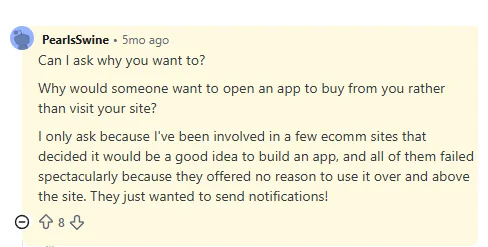
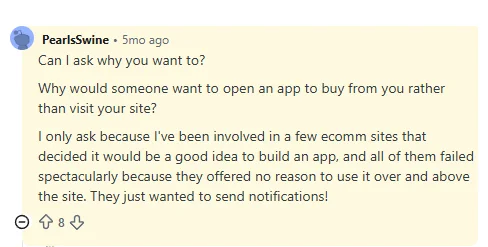
    3. “Apps Are Useless”

    The third idea is the “what does an app even add for the customer” objection. (see Reddit comments above)

    It’s assuming that launching an app is completely self-serving; that convincing someone to download your app is just a con job so you can ruin their life with spam notifications.

    Apps provide real value for certain customers.

    • Quicker, more convenient access to your store (one tap from the home screen)
    • A smoother shopping experience (not affected by whatever the latest thing iOS did to break Safari)
    • Direct updates from the brand about promos, new products, other perks (some customers actually do want to hear from brands)
    • A user experience built for returning customers (a brand’s website is often optimized to convert new customers; an app can be built to make it easier for regular customers to reorder/discover new products)
    • VIP perks (many brands use the app as a defacto VIP list, giving app users first dibs on promos or product drops)

    There’s a lot you can do in a new channel – especially when you can optimize every part of the user experience for people who already know your brand.

    Who Uses Retail Apps

    The through-line with all the common objections about mobile apps is that it assumes you’re launching one for everyone; that your goal is to have as many app users as email subscribers.

    The customers who install a brand’s mobile app are typically a small slice of the total customer base – often under 10%, sometimes 15-20% for brands where repeat purchases are natural (F&B, beauty).

    That segment is the most valuable segment a brand has.

    They’ve already bought, usually more than once. They liked the brand enough to install the app. They self-select toward the lower-friction channel because they want to buy from this brand more often, faster, with fewer steps.

    For these customers, the app does provide real value. They do want to receive push notifications. They want a more convenient way to interact with the brand, to buy from the brand.

    David Cost, VP of Ecommerce at Rainbow Shops, said this (which sums up the case for mobile apps perfectly:

    “In our experience, users break into two camps. There are users who prefer to buy on the app and users who prefer using the browser. You can’t convince one to go the other way, you need to meet them where they are.

    Our apps never had any functionality or usability beyond the web experience. The reason to have an app is not to have something that isn’t on the website, but for people who prefer that way to access Rainbow content.”

    The key line? “You need to meet them where they are.”

    Some people just prefer to use apps. Some specifically want an app from the brands they visit the most.

    You’re just giving them what they want.

    The Impact of Giving Your Best Customers an App 

    When you give your best customers what they want, you see some real, positive results that make launching it more than worthwhile (even if only a small share of your customers download it).

    This is where the incrementality debate comes in – and is again disproven.

    When you offer an app, the customers who download it:

    • Shop more often (since it’s easier, less friction to come back to your store)
    • Shop for longer (because the shopping experience is smoother, with fewer distractions)
    • Convert more, spend more in each order (because of the improved user experience, tailored to repeat customers)
    • Churn less (the app icon keeps your brand top of mind. Customers who otherwise might have stopped buying from you, out of atrophy, stay for longer)

    The last one might be the most important; someone who downloads your app is inherently more valuable to your brand, because they had the kind of intent to want to download your app in the first place.

    But without consistent touchpoints, brand loyalty atrophies, even for once hyper-engaged customers.

    App users have stronger revenue metrics across the board (see our Ecommerce Mobile App Benchmark Report for more on this).

    And the most important metric that improves is LTV – which often just comes from holding on to your best customers for longer, which naturally leads to more revenue and stronger profit margins over time.

    The Math: Even Small Adoption Pays Off

    We mentioned up top that you don’t need a large slice of your customer base to download the app in order for it to be a success.

    Here’s the math to show what we mean.

    Take a $10M-revenue ecommerce brand. Assume 5% of the total customer base installs and uses the app (that’s deliberately conservative by the way).

    That 5% naturally spends more; partly because of the better experience in the app, partly because they’re just wired to spend more from the average customer.

    Brands we work with always see a disproportionate revenue contribution from app users. So if 5% of your customers use the app, it’s likely that you’ll see at least 10% of total revenue come through the app – closer to 15-20% in most cases.

    (the disparity can be even greater. Junior Couture saw 50% of their peak season revenue through the app, from just 5% of their customers. Pharmazone gets 63% of their online revenue through their app, from around 15% of their customers).

    So if we take the deliberately conservative estimates – 5% of your customers contributing 10% of total revenue – the mobile app for a $10M brand is a sales channel doing $1M annually.

    It comes out to the same figure for a brand half the size ($5M annually) doing stronger in their app (20% of total revenue – which is in the midpoint of the 10-35% average revenue share we generally see from apps).

    Annual Revenue App Customer % Revenue Contribution App Revenue
    $5M 5% 10% $500K
    $5M 10% 20% $1M
    $10M 5% 10% $1M
    $10M 10% 20% $2M
    $25M 5% 10% $2.5M
    $25M 10% 20% $5M
    $50M 5% 10% $5M
    $50M 10% 20% $10M
    $100M 5% 10% $10M
    $100M 10% 20% $20M

    Cost to Revenue (ROI) of the App

    It shouldn’t be hard to see the value in a channel contributing $1M in annual revenue.

    But the case gets even better if you take the cost into account.

    With Vendrux, the cost to build and maintain your app starts at $1,499 per month, with a one-time, four-figure setup fee upfront.

    That’s nearly $100K in monthly revenue, on a cost of a little over a thousand per month. With Vendrux, everything’s done for you, there’s no separate system to manage, and no major workflow changes coming along with your app.

    That cost to benefit math makes having an app a no-brainer.

    Want to see what your app would look like?

    You’ve got the customer base, the repeat buyers, and now a rough sense of what the app channel could be worth. The piece still missing is what the app itself would look like for your brand.

    Vendrux lets you build a custom native app, without hiring developers or managing a separate platform. We’ll build you a free preview, so you can see your app in action and see what’s possible.

    Get a Free App Preview

    The Straight Answer

    Yes, customers really do use retail apps.

    They use the apps from massive brands like Amazon, Sephora, Gymshark. They also use apps from smaller brands, brands that aren’t household names, but are well-known in smaller ecommerce niches like men’s grooming and skincare, or clean protein and fitness supplements.

    The big misconception is the idea that you’re launching an app for everyone. You’re not.

    An app is for a small slice of a brand’s customer base. The most engaged, the most dialed in to the brand.

    That could only be 5% of their total active customer base. But 5% is more than enough to make an app worthwhile.

    If you’re a brand doing seven figures plus and see the case – or if you need more convincing – get in touch with us.

    Book a free strategy call and we’ll walk through it with you, show you what an app could look like, and help you decide if launching a mobile app is the right move for your brand. 

  • What Happens to Your Mobile App During a Platform Migration (and What To Do About It)

    What Happens to Your Mobile App During a Platform Migration (and What To Do About It)

    Replatforming is one of the biggest technical projects you’ll ever run. A Magento to Shopify Plus migration takes 12 to 24 weeks for a mid-sized brand, longer for complex catalogs. It’s the kind of thing that occupies all your engineering team’s attention, and requires intense planning and management to ensure your customers aren’t negatively impacted by the move.

    There’s one major issue we keep hearing about brands running into when they’re migrating their ecommerce platform: their app.

    The brand has a mobile app, which is tied to their original web platform. Migrating often means the app breaks; or requires a significant rebuild for the new platform, which adds to what is already an engineering and logistical slog.

    It’s never your primary concern. But it’s a significant one, all the more concerning if you have users on your app already, who you don’t want to disrupt.

    Keep reading and we’ll share the same advice we share with people from replatform brands that we’ve been talking to lately, on how to handle this tricky situation.

    The Problem: Why a Platform Migration Breaks Your App

    Whichever platforms you’re migrating to/from, and however your app is built, a replatform typically means your app will break.

    Your web platform and app are (or should be) tied together. They share from the same commerce backend. Inventory, orders, product details, accounts, all of this is connected, typically via platform APIs.

    Changing platforms means changing APIs. It means a new set of APIs, which may need to be built from scratch, or which may be built for you, but exposing limited functionality than you used to have access to.

    Your web UI is changing, and without updating your app, you risk showing two surfaces that look like different stores.

    The details can be a little different, depending on what your replatform looks like (which platform you’re moving from/to), and how your previous app was built.

    Let’s take a look at a few scenarios now.

    No-Code Mobile App Built on a Platform-Native Builder

    A no-code mobile app builder is a SaaS product purpose-built around one ecommerce platform’s APIs. You configure the app inside a vendor dashboard. The vendor’s product talks to your storefront. The data flow (catalog, cart, customer, checkout) runs through platform-specific connectors that only the vendor maintains.

    When you change platforms, the connectors stop working. The vendor’s product surface ends at the platform’s API surface, so there’s no rebuild path with the same vendor on your new stack. Tapcart, the largest no-code app builder in the Shopify ecosystem, states the constraint directly on its own site: it “is only able to support businesses that run ecommerce operations on Shopify.”

    This isn’t a con about Tapcart. It’s just the nature of the platform.

    It’s the same with the hundreds of other tools in the Shopify App Store, as well as app builders tied to other platforms (e.g. you’re on Magento, built an app with a Magento app builder, and now picking up and moving to Shopify).

    You’re looking at replacing your original app from scratch. Whole new vendor, whole new app.

    Custom-Built Mobile App

    Let’s say you’ve built custom. Fully custom, from the ground up. Maybe through an agency, maybe in-house.

    You’re still, more than likely, using platform APIs to connect your app with your website.

    In principle, you can rework the app to use the new platform’s APIs, and migrate your app along with your site.

    But while it “can” be done, it adds a huge amount of complexity to your migration – which is already a drain on your resources, and a lot of things to juggle. Realistically, you’re rebuilding your app for the new platform.

    If there’s a timeline you need to hit, get ready to extend it. If you need to keep within a budget, forget about it.

    We’ve come across this many times. Rarely does the business have the engineering capacity to build a new mobile app, alongside their web migration. 

    If you’re working with an agency, this means you and the agency need to be tightly aligned, or else there’ll be lag time between the website relaunch and the app relaunch. That may mean paying a premium to the agency to make your project their main priority.

    All up, it’s just not something you want to add to the scope of shifting your entire commerce operation from one platform to another.

    Your mobile app shouldn’t be a casualty of your replatform.
    See how Vendrux keeps it live through the migration.

    Book a Strategy Call

    Replatforming Directions (and What Your Options Are)

    The mobile app problem (and the solution) will look a little different depending on the direction of your migration.

    Here are three common situations we run into, and what they mean for your app.

    Off Shopify

    You’re moving off Shopify, to BigCommerce, Adobe Commerce, headless, custom, anywhere. You’ve probably got an app built with one of the app builders in the Shopify App Store (e.g. Tapcart).

    Once you migrate, your app stops working. Simple as that. Almost every Shopify app vendor only works with Shopify. So you’re now faced with a custom build for the new platform, unless there’s a no-code tool that happens to support your new stack.

    Off Shopify, the no-code mobile app ecosystem thins out fast. On BigCommerce there are a handful of options, none with the depth of the Shopify equivalents. On Adobe Commerce and SFCC, there’s effectively nothing at the no-code tier worth recommending. 

    A custom build is the default once you leave Shopify, and that means building a whole new app alongside the web replatform.

    Regular Shopify to Headless

    This one’s a niche edge case that a lot of brands don’t consider until it bites them. You’re staying on Shopify, but you’re moving your frontend to Hydrogen or a custom headless build.

    Technically, your app could still keep working. The Shopify backend is still there, and a Shopify-native app builder is still talking to the same Storefront and Admin APIs.

    The problem isn’t that the app stops working. It’s that the app stops keeping up. The whole reason you went headless is that you wanted to build custom frontend experiences the standard Shopify storefront couldn’t support. 

    Once you start shipping those experiences on the web, they don’t carry over to a templated, no-code app. The gap between your website and your app grows every month you keep building on the headless side – and eventually you might decide you need to rebuild the app anyway.

    Non-Shopify to Shopify

    This is the most common direction in enterprise replatforms right now. Magento to Shopify Plus. SFCC to Shopify Plus. Adobe Commerce to Shopify. Homegrown stacks to Shopify Plus.

    The good news: there are more app options on the Shopify side than on any other platform. Pick a Shopify-native app builder and configure something for a standard Shopify store in a few weeks.

    The catch: this is still a rebuild of your app. Your previous vendor isn’t coming with you, and even if you were on a custom build, the codebase needs to be reworked or replaced.

    There’s a second catch if you’re moving to Shopify Plus with headless or a complex custom build. The edge case from the section above kicks in early. The standard Shopify-native app builders won’t be able to match what you’re doing on the web, and you’ll outgrow them faster than you’d like. That’s the same gap, just hit sooner.

    So even on the most app-friendly platform in ecommerce, this is still a from-scratch app launch. The decision is which kind of app you launch.

    Why Vendrux Is the Best Solution for Replatforming Your App

    At Vendrux, we’re becoming specialists in this. That’s because our approach is naturally the best fit for a brand that’s replatforming, and having to rebuild or replatform an app at the same time.

    Here’s why Vendrux is the best way to handle your mobile app during a replatform.

    It’s Platform and Tech-Agnostic

    Vendrux works with whatever your new platform looks like, whether you’re moving to Shopify or away from it. We support Shopify, Shopify Plus, BigCommerce, Magento, Adobe Commerce, Salesforce Commerce Cloud, WooCommerce, and headless or fully custom commerce stacks. 

    The app is built on the same tech stack as your website – not a separate build connected by APIs.

    This is important. It means that when you migrate your website to a new platform (even to a fully custom, or headless stack), your app comes with it. We can build the app on your existing site, and have it switch to the new site once you launch, or build it on the new site that’s under development. Whichever works best for you.

    (Building with Vendrux also means, if you happen to migrate again in the future, your app will come with you. No dealing with the same headaches again.)

    The Timelines Line Up

    One of the biggest issues with rebuilding your app as a custom build is the timeline.

    A web migration might take three to six months. A custom app usually takes six months to a year.

    Do the math – even if both kick off at the same time, and you’re able to build the mobile app independently, you’re looking at one of two scenarios:

    • Pushing back the web migration until the app is ready
    • A time between the new website launching and the app being ready, where customers can’t use your app anymore.

    Neither are good outcomes. The app being unusable for any length of time is a disaster scenario, especially if you’d already built a decent sized user base.

    Vendrux takes six to eight weeks to launch; potentially quicker. The time lines up perfectly with your migration, so you can launch with zero downtime for your app users.

    Vendrux is Battle-Tested with Platform Migrations

    We’ve done this numerous times. We’ve seen many brands going through migrations, we know the issues that come up, the edge cases that have to be dealt with.

    And since we specialize in this kind of work (not exclusively – but it’s one of the things we’re best at), you know you’re getting a partner that’s working towards the same goals you are.

    We did this same thing with buybuyBaby, for instance; helping them launch a new app during their replatform, resulting in no downtime for their app users.

    “The incredible part was that we didn’t even have to think about the app during these transitions. When we finally reached out to check if our latest major redesign would affect the app, the response was immediate: ”You have nothing to worry about, everything will be fine.””
    -Steven Kachtan, CIO of Dream On Me

    It Works With All Your New Features

    You’re replatforming for a reason. You want to build something new – you want to expand your web experience, launch new features your old platform wasn’t capable of, ship a better, more modern UI.

    Whatever it is, Vendrux lets you reflect the same design, the same features in your mobile app. It’s not going to limit you to a basic template, or double the work to ship all these additions in a new channel.

    It’s fully synced with your new site, already. Whatever you’re building on the new site, you’re also building in the app.

    Replatforming doesn’t have to mean rebuilding your app.

    Your web replatform is already absorbing your engineering team’s attention. Content modeling, integrations, payments, checkout, cutover. Stacking a parallel app rebuild on top of that is the last thing you need.

    Vendrux builds custom native apps that travel with you across the migration. Same app, same App Store listing, same push subscriber base, on whatever platform you’re moving to next.

    Get a Free App Preview

    Final Thoughts

    Replatforming is already one of the most demanding technical projects you can run. Adding a mobile app rebuild on top of it just makes it messier. 

    It stretches engineering resources, breaks your timeline and budget, and risks real disruption for your app users.

    Vendrux is the ideal way to replatform your mobile app at the same time. It takes the app project off your plate during the migration. The same app keeps running through the cutover, and your team only needs to focus on the web side of things.

    If you’re planning a migration and wondering what to do with your app, that’s the conversation we’re built for. Book a strategy call and we’ll walk through your specific situation, and how we can help.

  • How to Turn Your Website into a Mobile App (2026 Guide)

    How to Turn Your Website into a Mobile App (2026 Guide)

    Mobile traffic probably accounts for the majority of your visitors now. But, a fully-optimized, fast, responsive mobile website isn’t enough. Not on its own.

    Mobile apps convert better, retain better, and give you access to push notifications. That’s true. Apps convert at roughly 3x the rate of mobile websites in ecommerce. App users shop more frequently, spend more per order, and stick around longer.

    Most online businesses today should have their own app. Especially because, for brands with a successful, mobile-friendly website, it’s not a whole new project. You have a great base to start with.

    If you want to turn your website into a mobile app, this guide is for you. It covers every option for turning your website into a mobile app: what each approach costs, how long it takes, and who it’s right for. 

    Can You Actually Turn a Website into an App?

    Yes. And it’s more common than most people realize.

    Turning a website into an app means taking your existing web content and delivering it through a native app framework, with native capabilities layered on top: push notifications, app store presence, native navigation, and deep linking.

    The result is a real app that users download from the App Store and Google Play. A native app that uses your website as its content engine – which happens to be the same way many of the biggest apps in the world already work.

    Multiple studies have found that 83-90% of Android apps contain hybrid web components in their code. Even among apps with 100,000+ users, more than half use web content as part of their architecture. 

    Amazon, Shopify, Instagram, and Gmail all blend native and web elements in their mobile apps. Shopify published a detailed engineering post describing web-based views as “a critical part of Shopify’s mobile strategy.”

    These companies could build everything natively. They choose not to, because using web content lets them ship faster and maintain less code. The same principle applies to your business, just at a different scale.

    For a deeper technical breakdown, see our guide to native apps vs hybrid apps.

    Why Turn Your Website into an App?

    If you’re still weighing whether an app is worth it, here are the numbers that matter.

    Mobile users spend their time in apps, not browsers

    Over 90% of smartphone time is spent in apps. The latest data from Sensor Tower’s State of Mobile 2026 report found that users spend less than 6% of their phone time in browsers. When your customers pick up their phones, they’re opening apps, not typing URLs.

    Apps convert and retain better

    Mobile apps convert at roughly 3x the rate of mobile websites in ecommerce. App users also view significantly more products per session and return more frequently.

    The retention gap is even bigger. App users typically deliver 3-7x higher lifetime value than mobile web visitors, driven by higher order frequency, larger average orders, and stronger brand loyalty.

    Push notifications give you a new, high-visibility, high-ROI marketing channel

    Push notifications reach your customers on their lock screen, instantly, at zero cost per send.

    They’re virtually guaranteed to be seen; unlike emails, which are getting seen and opened less and less.

    For ecommerce brands, push notifications are the reason to build an app.

    Automated push notifications for cart abandonment, back-in-stock alerts, and flash sales can drive hundreds of thousands in new revenue each month, with very little in the way of variable costs.

    Your competitors are launching apps

    According to Vendrux’s 2025 Benchmark Report, 21.5% of US brands doing $5M+ per month in revenue already have a mobile app. That number is growing. For brands with strong repeat-purchase models, an app is quickly becoming table stakes rather than a competitive advantage.

    Dive deeper: Get our latest Ecommerce Mobile App Benchmark Report to see the real numbers apps are generating for DTC ecommerce brands. 

    Three Ways to Turn Your Website into a Mobile App

    There are three main approaches, each with different cost, effort, and control trade-offs.

     Custom DevelopmentDIY App BuildersWebsite-to-App
    Upfront cost$100K-$500K+$50-$1,500~$1-2K setup
    Monthly cost$5K-$20K+$50-$1,500~$1,000
    Time to launch6-12 months1-4 weeks~4 weeks
    Team effortHigh (dev team)Medium (5-10 hrs/wk)Low (minimal)
    Updates sync to app❌ No❌ No✅ Automatic
    Any website platform✅ Yes❌ No✅ Yes
    CustomizationTotalTemplate-limitedMirrors your site
    Who manages itYou / dev teamYouService provider

    Now, let’s take a deeper look at the three ways to turn a website into an app.

    Option 1: Custom Native App Development

    This means hiring developers (or an agency) to build an app from scratch using platform-specific code. Swift or Objective-C for iOS, Java or Kotlin for Android. Two separate codebases, two development cycles, two maintenance burdens.

    When it makes sense:

    • The app IS your product (think Uber, Duolingo, or a banking app)
    • You need device-specific features that don’t exist on the web (AR, NFC, complex offline workflows)
    • You have the budget ($100K-$500K+) and are comfortable with a 6-12 month timeline
    • You have an in-house engineering team to maintain it after launch

    When it doesn’t:

    • You already have a working website and want the app to mirror that experience
    • You don’t have dedicated mobile developers on staff
    • You need to launch in weeks, not months

    Custom development delivers maximum control, but it’s the most expensive option by a wide margin. You’re essentially building a second product. Factor in $50K-$150K per platform for the initial build, plus 10-20% of the build cost annually for maintenance and updates.

    “There is no real business case for building an app from scratch for $1M+ when our mobile website is already good enough!”
    — Thomas Moberg, Product Owner, Bestseller (Jack & Jones, Only, Vero Moda)

    Option 2: DIY App Builders

    No-code app builder platforms let you create a mobile app yourself, without hiring developers. 

    While there are many general-purpose no-code app builders, the only ones that are really relevant for this conversation are those built for ecommerce.

    These tools connect with your store via platform APIs (typically working with Shopify – though there are some that also work with Magento and WooCommerce), and let you pull product data into pre-built app templates.

    When it makes sense:

    • You want direct, hands-on control over the app’s design and layout
    • You have a team member who can own setup and ongoing management
    • You’re on a platform with strong builder support (most options are Shopify-only)
    • Budget is the primary constraint

    When it doesn’t:

    • You don’t have someone to manage the app as an ongoing project
    • You’re on WooCommerce, BigCommerce, Magento, Salesforce Commerce Cloud, or a custom platform (there are options, albeit more limited)
    • Your website is heavily customized and you don’t want to rebuild that in the app
    • You want app and website to stay in sync automatically

    The subscription price for DIY app builders can vary greatly, from as little as $49 per month, to $1,500+ per month. The cost depends on the depth of features you need, and how much customization you need (some allow dev customization, but it’s generally around $1.5K extra just for access to dev tools).

    But consider this: that cost doesn’t include the cost of your team’s time: designing screens, configuring integrations, updating the app when your site changes, and troubleshooting issues. At typical loaded hourly rates, that’s $1,000-2,000/month in labor on top of the subscription. 

    The total cost of ownership is closer to custom development than the sticker price suggests.

    Option 3: Website-to-App Services

    This approach takes your existing website and extends it into native iOS and Android apps. 

    Your website remains the single platform you manage. Updates to your site appear in the app automatically. No separate codebase, no rebuilding.

    The service provider builds a native app framework (generally using Swift, Java, and Kotlin), then integrates your web content within that framework and adds native capabilities on top: push notifications, native navigation menus, a home screen icon and an app store listing.

    The John Varvatos app shows how subtle changes from website to app can make a big difference.

    The result is a production-ready app that users download from the App Store and Google Play. And it’s the most straightforward example of actually converting your website into a mobile app.

    When it makes sense:

    • You already have a solid, mobile-responsive website
    • You want app store presence and push notifications without rebuilding your tech stack
    • You want someone else to handle the build, app store submission, and ongoing maintenance
    • You’re on a niche website platform (incompatible with no-code tools), you have custom integrations that DIY app builders can’t handle, or you have a completely custom-built website

    When it doesn’t:

    • You want the app to be a fundamentally different experience from your website
    • You need native-only device features that don’t work on the web (AR, NFC, Bluetooth)
    • Your mobile website isn’t in good shape yet (fix that first; a website-to-app service can only be as good as the site it’s built on)

    Vendrux is the top website to app provider in this category, with 2,000+ apps launched over 10+ years across Shopify, WooCommerce, Magento, Salesforce Commerce Cloud, and fully custom platforms. 

    Other services exist as well. The key differentiator for website-to-app services as a category is that they’re fully managed: you’re not building or maintaining the app yourself.

    “Our website is already well-optimized so using Vendrux to transform our site into an app was a no-brainer. No crazy costs, no integration headaches, and we were launched in a month.”
    — Ahmed Yousef, Director of Ecommerce, Pharmazone

    What About AI App Builders and PWAs?

    Two other approaches come up often: AI-powered app generators and Progressive Web Apps. Both have a role, but neither is a full replacement for the three methods above.

    AI-generated apps

    Today, tools like Lovable, Bolt, and Replit let you describe what you want and generate a functional web app with AI. Some of these platforms have started offering mobile app export or conversion features, and there are also tools specifically built for mobile apps.

    For prototyping, side projects, and MVPs, these tools are genuinely impressive. I’ve used most of them.

    But for an established ecommerce brand that needs a production-grade mobile app, they’re not there yet. The generated code often needs significant manual work to be production-ready (especially to handle the complexities of an ecommerce store), and you’re on your own for app store submission, compliance, and long-term updates.

    If you’re evaluating these tools, the question to ask is: would you trust this to handle your customers’ checkout experience and payment information? For most serious businesses, the answer is not yet.

    Progressive Web Apps (PWAs)

    A PWA is a website built with modern browser APIs that can behave like an app: installable to the home screen, with some offline caching and (on Android) push notifications.

    PWAs are a good option for businesses that want app-like behavior without app store distribution. They’re cheaper to build, require no app store approval, and share a codebase with your website.

    But they’re not a real substitute for an actual mobile app.

    One problem is iOS. Apple limits what PWAs can do on iPhone: no App Store presence, restricted push notification delivery, no background sync, and all PWAs are forced through Apple’s WebKit engine.

    Your most valuable users are likely on iPhones, so this is a major issue.

    Yet even if you consider Android, where PWAs are more tolerated, they’re just not as effective as native apps. Users don’t treat them the same way. You’ll end up with a fraction of the downloads and usage as if you build a “real” app.

    Your brand being in the app stores is a major advantage – one you don’t get with PWAs

    How Much Does It Cost to Turn Your Website into an App?

    With any project, cost is usually the first question a business is going to ask.

    Here are some rough estimates:

    ApproachYear 1 CostYear 2+ AnnualTeam Time
    Custom development$150K-$400K+$30K-$80K+Significant (dev team)
    DIY app builder$2K-$20K$7K-$20K5-10 hrs/week
    Website-to-app service~$13-14K~$12KMinimal
    PWA$5K-$20KMinimalVaries

    Short answer: custom dev costs a lot. DIY app builders and website to app services typically cost more or less the same – both of which could end up being less than 1% of a custom app.

    The ROI of Turning Your Website into an App

    The most important number isn’t cost. It’s return on investment (ROI).

    For a brand doing $10M per year in online revenue, even a very conservative estimate of 5% of total revenue coming through the app translates to $500,000 per year. Against a website-to-app service cost of roughly $10K-$15K per year, that’s a 30-50x return.

    The math gets more dramatic as revenue scales.

    A $50M brand driving 20% of revenue through the app is looking at $10M in app revenue against the same $10K-$15K annual cost.

    At this level, not having an app is an irresponsible business decision.

    This doesn’t mean every business should rush to launch an app. But for brands with meaningful mobile traffic and a repeat-purchase model, the economics are hard to argue with.

    For a full cost breakdown by approach, see our full guide on mobile app development costs.

    How Long Does It Take?

    ApproachDev TimeApp Store ReviewTotal to Live
    Custom development4-12 months1-2 weeks5-14 months
    DIY app builder1-4 weeks1-2 weeks2-6 weeks
    Website-to-app service~2-3 weeks1-2 weeks~4 weeks
    PWA2-8 weeksN/A2-8 weeks

    Apple’s review process typically takes 5-7 business days per submission, and may require revisions. Google Play is generally faster. If you’re planning around a specific launch date (a holiday season, a product drop, a rebrand), build in buffer time for the review process.

    How to Choose the Right Approach

    If you’re not sure which path to take, start with three questions.

    What do you already have?

    If you have a working, mobile-responsive website that you’re happy with, the website-to-app approach is the fastest, lowest-risk path. You’re converting what already works rather than building something new.

    If the app needs to do things your website can’t (device hardware integration, complex offline features, a fundamentally different user experience), custom development is the way to go.

    If you want hands-on design control and have someone on your team to own the project, a DIY app builder can work.

    What’s your budget and timeline?

    Under $15K for year one and need to launch within a month or two? Go with a website-to-app service or DIY builder.

    Six figures and 6+ months available? Custom development becomes a realistic option.

    Trying to keep costs as low as possible? A PWA gives you some app-like features, but accept the iOS limitations before committing.

    Who’s going to manage this after launch?

    This is the question most people skip, and it’s the one that matters most long-term.

    No dedicated person for app management? A website-to-app service handles maintenance for you.

    With a DIY builder, you’re on your own for updates, troubleshooting, and keeping the app in sync with your site.

    Custom development requires ongoing engineering resources – so budget that into the cost, if you don’t have these resources in-house.

    Our Honest Stance on the Best Way to Convert a Website into an App

    We’re Vendrux. We built a website-to-app service. So yes, we’re biased.

    But here’s why we believe this approach is genuinely the best path for most online businesses.

    The web today is incredibly capable. You can build almost anything as a web experience: 

    • Flash UIs
    • Complex checkout flows
    • Loyalty programs, subscription flows
    • AI-driven, personalized recommendations
    • Interactive product configurators
    • Bundle builders, up-sells, guided buying assistants

    The list goes on. The gap between what’s possible on the web and what’s possible in a native app has narrowed to a sliver for most business use cases.

    And, for the majority of business, the mobile web is where you’ll get most of your traffic.

    So rather than rebuilding all of that in an app that lives separately from your website, and requires its own team to run, the smarter move is 

    • Invest in your website, make it as good as it can possibly be
    • Build any desired features or upgrades for the web
    • Extend your web experience into a native app

    You’ll get everything you need from a real mobile app, while basically managing one codebase.

    A few of the apps we’ve built at Vendrux

    Anything you build or improve on your website shows up in the app automatically, and you never have to worry about the two experiences falling out of sync.

    That’s real flexibility. Anything you can build for the web is possible in your app; and you can do so with your existing web dev team.

    There are cases where other approaches make more sense. 

    • If you need an app that’s fundamentally different from your website, custom development is the right call. 
    • If you want more control over every screen in your app (separate from your website) and have the team to manage it, a drag-and-drop builder can work.

    These are legitimate options that successful businesses are using.

    But the best choice for most ecommerce brands, online marketplaces, and engagement-driven SaaS businesses is building the best possible website and converting it into a native app.

    It’s zero-risk, low-overhead, high-ROI. 

    That’s what we do, and that’s why we built Vendrux.

    Ready to explore turning your website into an app? Get a free consultation now. No cost, no obligation.

    How Vendrux Turns Your Website into an App

    If the website-to-app approach sounds like the right fit, here’s what the process looks like with Vendrux.

    Vendrux is a fully managed service. You’re not building or maintaining the app yourself. The Vendrux team handles everything, from the initial build through app store submission and ongoing updates.

    How it works

    You can go from website to app in just three steps, in under a month.

    1. Book a strategy call. Fill out the form with your website URL. The team discusses your goals, answers your questions, and assesses whether your site is a good fit.
    2. Get your custom app preview. The Vendrux team builds a personalized preview of your app. You see exactly how your website looks and feels as a native app before committing.
    3. Launch. Vendrux handles the full build, QA testing, and app store submission. Your app goes live on the App Store and Google Play while you focus on your business.

    What you get

    • Native iOS and Android apps listed in both app stores
    • Full parity with your website: every feature, every integration, every page
    • Unlimited push notifications at no cost per send (integrated with OneSignal and Klaviyo)
    • Automatic sync: update your website, and the app updates too
    • Ongoing maintenance, updates, and support handled by Vendrux
    • Works with any platform: Shopify, WooCommerce, BigCommerce, Magento, Salesforce Commerce Cloud, and custom builds

    Vendrux has launched 2,000+ apps over 10+ years for brands including John Varvatos, Jack & Jones, Vero Moda, Tadashi Shoji and Pharmazone.

    “We tried six companies and I feel like you guys have the best combination of service, functionality, and price.”
    — Kenneth Chan, Founder & CEO, TOBI

    “Vendrux keeps this whole thing simple and streamlined. No more juggling two different platforms, no more wasted time on maintenance.”
    — Eric Lowe, Director of Ecommerce, XCVI

    Who it’s not for

    Vendrux works best for businesses with a strong existing website. If your mobile site needs significant work, fix that first. If you need the app to be a completely different experience from your website, or you need deep native device features (AR, NFC, complex offline workflows), custom development is a better fit.

    Get started

    Ready to talk through whether an app makes sense for your brand? 

    Book a free 30-minute strategy call with one of our app experts. We’ve built 2,000+ apps for brands like yours, and we’ll give you an honest assessment of whether this is the right move, what it takes to launch, and examples of what brands like yours are doing.