Author: Vendrux

  • Push Notifications for Ecommerce: 14 Examples, Best Practices & Strategy

    Push Notifications for Ecommerce: 14 Examples, Best Practices & Strategy

    Push notifications are the #1 reason for ecommerce brands to build a mobile app.

    They’re fast, direct, personal, effective, and basically zero-cost. They’re versatile: you can use push notifications to drive serious revenue (we’ve had worked with brands that made $200-$300k per month from push), or you can use them just to build awareness.

    Yet they’re still criminally underutilized.

    In this guide, we’ll give DTC and retail ecommerce brands everything they need to know to start using push notifications to their full potential.

    From a high-level overview of push notifications, to different use cases for ecommerce push notifications, the best push notification examples (real pushes from real brands), and best practices to follow, this article is a complete guide to help you increase retention, customer loyalty and LTV in a big way.

    If that sounds good, keep reading.

    Vendrux helps you leverage the full power of push notifications, by converting your website into native mobile apps. Want to see how easy it is? Get a free preview now.

    What are Push Notifications?

    Push notifications are short, clickable messages that appear directly on a user’s device – either their smartphone or desktop/laptop.

    There are two different types of push notifications that ecommerce brands should know about:

    • Mobile push notifications: Sent through a mobile app to a user’s phone or tablet. These appear on the lock screen, notification center, or even as banners while the device is in use. (they don’t require the app to be open, like an in-app message).
    • Web push notifications: Delivered through browsers like Chrome, Safari, or Firefox, even when a user isn’t actively on your website. These can reach users on desktop or Android devices, but have more limitations (especially on iOS).

    Note that we’ll be focusing on mobile app push notifications, as these are the most prevalent and effective type of push notifications.

    (Check out a deeper breakdown of web vs mobile app push notifications)

    Why Are Push Notifications So Effective for Online Stores?

    When it comes to engaging mobile shoppers, it’s tough to match the ROI of push notifications.

    Here’s why push notifications work so well for ecommerce:

    • They’re immediate: Messages land directly on a user’s screen, often drawing instant visibility and prompting action within seconds.
    • They’re low-noise: Unlike email or social media, push doesn’t compete in a crowded feed or inbox.
    • They’re cost-effective: Push notifications are free to send; there’s no cost per message like SMS.
    • They’re high-converting: High visibility, high engagement rates, and low friction (users can get straight into the app with one tap) leads to impressive conversion rates.
    • You’re in full control: Push is an owned channel. No deliverability issues like email, no throttling your reach like social. No ad spend. Just a direct line to your best customers.

    Push notifications are a powerful part of your retention toolkit. They’re more direct than email, more cost-effective and versatile than SMS (but work perfectly in concert with your other retention channels – not in competition).

    Use Cases & Types of Push Notifications for Ecommerce

    One of the best things about push notifications is how versatile they are for ecommerce & retail brands.

    There are many ways to use push. You can use them as a direct response channel (for promotions, launches or product recommendations), an engagement channel (quick prompts to stimulate action), or simply an awareness play (like a tiny billboard on the user’s phone).

    Here are some specific use cases for push notifications in ecommerce:

    • Welcome and onboarding flows
    • Abandoned cart reminders
    • Order and delivery updates
    • Price drops and back-in-stock alerts
    • Flash sales or limited-time promotions
    • Loyalty and reward program updates
    • App-exclusive deals
    • Post-purchase follow-ups

    Push Notification Best Practices for Ecommerce

    Like any marketing channel, push notifications don’t deliver results on their own. They need to be done right.

    It’s especially important to handle push correctly, because there’s a thin margin for error, where push notifications go from being a welcome update to an annoyance.

    Once they start to become annoying, the user’s going to to turn off notifications – and you lose access to them forever.

    To make sure that doesn’t happen, AND you get the most return from your push notifications, here are some best practices to follow.

    1. Segment and personalize

    Personalized push notifications have been shown to achieve 10% higher open rates, according to CleverTap.

    Don’t send the same message to everyone. Use data like browsing behavior, past purchases, location, and engagement history to tailor notifications to the individual, and ensure a great user experience.

    2. Be concise, clear, and actionable

    Push messages should be short and direct. You’ve got a limited amount of space to work with, so make it count.

    For promotional push notifications, focus on one clear action per notification, and lead with the value.

    Use strong calls-to-action like “Shop Now,” “Claim Your Reward,” or “View Your Order” to increase conversions.

    3. Create urgency and exclusivity

    Push works great when paired with urgency and scarcity. To get more conversions, urge the customer to act quick.

    Phrases like “Ends today,” “Back in stock,” or “App-only deal” work brilliantly. Limited-time offers paired with push are especially powerful for flash sales and promotions.

    4. Get the timing right

    Avoid sending messages too early, too late, or too often. You’ll get the best results if you catch the user right when they’re free and in the mood to take action.

    If not, there’s a chance they’ll come back to your notification later; but also a chance your notification get swiped to the side and forgotten.

    Analyze your audience’s time zones and behavior to determine ideal delivery windows. A few well-placed messages per week often outperform daily blasts.

    Read more: What’s the Best Time To Send Push Notifications?

    5. Use automated flows

    Trigger messages based on user behavior, like cart abandonment, post-purchase milestones, or app browsing activity.

    These flows run in the background and deliver consistent results with no manual effort. Automated push notifications also tend to perform the best, because they’re inherently personalized (tied to user actions, rather than wide, generic blasts).

    Read more: 12 Automated Push Notifications that Drive Revenue on Autopilot

    6. A/B test and iterate

    There’s no one-size fits all playbook. Test different messages, send times, CTAs, and formats to see what performs best for your brand.

    Even small optimizations can lead to significantly higher click-through and conversion rates.

    14 Push Notification Examples for Ecommerce Brands

    Want inspiration? We collected a ton of examples of push notifications from major ecommerce brands, to show you how the big players are using push.

    Here are 14 different types of push notifications, with the best examples of each, from brands like True Classic, Sephora, H&M, Mango and more.

    1. Promotions and Deals

    Notify users of site-wide sales, limited-time discounts, or exclusive offers to drive immediate traffic and purchases.

    Tips for Writing:

    • Use action-oriented language to prompt immediate responses.
    • Highlight the urgency by including phrases like “limited time” or “today only.”
    • Be clear and concise, focusing on the main benefit to the user.

    Examples:

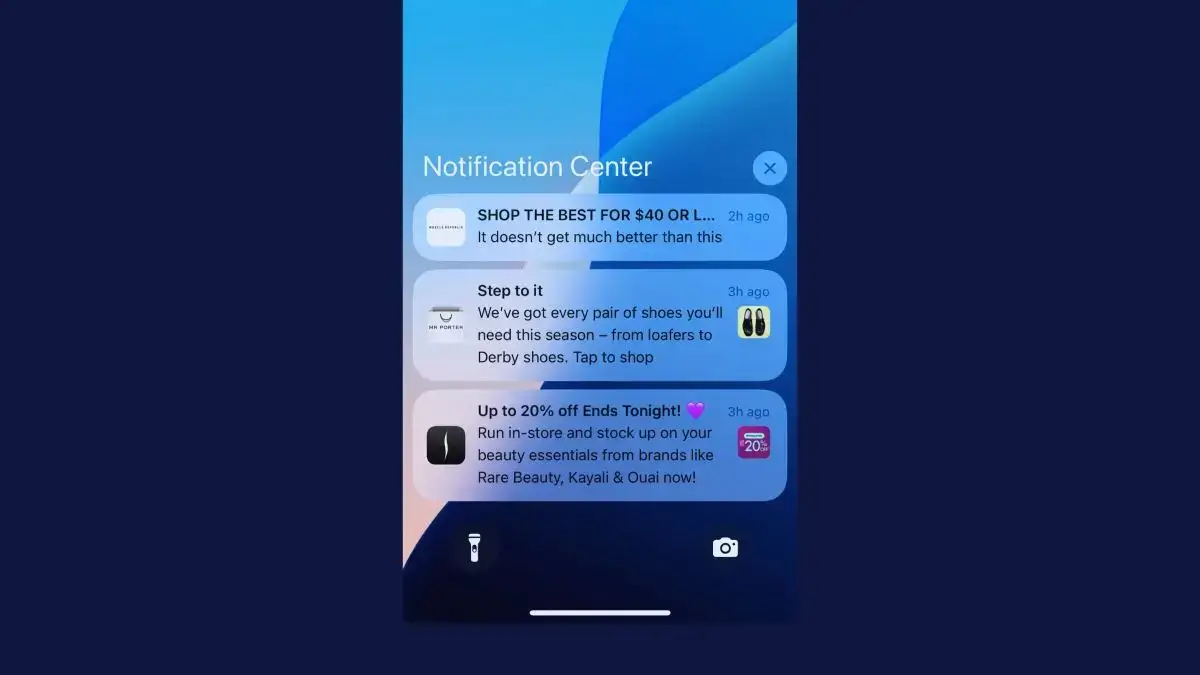
    1. Rainbow Shops: “FROM $4.99. Nothing short of fabulous!”
    2. True Classic: “Make This Your Hottest Summer Ever With 40% Off Sitewide Using Code: HOT.”
    3. H&M: “Summer sale starts NOW. Up to 50% off in stores and online.”

    2. Abandoned Cart Recovery

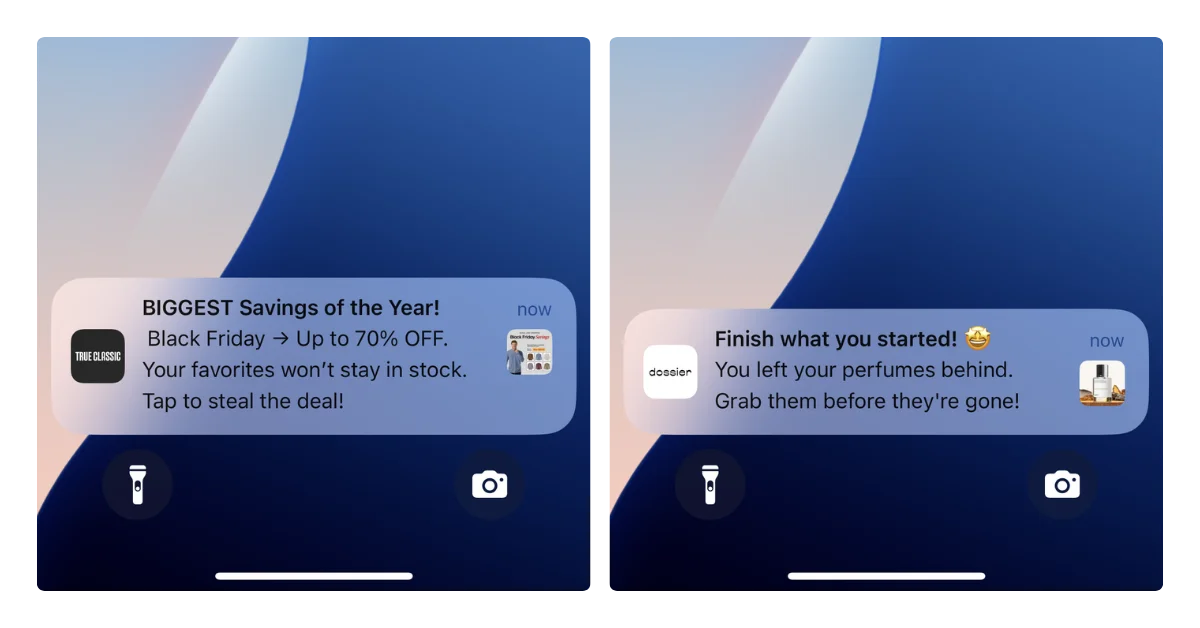
    Abandoned cart push notifications remind users about items left in their cart with a compelling message or discount to encourage them to complete the purchase.

    These notifications significantly reduce cart abandonment rates and deliver major revenue boosts.

    Some of our users have recovered six figures ($200,000+) in just thirty days using abandoned cart notifications alone.

    We built cart abandonment push notification sequences into the Vendrux platform. Each time a customer activates abandoned cart notifications, they see a near-immediate ROI, and literally tens of thousands of dollars generated in days, simply by reminding people about the items left in their cart.

    Book a free demo now to learn how to do the same for your brand.

    Tips for Writing:

    • Offer an incentive, like a discount code, to encourage completion.
    • Create a sense of urgency to prompt quick action.
    • Don’t stop at the first message, we find a sequence of 3 is ideal.

    Examples:

    1. Chubbies Shorts: “So you’re just gonna leave this cart unattended? Use code BACK15 to get 15% off the world’s best weekend-wear.”
    2. Hobbiesville: “You left something in your cart! Tap here to start your checkout.”

    3. Product Announcements

    Launch new products or collections with excitement. Push lets you reach your audience instantly when something fresh drops.

    Over time, you’ll train your customer to expect exclusive product drops and opportunities coming just by keeping the app active and push notifications active (improving long-term engagement and retention rates).

    Tips for Writing:

    • Highlight the exclusivity or novelty of the product.
    • Use engaging visuals if possible to showcase the product.
    • Include a call-to-action to drive users to the app or website to view the product.

    Examples:

    1. Kith: “Hey, promise to keep a secret? You’re getting a super exclusive first look at our new arrivals way before the rest of the public.”
    2. H&M: “NEW ARRIVALS. Summer resort style in focus.”

    4. Seasonal and Holiday Campaigns

    Capitalize on seasonal shopping peaks with timely messages around holidays, gift guides, and time-limited themes, and drive sales for low cost (while bypassing crowded inboxes and social feeds).

    Tips for Writing:

    • Align your message with the holiday or season to make it relevant.
    • Use festive language and visuals to capture the holiday spirit.
    • Include specific dates and times to create urgency.

    Examples:

    1. True Classic: “Happy Father’s Day from True Classic! Here’s to every shoelace tied, every set of training wheels retired, and every little league game reffed. Dads, we couldn’t do it without you.”
    2. True Classic: “Order TONIGHT to get your gifts in time for Father’s Day!”
    3. Rainbow Shops: “It’s a Summer Sale! Get it online and in-store.”

    Learn more about running push notification campaigns for the holiday season in this guide.

    5. Special Events

    Promote live sales, influencer takeovers, or in-person activations. Push notifications create buzz and boost attendance or engagement.

    Push notifications create a sense of urgency and exclusivity, which are great tactics for boosting conversion rates.

    Tips for Writing:

    • Clearly state the event and its benefits.
    • Use countdowns or time-limited language to emphasize urgency.
    • Encourage immediate action with phrases like “shop now” or “don’t miss out.”

    Examples:

    1. Kith: “End of Season Event. Shop our selection of apparel, footwear, and lifestyle products—now at exclusive prices.”
    2. Farfetch: “Trending pieces in sale. Tap to shop the most-wanted pieces from our global network of brands in the sale, now with up to 60% off selected styles.”

    6. Personalized Recommendations

    Suggest products based on browsing or purchase history. Personalization increases relevance and conversion rates, and enhances the shopping experience for the customer.

    Some studies find as much as 4x higher open rates from personalized notifications.

    Tips for Writing:

    • Use the user’s name to make the message feel personal.
    • Recommend products that align with the user’s browsing or purchase history.
    • Provide a direct link to the recommended products.

    Examples:

    1. Rainbow Shops: “HEY GRILL MASTER, Take a little shopping break to cool off. 25% off Mens Styles.”
    2. Chubbies Shorts: “The fellas on the golf course won’t know what hit ’em. Turn heads with our summer golf collection.”

    7. Loyalty and Rewards

    Notify users when they’ve earned points, unlocked perks, or are close to a reward threshold, motivating continued engagement and purchases.

    Tips for Writing:

    • Clearly communicate the user’s current points or rewards status.
    • Encourage further engagement by highlighting the benefits of accumulating more points.
    • Offer exclusive rewards or early access to sales for loyalty members.

    Examples:

    1. True Classic: “You’ve earned 500 points! Redeem them on your next purchase.”
    2. Farfetch: “Welcome Reward +50 Points. Completing Your Shopping Preferences +50 Points.”
    3. Kith: “Achievement Completed. Welcome Reward +50 Points.”

    8. Order and Shipping Updates

    Keep customers informed post-purchase with shipping confirmations, tracking info, and delivery alerts to build trust, reduce support requests, and improve the overall customer experience.

    Tips for Writing:

    • Be clear and concise about the order status.
    • Include tracking information or expected delivery dates.
    • Reassure customers with friendly and professional language.

    Examples:

    1. “Your order has shipped! Track it now.”
    2. “Your order is out for delivery today.”

    9. Engagement Messages

    Keep users engaged with non-transactional nudges like “Check out what’s trending” or “People are loving these picks.”

    This keeps users active and engaged, and helps your brand (and app) stay top-of-mind.

    Tips for Writing:

    • Use engaging language to capture the user’s interest.
    • Highlight the benefits of exploring new content or participating in interactive activities.
    • Provide clear calls-to-action to drive engagement.

    Examples:

    1. Kith: “Check out our best-sellers, new arrivals & more.”
    2. Mango: “Shop the most-wanted items now!”
    3. H&M: “Top jeans picks for summer. These jeans go with everything.”

    10. Urgency and Scarcity

    Highlight low-stock alerts, expiring offers, or flash deals to drive FOMO and prompt faster decisions.

    Tips for Writing:

    • Use time-sensitive language to emphasize urgency.
    • Highlight the limited availability of products.
    • Encourage immediate action with clear calls-to-action.

    Examples:

    1. Fashion Nova: “LAST CHANCE Styles at $3, $5, $7 and $9! Shop These Major Deals B4 They’re GONE!.”
    2. Mango: “An extra 15% off on your faves for a short time more. Online code: EXTRA15.”
    3. True Classic: “LAST CALL. $40 ALL BOTTOMS expires in JUST A FEW HOURS! Shop now or forever hold your peace.”

    11. App-Specific Promotions

    Reward your app users with exclusive deals, early access, or app-only product drops and promos, reinforcing app value and retention, and giving clear incentives for customers to regularly shop on the app.

    Tips for Writing:

    • Clearly state the benefits of using the app.
    • Offer exclusive discounts or perks for app users.
    • Encourage app downloads with compelling calls-to-action.

    Examples:

    1. Sephora: “Download our app and get a free gift with your first order.”
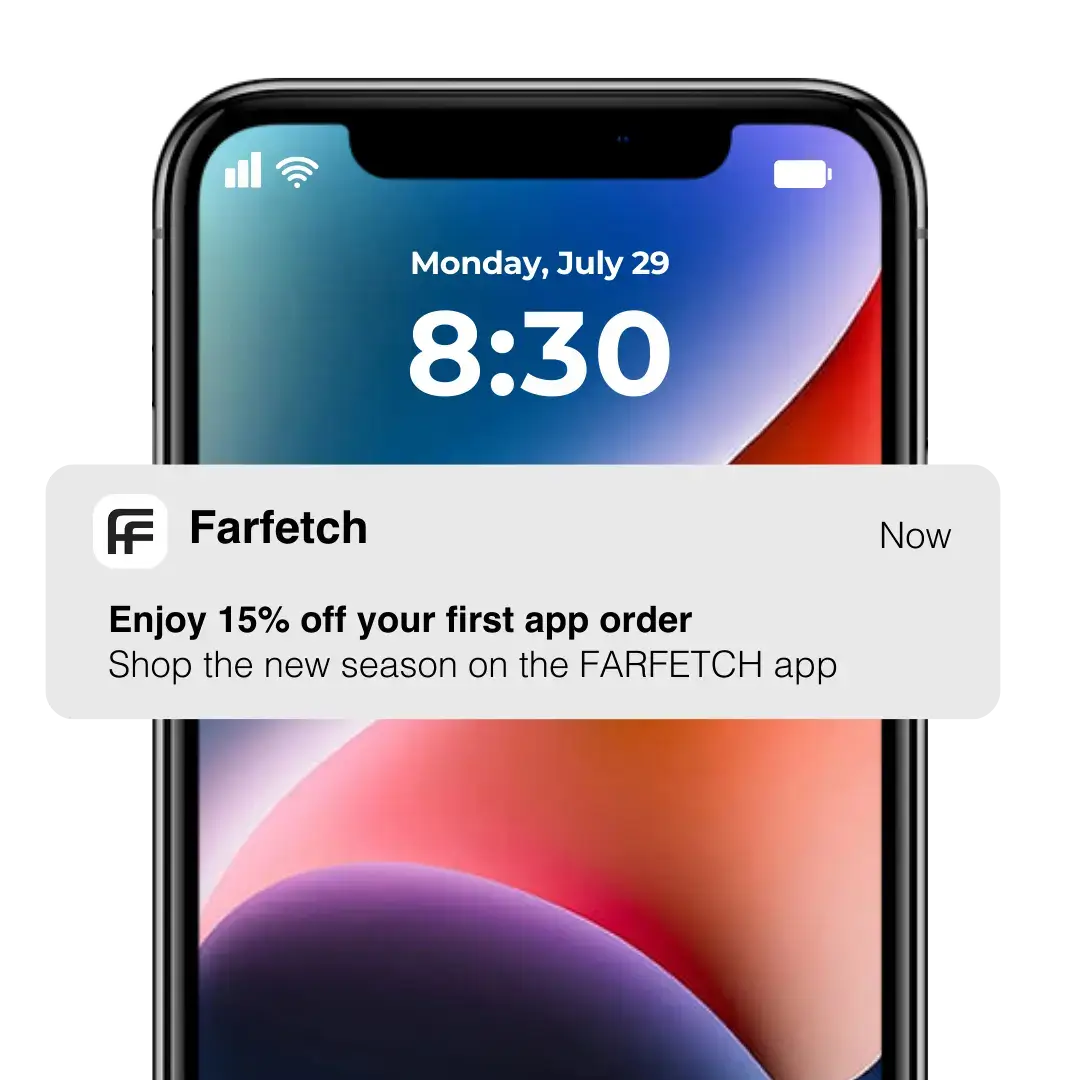
    2. Farfetch: “Enjoy 15% off you first app order. Shop the new season on the FARFETCH app.”
    12. Event Reminders

    Send a timely reminder before a sale starts, a product restock, or a loyalty deadline. Great for maximizing campaign impact.

    Tips for Writing:

    • Provide clear information about the event and its benefits.
    • Use engaging language to build excitement.
    • Include specific dates and times to ensure users don’t miss out.

    Examples:

    1. Kith: “End of Season Event. Shop our selection of apparel, footwear, and lifestyle products – now at exclusive prices.”
    2. Sephora: “Beauty Pass Sale Coming Soon! Get up to 15% off from 9pm, 26 Jun.”

    13. Feedback Requests

    Prompt customers to leave a review, rate a product, or answer a quick survey post-purchase to generate UGC and insights.

    Tips for Writing:

    • Be direct and courteous in your request.
    • Highlight the importance of their feedback.
    • Offer incentives for completing surveys or leaving reviews.

    Examples:

    1. True Classic: “Love your new shirts? Leave a review and let us know what you think!”
    2. Sephora: “Help us improve! Take our quick survey and get a chance to win a $50 gift card.”

    14. Re-engagement

    Target inactive users with personalized win-back messages, offering incentives or highlighting new features or products that might interest the customer.

    Tips for Writing:

    • Personalize the message to make it more compelling.
    • Offer exclusive incentives to encourage return visits.
    • Highlight what’s new or improved to spark interest.

    Examples:

    1. Mango: “We miss you! Come back and enjoy 20% off your next purchase.”
    2. Rainbow Shops: “It’s been a while! Check out our new arrivals and get an exclusive 10% discount.”
    3. Sephora: “Caught you browsing! Continue your journey and add this item to your cart.”

    Push Notification Opt-Ins: (The Step Most Brands Overlook)

    Before you can send a single push notification, users need to say “yes.” You could be getting 100% click-through rates on all your push messages, but it’ll mean little if you’re only reaching 10% of your app users.

    That’s what makes the opt-in moment one of the most critical elements of your entire push notification strategy.

    Opt-in rates can vary widely. Mobile apps push averages ~60% average (81% on Android, 51% on iOS).

    Even small improvements in this number will dramatically increase your campaign reach and ROI.

    How to Optimize for Push Opt-Ins

    Here are some tips on maximizing the percentage of app users who opt-in (and stay opted in) to push.

    1. Time the ask strategically

    Most apps show an opt-in prompt as soon as the user installs the app.

    This could be a mistake. The user doesn’t know what they’re opting in to, and the default action is often to say “no”.

    Instead, consider waiting until they’ve completed a meaningful action, like browsing a product, making a purchase, or engaging with your brand. Ask when value is clear and engagement is high.

    2. Get ahead of the default prompt

    Most brands rely on the default system prompt with no context. That’s a mistake.

    Use a pre-permission screen (also called a “soft ask”) to explain what users will get (exclusive deals, order updates, back-in-stock alerts, etc).

    3. Make the value clear

    Clearly explain to the user why it benefits them to enable push notifications.

    “Enable notifications to stay up to date on your orders and get early access to sales” is far more effective than “We’d like to send you notifications.”

    Speak to the customer’s interest, not your own.

    “Turn on notifications for early access to our Black Friday sale” or “Be the first to know when your favorites are back in stock” are some

    4. Test opt-in placement and format

    Use A/B testing to compare timing, design, and messaging.

    Even small changes to when and how you ask can significantly improve opt-in rates.

    5. Make opting in feel like part of onboarding

    Rather than treating it as a system-level interruption, embed it into your onboarding flow or post-purchase experience. Position it as a feature, not a request.

    6. Make it easy to re-enable push notifications

    You can only show the default opt-in popup once. However, you can constantly communicate inside your app the benefits of having push enabled, and make it easy for customers to re-enable push if they previously opted out (like how Shein and Temu do it below).

    It’s up to you how aggressively you try to re-engage users; but at the very least, you should make this option easily visible in their account page.

    Key Push Notification Tools

    What tools do you need to send ecommerce push notifications?

    Not much. If you’re not sending push notifications at all, here’s what you need to start tapping into this powerful tool for customer engagement.

    1. A Push Notification Service

    Like with email or SMS, you’ll need a software provider that handles sending and all the technical bits and pieces under the hood.

    Like an email service provider, a good push service lets you:

    • Automate flows like abandoned cart, post-purchase, and back-in-stock
    • Segment audiences for more targeted messages
    • Track open rates, CTRs, and revenue impact
    • Integrate your email, SMS and push in one place

    Some popular push notification services include:

    OneSignal

    • Highly flexible and cost-effective. Great for both web and mobile push, with strong automation, segmentation, and analytics. Developer-friendly and widely used across ecommerce stacks.

    Klaviyo

    • Best for brands already using Klaviyo for email and SMS. Supports mobile push on all plans, and allows unified flows across channels. Strong automation and personalization features.

    PushWoosh

    • Does mobile push, as well as web push, email, SMS, WhatsApp, and more. May require more technical setup than the other platforms.

    2. A Mobile App

    The other crucial element (to send mobile app push notifications) is a mobile app.

    Mobile apps deliver a ton of benefits for ecommerce brands, above and beyond push. But if nothing else convinces you, the ability to reach out customers with a direct, personal, real-time communication channel should.

    If you don’t have an app yet, the good news is it’s easy to launch one. As long as your mobile website is fast and works well, you’re already 90% of the way there.

    Vendrux will turn your website into Android & iOS apps in under 30 days, for a low cost, while retaining all the important features from your website.

    Examples of high-revenue ecommerce apps built with Vendrux

    Your apps integrate with OneSignal or Klaviyo, with push notifications set up and ready to go, out of the box.

    Everything about the app (build, technical maintenance, updates, App Store submission) is done for you, and you’ve also got the option to have us take care of your push notification strategy too.

    For less than a day’s sales, you could have your very own branded shopping app, live, in the App Stores and on your customers’ mobile phones, ready to drive revenue with push notifications.

    Want to see how your website will look as a native app? Get a free app preview now – all you need is your website’s URL!

    Build a Direct Line to Your Best Customers with Push Notifications

    Push notifications are one of the most overlooked growth tools in ecommerce today.

    They give brands a direct, high-converting way to reach customers, right on their mobile device, in real time (without the noise of crowded inboxes or the cost of paid ads).

    Now, more than ever, brands need low-cost, dependable ways to connect with their customers.

    Push notifications are the best way to do it. Especially because they specifically reach app users – who are most likely to be your most engaged, highest value customer segment.

    That means the marketing dollars you put into push notifications will typically draw a higher return, because you’re communicating with high-intent, engaged, loyal customers.

    If you want to start integrating push into your marketing strategy, here are the action steps to take:

    • If you don’t have one already, launch your mobile app (see Vendrux for the easiest way to do it).
    • Start out with one high-impact use case, like abandoned cart recovery.
    • In time, start adding special offers and personalized messages into the mix.
    • Track performance, learn what resonates with your audience, and build from there.
    A real brand – $360k with abandoned cart notifications in just one month

    Ready to add 5-6 figures in monthly revenue, for little to no incremental cost? Start sending more push notifications.

    If you want to learn how other brands like yours are using push notifications to boost engagement and retention (and how you can replicate their success), get in touch now.
  • 32+ Ecommerce Mobile App Statistics (The Business Impact of Mobile Apps)

    32+ Ecommerce Mobile App Statistics (The Business Impact of Mobile Apps)

    Customer acquisition costs are climbing, putting a squeeze on margins. Email and SMS channels are more crowded than ever, making it harder to retain your best customers.

    For ecommerce brands looking to drive sustainable growth, the answer isn’t spending more on ads. It’s building stronger relationships with existing customers.

    Mobile apps have quietly become the ultimate retention engine for ecommerce brands. They’re driving high-margin sales, and powering high-LTV customer segments. And they work across almost every category.

    Our team broke down the data. We created a report based on 30+ industry sources, as well as our own internal data, to show the business impact of mobile apps.

    Here’s all you need to know about the state of mobile apps in ecommerce today.

    Get the full picture on how mobile apps drive real results for ecommerce businesses. Download the 2025 Ecommerce Mobile App Benchmark Report.

    The Mobile App Market Is Massive (And Growing)

    The market for shopping apps is growing fast. 

    76.5% of US smartphone users (roughly 164 million people) regularly use shopping apps, with 78% of consumers worldwide embracing mobile app shopping.

    This isn’t just casual browsing. It’s a major behavior shift:

    • Users spend 201.8 minutes per month in shopping apps versus just 10.9 minutes on mobile websites
    • 56% of global consumers shop on mobile at least once a week
    • Higher-income households show 82% adoption rates for shopping apps
    • Millennials lead usage rates, with 61% having downloaded retail apps and 58% preferring to purchase via apps

    The engagement numbers tell a compelling story about user intent. When someone downloads and uses a shopping app, they’re not just browsing. They’re actively looking to buy.

    Revenue Contribution: Small Segment, Outsized Sales

    Here’s where the data gets really interesting. 

    We analyzed real ecommerce brands across various industries to see what kind of revenue their apps actually generate.

    The results showed an outsized contribution from app users every time.

    • Brand A (Wellness): Just 16% of all customers used the app, but they generated 62% of total revenue.
    • Brand B (Fashion): Only 7% of traffic came from app users, but they drove 20% of all revenue.
    • Brand C (Cosmetics): 10% of all users were on the app, yet they contributed 15% of sales.
    __wf_reserved_inherit

    This pattern holds across industries. 

    Our research shows that retail and ecommerce brands typically see 10-30% of their total online revenue coming through their apps, with high-performers hitting 40-60% of online sales from their app channel.

    The math is simple. Not every shopper will download an app. But those who do are almost guaranteed to spend more.

    Even with a smaller user base, apps consistently punch above their weight when it comes to revenue generation.

    Engagement & Habit‑Building

    Mobile apps excel at creating regular shopping habits. App users don’t just convert more – they come back more often and engage more deeply.

    Here are some patterns we saw from brands we studied:

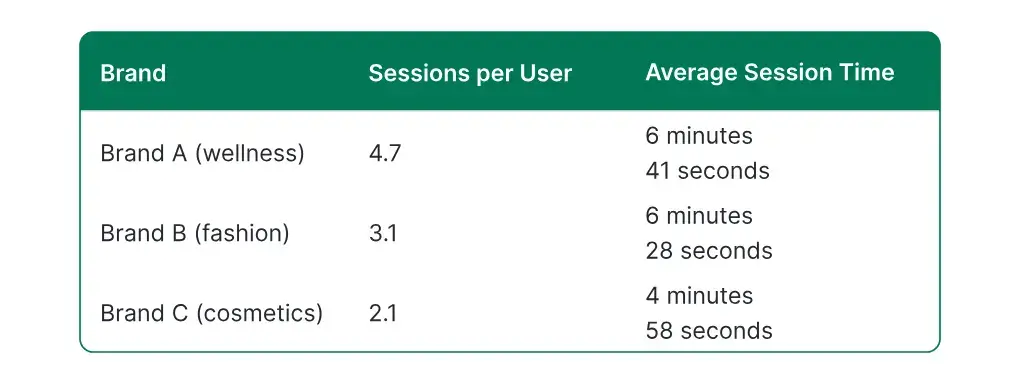
    • Brand A users: 4.7 sessions per month, averaging 6 minutes 41 seconds each
    • Brand B users: 3.1 sessions per month, averaging 6 minutes 28 seconds each
    • Brand C users: 2.1 sessions per month, averaging 4 minutes 58 seconds each
    __wf_reserved_inherit

    Compare this to mobile web users who typically spend 1-2 minutes per session. App users spend 3-7x longer per session, exploring products, reading reviews, and making purchase decisions.

    They also view approximately 4.2x more products per session than mobile web visitors. Indicating much deeper engagement with your catalog.

    Mobile App Conversion Rates

    The conversion data reveals why apps are such powerful revenue drivers. 

    Across every brand we studied, app users converted at much higher rates:

    • Brand A (Wellness): 9.1% app conversion vs 1.1% mobile web (8x higher)
    • Brand B (Fashion): 2.6% app conversion vs 0.2% mobile web (11x higher)
    • Brand C (Cosmetics): 2.8% app conversion vs 1.5% mobile web (1.9x higher)
    __wf_reserved_inherit

    These aren’t small improvements. They represent clear differences in how customers behave when they have a dedicated app experience versus browsing on mobile web.

    Average order values are also higher in apps.

    Our data found mobile app AOV typically 10-50% above mobile web. While industry reports show app users spend about $95 per order versus $73 on websites.

    Ecommerce Push Notifications

    Push notifications alone can justify building an app. 

    __wf_reserved_inherit

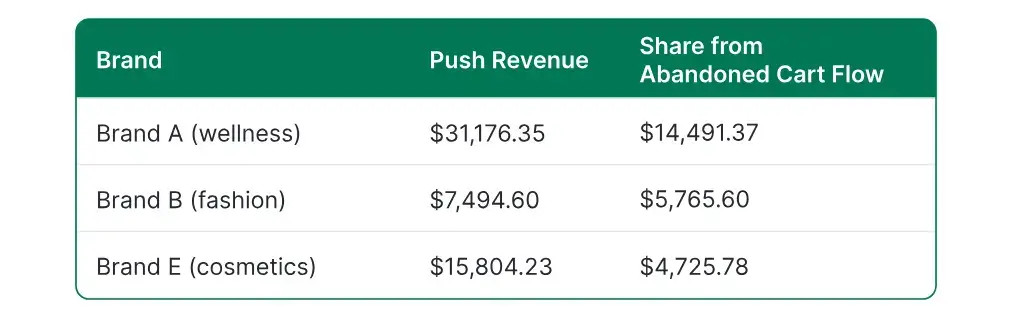
    Our data shows abandoned cart push campaigns generating substantial revenue with minimal effort:

    • Brand D (Cannabis Retailer): Recovered over $360K in a single month through abandoned cart push notifications alone.
    • Brand A (Wellness): Generated $14K+ monthly from automated cart recovery.
    • Brand B (Fashion): Recovered $5.7K monthly.
    • Brand E (Cosmetics): Recovered $4.6K monthly.
    __wf_reserved_inherit

    Push notifications consistently outperform other channels:

    • Click-through rates of 3-5% (3-5x higher than email)
    • Conversion rates of 1.5-4%
    • Up to 10x higher revenue per user compared to email and SMS

    The best part? These are automated flows that run in the background once set up. 

    No ad spend, no manual campaigns. Just recovered revenue from customers who were already interested enough to add items to their cart.

    Learn more: All You Need to Know About Push Notifications for Ecommerce

    Mobile App ROI & Cost Economics

    Traditional mobile app development used to require massive investments – $100,000-$250,000 and 10-13 months to launch. 

    But modern web-to-app solutions have changed the economics entirely.

    Here are some real ROI examples from Q1 2025:

    • Brand A: $2.07M app revenue contribution, $4,500 quarterly cost = 459x ROI
    • Brand B: $194K app revenue contribution, $1,800 quarterly cost = 108x ROI
    • Brand C: $1.82M app revenue contribution, $6,000 quarterly cost = 303x ROI
    __wf_reserved_inherit

    With managed solutions like Vendrux, brands can go live for as little as $1-2K upfront.

    Abandoned cart notifications, on their own, can easily generate $10K+ in revenue per month – which would drive a 5-10x ROI.

    When you consider that abandoned cart revenue only makes up around 10% of total mobile app revenue, that gives you an idea of the how high your mobile app’s ROI can scale.

    Want to see how you can launch your own, high-ROI mobile app? Get a free preview of your app now.

    Retention & Lifetime Value

    App users don’t just buy more initially. They become more valuable customers over time:

    • Customer lifetime value is 2.8-5x higher for app users versus web-only shoppers
    • 60% of first-time app buyers make at least one additional purchase
    • App users purchase approximately 33% more often than non-app users
    • 60% of app customers make multiple purchases in a year, compared to only 40% of mobile website customers

    This retention advantage compounds over time, making the initial investment in an app increasingly valuable as your customer base grows.

    The Competitive Landscape (How Many Brands Have Apps?)

    Despite the clear benefits, most brands haven’t adopted mobile apps yet. 

    Our research shows:

    • Only 4.56% of US brands with $100K+/month revenue have mobile apps
    • Just 3.37% of Shopify brands with $50K+/month revenue have apps
    • Ecommerce brands with custom-built websites are 2x more likely to have a mobile app

    This represents a significant opportunity for early movers. The cost to acquire app users is also relatively low – $3-4.50 per install for retail apps – often cheaper than other customer acquisition channels.

    Learn more: How Many Ecommerce Stores Have Mobile Apps?

    Ecommerce Mobile App Trends to Watch (2025‑2026)

    We’ve seen the current state of mobile apps for ecommerce. But how about the near future?

    Here are a few trends emerging in the world of mobile apps and ecommerce.

    The First-Party Data Advantage

    As third-party cookies disappear and Apple’s tracking limitations expand, brands need direct relationships with customers. 

    Apps provide first-party data and zero-party data collection opportunities. 

    Expect more brands to see the value in mobile apps, not just for driving sales, but for collecting crucial data on their customers.

    Enhanced Experiences

    AR try-on features, AI-driven personalization, and social commerce “feed” experiences are becoming standard expectations for mobile shopping.

    Watch brands build more innovative apps, utilizing these features to build immersive shopping experiences.

    Omnichannel Integration

    Apps increasingly connect online and offline experiences, with 74% of consumers worldwide using retail apps while shopping in physical stores.

    Apps aren’t just a better way to shop online. They’re becoming a powerful asset for the physical retail CX as well.

    The Bottom Line

    Mobile apps can generate up to 7x more revenue per user and contribute 40-50% of online sales for ecom brands.

    They build stronger customer relationships, drive higher conversion rates, and create automated revenue streams through app-only features like push notifications.

    The data is clear. While not every website visitor needs your app, your best customers absolutely do. 

    Apps provide a superior experience for your most valuable shoppers while giving you direct access to re-engage them.

    For brands serious about sustainable growth and customer retention, the question isn’t whether to build an app. It’s how quickly you can launch it.

    Ready to get the full picture? Download the complete 2025 Ecommerce Mobile App Benchmark Report for everything you need to know about the performance of mobile apps in ecom & retail, based on real brand data. 

    Get the full report here.

  • How Much of Mobile App Revenue is Incremental? (Here’s What the Data Shows)

    How Much of Mobile App Revenue is Incremental? (Here’s What the Data Shows)

    Despite more people buying on their phones than ever before, and the barrier of entry to mobile apps being lower than ever before, a relatively small share of ecommerce stores have their own app.

    The number one objection I hear when I tell a brand owner to launch an app is: “Won’t most of the revenue just come from people who would have bought on my website anyway?”

    It’s a fair question to ask. If you’re going to invest in a mobile app (or any channel), you want to be confident that it’s going to add a real, incremental lift to your business.

    So is this a real concern? Are mobile apps just shifting revenue from one channel to another? Or is it a channel that can add real numbers to your bottom line?

    We’ve helped more than 2,000 brands, including hundreds of high-revenue ecommerce brands, go from website to website + app. So we’ve got a lot of data to work with.

    Here’s what it tells us.

    Will a Mobile App Just Cannibalize My Website Sales?

    The short answer: some overlap exists, and pretending otherwise would be dishonest. 

    A portion of the customers who buy through your app would have purchased on your website if the app didn’t exist. That’s true.

    But framing app revenue as either “incremental” or “cannibalized” misses what’s actually going on. The more useful question isn’t “where did this sale happen?” It’s “would this customer have spent this much, this often, at all?”

    That distinction matters because apps don’t just give customers a different place to buy. They change how customers behave. 

    More frequent visits. Larger orders. Purchases triggered by push notifications that wouldn’t have happened otherwise. 

    Even when a sale “moves” from web to app, the customer’s spending patterns shift in ways that increase their total value over time.

    This is the difference between channel shift (same revenue, different screen) and behavioral lift (more revenue, period). The data consistently shows the latter.

    How Mobile Apps Drive Revenue That Wouldn’t Exist Otherwise

    There are four distinct mechanisms that drive genuinely new revenue through mobile apps. Each one is measurable, and each contributes to the gap between what a customer spends on your website versus what they spend when they have your app.

    Let’s take a look now.

    Lower Friction – More Frequent Visits

    When your store is one tap away on a customer’s home screen, they visit more often. It’s simple friction economics.

    Opening an app takes one tap. Visiting your website on mobile means opening a browser, typing a URL or searching, then navigating to what they want.

    The difference shows up clearly in session data from brands we work with.

    These extra sessions aren’t all replacing web visits. A couple, maybe. But John Varvatos isn’t taking people who visit the website 12x more than the average user and shifting them to their mobile app.

    These are additional moments when a customer opens your store because the barrier is low enough that it happens on a whim, during a commute, while waiting in line. 

    Each of those sessions is an opportunity to buy – that didn’t exist before.

    Better Experience – Larger Orders

    App users also spend more per visit.

    Across brands with live apps, AOV lifts of 10-50% are typical. Sleefs sees 30% higher AOV in their app. XCVI sees the same.

    Native apps load faster, offer fewer distractions (no browser tabs, no URL bar, no competing notifications from other sites), and feel more like a dedicated shopping experience.

    That keeps shoppers engaged for longer, spending more time in your store. And as anyone with a background in retail will tell you, the longer someone spends in a store, the more they’ll buy.

    Push Notifications Reach Customers When Your Website Can’t

    This is the strongest argument for incrementality, because push notifications are a channel that literally does not exist without an app.

    When you send a push notification, you’re reaching customers who aren’t browsing your site, aren’t checking their email, and aren’t thinking about you at that moment. 

    A notification appears on their lock screen, and suddenly they’re back in your store. That purchase wouldn’t have happened otherwise.

    Abandoned cart push notifications are especially clear-cut. 

    Your website has no way to tap a customer on the shoulder and say “you left something in your cart” through a lock screen notification. Email works fairly well, but not nearly as well as a push notification.

    Push lands instantly, is almost guaranteed to be seen, and sends the customer right back to the app, which increases the chance of a conversion.

    The revenue impact of abandoned cart push is no joke. Brands we work with generate anywhere from $20K to $200K per month just from abandoned cart push notifications.

    Online pharmacy Pharmazone runs abandoned cart push that converts at 22%. That’s almost 1 in 4 notifications leading to a sale.

    Revenue from abandoned cart push notifications is revenue from a channel that didn’t exist before the app launched. By definition, it’s incremental.

    App Users Become More Valuable Customers

    The incrementality argument gets stronger the longer you look at it. App users don’t just spend more per transaction; they compound in value over months and years.

    App users:

    • Stay customers for longer.
    • Purchase more over time.
    • Become more valuable customers over time.

    The app sets a powerful flywheel in motion.

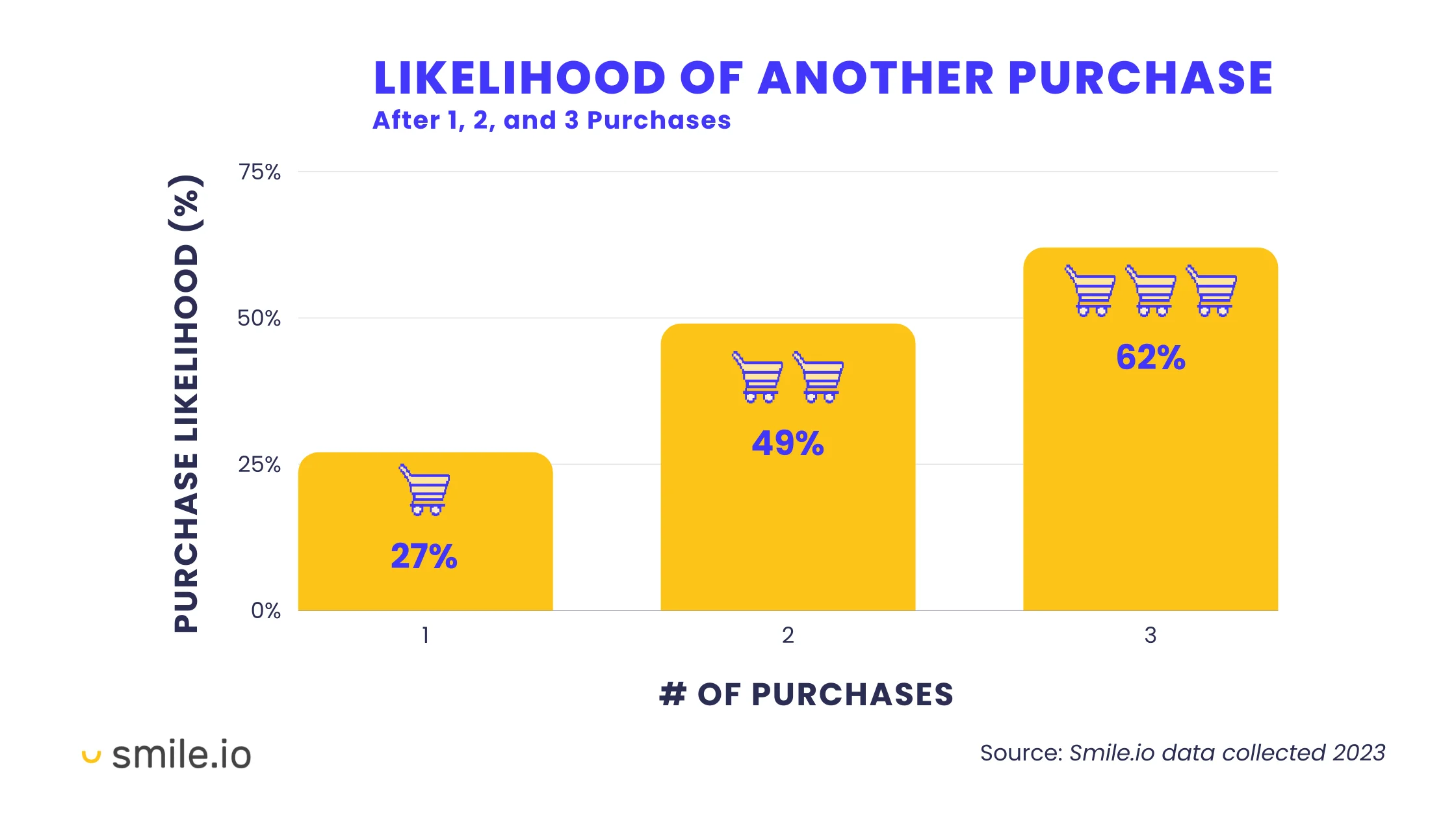
    Research from Smile.io across 1.1 billion shoppers shows that a first-time buyer has just a 27% chance of making a second purchase. But once they do, the probability of a third jumps to 49%. After a third purchase, it climbs to 62%. 

    Each purchase makes the next one more likely. And customers don’t just buy more often; they spend more each time too. 

    Average order values grow roughly 30% within six months and 45% over three years as trust and familiarity deepen.

    The combination of a home screen icon, push-driven re-engagement, and a frictionless shopping experience gets customers past that critical second and third purchase faster. Even if their first app purchase would have happened on the website, the fifth, tenth, and fifteenth purchases may not have. 

    That long-tail compounding is where the real incremental value lives.

    “The app’s been invaluable to us. The cost we’re paying versus what we’re getting back is tenfold.”
    — Nick Barbarise, Director of IT at John Varvatos

    The Crazy Value of App Users (and the Retention Question)

    One thing we constantly see: app users contribute far more revenue than the average shopper.

    Let’s take a look at some real data from Vendrux brands (see more in the Vendrux Ecommerce Benchmark Report).

    We have a fashion brand where just 2% of mobile traffic comes through the app, but that 2% generates 35% of mobile revenue. 

    The pattern doesn’t stop there. Junior Couture, a luxury childrenswear brand on Salesforce Commerce Cloud, sees an extreme impact:

    “Only about 5% of users are on the app, but they generate around 50% of sales.”
    — Narasimha Pinnelli, Architect at Junior Couture

    More examples:

    • Pharmazone sees 63% of online revenue from their app. 
    • Kiokii, with roughly 10% of their customer base using the app, generates 35% of total online revenue through it. 
    • Tadashi Shoji gets 18% of total online revenue from their app, with app users generating 10x more revenue per user than mobile web visitors.

    But here’s your response – “you’re just proving that incrementality is false! Apps only generate more revenue because they’re already your most valuable customers!”

    Perhaps. If we take that as the truth, and say that an app user who spent $500 this year would have spent the exact same amount on the website, there’s still value in the app.

    Mobile apps keep customers closer. They’re a direct line to the customer, an owned channel, where you control the relationship.

    That increases retention. And it does so for the customers who matter the most – your top spenders, your top 20% who are worth the most to retain.

    Why “Incremental vs Cannibalized” Is the Wrong Framing

    Trying to classify every app dollar as either “new” or “stolen from the website” is a bit like asking whether your loyalty program cannibalizes non-loyalty purchases.

    Of course some of your loyalty members would have bought anyway. But the program changes their behavior in ways that increase total spend. You don’t shut down the loyalty program because some members were already customers.

    Or if you look at your 10% first purchase discount and wonder if these customers would have bought at full price instead.

    The same logic applies to apps. Even the portion of app revenue that “would have happened on the website” still carries value. 

    Customers buying through the app are in a faster, more focused environment. Their experience is better, their satisfaction is higher, and their likelihood of returning is greater. 

    That has downstream effects on retention and lifetime value that are hard to attribute to a single transaction but very real at the portfolio level.

    Some Mobile App Revenue is Incremental. Not All

    Here’s where the math makes the incrementality debate somewhat academic.

    Brands with mobile apps typically see 10-35% of total online revenue flow through the app channel. Let’s meet in the middle and say 25%. 

    Now let’s be deliberately conservative and assume only half of that is truly incremental, that the other half would have happened on the website anyway. 

    That still leaves a 12.5% net revenue lift from launching an app.

    What does 12.5% incremental revenue look like at different scales?

    Annual RevenueApp Revenue (25%)Incremental Lift (12.5%)
    $10M$2.5M$1.25M in new revenue
    $20M$5M$2.5M in new revenue
    $50M$12.5M$6.25M in new revenue
    $100M$25M$12.5M in new revenue

    A managed app service like Vendrux costs under $25K per year. Even the $10M brand in this scenario is looking at a 50x return on the incremental revenue alone, and that’s using assumptions that are deliberately stacked against the app.

    And remember: this is the conservative case. It assumes half the app revenue is cannibalized. In practice, the combination of push notification revenue, higher AOV, stronger retention and increased purchase frequency suggests the truly incremental share is likely higher than 50%.

    How Can You Measure Whether Your App Revenue Is Incremental?

    If you want to move past theory and measure incrementality for your own brand, there are four practical ways to get an idea of how much mobile revenue is actually incremental.

    • Watch total revenue after launch. If app revenue is purely cannibalized from the web, your total online revenue stays flat after launching the app, with web revenue dropping by whatever the app generates. If total revenue goes up, the app is driving incremental value.
    • Compare per-user metrics. Look at ARPU (average revenue per user), purchase frequency, and AOV for app users versus web users. The delta between these numbers represents behavioral lift. It could still indicate higher quality customers moving from one platform to another; but concentrating these customers in a high-retention channel is worth it, as we discussed.
    • Track push notification revenue. Abandoned cart recovery, promotional campaigns, and re-engagement pushes all generate revenue through a channel that didn’t exist before your app. This revenue is incremental by definition.
    • Monitor web revenue post-launch. Does your web revenue drop by the same amount as your app revenue generates? Or does it stay steady?

    Want an estimate of how much revenue your app could add? Use our free Ecommerce App Revenue Calculator to find out. 

    Ready to Launch?

    The fastest way to answer the incrementality question for your own brand is to see real data from your own store.

    And the easiest way to launch your own mobile app, and see the incremental lift it can provide, is with Vendrux.

    Vendrux turns your existing website into a full-featured mobile app, with minimal overhead, no technical debt, and a team to support you and handle everything for you.

    You could be live in 30 days, with an app that retains everything you’ve worked so hard to build for your store – PDPs, collections, personalization features, site search, subscriptions, and everything else you rely on to drive revenue.

    Get a free consultation to see what your app could look like, and what the return could be. No commitment required. If the math doesn’t work for your brand, we’ll tell you.