Author: Vendrux

  • Fashion Mobile App ROI: Real Benchmarks and Expectations For Your Brand

    Fashion Mobile App ROI: Real Benchmarks and Expectations For Your Brand

    Of all the arguments for and against a mobile app, the one that matters most is ROI.

    What kind of return on investment are you getting from launching a mobile app? In simplest terms, how much am I getting back for every dollar I invest in it?

    That’s what you need to know if you’re a business owner, or if you’re presenting the project to your board, your CEO, or your boss.

    And that’s what we’re going to address here: the clear business case for a mobile app, specifically for fashion and apparel brands. We’ll look at the statistical benchmarks you can expect, where the ROI comes from, and how to maximize your chance of launching an app that adds multiples to your bottom line.

    Data sources

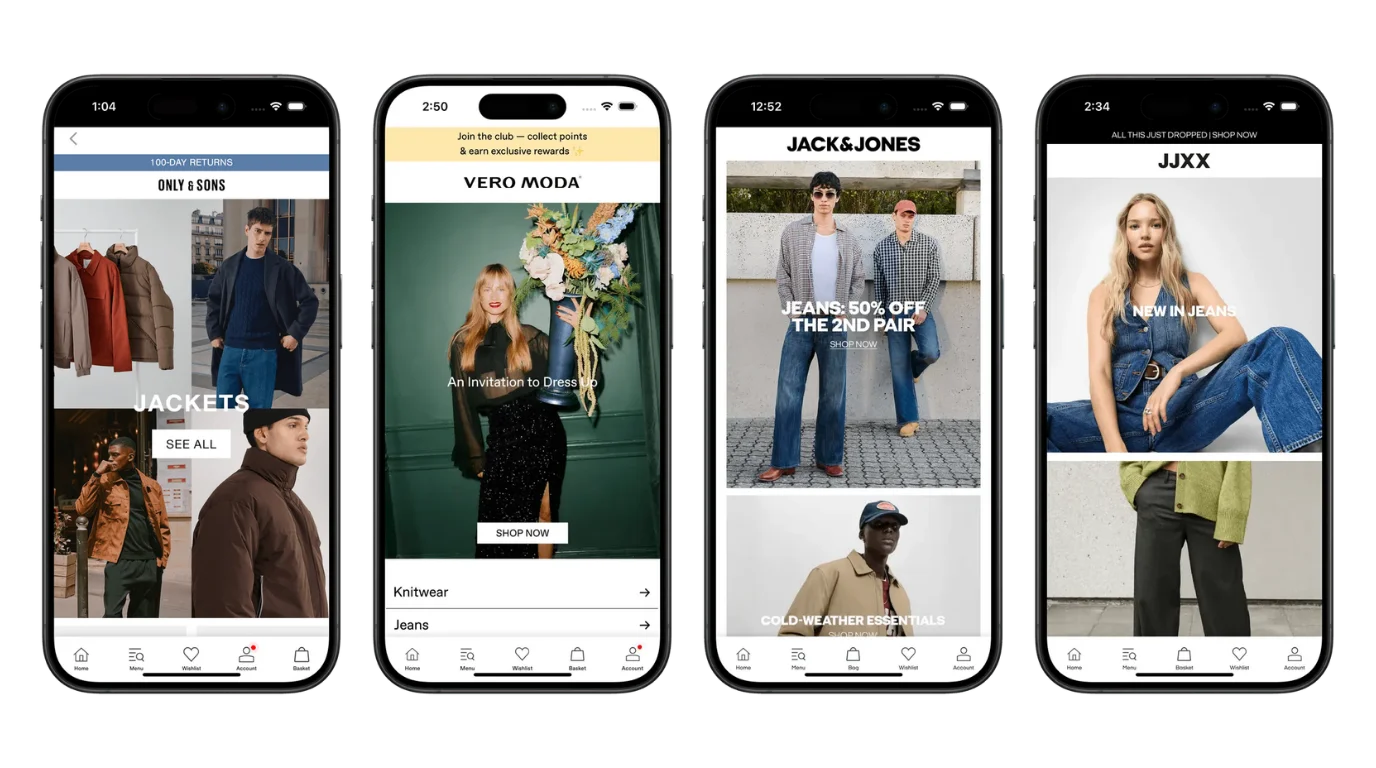
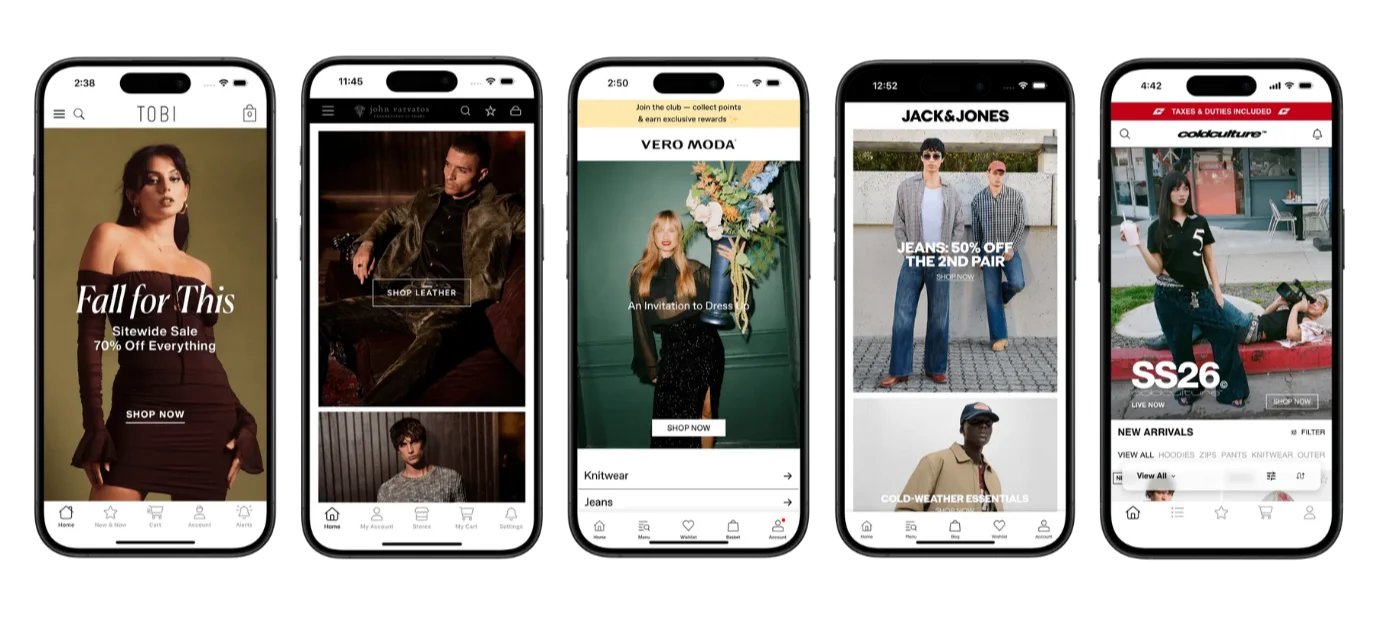
    These numbers come from fashion brands we’ve worked with at Vendrux (including brands like John Varvatos, Jack & Jones and Cold Culture), combined with industry benchmarks and data from publicly available case studies. Get a free consultation to discuss the business case in more detail.

    What’s the Typical ROI of a Fashion Mobile App?

    Fashion brands with mobile apps typically generate 10-30% of total online revenue from the app, with top performers exceeding 30%. That revenue comes from a small slice of the customer base (5-15% of active users), which means revenue per app user runs 3-10x higher than mobile web visitors.

    Here are some examples of the revenue impact of mobile apps for fashion brands:

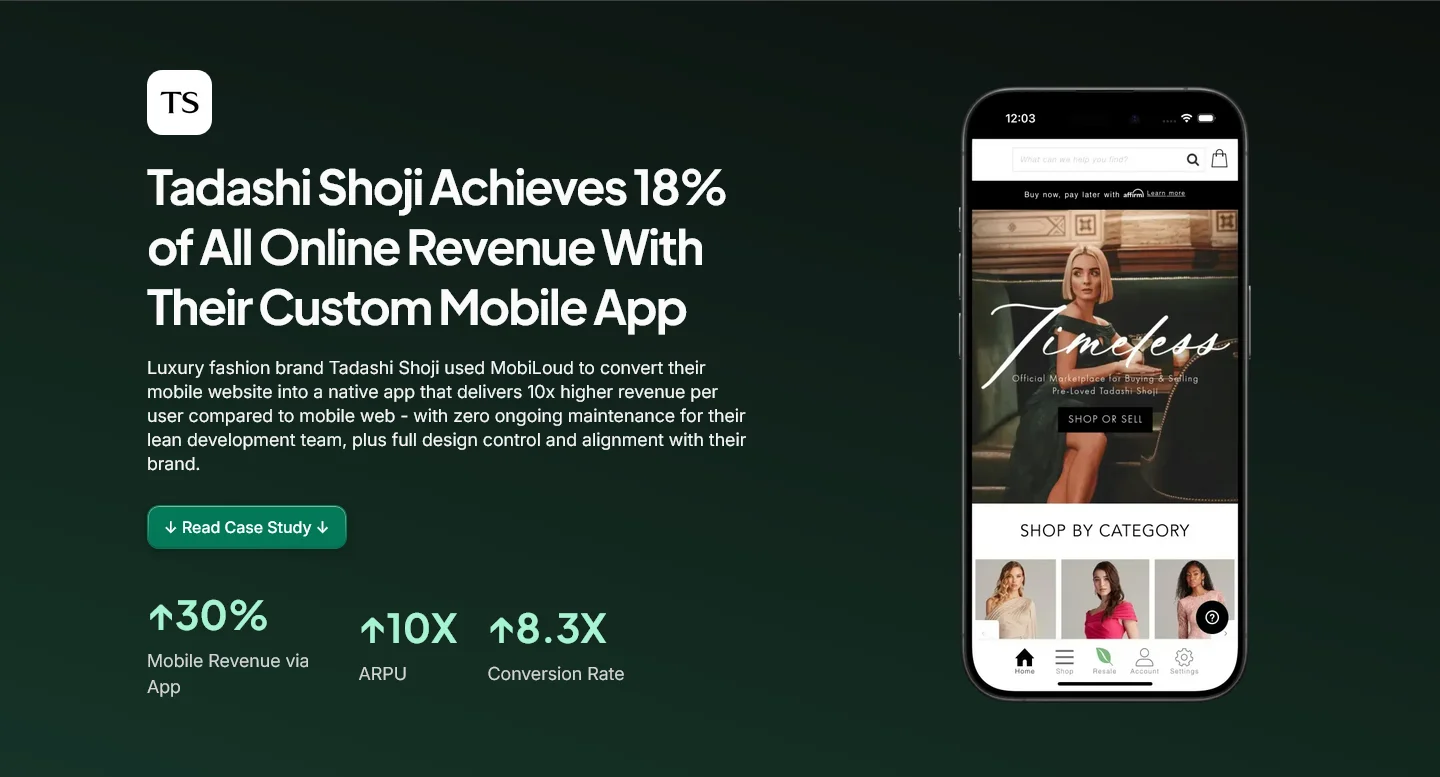
    • Tadashi Shoji (luxury fashion, Magento) sees 18% of total online revenue through their app, with 10x revenue per app user vs mobile web.
    • John Varvatos (luxury fashion, Salesforce Commerce Cloud) gets 10x higher revenue per user through their mobile app.
    • XCVI (women’s fashion, Shopify) gets 4.8x higher revenue per app user, with 30% higher AOV in the app.
    • Junior Couture (luxury childrenswear, Salesforce Commerce Cloud) saw around 50% of their BFCM sales in 2025 come through their app, despite app users making up just 5% of their customer base.

    There are two primary things to take into account.

    One is how app users contribute an outsized share of revenue. On a user for user basis, each app shopper is more valuable and more important to your business.

    The second is the overall revenue potential of your mobile app.

    Taking a benchmark of 20% revenue contribution, a mobile app could generate over $1M per year for a brand doing $5M+ in total online revenue.

    That’s a real revenue channel.
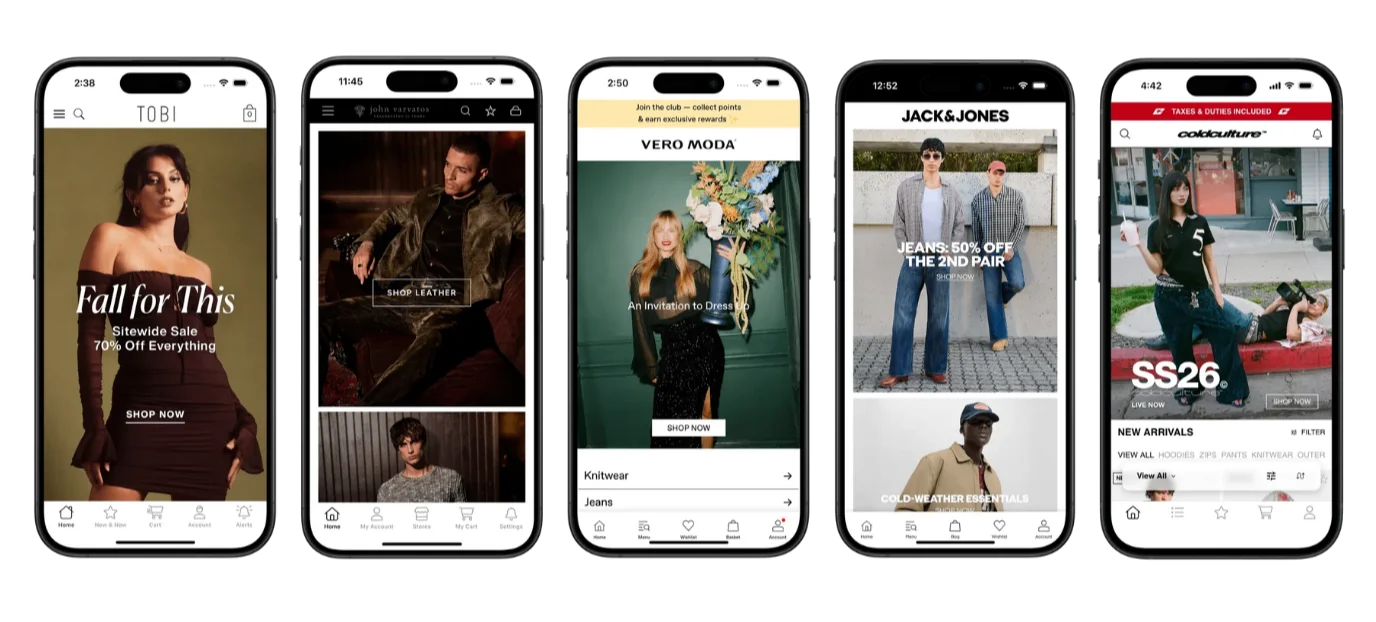
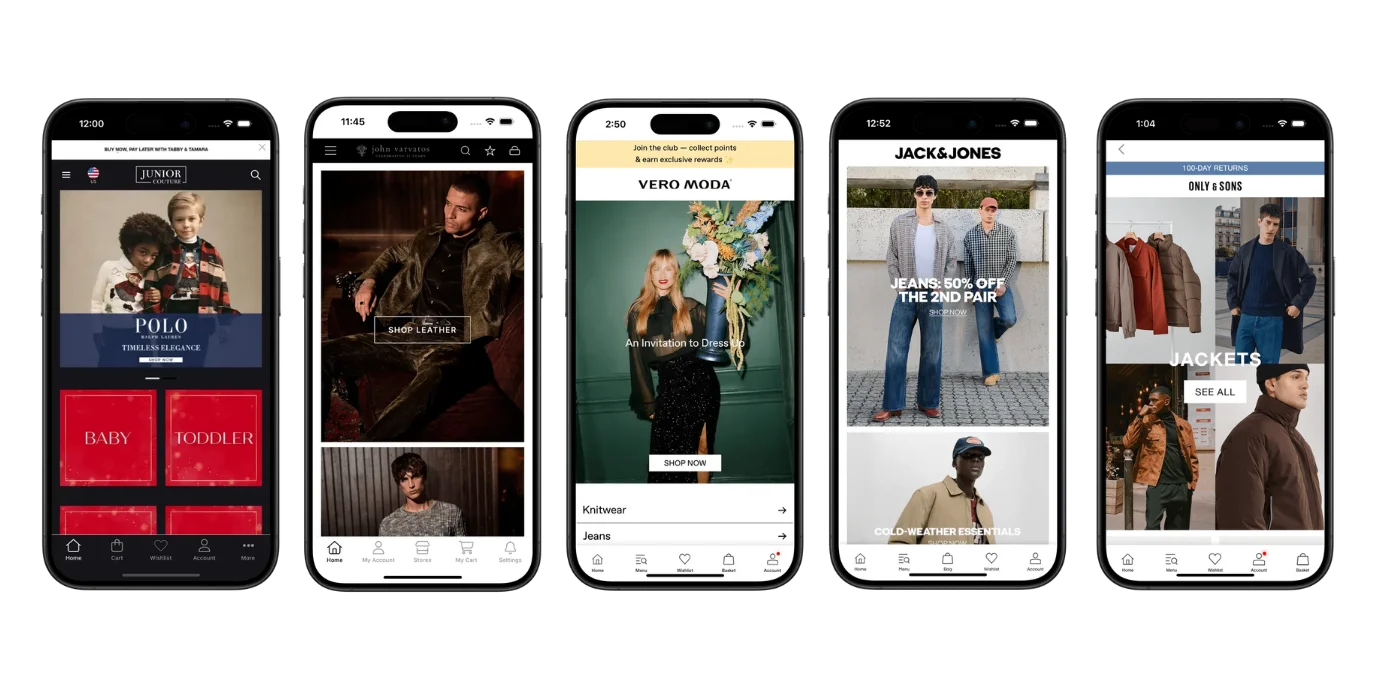
    Examples of sucessful fashion apps, built with Vendrux

    The Four Drivers of ROI for Fashion Apps

    So where does all that ROI come from? 

    It’s not any one thing. Four main drivers stack on top of each other to produce the lift in the numbers above, and each one compounds the others.

    Higher Average Order Value (10-50%+ Per Order)

    App users spend more per order. The Vendrux Ecommerce Mobile App Benchmark Report shows AOV lifts of 10-50% are typical across verticals, with fashion no different – such as XCVI, who sees +30% AOV in the app vs mobile web.

    Apps keep shoppers engaged for longer, with fewer distractions pulling them away. And longer session times lead to larger baskets, more money spent in each order.

    Higher Conversion Rates (2-8x Mobile Web)

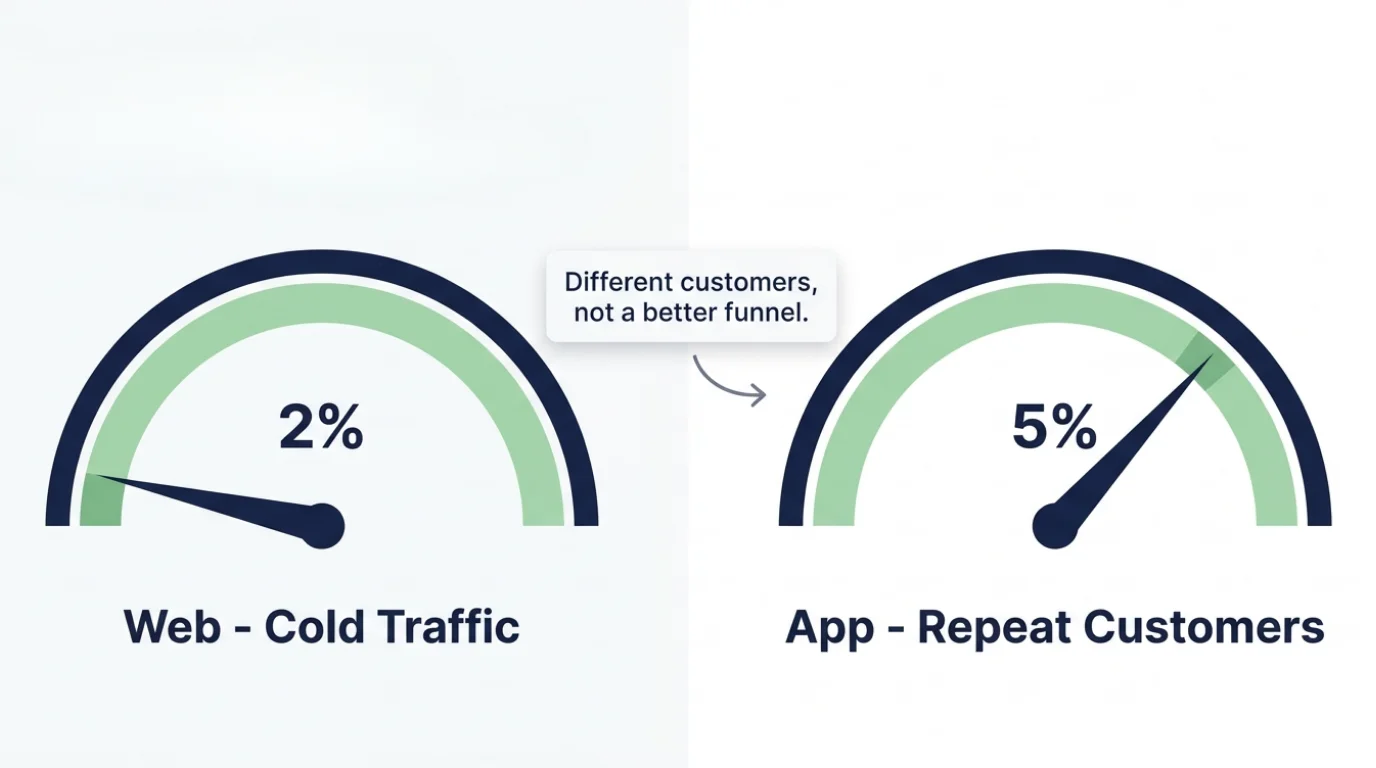
    Your app users convert at 2-8x the rate of mobile web shoppers. XCVI sees 2x higher conversion in the app. Tadashi Shoji sees 8.3x. The industry benchmark for fashion apps sits around 2.6% in-app vs 0.2% mobile web, an 11x gap.

    Mobile apps are more convenient, built for the device, and easier to navigate without the browser chrome. That, plus the higher quality of shoppers who come to your app, means each session is more likely to end in a sale.

    Repeat Purchase Rate and Customer Lifetime Value

    This is the compounding driver, and it’s the one that makes the case over the long term.

    Fashion app users don’t just spend more once. They spend more over months and years, and they buy more often. 

    That’s the full force of compounding: more sessions, better retention, higher repeat rate, more purchases per year.

    The mechanism is habit. A home screen icon next to a shopper’s social apps gets opened. And once a customer hits three or four purchases with your brand, retention shifts from a monthly decision to a default.

    Research from Smile.io across 1.1 billion shoppers shows that a first-time buyer has a 27% chance of a second purchase, a 49% chance of a third, and 62% after that.

    Fashion sits at the high end of this curve, because customers who find brands they trust often become near-exclusive buyers in certain categories (jeans, basics, activewear, outerwear).

    Your app is what gets them to the third or fourth purchase faster than any other channel.

    “The app’s been invaluable to us. The cost we’re paying versus what we’re getting back is tenfold.”
    — Nick Barbarise, Director of IT at John Varvatos

    Push Notifications as a Zero-Cost Retention Channel

    Push is the channel that doesn’t exist without an app. And it’s the single most cost-efficient message you can send.

    Push notifications reach customers who aren’t on your site, aren’t reading email, and aren’t thinking about your brand at that moment. They cost effectively nothing per message. That means each sale you get as a result of a push notification is essentially found money.

    For a fashion brand, the push plays are straightforward:

    • Drop alerts. A new collection lands and a large share of app users open within the hour.
    • Back-in-stock notifications. Shoppers who wanted a sold-out item buy fast when it returns.
    • Loyalty tier nudges. “You’re $30 away from free shipping” turns a browser into a buyer.
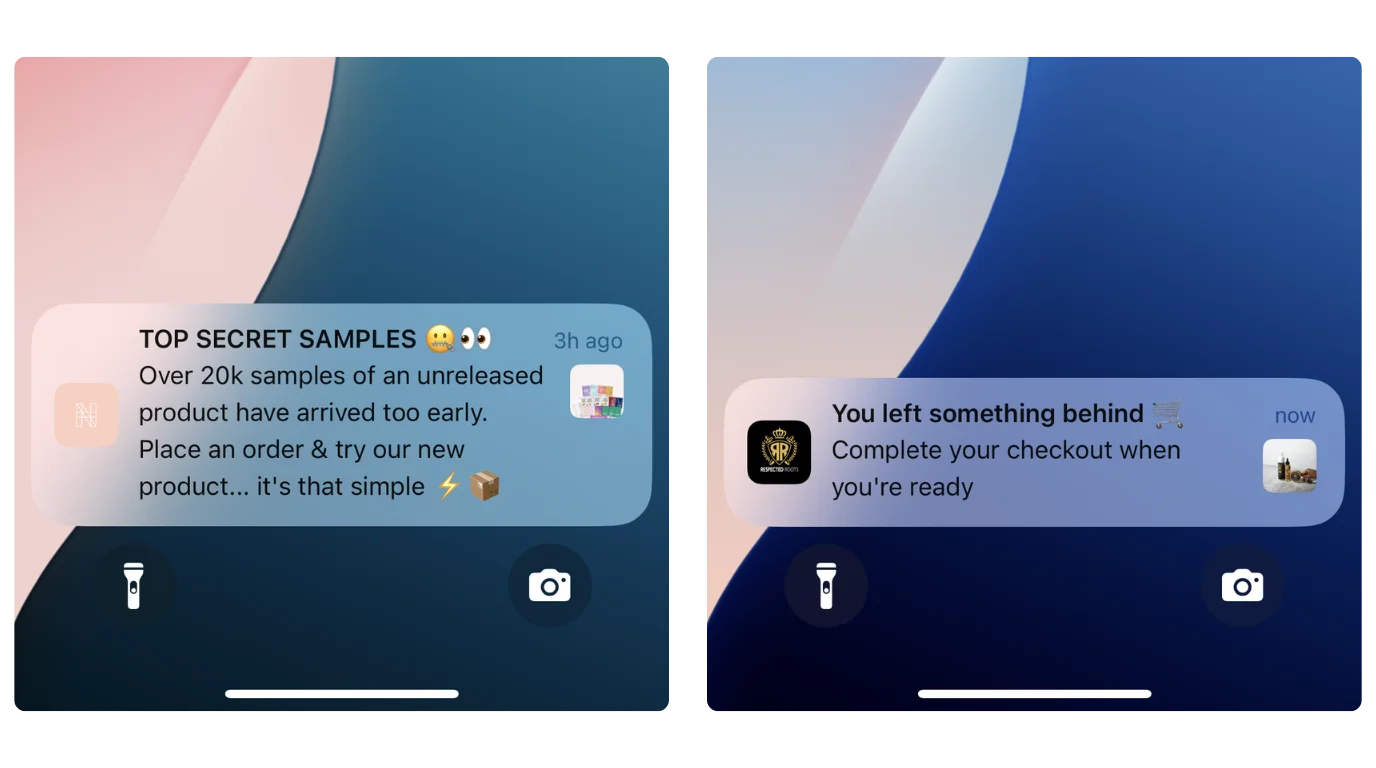
    • Abandoned cart recovery. Push lands on the lock screen within minutes. Some Vendrux brands see 10-22% conversion rates on abandoned cart push.

    This matters more now than ever. Meta CPMs are up 19% year-over-year and ecommerce CAC has climbed roughly 40% since 2023. Push is how fashion brands keep their customer economics intact while acquisition costs climb everywhere else.

    How to Model ROI for Your Own Fashion Brand

    Industry averages are a useful starting point. The real question is what an app would look like for your specific brand. Here’s the framework.

    The Inputs You Need

    Pull these from your analytics before you model anything:

    • Annual online revenue. Total across channels.
    • Mobile share of online revenue. For most fashion brands this is 50-80%.
    • Current mobile web conversion rate. Your baseline.
    • Current mobile AOV. Your baseline.
    • Repeat purchase rate. How many customers buy more than once in 12 months.

    If your repeat purchase rate is under 20%, the retention driver will do less of the heavy lifting for you. You’ll lean more on conversion and AOV lift instead.

    The Lift Assumptions (Conservative, Realistic, Aggressive)

    Three scenarios using the benchmark ranges. Pick the one that matches your brand.

    Driver Conservative Realistic Aggressive
    App adoption 5% of mobile users 10% of mobile users 15%+ of mobile users
    Conversion lift 2x mobile web 3x mobile web 5x+ mobile web
    AOV lift +10% +20% +30-50%
    Repeat rate lift 1.5x 3x 5-7x
    Share of online revenue 10% 20% 30%+

    A small boutique with low mobile share and infrequent repeat purchases sits in conservative. A mid-sized DTC brand with strong email and SMS and a loyalty program sits in realistic. A drop-driven brand with a cult following and sub-$1,000 AOV sits in aggressive.

    Want to see how much revenue you could get from an app? Use our free calculator to spin up an estimation in seconds.

    How Much of That Revenue Is Incremental?

    Here’s the elephant in the room. How much of that app revenue is genuinely new, versus revenue that would have happened on your website anyway?

    Some overlap always exists. A portion of your app purchases would have closed on mobile web if the app didn’t exist. Pretending otherwise is dishonest.

    But the useful question isn’t “where did this sale happen?” It’s “would this customer have spent this much, this often, at all?”

    A conservative assumption is that 50% of your app revenue is net new. The other half shifts from mobile web to the app. Use that as your floor when you model.

    In reality, the incremental share is usually higher. Four parts of the lift are genuinely new revenue:

    • Push-driven revenue is incremental by definition. Every dollar you generate from push is new, because the channel doesn’t exist without the app. Abandoned cart recovery alone generates anywhere from $20K to $200K per month for Vendrux brands.
    • AOV lift on purchases that would have happened anyway. A $100 order on mobile web becomes a $130 order in the app. The extra $30 is incremental.
    • Increased session frequency. App users visit more often. John Varvatos sees 12x more sessions per app user vs mobile web. These extra sessions aren’t cannibalized from the website; they’re new touchpoints that drive new purchases.
    • Compounded retention. App users stay customers longer and buy more over their lifetime. The long-tail LTV lift is net new.

    Realistically the incremental share usually lands somewhere in the 60-80% range. 

    If you want a deeper breakdown with the math worked out, see our article where we answer the question once and for all: is mobile app revenue incremental?

    For the rest of this article, we’ll use the 50% conservative floor. Whatever ROI comes out of that math is the low end of what you’d actually see.

    The Cost Side: What You Spend on Your Mobile App

    Revenue lift is only half of the ROI equation. What you spend matters just as much, because the ROI multiple you earn depends entirely on the denominator.

    The money you spend on developing an app can fall in a very wide range.

    If you’re building a custom native app, you’re looking at $100K-$250K+ upfront, on top of the sizable recurring costs for OS updates, integration updates, bug fixes, and adding new features.

    That cuts a long way into your ROI – and if your app doesn’t generate quite as much revenue as you hope (or takes longer to get there), you might not even make any profit after COGS and associated costs.

    There are better options, though – which make a positive ROI essentially a given.

    Vendrux: The High-ROI Mobile App Builder for Fashion Brands

    Vendrux turns your existing fashion website into full-featured native iOS and Android apps. Your catalog, checkout, product pages, loyalty, subscriptions, and personalization all carry over. You get push notifications, app store presence, and a home screen icon on top of the user experience you’ve already built and perfected over years.

    It’s faster and simpler than building a custom app – and significantly more cost-effective.

    Instead of a six-figure cost (and a 6-12 month timeline), you’re looking at a cost starting from $1,499 per month, and a time to launch of weeks, not months.

    The cost includes ongoing maintenance and updates (which can add up to another six figures in annual costs for custom app development), and means a ten to twenty times lower total investment – with the same revenue lift on the other end.

    Payback Period

    Alongside the total ROI, a more efficient approach like Vendrux’s offers another big advantage: significantly faster payback period.

    This is the first level of ROI: earning back the money you spent to build the app.

    It’s not the whole story, but it’s an important part – because until you hit payback, the project is considered a loss.

    With a custom app, you can expect six months, minimum, before you even get a working version of your app. You don’t start making any money back on your investment until at least this time.

    With Vendrux, you’re live in a month (for 10% of the cost). That makes the payback period just around a couple of months – and significantly reduces the risk, because you’re almost guaranteed to recoup your investment within a short time frame.

    Running a fashion brand doing $1M+ online?

    Your website, catalog, checkout, loyalty program, and retention flows are already working. An app doesn’t need to replace any of that.

    Vendrux turns your existing fashion website into full-featured native iOS and Android apps. Live in weeks, payback in one or two months, ROI that compounds instantly.

    Get a Free App Preview

    Does ROI Differ by Fashion Sub-Segment?

    Of course, fashion is not just fashion. It’s brands like H&M, it’s independent boutiques, it’s designer labels, it’s streetwear brands.

    We’ve worked with just about all of them – so we’ve got an idea of how the ROI differs across each sub-category.

    Here’s an idea of what you can expect for different types of fashion brands.

    Luxury Fashion

    High AOV ($300-$2,000+) magnifies the dollar value of every conversion lift. A 2x conversion on a $500 AOV is worth more than a 5x conversion on a $40 AOV. 

    Low-friction checkout, saved addresses, and VIP-style treatment (like we’ve seen at Tadashi Shoji, John Varvatos, Moda di Andrea) push per-user revenue multiples to 10x mobile web or higher. 

    Luxury customers expect white-glove treatment; your app is how you deliver it at scale.

    Mid-Market DTC Brands

    This is where loyalty, drops, and repeat purchases do the work.

    Most fashion brands are in this segment, and typically see app users generating 4.8-7x vs mobile web on revenue per user. 

    These brands win by making their app the native home of their loyalty program and their new-arrival calendar. Push notifications for drops and back-in-stock do disproportionate work.

    Fast Fashion and Mass Market

    This is where apps have the biggest impact. Realistically, the strategy for brands like Temu, Shein, and older players like H&M and ASOS is app-first.

    For these brands, it’s all about volume, and building regular browsing habits, which the likes of Shein and Temu in particular have nailed to perfection.

    Resale and Secondhand

    Peer-to-peer marketplaces like Vinted, Depop, and Poshmark run a different model. But if you’re a DTC fashion brand exploring a resale layer, your app is usually where that integration lives. 

    Resale has been the fastest-growing fashion app category in recent years, and having your own app lets you launch a resale experience without funneling customers to a third-party marketplace.

    When a Fashion Mobile App Doesn’t Deliver ROI

    Not every fashion brand should necessarily have an app. The equations we’ve looked at here assume certain conditions – and without these conditions, the ROI question looks different.

    You need to be above a certain revenue tier, and have the right customer base to justify an app.

    Here are some times when an app may not be worth it (yet):

    • You’re under $1M annual online revenue: Your app’s revenue potential at 20%+ of total revenue is a lot tighter. Typically better to focus on scaling further through acquisition first.
    • Mobile traffic under 50% of total: If your customers don’t predominantly shop on mobile, app adoption will likely be a lot less.
    • Your mobile experience is broken: The biggest mistake is launching a mobile app to fix a poor mobile website. That’s backwards – you’ll always get more traffic to your website, so fix this first (then extend it into an app with Vendrux).
    • One-and-done purchase brands: If your fashion brand has very low repeat purchase potential, the app might not make sense. You may be surprised, though (we’ve found high-AOV luxury brands typically get the highest ROI from an app).

    It generally comes down to having an accessible market large enough to justify the cost of your app, plus having a customer base who would actually want to use it.

    Don’t make the mistake of thinking that you need all your customers to download the app. You just need a small, engaged share of customers (5-15% of your total customer base) to justify launching an app.

    How to Maximize Your Fashion App ROI

    A mobile app can be a major revenue generator, and one of the best ROI plays a clothing brand can make.

    That said, it’s not a given. You need to be smart about how you build, manage, and promote it.

    • Make it visible: you don’t need to do a lot to promote it, but at the very least, make sure people know it exists. Your best customers want to use the app. Just tell them about it.
    • Use push notifications: they’re your #1 engagement tool, and not only drive revenue, but maintain app retention as well.
    • Keep your app up to date: a buggy or outdated app won’t hold on to users.
    • Build the right way: a Vendrux build comes with less than a tenth of the cost of a custom app, and even less of the ongoing complexity you get from managing a completely separate storefront. It completely changes the ROI equation.

    Vendrux builds, submits and manages your app for you. You get all the benefits of a mobile app, with minimal lift and expense.

    All this with a short payback period, a consistent user experience with your website, and a team behind you to support your growth.

    If you want to see what’s possible, get in touch and book a free preview of your app. We’ll show you an interactive preview of what it could look like, as well as walking you through the business case and the potential ROI that’s on the line.

  • The Complete Guide to Mobile App Development for BigCommerce

    You run a BigCommerce store and you want a native mobile app for your customers. Now you’re trying to figure out what that takes: what it costs, what you get, and how to do it without handing over the next year of your roadmap to a mobile development project.

    Your options are narrower than they are for mass-market ecommerce platforms like Shopify. BigCommerce has a smaller ecosystem of mobile app tools, and most of what exists was built for simple stores with standard catalogs. 

    If you’ve customized your Stencil theme, run B2B Edition, operate Multi-Storefront across brands or regions, or built a headless storefront on Catalyst, and you want to carry all this work over to your app, your options narrow further.

    This guide covers the realistic options you have to launch a BigCommerce mobile app, the limitations and roadblocks you can expect, and how Vendrux lets you launch an app without the custom development tax.

    Does BigCommerce Have a Mobile App Builder?

    No. BigCommerce is built for web storefronts and commerce backends; it doesn’t have a native iOS or Android built tool, or a first-party customer-facing mobile app product.

    Three different things get called “BigCommerce mobile apps,” and only one is what you’re  looking for:

    1. The BigCommerce admin mobile app. A free iOS and Android app for merchants to manage their store from a phone: view orders, update inventory, check sales. It’s on bigcommerce.com/product/mobile-app. Useful for you as an operator. It has nothing to do with your customers’ shopping experience.
    2. Installable apps on the BigCommerce developer platform. BigCommerce has extensive developer documentation for building installable apps that live in the BigCommerce App Marketplace: Single-Click Apps, Connector Apps, Scripts-Only Apps. These extend the control panel or connect third-party services to merchant stores. They’re not shopping apps either.
    3. A customer-facing native shopping app for your store. This is the one you want. BigCommerce doesn’t have a product that does this.

    BigCommerce is a powerful ecommerce engine. You’ve got Stencil themes, the GraphQL Storefront API, the Checkout SDK, Catalyst for headless, and 1,200+ apps in the marketplace.

    What it doesn’t give you is a path from your storefront to a native app.

    Why BigCommerce Stores Need a Mobile App

    Most brands, today, should have their own mobile app. For a raft of reasons.

    • Most of your traffic is already on mobile. A mobile app meets your customers where they are, with a more seamless user experience.
    • Apps drive stronger engagement metrics across the board:10-50% higher AOV, higher conversion rates, longer session times.
    • An app keeps you closer to your customers, driving stronger retention through an always-on home screen presence, as well as push notifications (which reach your customers instantly, for free).
    • Having an app is a crucial brand authority signal – particularly important for global, enterprise brands, like those that often use BigCommerce.

    An app can easily make up 20-35% of your overall revenue (these numbers are common from brands we work with). That’s a channel that’s worth having, period.

    The case for an app is clear. Getting there is usually the hardest part.

    The Roadblocks to Launching a Mobile App for BigCommerce Stores

    You want a mobile app, sure.

    But most BigCommerce merchants who set out to build an app end up hitting the same roadblocks.

    Let’s break them down now.

    Custom Native Development Costs $150K+ (and Never Stops)

    The traditional way to build an app is to hire a dev team or agency to build native apps from scratch, connecting them to BigCommerce through the GraphQL Storefront API, Checkout SDK, and Webhooks.

    The math for this is pretty brutal. Here’s what you’re looking at:

    • Initial build: $150,000 to $500,000+. This depends on catalog complexity, whether you run Multi-Storefront, whether you use B2B Edition, and how deep your ERP integration goes. Enterprise builds at the top of this range are common.
    • Annual maintenance: $50,000 to $100,000+. iOS and Android release new OS versions every year. The App Store Review Guidelines and Google Play policies update constantly. You need engineers on retainer to keep the app compliant, secure, and running on current devices.
    • Integration rebuild cost. Every BigCommerce app or integration your store depends on (Klaviyo, Yotpo, Searchspring, Avalara, ShipperHQ, Gorgias, LoyaltyLion, ERP connectors) has to be rebuilt in native code, often without a ready-made SDK. Each one is its own line item.

    That’s just a difficult cost to justify, especially costs rising and margins shrinking globally, as they are now.

    The Operational Complexity of Managing Two Platforms

    Launching a custom app also creates major operational overhead.

    You now have two codebases (three, if you have different builds for iOS/Android). Your website is maintained by one team on one release cycle. Your app is maintained by another team on a separate release cycle governed by App Store and Google Play approvals. 

    Every new product, pricing rule change, theme update, checkout tweak, promotional campaign, and integration swap on the website has to be replicated in native code on the app side.

    What often happens is you stop maintaining the app, it falls out of step with your website, and eventually becomes a relic no one uses anymore. 

    No-Code App Builders Weren’t Built for Serious BigCommerce Stores

    There are few no-code tools that are built for the complexity of BigCommerce setups.

    Sure, there are several tools out there that integrate with BigCommerce (you’ll find a couple in the BigCommerce app marketplace).

    They work if your store is relatively simple. But they’ll struggle to replicate complex web features in your mobile app.

    Customized Stencil themes, headless storefronts on Catalyst, Next.js, or Makeswift, B2B features, multi-storefront sites, deep integration stacks.

    All these things power your website – but they’re unlikely to work with your app.

    No-code BigCommerce mobile app builders are decent for what they’re built for. But for custom BigCommerce stores, these tools aren’t really an option.

    A Progressive Web App Isn’t a Real Mobile App

    Another alternative often mooted is settling for a Progressive Web App (PWA).

    If you’re running a headless Catalyst storefront, you’re likely already shipping a PWA by default. Catalyst targets Google Lighthouse scores of 100 out of the box and includes service workers for offline caching and add-to-home-screen capability.

    This is useful for mobile web performance. It is not a substitute for a native app.

    You don’t get the easy installation, full native push notifications, and brand authority that you get with a real mobile app.

    What Your BigCommerce Mobile App Needs to Do

    What do you really need from your mobile app?

    The one thing that’s often overlooked – yet is really all you actually need from your app – is feature parity with your website.

    Too many apps (especially cheaper builds) cut corners, sacrifice features from your website, and end up offering a watered-down version of your website.

    This is a major problem: because if your app is not as good as your website, what reason is there for someone to use it?

    “The app needs to be at least as functional as the website. It doesn’t need to be better than the website, but the user experience can’t be worse.”
    — David Cost, VP of Ecommerce at Rainbow Shops

    Your BigCommerce website probably has some combination of the following features:

    • Full catalog and pricing fidelity. Products, variants, custom fields, Customer Groups, Price Lists, B2B tiered pricing, custom facets, and active promotions, all rendered correctly.
    • Your checkout, exactly as it works on web. Optimized One-Page Checkout or a Checkout SDK custom flow. Avalara for tax, ShipperHQ for shipping rules. Apple Pay, Google Pay, and every supported gateway firing cleanly inside the app.
    • Every BigCommerce app and integration your store depends on. Klaviyo flows, Yotpo reviews, Searchspring or Klevu search, Gorgias support widgets, Smile.io or LoyaltyLion rewards, ERP connectors through Celigo. All working inside the app the same way they work on web.
    • Multi-Storefront and B2B Edition. Multiple storefronts from one BigCommerce account. Buyer Portal, Quick Order, quote management, company accounts, purchase orders, CPQ.
    • Headless and Catalyst compatibility. Works with a Catalyst frontend, a Makeswift-edited Next.js storefront, or any framework-agnostic build against the GraphQL Storefront API.

    When you launch a mobile app, you want it to carry over all of the features you rely on from your website, with some core native functionality layered on top.

    The Blueprint: How to Build a Native App for Your BigCommerce Store With Vendrux

    There’s one way to get everything you need from a BigCommerce mobile app, without the overhead and complexity of a custom native app.

    Vendrux takes your live BigCommerce storefront and turns it into native iOS and Android apps. 

    Some of the apps we’ve built for global ecommerce brands

    Your website powers the app. It carries over your Stencil theme, your headless Catalyst frontend, your customizations, your integrations, your checkout, your B2B and Multi-Storefront setup. Everything that already works on your website works inside the app, with real native capabilities on top.

    There’s no second codebase, no parity drift, and no feature lag.

    How It Works

    Vendrux builds iOS and Android apps that render your BigCommerce storefront natively. The storefront is the app. Every page, product, category, promotion, and integration that exists on your website works in the app, out of the box. The app delivers your actual storefront, not a parallel reconstruction of it.

    Vendrux adds a native layer on top of your store: push notifications, native navigation, deep linking, splash screens, and everything the App Store and Google Play require.

    It’s the most direct way to turn your BigCommerce site into a mobile app.

    What Carries Over

    Everything you’ve invested in for your website works in your mobile app, including:

    • Your Stencil theme or headless Catalyst/Next.js/Makeswift frontend, rendering natively.
    • Your full product catalog, including custom fields, variants, Customer Groups, and Price Lists.
    • Optimized One-Page Checkout, or your custom Checkout SDK flow, complete with Avalara tax, ShipperHQ shipping, Apple Pay, and Google Pay.
    • Every BigCommerce app and integration your store runs on. Klaviyo. Yotpo. Searchspring. Klevu. Gorgias. Smile.io. LoyaltyLion. Avalara. ShipperHQ. ERP connectors through Celigo.
    • Multi-Storefront configuration across brands, languages, or regions.
    • B2B Edition, including Buyer Portal, Quick Order, quote workflows, and company accounts.
    • Promotions, banners, A/B tests, personalization logic, and every piece of merchandising you’ve built.

    Whatever your website shows, the app shows. When you update your website, the app updates. There’s no resubmission, no parallel development.

    The Native Layer Added on Top

    The app isn’t just a website in a box. It looks, feels, functions like any other native app (and is fully compliant with the app stores’ requirements). 

    You get:

    • Push notifications – including a native abandoned cart flow, plus integrations with Klaviyo and OneSignal that allow you to set up powerful automations and segmentation.
    • Native tab bar and navigation patterns customers expect from apps like Amazon or Sephora.
    • Deep linking from email, SMS, and paid campaigns straight into product pages and categories.
    • Native splash screens and loading states.
    • Full App Store and Google Play presence with listings, creative, screenshots, and store optimization.

    Your app does everything a high-end ecommerce mobile app needs to do.

    The Project, Step by Step

    Launching a mobile app for your BigCommerce store with Vendrux is easy.

    The whole project is managed for you by the Vendrux team – configuration, build, testing, and app store submission. You can test and provide your input throughout the process, but otherwise, there’s very little required from you.

    The process takes around four weeks, and there’s essentially only three steps involved:

    1. Setup: we’ll walk through your goals, the process, and any specific requirements for your app.
    2. Build: we do all the technical work, taking all the hard parts off your plate.
    3. Launch: we handle the app store submission process, and help you set up launch materials to start getting downloads.

    After you go live, the Vendrux team stays around to handle routine updates, technical maintenance, and work with you to grow your app and make sure it’s a success.

    You’re looking at a cost in the low-four figures to go live, with a predictable monthly cost that’s a fraction of what you’d usually pay to keep developers on staff or an agency on retainer.

    Skip the $150K custom dev trap.

    Your BigCommerce storefront is already doing the work. You don’t need a second codebase, a second engineering team, and a maintenance budget that never stops growing.

    Vendrux turns your existing BigCommerce store into native iOS and Android apps, keeping your Stencil theme, checkout flow, and every integration you rely on. No parallel build. No parity drift.

    Get a Free App Preview

    Launch Your BigCommerce Mobile App Without the Custom Dev Tax

    BigCommerce is a powerful commerce engine. You’ve got a deep API, Catalyst for headless, B2B Edition, Multi-Storefront, and an integration stack that can carry a nine-figure business. 

    You’re just missing one thing: a native app.

    Vendrux is the easiest, most cost-effective, and all-round best way to create a mobile app for a BigCommerce store.

    You get all the power of BigCommerce, all your endless optimizations and iterations, carried over to a native app that lives on your customer’s phone.

    Get in touch and get a free preview of your BigCommerce app to see what’s possible.

    We’ll answer your questions, walk you through the process, and break down the business case for your brand.

  • Video Commerce: The Winning Engagement Strategy For Ecommerce Brands in 2026

    Video Commerce: The Winning Engagement Strategy For Ecommerce Brands in 2026

    Static product pages are losing attention. Shoppers who spend hours watching TikTok and YouTube Shorts do not change modes when they land on a store. They want to see the product move, hear someone talk about it, and watch a real person use it before they commit. The text-and-carousel product detail page, which has defined ecommerce for fifteen years, no longer matches how buyers actually evaluate products.

    Video commerce is how mid-market and enterprise ecommerce brands are closing that gap. It is not a tactic or a content experiment. It is becoming the default engagement layer for modern ecommerce, the surface where discovery, consideration, and conversion increasingly happen on the same screen.

    This article covers what video commerce is, why it is winning right now, the four formats driving real results, how it changes engagement economics, where to deploy it across the customer journey, and how to extend every piece of your video program into a native mobile app. It closes with a practical rollout plan for mid-market teams.

    What Video Commerce Is (And What It Isn’t)

    Video commerce is the practice of using video as the primary conversion surface of a shopping experience, rather than as a supporting asset. 

    The product is not described next to a video. It’s tagged inside the video, clickable, and purchasable without leaving the frame.

    The distinction matters. Uploading a product demo to YouTube is not video commerce. Running a video ad on Meta is not video commerce either. Both use video, but neither turns the video itself into a transactional surface.

    Video commerce covers four umbrella formats, each broken down below:

    • Shoppable video: pre-recorded video with tagged, clickable products
    • Live shopping: real-time hosted events with in-stream chat and checkout
    • User-generated video: customer and creator-filmed content embedded in the shopping journey
    • Interactive product video: video that adapts to the viewer with branching, variant selection, or personalization

    The common thread: the video sits inside the purchase journey. That is what separates video commerce from video marketing. 

    Marketing drives traffic to a store. Commerce happens inside the video.

    Why Video Commerce Is Winning Right Now

    Three forces are converging right now.

    The first is consumer behavior. Short-form video has trained buyers to evaluate products visually first. The TikTok generation is not a demographic, it’s a shopping behavior now common across every age group with disposable income. 

    When shoppers land on a text-heavy PDP after watching a 15-second product demo on social, the format mismatch is obvious. They bounce.

    The second is engagement data. Brands that have deployed video on PDPs consistently report longer dwell times and higher interaction rates on video-enabled pages.

    Shopify, Adobe Commerce, and BigCommerce have all moved native video shopping features into their core platforms in recent releases, which is the clearest signal that the behavior is no longer experimental. For the broader context, statistics show that attention is concentrating on mobile, which aligns perfectly with video as a medium.

    The third is the authenticity problem. As generative AI floods the web with synthetic text and images, buyers are increasingly skeptical of static content. 

    A real person on camera talking about a real product solves this in a way copy cannot. User-generated video and live shopping signal authenticity that AI content struggles to replicate.

    Then there’s the platform evidence. TikTok Shop, Amazon Live, and YouTube Shopping have all scaled from novelties into core retail surfaces. When the largest retail platforms in the world invest this heavily in video commerce, mid-market brands need to match the experience buyers have been trained to expect on their own stores.

    The Four Video Commerce Formats Driving Real Results

    Video commerce comes in several different forms. Each format solves a different part of the engagement problem. Most brands start with one and layer in others as the program matures.

    Shoppable Video on Product and Category Pages

    Shoppable video is the workhorse. Pre-recorded videos with tagged products sit directly on PDPs, category pages, or homepage feeds. When a shopper sees a product they want, they tap the tag and either add it to cart or view the full product page without leaving the video.

    Fashion, beauty, and home goods brands have adopted this format most aggressively. A single product page might feature a hero video, a how-to creator video, and a customer styling video, each tagged and clickable.

    The production economics are the main advantage. Shoppable video can be repurposed from social content you already own. You are not filming from scratch, you are tagging what you already have.

    Live Shopping Events

    Live shopping is the highest-engagement format in video commerce. A host goes live, demos products in real time, answers chat questions, and runs time-bound offers. Viewers buy directly in-stream.

    Live builds urgency through scarcity, community through chat, and trust through unscripted presence. The combination produces AOV spikes and conversion rates several multiples higher than static PDPs during the event window.

    The best-performing live programs are episodic. Customers know when to tune in, which turns a one-time event into a recurring engagement habit.

    User-Generated Video and Creator Content

    UGC video converts because it sidesteps the credibility problem of brand-produced content. A customer filming themselves using a product is the closest thing to a live referral: unscripted, unpolished, visibly authentic.

    Sourcing is what separates programs that work from programs that don’t. The three common models for UGC sourcing are:

    • Affiliate-driven: creators post shoppable video to social, earn commission on referrals
    • Review-incentivized: customers upload video reviews in exchange for credit or samples
    • Partner-creator programs: long-term relationships with a curated roster of creators

    Brands that treat UGC as a pipeline, not a one-off campaign, build a library that feeds shoppable video surfaces indefinitely.

    Interactive and Personalized Product Video

    Interactive video is the emerging category. Viewers interact with the video itself, switching product variants, changing colors, selecting sizes, or branching into specific feature demos.

    This format is most valuable for consideration-heavy categories: furniture, electronics, high-AOV apparel, where shoppers need to explore multiple configurations before buying. The production cost is higher than shoppable video, but interactive video pages routinely show stronger time on page of traditional PDPs in the same category.

    The tradeoff is practical. The more interactive and personalized the video, the more resource-intensive it is to create.

    Interactive video is not where most brands should start. It rewards teams with mature video programs that have already proven ROI on simpler formats.

    How Video Commerce Changes the Engagement Economics for Ecom Brands

    The case for video commerce is not primarily a conversion-rate argument. It’s an engagement-economics argument.

    A video-heavy strategy drives an uplift in certain metrics, which compound over time.

    Time on page

    Video-enabled PDPs hold attention meaningfully longer than static ones. The longer a shopper engages with a product, the more confidence they build, and confidence is what closes high-consideration purchases.

    AOV lift

    Tagged products in video naturally cross-sell. A creator styling a dress with a jacket and a bag sells the outfit, not the dress. Live shopping events drive even larger average order value spikes because hosts can bundle on the fly.

    Repeat engagement

    Episodic live content and a continuously updated video library give customers reasons to come back that static catalogs cannot match. Occasional buyers become regular viewers, and viewers become high-LTV customers.

    Recognition and habit

    Video-first brands build recognition faster. Customers remember the host, the set, the tone. That familiarity compounds into loyalty in ways text and still images rarely produce.

    The CFO-facing framing is this: video commerce is an LTV play, not a conversion play. 

    Conversion improvements are real but marginal. The meaningful wins come from repeat purchase rate, AOV, and the kind of brand affinity that makes customers choose you when they have options.

    Where to Deploy Video Commerce Across Your Whole Customer Journey

    The common mistake, when adopting video commerce, is treating it as a PDP feature. 

    You have your product image carousel, throw a video in there, and call it “video commerce”.

    It’s really a customer journey strategy, and the highest-performing programs deploy video at every stage.

    Discovery

    Shoppable social video on TikTok, Instagram, and YouTube Shorts. The goal is to convert casual viewers into owned-audience shoppers. Link-in-bio and shop tabs are the bridge, but the best programs pull that traffic back to owned surfaces where the next video can touch them.

    Consideration

    Video-enabled PDPs, category landing pages, and collection hubs. A buyer researching an expensive purchase wants multiple angles, use cases, and reviewer perspectives, all of which video delivers faster than text.

    Decision

    Live shopping events, product launch livestreams, interactive demos, and comparison videos. Decision-stage buyers need their final objections answered, and live formats answer objections faster than any FAQ page.

    Post-purchase

    Onboarding videos, how-to content, and unboxing-style tutorials reduce returns and build the foundation for repeat purchases. Post-purchase is the most under-invested video surface for most brands, and the one with the highest ROI on time spent, because it directly protects margin.

    Mobile app

    Apps are the highest repeat engagement surface for video commerce, and the one most brands leave on the table. 

    Native video feeds, push-notified live events, and app-only creator content drive repeat visits in ways mobile web cannot match.

    Extend Your Video Commerce Program Into a Native App with Vendrux

    A lot of ecommerce brands now are making the smart play to invest heavily in video commerce on their website: shoppable PDPs, live shopping events, creator content, UGC libraries. 

    The problem is that, when you go to launch a mobile app, integrating unique, video-heavy user experiences makes the job a whole lot more complex.

    Vendrux solves that problem. Vendrux turns your existing website into a full-featured native mobile app for iOS and Android, and ensures every video commerce feature that works on your store runs natively inside the app. 

    Shoppable video, live shopping, UGC feeds, interactive product video: everything carries over.

    The DIY App Builder Problem

    The most common approach for modern ecommerce brands launching a mobile app is to use a DIY mobile app builder (like those in the Shopify App Store).

    The problem (especially for sites with custom features and bespoke PDPs) is that these tools build a new storefront, inside of their own templates.

    That means features like shoppable videos and UGC feeds often don’t carry over. The tool may have an integration built for popular video commerce tools, but the integration likely won’t enable everything you can do on your site.

    This limits the potential of your app, and often results in a user experience that lags behind your website.

    The Vendrux Solution

    Instead of making you rebuild your website inside templates, Vendrux directly converts everything from your website to a native app.

    The app is powered by your website, and everything that works on your website works in the app.

    You manage the UX of both channels from one place (your website). One codebase, one content pipeline. Update a video on your site, and it appears in the app. There’s no duplicated workflows, separate management backlog, or missing features.

    MASC’s Video Commerce Strategy

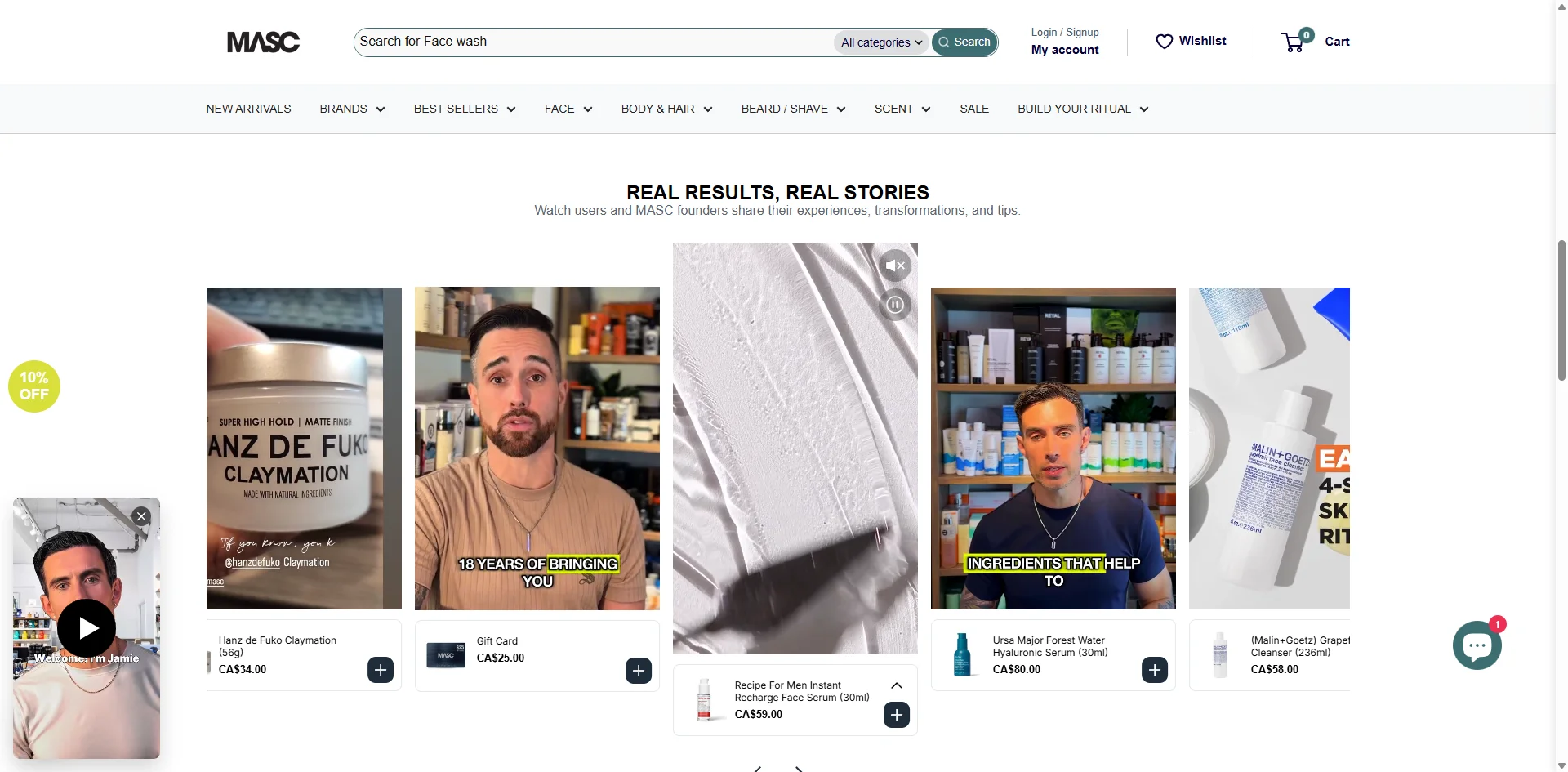
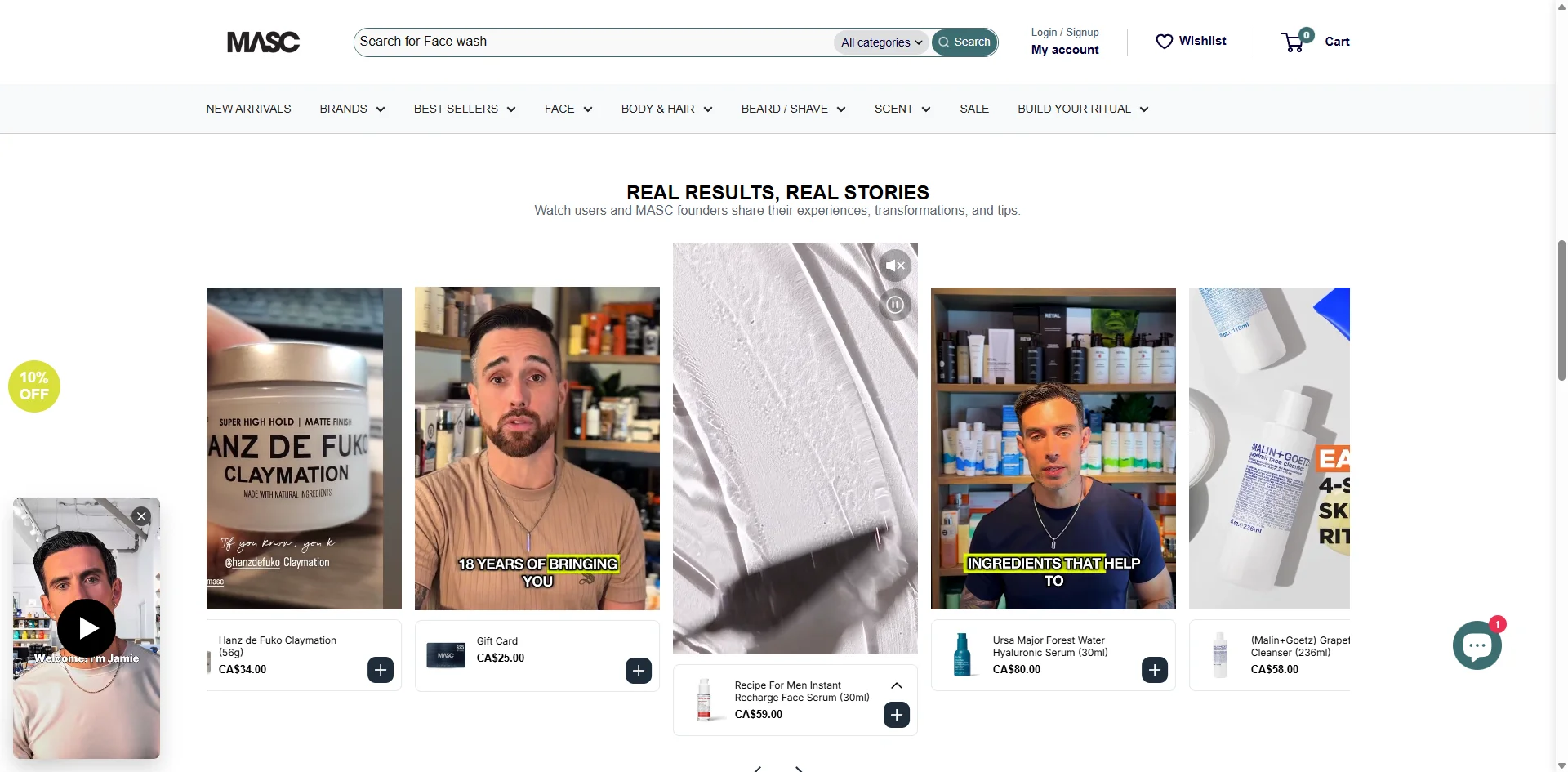
    Men’s skincare brand MASC runs on video. Their website is far from standard, with shoppable reel-style videos that makes it feel more like Instagram or TikTok than a static ecommerce site.

    The brand originally had an app built with a DIY app builder, which didn’t carry over all of their video commerce features.

    As a result, it lagged behind their website, and didn’t offer the user experience their customers expected.

    They switched to Vendrux, and were finally able to deliver their full UX in the convenient, high-touch surface of a mobile app.

    “Vendrux allowing us to use all the features that we already pay for with other companies is important.”
    — Patrick Levesque, Co-Founder, MASC

    Read more about MASC’s mobile app journey.

    Why an App Compounds Every Engagement Win

    Video commerce is an engagement economics play, and mobile apps dominate the metrics that matter most. 

    App users open more often, spend longer per session, and respond to push notifications at rates email cannot approach. That means every engagement boost from your video program is amplified inside a native app: 

    • Longer dwell times become repeat sessions
    • AOV lifts become higher reorder frequency
    • Live shopping events become recurring tune-in behavior.

    Just see the platforms that dominate video commerce: TikTok, Instagram, as well as new players like Whatnot. They’re all mobile-first.

    If you want to get the most out of your video commerce strategy, you need to replicate that, on your own channels.

    Launch your own TikTok Shop or Instagram-style app.

    Vendrux extends your existing website into a native iOS and Android app, so every video commerce feature on your site runs inside the app too. One codebase, one content pipeline, and no feature gaps between your website and app.

    Get a Free App Preview

    Getting Started: A Practical Video Commerce Rollout for Mid-Market Brands

    Four steps separate brands that see results from brands that stall after a pilot.

    1. Audit where video already lives in your stack. Most mid-market brands are more fragmented than they realize: social video, email video, PDP video, and customer service video, all managed by different teams with no shared asset library. The audit is the unglamorous first step that unlocks everything else.
    2. Pick one format and one surface for the pilot. Resist the instinct to launch everything at once. The two highest-ROI starting points are shoppable video on PDPs (if you have a creator pipeline) or live shopping events (if you have a team that can host well).
    3. Build the sourcing pipeline before investing in tooling. Video commerce tools are commoditized. The differentiator is content supply. Brands that stall are usually the ones that bought platforms before they figured out how they would continuously source video.
    4. Instrument the right metrics. For the first 90 days, track watch time, interaction rate, and repeat visit rate, not just conversion. Engagement metrics tell you whether the program is working months before the revenue shows up.

    Final Thoughts

    Video commerce is not a passing trend, or a hack. It’s a structural shift in how ecommerce brands will compete for attention over the next five years.

    Treat video as the engagement layer of your store, not just a gimmick or a marketing afterthought. Extend that engagement into every surface your customers use, including a native mobile app.

    There’s little doubt, by now, that video works. The only question left is how long you wait until you make this a core part of your marketing strategy.

  • Shopify Mobile App Development: How to Build a Mobile App for Your Shopify Brand

    Shopify Mobile App Development: How to Build a Mobile App for Your Shopify Brand

    Mobile apps should be on the radar for any serious Shopify brand. The business case writes itself: app users come back more often, spend more per order, and cost less to reach than customers stuck on mobile web. 

    The question isn’t whether to build one. It’s how.

    This guide walks through Shopify mobile app development for brand operators: why an app earns its keep, what it actually needs to do, what it takes to build, and which path fits which kind of brand. 

    The short version: you don’t need to reinvent the wheel. Most Shopify brands can simply convert their existing store into an app with Vendrux, the industry leader in website to app conversion.

    There’s a case for other approaches too, and also a lot more to know about mobile app development for Shopify. Keep reading and we’ll explain all you need to know.

    Why Your Shopify Brand Needs a Mobile App

    Once a Shopify store gets past the initial growth phase, acquisition costs climb and the math quietly shifts toward retention. 

    New customers get more expensive every year. When that happens, the customers you already have become your profit center. And an app is the direct line to those customers.

    Here are some concrete reasons to build a mobile app:

    The retention power of a home screen icon

    Your app icon lives on the customer’s home screen, as a daily reminder of your brand, putting you in the same headspace as Amazon, Instagram, and TikTok. Customers open it without being prompted and come back between campaigns, so return visits stop depending on email opens and retargeting spend.

    App shoppers spend more per visit and per year

    App users consistently post higher AOV and higher annual spend than mobile web shoppers. Some of that is self-selection (your most engaged customers install); the rest is experience, with faster checkout, saved account details, one-tap payment, and navigation built for the phone instead of adapted to it.

    Push notifications reach customers directly at zero cost per send

    Messages land on the device in real time with open rates averaging near 90% (Bloomreach). Email opens have settled around 25% and keep trending down; SMS costs per message and burns out fast. Push is the only retention channel that combines high reach, direct-to-device delivery, and no marginal cost.

    Behavioral pushes recover revenue the mobile web can’t

    Abandoned cart, back-in-stock, and price-drop notifications reach customers the moment it matters and convert at rates email can’t touch. Once your install base is meaningful, these are often the single biggest source of app-attributed revenue.

    None of this replaces your website. An app extends your brand’s presence beyond your website, into a channel where your best customers already live. 

    For a full breakdown of the business case, see our guide to why your Shopify store needs a mobile app.

    Rebuild or Convert? The Core Choice in Shopify Mobile App Development

    Every path to a Shopify mobile app falls into one of two camps: rebuild or convert.

    Before asking yourself “what’s the best way to build an app”, or “what’s the best Shopify mobile app builder”, you first need to settle on whether you want to rebuild your website, or convert what you already have.

    Rebuild

    Rebuild means you recreate your store inside a native app. 

    Custom development agencies do this with fresh code. Most Shopify mobile app builders do it with drag-and-drop templates. Either way, the app becomes a second storefront. 

    You sync your Shopify catalog through APIs, but product pages, collection pages, navigation, and account screens all get rebuilt in native code or the builder’s template system. 

    Every integration you rely on (loyalty, reviews, subscriptions, search merchandising) has to be rebuilt or re-integrated through whatever SDK or API the app environment supports. And going forward, the app has to be managed separately from your website (as it’s essentially a separate surface).

    “We went with one company because they promoted how heavily they were involved in Shopify and how simple it would be. In some regards, it’s simple, but there were still issues because we essentially had to maintain two different storefronts.”
    — Eric Lowe, Director of Ecommerce, XCVI

    Convert

    Convert means you take your existing Shopify site and extend it into a native app. 

    Your site’s storefront powers the shopping experience, and native elements handle the parts the web can’t do well: push notifications, deep links, app store distribution, and a home-screen icon. 

    The result is a native app where native matters and your existing website where it already works.

    Arguably the most valuable real estate in ecommerce: the home screen.

    Why the Framing Matters

    The choice between rebuild and convert determines everything downstream:

    • Cost. Rebuild means paying to build a second version of your store. Convert means paying for the native layer only.
    • Time. Rebuild is months of development and QA before launch. Convert is weeks.
    • Sync. Rebuild apps drift from the website over time: every feature added to the site has to be ported to the app. Convert apps inherit every site change automatically.
    • Maintenance. Rebuild apps carry a permanent dev overhead. Convert apps carry the same maintenance as the website, plus a thin native layer.
    • Feature parity. Rebuild apps start with a subset of your site’s features and work toward parity. Convert apps start at parity on day one.

    “It’s great to have an app, but realistically, you can’t really be managing your website and your app separately.”
    — Patrick Levesque, Co-founder, MASC

    Both camps produce real, functional native apps. The difference is how much work and cost sit behind them, and how closely the app tracks the website as time goes on.

    What Your Shopify Mobile App Needs (and What It Doesn’t)

    Most brands exploring mobile apps for the first time underestimate one thing: your Shopify store already does almost everything your app needs to do.

    • Your mobile site already has the catalog, product pages, search, cart, and checkout. 
    • It processes payments through Shop Pay, Apple Pay, and Google Pay. 
    • It runs your loyalty program, reviews, subscriptions, personalization, and merchandising rules. 
    • It integrates with Klaviyo, Attentive, Recharge, Yotpo, Okendo, LoyaltyLion, and whatever else lives in your stack. 

    That took years to assemble and tune. Everything likely works well on mobile, and there’s nothing fundamentally different about how someone buys on your app vs on your website.

    What an app adds on top is a native layer:

    • A home screen icon so customers can reach you without typing a URL or searching an inbox
    • Push notifications, both broadcast (sales, new drops) and behavioral (abandoned cart, back in stock, price drop)
    • Native navigation chrome: tab bars, native transitions, gesture handling that feels like an app rather than a browser tab
    • Deep linking and attribution so marketing links open the right product inside the app
    • App store presence on iOS and Google Play

    That’s the layer worth paying for. Everything else, the part that makes your store your store, already exists on your site.

    “Our apps never had any functionality or usability beyond the web experience. The reason to have an app is not to have something that isn’t on the website, but for people who prefer that way to access Rainbow content.”
    — David Cost, VP of Ecommerce, Rainbow Shops

    There are cases for unique, app-specific features, and a user experience significantly different from your website. But for most ecommerce brands, this is an unnecessary (and expensive) flourish.

    What It Takes to Build a Shopify Mobile App

    Here’s an idea of what you’re looking at investing to build a mobile app: in terms of cost, time and more.

    Cost

    • Custom native development typically runs $150,000 to $500,000+ for a launched v1, depending on scope, plus $50,000 to $150,000 per year in ongoing maintenance. You’re paying for two apps (iOS and Android), a backend, design, QA, and project management.
    • DIY app builders can vary greatly in cost, from as low as $50 per month, to $1500+, depending on what kind of features and integrations you need. They may come with revenue share on top (commonly 0.5% to 2% of app-generated revenue).
    • Vendrux’s done-for-you service runs on a subscription model with a one-time setup fee (which covers design, configuration, integrations, and app store submission). The monthly cost starts at $1,499 per month (with no revenue share). The cost is a little higher than a DIY app builder – but with less effort attached (since it’s a full-service model).

    Get a full breakdown of these numbers in this article: How much does it cost to turn a Shopify store into an app.

    Time

    • Custom development: expect six to twelve months to launch v1, often longer once integrations and QA stretch.
    • DIY builders: it can take a few weeks to configure at the template level, longer as you hit the edges of what the builder supports.
    • Vendrux: six to eight weeks from kickoff to app store launch (with everything handled by the Vendrux team).

    Team effort

    Here’s the important part that often gets missed.

    With custom development, you need a product manager, designers, iOS and Android engineers, a backend team to integrate with Shopify, and QA. 

    Most Shopify brands don’t have that team in-house and hire an agency, which adds overhead and translation cost on every decision.

    DIY builders need a dedicated in-house operator to configure, maintain, and optimize the app. You’re running the tool yourself.

    Vendrux, as a managed service, needs very little team effort on your side. The team handles the build, testing and app store submission for you, so the human capital is close to zero.

    Ongoing maintenance

    First-time builders also tend to underestimate this part: an app isn’t a one-time project. 

    iOS and Android ship major platform updates every year, Shopify updates its APIs, new versions of the apps in your stack roll out, and app store policies shift. 

    Every update is work. With a rebuild-based app, that work sits on your team or your agency bill. With a convert-based app, most of it is inherited from the website updates you’d already be making, and the platform handles native-layer changes.

    The Best Way to Build a Shopify Mobile App (for Most Brands)

    For most Shopify brands, the best approach is to convert your existing site into a mobile app rather than rebuild it. 

    The logic is simple: if the app should do most of what your website already does, and for the vast majority of Shopify brands it should, rebuilding that same work in a second environment is duplicated effort you pay for in cost, time, and ongoing divergence.

    In that category, Vendrux is best way to build your app.

    Vendrux takes your existing Shopify storefront and converts it into native iOS and Android apps. The project is managed end to end by Vendrux’s team. 

    Your site is the single source of truth, so every change you make (to your theme, checkout, integrations, or merchandising) flows automatically into the app. Launch takes around 6-8 weeks, on a flat subscription, with no revenue share. Vendrux handles app store submission, QA, and ongoing platform maintenance throughout.

    Some of the Shopify-powered mobile apps built with Vendrux

    Here’s why this works perfectly for most Shopify brands:

    • No duplicated work. Everything built on the web is the app.
    • Every integration already works. Klaviyo, Yotpo, Recharge, LoyaltyLion, Searchanise, and whatever else you run on the site works in the app.
    • Launch in weeks, not quarters. The app is live in the stores before most custom builds finish their discovery phase.
    • No ongoing dev team required. Vendrux handles native-layer maintenance; you focus on running the store.
    • Predictable cost. Flat subscription, no revenue share eating your margin as the app scales.

    The economics are straightforward for higher-end Shopify brands. A store doing $10M a year where the app drives 10% of revenue generates $1M in app-attributed sales against a subscription that could cost under $20K a year. 

    At 20% of revenue (which is very realistic for brands that actively promote the app), the math stops being a question – you’re looking at $2M+ annually through the app, for a channel that costs a little over a thousand per month (with little to no operational overhead on top of that).

    This is why Vendrux tends to land with Shopify Plus and larger Shopify merchants: the upside compounds fast, and the subscription cost sits well below most line items on the marketing budget.

    When Vendrux Doesn’t Make Sense

    It would be nice to say that Vendrux is a no-brainer for every brand. It is for some – but not in every case.

    First, whether to launch an app in the first place. If your store is in a lower revenue bucket (doing less than roughly $500K/year in revenue), your customer base is likely not large enough to justify an app.

    We generally advise brands to focus on acquisition and getting their website fully optimized up until around $1M in revenue, then revisit an app.

    Second: if you want a fundamentally different user experience in the app, something your website doesn’t do and shouldn’t do, the convert approach isn’t the right fit. 

    You’re better off rebuilding; generally through a mobile app builder like Tapcart, Appmaker, Appbrew, etc.

    These tools are built to create differentiated app experiences, with more freedom of customization. So if you want to tinker and invest more time in creating something that exists separately from your site, these tools are the way to go.

    Ready to get serious about building an app?

    You’ve already built a Shopify store that works: catalog, checkout, Shop Pay, loyalty, subscriptions, reviews, and every integration in your stack. Rebuilding all of that in a second environment usually isn’t where the effort belongs.

    Vendrux converts your existing Shopify storefront into native iOS and Android apps, handles the full build and submissions, and keeps the app in sync with your site automatically. Launch in around 30 days, on a flat subscription.

    Book a Free Strategy Call

    Mobile Apps for Shopify vs Shopify Plus: Does It Matter?

    How about Shopify vs Shopify Plus – does the mobile app decision change depending on which version of Shopify you’re on?

    The core decision doesn’t change on Shopify Plus. But the argument for converting instead of rebuilding gets stronger.

    If you’re on Shopify Plus, you probably have a more custom setup. Some combination of:

    • Checkout extensions
    • Shopify Scripts
    • Flow automations
    • Custom Liquid logic
    • B2B permissions
    • Markets for international commerce
    • Custom pricing rules
    • Tiered loyalty
    • Multi-warehouse inventory

    That complexity is what Plus is for. It lets you run a store that matches how your business actually operates.

    On the rebuild path, implementing all of this in your mobile app gets tricky (or expensive).

    That’s a lot of complexity to rebuild. Many mobile app builders can’t handle it. And a custom development project is going to run up a significant bill (and not a one-time bill either).

    When you convert your Shopify store into an app with Vendrux, your app inherits every bit of complexity from your website.

    Because the app runs on your existing Shopify storefront, Shopify Scripts, Flow, custom Liquid, checkout extensions, B2B logic, and Markets already work. The app is as sophisticated as your site, automatically.

    That’s why the convert case gets stronger as your Shopify setup gets more complex, not weaker.

    For the Plus-specific breakdown, see our Shopify Plus mobile app development guide.

    Getting Started: Turn Your Shopify Store into a Mobile App

    Launching a mobile app is the right call for most successful Shopify brands.

    But the real question is: does your app need to do something fundamentally different from your website? 

    If the answer is no, and for the vast majority of Shopify and Shopify Plus brands the answer is no, converting beats rebuilding on cost, time, feature parity, and ongoing maintenance.

    “Shopify is already very mobile responsive and well structured, so using Vendrux to just mirror our Shopify site was for me the best option in terms of money and time.”
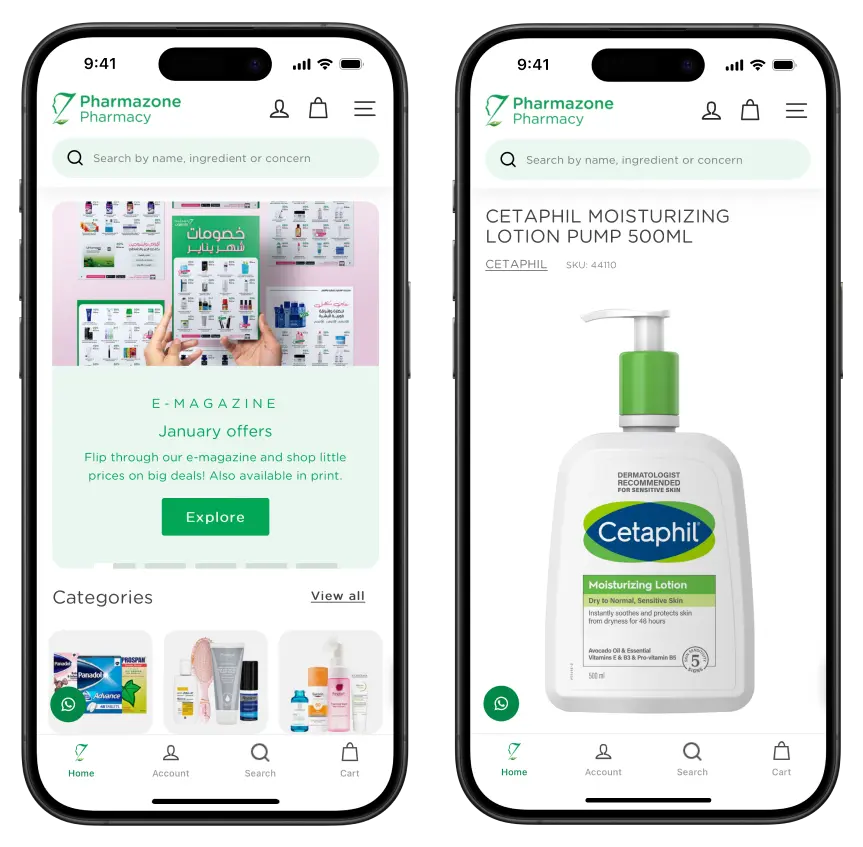
    Ahmed Yousef, Director of Ecommerce, Pharmazone

    Vendrux is built for that decision. It converts your existing Shopify store into native iOS and Android apps, handles the build and submissions end to end, and keeps the app in sync with your site automatically. You can launch in around 6 weeks, and gives you a dedicated channel for your best customers, customized completely to your brand.

    If you’re ready to explore launching your own branded mobile app, get in touch with us and get a free preview of your app. We’ll show you what’s possible, walk you through the process and the options, and help you understand the best way to create a mobile app for your Shopify store.

  • Mobile Apps & Agentforce Commerce: Extending Your AI Storefront to a Native App

    Mobile Apps & Agentforce Commerce: Extending Your AI Storefront to a Native App

    Salesforce’s rebrand of Commerce Cloud to Agentforce Commerce in late 2025 wasn’t just cosmetic. Every major release since has been agent-first, shipping new AI capabilities for merchants.

    These are exciting times for ecommerce, especially for SFCC merchants. Features like Personal Shopper, Merchant Agent, and Guided Shopping are transforming your web user experience. But in 2026, a great mobile website is not enough.

    You need retention, ownership and reliable engagement. You need a mobile app. 

    But integrating all the power of Agentforce into a new channel is not as easy as you’d hope it would be.

    This article is going to walk through the potential that Agentforce Commerce brings for your brand, how mobile apps amplify Agentforce’s key features, and how Vendrux turns your existing SFCC storefront into a native app that brings every Agentforce feature with it.

    What is Agentforce Commerce – And What Can It Do?

    Agentforce Commerce is Salesforce’s suite of AI agents built on top of Commerce Cloud and grounded in Data Cloud.

    These aren’t chatbots in the old sense. They reason across your catalog, inventory, customer profiles, and order history using the Atlas Reasoning Engine, then take action on behalf of the shopper or merchandiser.

    Here are four of the biggest capabilities for SFCC merchants:

    Personal Shopper

    Personal Shopper is the flagship shopper-facing agent, available since February 2025. It handles natural-language product discovery, refines recommendations based on learned preferences, answers product questions in-conversation, and can complete checkout inside the chat window. It’s grounded in your catalog, inventory, reviews, and each shopper’s Data Cloud profile.

    Pandora’s deployment gives a sense of what this looks like live. Their Personal Shopper, “Gemma,” handles jewelry discovery by occasion, recipient, and budget.

    Paired with a service agent handling post-purchase questions, Pandora has reported a 10% NPS lift and meaningful call deflection.

    Merchant Agent

    This feature is merchandiser-facing rather than shopper-facing. Merchant Agent writes product descriptions at scale, generates promotions, flags slow-moving SKUs, and responds to natural-language requests like “boost underperforming outerwear in the US for the next two weeks.” 

    The outputs flow to shoppers through the channels you already run: on-site banners, email, SMS, and push.

    Guided Shopping

    Guided Shopping is part of Agentforce for Retail. It covers product search, add-to-cart, reorder, and order tracking inside the same conversational interface, and is designed to collapse the multi-page browse journey into a single back-and-forth.

    Intent-Aware Search

    This is the successor to Einstein Search. Built on a commerce-tuned small language model (via Salesforce’s Cimulate acquisition), Intent-Aware Search interprets shopper intent conversationally rather than matching keywords. 

    A query like “something for a beach wedding in Italy” returns styled, refined results instead of a literal keyword match.

    These agents live as part of your storefront experience. They’re served through Commerce Cloud, grounded in Data Cloud, and rendered wherever your storefront renders.

    Read more: SFCC Composable Storefront & Mobile Apps: How They Work Together

    The Mobile App-Agentforce Synergy

    Agentforce is powerful. It’s powerful for your web storefront. And it gets even more powerful when you have a mobile app.

    All these AI-driven features excel at personalization and data-driven customer experiences, all of which align perfectly with mobile apps.

    Here’s what happens when you extend your Agentforce storefront to a mobile app.

    Persistent sessions make conversational commerce viable

    Personal Shopper, Guided Shopping, and any conversational flow depend on session continuity. A shopper asks for a recommendation, switches to check a message, comes back, asks a follow-up. 

    In a native app, the conversation remains. On mobile web, it often doesn’t. iOS Safari will background and evict tabs when memory is tight. A shopper switching apps can return to a reset session. Network changes between Wi-Fi and cellular can drop stateful connections. Each of these breaks the thread of a conversation the shopper and the agent were building together.

    The whole point of a Personal Shopper is sustained context. An app gives the agent the environment to keep that context intact.

    Push turns every Agentforce signal into an addressable action

    Agentforce generates signals constantly: 

    • Browse abandonment
    • Slow-moving inventory Merchant Agent thinks should move
    • Personalized promotions based on a shopper’s recent behavior. 
    • Loyalty moments tied to reorder cadence

    On web, those signals only reach a shopper who happens to be on your site when the signal fires. Everyone else sees them on their next visit, if they come back.

    Native push notifications give Agentforce a direct line to the device. An agent identifies an intent, Data Cloud segments the audience, your Marketing Cloud journey fires a push message to the shopper which is virtually guaranteed to be seen.

    The practical result: the hyper-personalized recommendations and promotions your Agentforce investment generates reach the shopper at the moment they matter, not only when the shopper happens to be on-site.

    App sessions enrich Data Cloud

    Data Cloud is what makes Agentforce smart. The more signal it has on each customer, the better every agent’s output.

    A native app generates signal mobile web struggles to capture cleanly:

    • Session frequency
    • Time-in-app
    • Which categories a shopper browses late at night versus at lunch
    • Push engagement patterns
    • In-app search queries

    These events flow into Data Cloud, join the unified profile, and inform the next Personal Shopper recommendation, the next Merchant Agent promo, the next Journey Builder segment.

    Your Agentforce investment compounds inside an app. The app is both a new delivery surface and a new data source.

    The Mobile App Problem for Agentforce Commerce Stores

    A mobile app is a powerful asset and engagement surface for any ecommerce brand, especially those running a modern storefront powered by Agentforce Commerce.

    The problem? It also brings a lot of complexity that most brands would rather not have to take on.

    Native app development is already a major project

    Mobile app development takes a long time, costs a lot, and adds a huge amount of technical complexity to your stack.

    A custom iOS and Android app means two codebases, separate development teams, and constant iterations, with all your teams scrambling to keep each channel in sync.

    You’re looking at a timeline of possibly 12 to 18 months for an enterprise-grade build to go live, with a six or seven-figure investment – and recurring maintenance an ongoing line item after that.

    Agentforce adds another integration layer

    Custom mobile apps are already a huge investment, before you take into consideration the complexity of Agentforce storefronts.

    A straightforward, no-frills shopping app may be easy enough to build. But bringing Agentforce into your app requires stitching together several SDKs.

    Salesforce released the Agentforce Mobile SDK in June 2025, with iOS 17+ and Android API 29+ requirements. It handles the agent integration itself, but the surrounding infrastructure is separate work:

    • MobilePush SDK for push delivery
    • Data Cloud ingestion for the behavioral signals that make agents smarter
    • Messaging for In-App for the chat surface
    • Authentication and session plumbing that bridges your app to SLAS or your SFCC auth layer.

    Four SDKs to integrate, version, secure, and maintain, each on its own release cadence.

    The ongoing tax of feature parity

    Agentforce is moving fast. Spring ’26 added two-way commerce messaging across email, SMS, and WhatsApp. More features are undoubtedly coming.

    Each new capability Salesforce ships means a new dev cycle to integrate this in your app.

    As your storefront evolves, you’re faced with the decision to either invest what’s needed to keep your app in line with your website, or sacrifice features from your app and let the user experience lag behind your site.

    Neither choice is ideal.

    Mobile apps are still a necessary channel

    Despite the complexity of building – and, more notably, maintaining a mobile app, it’s still a channel you need to have.

    Shoppers today are mobile first, and with the rising cost and unpredictability of most acquisition channels, dependable retention channels are essential.

    If you want to stay close to your best customers, and reduce your reliance on paid ads and retented traffic channels, and if you want to present your brand as authoritative and trustworthy, you need a mobile app.

    The question is how to find a manageable way to build it.

    Agentforce is powerful. Custom mobile builds are expensive.

    You’ve seen what Personal Shopper, Merchant Agent, and Guided Shopping can do on your storefront. You’ve also seen what a custom iOS and Android build from scratch actually costs.

    Vendrux extends your SFCC storefront into a native iOS and Android app, with every Agentforce feature carried over and a fraction of the investment of a custom build.

    Get a Free App Preview

    The Vendrux Solution for Agentforce Stores

    For brands that don’t want to spend $250K+ on a custom, complex mobile app – but also don’t want to sacrifice the powerful features that Agentforce provides – Vendrux is the answer.

    Vendrux turns your existing SFCC storefront into full-featured native iOS and Android apps. You maintain one codebase – your storefront. That storefront powers your app, with native navigation, push notifications, and a presence in the app stores and your customer’s home screen.

    Every Agentforce feature you’ve configured on your storefront works in the app from day one, with zero additional integration. And you don’t need to worry about the problems of juggling another codebase.

    Some of the SFCC-powered mobile apps built with Vendrux

    A native app powered by your existing storefront

    Vendrux gives you a true native app with native UI layered on top of your storefront: native tab bars, native menus, native transitions.

    All your web features carry over, by default: SCAPI endpoints, your Page Designer content, your Adyen integration, your Algolia or Coveo search, your Agentforce widget configuration. It all continues to work exactly as they do on the web.

    Every Agentforce feature carries over to your mobile app

    Here’s the beauty about Vendrux’s approach: because your storefront is what the app renders, everything configured on your storefront (including Agentforce features) works in the app:

    • The Personal Shopper chat widget, in its native place on your pages
    • Guided Shopping flows, with the same add-to-cart, reorder, and order tracking behavior
    • Intent-Aware Search, returning the same results through the same SCAPI calls
    • Merchant Agent outputs, from generated product descriptions to flagged promotions

    These are features that would usually take months to build, test and ship for a native app. With Vendrux, they work by default.

    Your Agentforce investment extends to mobile as a byproduct of the app existing.

    Native push for Agentforce-driven messaging

    All the data signals generated by Agentforce become powerful, hyper-personalized signals for push notifications.

    Browse abandonment, slow inventory, personalized promotions, loyalty moments. You use these to trigger automations, or to personalize your promotional campaigns, which already benefit from the direct, low-cost, high-visibility qualities of push as a channel.

    One codebase, one team, one roadmap

    The best part – you get the full power of Agentforce in your mobile app, without the downside of building and managing a new system.

    You manage your website, and every new feature you build, configuration you tweak, improvement you ship, goes live in your mobile app automatically.

    That automatic feature parity, without the added work of managing a separate storefront, is all the more important with the speed at which ecommerce is evolving today.

    Vendrux is the only way to ensure your mobile app keeps up.

    How Vendrux Works

    Vendrux is the most effective way for SFCC brands to launch mobile apps. We power the mobile apps for numerous Salesforce brands, providing the ideal solution for global brands with complex setups to extend that setup to high-retention mobile apps.

    Vendrux is a fully managed service. We handle everything to do with your mobile apps, including build, testing, publishing to the app stores, and ongoing maintenance after launch.

    We create a native layer for your storefront, letting your existing website power a full-featured native app.

    Your app and website are fully synced, meaning no feature gaps or lag between web and app, by definition. Build or design once, go live everywhere.

    It’s a fraction of the cost of building a fully custom app, and significantly less operational overhead. 

    You can go live in around 6-8 weeks – compare that to a custom native app, which can take 12+ months to launch. By that time, the Agentforce platform could look completely different.

    Vendrux lets you build fast, and iterate faster, without sacrificing any of the features your mobile app needs.

    SFCC brands running on Vendrux

    Vendrux works with ecommerce brands across many different ecommerce platforms – but Salesforce Commerce brands are among our most notable partners.

    • John Varvatos, a luxury menswear brand that runs on SFCC leverages Vendrux to deliver a VIP app experience for their top customers.
    • Junior Couture, a luxury childrenswear retailer, who also is able to maintain a low-lift, high-impact surface for their most valuable customer segment.
    • Bestseller, the fashion group behind Jack & Jones, Vero Moda, and over a dozen other brands runs Vendrux apps across its portfolio.

    These are global, enterprise-level brands, who recognize that the best way to build and maintain a native ecommerce app is not a separate system, but an app fully synced and powered by their existing website.

    See more Vendrux case studies here.

    Your Agentforce stack is ready.
    See how Vendrux turns that into a high-powered mobile app.

    Book a Consultation

    Agentic Commerce is the Future. Vendrux Helps You Keep Pace

    Salesforce is not hedging on where Commerce Cloud is going. The platform is now called Agentforce Commerce. Every release is shipping agent capabilities first. The company’s roadmap is hyper-focused on building and broadening Agentforce features.

    Agentic Commerce is not hype. It’s clear it’s the future of how businesses sell online.

    Mobile apps extend this to a low-friction, personalized, contained surface for your best customers. And Vendrux is the most effective way to make this happen, particularly for complex storefronts, and brands who want to be able to move fast, without multiple dev cycles for every new feature.

    Talk to our team to learn how to extend your Agentforce investment into a full-featured native app. Book a free consultation, or get a free preview of your app to see what’s possible.

  • How to Build a Multi-Storefront Ecommerce Mobile App

    How to Build a Multi-Storefront Ecommerce Mobile App

    Running a multi-storefront ecommerce business creates a specific problem the moment you decide to build a mobile app: how do you fit a dozen storefronts into a product the user taps once to open?

    This can be a major roadblock for global brands, brands with B2B and B2C stores, wholesale/retail, brands with buy/sell platforms, and a lot of other edge cases where you have multiple “stores” under one banner.

    A lot of the time, launching a mobile app for these brands either means launching separate apps with their own listings, reviews and update cycles, or a heavily complex development project, which could reach into the high six-figures in cost.

    Neither of these options are ideal. If your brand falls into this category, you’ll likely want to find a simpler way to build and maintain one, unified mobile app.

    Keep reading for the full picture.

    What Is a “Multi-Storefront” Ecommerce Business?

    Most businesses that land here fall into one of four patterns.

    The underlying app requirement is the same in all four: a single installed product has to serve several distinct commerce experiences without forcing shoppers to download separate apps.

    Multi-storefront apps let both audiences coexist without building two completely separate apps, as long as each audience is gated into its own flow after login.

    Multi-Region or Multi-Country Brands

    This is a common scenario. A brand sells in several countries, often with localized storefronts covering language, currency, shipping rules, and catalog differences. 

    We commonly hear from brands that run anywhere from three to fifteen regional storefronts. They might operate in the US, UK, Brazil, and multiple EU countries, with different sites, but the same brand across all.

    B2B and DTC or Wholesale and Retail Splits

    Brands might run a consumer-facing DTC storefront alongside a wholesale or B2B storefront on the same domain. The two experiences share a brand but differ on almost everything that matters commercially. Catalog, pricing, login-gated access, checkout, and sometimes the underlying platform all diverge.

    New Retail and Buy/Sell or Refurbished Storefronts

    Electronics retailers, collectibles platforms, sneaker marketplaces, and luxury resale brands frequently run a new-product catalog alongside a buy/sell, trade-in, or refurbished storefront. 

    Each side is under the same brand, but the commerce logic is genuinely different: new retail on one side with standard checkout and fulfillment, peer-to-peer or refurbished on the other with condition grading, seller payouts, escrow, and different trust and review flows.

    Multi-Brand Retail Groups

    Many enterprise brand portfolios exist with a number of individual brands under their umbrella.

    Think Unilever (as well as countless smaller portfolio companies).

    Most of the time, these groups will offer individual apps for each brand. But in some cases, the brands are combined and offered in the same web/app experience.

    Sub-Brands, Clubs, or Portfolio Experiences

    Less common, but the same mechanic supports it. Sports clubs, franchise networks, and brands that let users pick which “world” to enter on first launch all fit the multi-storefront pattern.

    The Edge Cases That Make Multi-Storefront Apps Hard

    On paper, a multi-storefront app sounds like a simple routing problem. After all, on web it’s easy – there’s no problem showing the right locale to the right user.

    In practice, the real-world shape of multi-storefront ecommerce creates edge cases that break most app infrastructure.

    Different Ecommerce Platforms Per Region

    International brands grow by acquisition, partnership, and regional hand-off, which often means the US site often runs on Shopify while the Latin American sites run on VTEX, the European sites on Magento, and a Middle Eastern site on Salla or a custom build. 

    Most app builders assume a single backend platform and cannot route one app to several different ones. Custom native teams can technically handle it, but every new platform is a new integration project. You’re turning a $50-$100K project into one that could touch seven figures.

    Separate Authentication and Checkout Flows Per Storefront

    Each regional or brand storefront often has its own account system, checkout rails, and loyalty platform. A shopper who signs up in the US does not automatically have an account in Germany. The app has to respect each storefront’s auth logic instead of flattening everything into one global user table.

    Language, Currency, Catalog, and Tax Logic

    These are not decorative differences. A shopper seeing US dollars when their card charges in euros is a returns event waiting to happen. Every region has its own SKUs, VAT treatment, shipping windows, and locally relevant promotions. The app cannot paper over any of that.

    Platform-Specific Payment Rails

    Pix in Brazil, iDEAL in the Netherlands, Klarna in the Nordics, Cash on Delivery across the Middle East. Each storefront needs to pass through the payment methods shoppers in that region actually use. 

    If the app bypasses the website’s checkout, those methods have to be re-integrated from scratch.

    Why the Default Has Been “One App Per Storefront”

    The combination above is exactly why most mobile app platforms default to the simplest possible architecture: one app, one backend, one storefront. Multiply by regions and you get a portfolio of apps. That architecture is easier for the vendor, worse for the brand, and worse for the shopper.

    The Multi-App Problem

    Separating different languages, catalogs, logic etc is easy enough if you say “we’re going to launch different apps for each location” (or for B2B & B2C, wholesale & retail).

    Sometimes this is the best approach. In a lot of cases, it’s not (particularly global brands).

    Different apps means:

    • Different app store listings
    • Different reviews
    • Different rankings and ASO signals
    • Different update cycles

    It’s just so much more to juggle. One app for all your properties streamlines it tremendously.

    How Vendrux Builds You a Multi-Storefront Mobile App

    There’s a perfect solution for global brands, and other multi-faceted ecommerce brands that need to integrate multiple “stores” in one mobile app.

    Vendrux builds a single app that can run multiple configurations. Each configuration is the complete definition of one storefront experience, covering navigation, styling, URLs, auth, push setup, and native behaviors. One app can hold as many configurations as the business needs.

    How It Works (In Practice)

    The UX most brands use is straightforward. On first launch, the app shows a menu – typically flags with country names, or logos with brand names – and the shopper picks theirs. 

    The app loads that configuration, and everything from that point forward is the storefront they selected. 

    If the shopper wants to switch later (traveling, expats, browsing another market), they change their selection from the settings screen.

    Under each configuration, the app points at whatever website powers that storefront. That could be Shopify in the US. VTEX in Brazil. Magento in Germany. BigCommerce in Australia. The app doesn’t care what platform powers each storefront.

    The same thing runs true if you want different brand stores in one app, or a B2B and B2C retail, or a traditional storefront and a P2P marketplace.

    You can ship this with:

    • One iOS app and one Android app
    • One App Store listing and one Play Store listing
    • One native binary to maintain across platform updates and OS releases
    • One dashboard to manage every storefront’s configuration
    • One set of native features (push, deep linking, native checkout upgrades) applied across all configurations

    Each storefront remains independent (and managed via the web, as you currently do it), with their own:

    • Content, catalog, pricing, and checkout
    • Language, currency, tax, and payment methods
    • User accounts and order history
    • Push notification segmentation
    • Analytics, attribution, and reporting

    Most Vendrux customers with multi-storefront setups ship a single multi-configuration app. It is the recommended default because it compounds review signal, ranks under one App Store listing per region, and gives marketing teams one asset to promote instead of a portfolio.

    We’ve done this for multiple customers, the most notable being Bestseller. This international, family-owned fashion company has over 20 brands, with most operating in a number of different markets (their products are sold in over 90 countries altogether).

    For several of their brands, we helped them launch apps that combine each of their brands’ locations inside of one app.

    No “Jack & Jones US”, “Jack & Jones Germany”, “Jack & Jones Denmark” etc – just one Jack & Jones app, that customers in all of their supported markets can use and switch to their own region.

    “Through history we’ve tried doing what Vendrux does. We couldn’t find another company that could offer the same features at the same price point, same time to market, and make it as easy as Vendrux could.”
    — Svend Hansen, Product Owner at Bestseller

    It’s just one example of how Vendrux can easily accommodate some of the most difficult ecommerce configurations, and simplify the process of launching and maintaining mobile apps.

    Vendrux’s Multi-Storefront Solution vs the Alternatives

    The two broad alternatives to launch a mobile app would be to custom-build apps from scratch, or use a DIY no-code app builder.

    Generally speaking, neither are ideal. Let’s break it down:

    Custom Native Development

    Custom native development can handle multi-storefront apps. By definition, if you’re coding apps from scratch, there’s nothing you can’t do.

    But the problem is, the complexity of this kind of project is brutal.

    Custom “from scratch” builds are long and costly and difficult to maintain in the first place. You’re usually looking at $100K+, just for the first build (not taking into account the ongoing maintenance cost).

    Now, by integrating multiple storefronts, potentially with different platforms, different APIs, auth flows, payment gateways, backend logic, you’re adding multiples to the complexity (and cost).

    In the best case, we typically don’t recommend building from scratch if you’re an ecommerce store. It’s even worse with edge cases like these. You’re turning what could be a high-ROI project into an operational nightmare.

    No-Code App Builders

    The other alternative is to use a no-code tool.

    These tools are a great way to build an app, for certain types of stores. But they’ll likely struggle with more complicated setups.

    Most, on their higher plans, support currency localization. But that usually doesn’t cover brands with completely different storefronts for each region.

    And almost certainly not brands with starkly different B2B and B2C channels, or P2P selling.

    You’re often going to end up with separate apps, which as we’ve established, generally isn’t ideal.

    Also, these tools are explicitly tied to the platforms they’ve built API integrations with (usually only Shopify).

    If you’re a brand with a US store on Shopify, but selling on PrestaShop in the EU and Salesforce Commerce Cloud in Australia, there’s basically no way you’ll be able to ship one unified app with these no-code app builders.

    Running multi-region or multi-brand ecommerce?

    Your team already maintains every storefront in the format that works best for each region: different platforms, different currencies, different checkouts. You don’t need to rebuild that architecture for the app.

    Vendrux extends every one of your storefronts into one native app, with one App Store listing and one dashboard to manage it all. Around 30 days from kickoff to live in both stores.

    Book a Free Strategy Call

    How to Turn Your Multi-Config Ecommerce Store Into a Unified Mobile App

    Vendrux is the easiest, most effective way for ecommerce stores with multiple configurations to launch a mobile app that features all of their configs under one banner.

    The operational cost, the marketing cost, and the shopper experience are all so much better compared to the portfolio-of-apps model.

    And you get this one, unified app, without the massive complexity of a custom app built from scratch.

    If you do need separate apps, we can of course accommodate that too. The key point is that we work for you – you don’t adapt your store, your tech stack, and your desired output to fit our platform.

    If you want a closer look at what’s possible, get in touch – get a free preview and we’ll show you an interactive demo, and walk you through how we’ll turn your multi-config setup into the perfect mobile app.

  • Do Mobile Apps Boost Conversion Rates for Ecommerce Stores?

    Do Mobile Apps Boost Conversion Rates for Ecommerce Stores?

    The average conversion rate for mobile ecommerce sites is just 1.8%. Various studies (such as Vendrux’s Ecommerce Mobile App Benchmark Report) show average mobile app conversion rates can be up to 7x higher.

    So the answer is pretty clear, right? If you’re struggling with low conversion rates on your site, you should launch a mobile app.

    It’s not quite that straightforward. This is actually a common mistake – and if you’re launching an app for this reason, it may lead you down the wrong path.

    We’ve seen the impact of countless apps for countless brands, in the 10+ years we’ve been building mobile apps for online brands. So we’ve got a lot of experience seeing which metrics shift, and for what reasons, when a brand launches a mobile app.

    Keep reading for all you need to know, and the real answer to the mobile conversion rate problem.

    The Short Answer: Yes, But Not for the Reason You Think

    Mobile apps do convert better than the mobile web. The data is undeniable.

    Our Benchmark Report finds up to 7x higher conversion rates from app users, on average. That’s a huge difference.

    But, like any kind of data, looking at it on its own, without context, is misleading.

    The conversion rate gap exists primarily because of who’s shopping in each channel, not because apps inherently convert that much better.

    A mobile website gets traffic from all kinds of sources, with wildly different levels of intent.

    There’s someone coming back to reorder their staples, alongside someone who clicked a link from a Facebook ad, someone who made a Google search and opened five different brands’ sites, and someone who clicked a link from an email.

    In an app, each visitor comes with a higher level of intent. They know you, they downloaded your app. They’re built to convert at a higher rate, no matter the surface.

    Is There a Real Conversion Boost from the App Itself?

    Strip out the audience effect for a second. Same customer, same intent, same product – does the app format actually convert better than mobile web?

    Yes. Just not by as much as the headline stats suggest.

    A few things genuinely drive higher conversion rates in an app:

    • Fewer distractions. No browser tabs competing for attention, no cross-site retargeting, no banner ads, no auto-playing videos from other tabs.
    • Persistent login and saved payment details. It’s generally smoother to check out in an app, and the user is likely already logged in, reducing the number of steps required to buy.
    • Faster load times and smoother navigation. No reloads, no waiting for pages to render. The session stays warm.
    • Stable cart state. Carts don’t get lost when the browser crashes or the user multitasks.
    • No price-comparison friction. A shopper in your app isn’t toggling between five competitor tabs.

    Add it all up, and yes, the same shopper will probably convert at a higher rate inside your app than on your mobile site.

    It’s just not as high as the data suggests.

    The bulk of the buying experience really isn’t that much different. And there’s not a lot you can do in an app that you can’t do on the mobile web (such as one-click payment options like Apple Pay and Shop Pay) in the first place.

    Abandoned cart recovery in apps

    Apps also give you a free, direct channel to recover would-be lost sales. A push notification an hour after a shopper bails on checkout (or the next morning) can pull them back in to complete the purchase. Functionally, that’s a conversion lift on the same traffic, just measured a few hours later than the original session – and it’s one of the highest-ROI features an app unlocks.

    Why Conversion Rate Is the Wrong KPI for Your App

    Conversion rate is fundamentally an efficiency metric. It measures how well you turn earned and paid traffic into revenue. It tells you whether you’re squeezing enough value out of every visit.

    That makes sense for your website. Website traffic is scarce and expensive. You’re paying for clicks, fighting for SEO rankings, and competing for organic visibility against every other brand in your category. Every visit has to count.

    Apps don’t operate under the same economics.

    App Sessions Aren’t a Scarce Resource

    Once a customer installs your app, opening it costs you nothing.

    You’re not paying per visit. You’re not bidding against competitors for their attention. A push notification costs zero dollars and lands directly on the lock screen. A returning customer who opens the app because they saw your icon on their home screen also costs zero dollars.

    When sessions are abundant and free, “what percentage of sessions convert?” stops being the metric that matters. The constraint that makes conversion rate most meaningful on your website (scarce, expensive traffic) doesn’t apply.

    Habitual Engagement Beats Per-Session Conversion

    The job of an app isn’t to maximize the conversion rate of every individual session. It’s to drive repeat opens and habitual engagement.

    A customer who opens your app eight times this week and buys once is more valuable than a customer who opens it once and buys once at a higher conversion rate. 

    The first customer is in your orbit. The second one might forget about you next month.

    For most ecommerce brands, frequency multiplied by AOV beats raw conversion rate every time.

    So Why Launch an App? Retention, AOV, and Repeat Engagement

    If conversion rate isn’t the reason to build an app, what is? Is there any difference?

    Apps deliver the biggest uptick in the metrics that drive long-term revenue: retention, average order value, and engagement frequency. This is where the format genuinely changes the customer experience, and it’s where you’ll see the biggest delta if you launch one.

    Retention and Repeat Purchase Rate

    App users come back more often than web users. The mechanics are simple – your app icon sits on their home screen next to Amazon and Instagram, push notifications reach them directly, and re-entry takes one tap instead of typing your URL or digging through email.

    A customer who shops with you once every three months on the web could be a customer who shops multiple times a month in the app. That shift compounds into significantly higher retention rates and customer LTV.

    Average Order Value

    App sessions run deeper than web sessions. Users browse longer, stack more items into carts, and use features like wishlists and recommendations more often. That depth shows up in average order value.

    It’s not unusual to see $70 mobile web AOV climb to $100+ in the app, with the same product catalog and pricing, just because the app keeps the shopper engaged for longer.

    Engagement Frequency

    Mobile web sessions are short. Three minutes is typical. App sessions routinely run double that.

    More time in your store equals more product exposure, more discovery, and more repeat behavior. Over a 12-month window, that engagement gap is what produces the LTV difference between an app user and a web-only user.

    Best KPIs to Track in Your App

    So if conversion rate isn’t the right KPI for your app, what is? 

    These are the core KPIs that track how your app is performing:

    • Daily and monthly active users (DAU, MAU)
    • Sessions per user per week
    • Repeat purchase rate (app users vs web-only users)
    • 30, 60, and 90-day retention curves
    • LTV by channel over a 12-month window
    • Push engagement – opt-in rate, open rate, attributed revenue

    Monitor and optimize those numbers. Stop benchmarking your app against your mobile web conversion rate. It’s not the same job.

    The Real Fix for the Mobile Conversion Rate Problem

    Now let’s address the elephant in the room. If your mobile web conversion rate is sitting at 1.8% and you want to fix it, an app isn’t the answer.

    The fix is improving your mobile web experience. Not shifting your attention to a different surface.

    This is where most operators get stuck. They see the conversion gap, assume the app is the magic fix, and skip past the actual problem – which is that their mobile site is underperforming.

    Mobile Web Has Never Been More Capable

    The tools available to build a high-converting mobile site today are dramatically better than they were even three years ago.

    If you’re on Shopify, you have access to themes, apps, and CRO tools that can move your mobile conversion rate substantially. Personalization, dynamic content, on-page recommendations, AI-assisted product discovery, smart search, instant checkout – all of it is available, much of it for cheap or free.

    AI specifically has changed the game. Generative product descriptions, dynamic merchandising, image-based search, real-time chat agents, predictive personalization. Capabilities that required enterprise budgets two years ago now ship in $50/month apps (or even Shopify’s core features).

    If your mobile site is converting at 1.8%, there’s almost certainly significant low-hanging fruit on the table.

    The Math of a 1.8% to 2.5% Lift

    Even a small uptick in conversion rate on your website will likely drive a massive impact for your overall business economics.

    Say you’re driving 250,000 monthly mobile web visitors. Your mobile conversion rate is the industry average of 1.8%. Your AOV is $100.

    • 250,000 visitors x 1.8% CVR = 4,500 orders
    • 4,500 orders x $100 AOV = $450,000/month in mobile web revenue

    Now run a CRO push and lift that conversion rate to 2.5%. Same traffic, same AOV, same product catalog.

    • 250,000 visitors x 2.5% CVR = 6,250 orders
    • 6,250 orders x $100 AOV = $625,000/month

    That’s an extra $175,000/month, or roughly $2.1M/year, from a single round of CRO improvements on your mobile site. No new traffic acquired, no new channel launched, no platform migration.

    And there’s nothing aspirational about 2.5%. Plenty of well-optimized mobile sites convert at 3% or higher. The ceiling is well above where most brands sit.

    Fix your website first. The math is overwhelmingly in your favor.

    The Bonus – Improve Your Website’s Conversion Rate, Improve Your App

    A lot of operators want to ship a separate app, a completely different surface, as a way to “fix” conversion rates.

    Realistically this is just fixing conversion rates for the top ~10% of your customers, and ignoring the rest – and now giving you a new channel to manage.

    This is why launching an app with Vendrux is so smart. 

    With Vendrux, your app reflects your web experience. The checkout flow, design, UX, and everything else you build on the web carries over to the app.

    When you do CRO work to improve your mobile website, that carries over to your app as well. You’re not treating the app and website as completely separate storefronts. When you ship improvements, you’re shipping them across every surface your customers shop on.

    This makes your work compounding, rather than fragmented.

    Make your investments go further.

    If you’re shipping CRO upgrades to your mobile site – faster checkout, better recommendations, smarter search, sharper merchandising – you’ve already done the hardest work. The question is whether those wins stop at your website or carry over to your most loyal customers in a dedicated app.

    Vendrux extends your existing site into a fully native mobile app, synced with your website in real time. Every CRO improvement you ship shows up in both surfaces – one team, one roadmap, two channels.

    Get a Free App Preview

    The Final Word on Mobile Apps & Conversion Rates

    Mobile apps don’t fix conversion rates. They’re the wrong tool for that job.

    What apps do is deepen the relationship with the customers who already love you – the top 10-15% who drive a disproportionate share of your revenue. That’s where it’s worth launching an app – to boost retention, AOV, repeat engagement, and LTV.

    If you want to lift your mobile conversion rate, fix your mobile website. That’s where most of your traffic lands, and modern tools mean that just about anything you can build in an  app, you can realistically build on the web as well.

    Don’t look at the problem backwards, like many operators. Build a perfectly optimized mobile website, and turn it into a mobile app that extends your improvements to a new, high-retention, high-engagement mobile channel.

  • Ecommerce Mobile App Challenges, Edge Cases and Niche Roadblocks for Enterprise and Legacy Brands

    Ecommerce Mobile App Challenges, Edge Cases and Niche Roadblocks for Enterprise and Legacy Brands

    The hardest part of launching a mobile app for an enterprise or legacy ecommerce site has nothing to do with UX, push strategy, or getting installs. The ecommerce mobile app challenges that block these projects are structural, and they live in your stack.

    If you’re not running a six-month-old DTC site on Shopify with a stock theme, if your site has custom features, niche integrations, or a complex tech stack, your path to a mobile app can look cloudy at best.

    At Vendrux, we’ve spent over 10 years working with online brands, including brands with sites built on Salesforce Commerce Cloud, Adobe Commerce, BigCommerce Enterprise, Shopware, or custom stacks.

    In that time, we’ve talked to thousands of people, hearing countless challenges and reasons why the standard mobile app solutions didn’t work for them.

    Below, we break down everything we’ve learned, and what you can do to get past these challenges and launch the perfect mobile app.

    Challenge One: Custom-Built Storefront Logic

    Some of the hardest features to translate to a mobile app are the ones the customer doesn’t even think of as “features.” They’re how the website works and runs under the hood.

    Custom JavaScript, custom code on top of a platform, third-party widgets stitched together over years of releases. This kind of thing powers your website, but when you build a mobile app, you’re often working with a brand new codebase where all of this logic needs to be rebuilt from scratch.

    Here are a few examples:

    Custom and Heavily Modified Checkouts

    Most enterprise or legacy sites have custom checkouts that do a lot of heavy lifting.

    • Custom fields capture B2B PO numbers.
    • Regional payment routing decides between Stripe, Adyen, and Mercado Pago based on country.
    • Fraud rules built on top of Signifyd or Sift tag risky orders before they hit fulfillment. 

    There’s usually an A/B test that ran for six months and kept the variant. Sometimes a discount engine fires conditionally based on cart composition.

    Checkout is possibly the most important part of your site. It’s where you get paid. If you’ve spent years perfecting this, you don’t want to have to swap it out in your app for a plain vanilla checkout.

    Custom Product Configurators and Specialty Flows

    Selling simple, standard products is easy. But what about if each product requires specific inputs from the customer?

    • Eyewear sites collect prescription data.
    • Pharmacies handle prescription upload and pharmacist verification.
    • Jewelry sites configure ring size, gem type, and engraving in a single flow.
    • Subscription boxes start with a quiz and end with a curated bundle.
    • Made-to-order furniture brands collect dimensions and finishes that tie into a manufacturing system.
    Warby Parker has prescriptions as part of their checkout flow. Just another thing that adds complexity in an app

    Each one is built either as a custom platform extension or as homegrown JavaScript on top of your storefront. You’ve built it to work well on the web, but getting these custom features to carry over to a mobile app often means building a new feature from scratch.

    Custom Loyalty, Tiers, and Gift-with-Purchase Rules

    Everyone has a loyalty program. And simple loyalty programs are easy to carry over to an app.

    But what if your loyalty program isn’t the same as everyone else’s? Just a few niche, brand-specific rules can cause problems.

    • “Spend $150, get a free travel-size from the new collection.”
    • “Gold tier customers see exclusive products for 24 hours before launch.”
    • “Earn double points on app purchases this month.”

    You’ve likely built customizations into your program via the web, whether it’s with an app like Yotpo or LoyaltyLion, or a custom-built feature.

    But extending this further, to a new environment (an app) adds a whole new layer of complexity.

    Challenge Two: Multi-Stack, Multi-Region, Multi-Customer Setups

    The bigger and more established your brand, the less likely your storefront looks like a simple, “out of the box” Shopify store.

    Maybe you’re selling in five different countries. Maybe you have B2B and B2C on the same site, with different storefronts and customer accounts. Maybe you’re running multiple brands under one parent company and want one app to serve each store. Each one of these adds layers that off-the-shelf app builders weren’t designed for.

    Here are some of the multi-storefront setups we typically see:

    Multiple Regional Storefronts (Often on Different Platforms)

    A brand sells in five countries. The US storefront runs on Shopify Plus. The Latin America storefronts run on VTEX. The European storefronts run on Magento or Adobe Commerce or PrestaShop.

    Yet the customer experience needs to feel unified: one app, the user picks a country on first launch and gets the right storefront.

    Most app builders force you to build one app per storefront. Five regions means five App Store listings, five Play Store listings, five review processes, five sets of marketing pushes. The cost of running all those apps gets huge fast.

    B2B and B2C on the Same Brand

    Selling B2B and B2C tends to be very different.

    With B2B ecommerce, you have things like:

    • Customer-specific pricing
    • Net 30 terms
    • PO number fields at checkout
    • Tax-exempt certificates on file
    • Sales reps placing orders on behalf of accounts

    If you’re a brand with both B2B and B2C operations, it’s not uncommon to have completely different backends powering each one. Yet you may want all of this to fit into one, unified app (with perhaps a switcher that allows the user to choose which store to shop from).

    Same thing goes for retail/wholesale, stores with new products and trade-ins, or any kind of business with multiple buying paths. This becomes very complicated to transfer into an app.

    Multi-Brand Retail Groups

    Your company might operate multiple brands, with their own sites under separate URLs – yet you want a customer to be able to download one app, and shop from all your brands, without having to download 10 different apps.

    Most of the time, building one app that includes several different branded sites will be a nightmare. Standard mobile app builders almost certainly won’t be able to handle this kind of complexity.

    Running a custom checkout, multi-region, or ERP-backed stack?
    See what your site will look like as a native app:

    Get a Free App Preview

    Challenge Three: Complex Backend Systems

    Your site’s UI is just the tip of the iceberg. What really runs your ecommerce operation is the 95% below the surface. 

    It’s your tech stack that includes ERPs, order management systems, product information management platforms, custom inventory feeds.

    This is what powers your website. Getting it to do the same for a mobile app is a major challenge.

    ERP, OMS, and PIM Tie-Ins

    For enterprise and legacy brands, the catalog, real pricing, and authoritative inventory live platforms like SAP, Oracle, NetSuite, Microsoft Dynamics, or a custom OMS. Your storefront pulls from those systems through middleware that took years to stabilize.

    Making this work with a mobile app means a lot of custom development. Off-the-shelf app builders are built to work with public APIs from Shopify, WooCommerce etc. They aren’t built for legacy systems like these.

    Real-Time Inventory, BOPIS, and Omnichannel

    For simple ecommerce stores, where the customer enters their address, pays, and you deliver the item, building an ordering flow is simple, no matter the surface.

    When you have non-standard purchasing options, it gets a lot more difficult.

    Perhaps you have physical stores, and you want to allow “Buy online, pickup in store” (BOPIS), or you need to sync inventory between online and physical. Perhaps you want to show which stores are in stock of a certain item.

    REI Co-op‘s “buy online, pick up in-store” feature

    You’ve built the systems to accommodate this on your site – but with an app, you’re often forced to build and integrate this all over again.

    Headless and Composable Architectures

    The common conception about headless and composable stacks (Hydrogen, Next.js, a custom front end) is that it makes it easier to ship a mobile app.

    In a way, it is. It’s easier than integrating a custom React Native app with a stock Shopify or WooCommerce store. But it’s still a whole rebuild of your frontend, and basically a new storefront you need to manage.

    All this when your mobile website almost certainly offers a great user experience already. Yet you’re building a whole new React Native or Flutter app, and juggling 20 APIs, just to rebuild what already works.

    Challenge Four: Regulated and Specialty Industries

    Some industries come with rules. Age verification at the start of a session, ID checks at delivery, prescription handling, App Store policy restrictions on what you can sell or how you can describe it.

    Each one adds a layer that off-the-shelf app builders weren’t designed for, and a new thing that has to be built into custom mobile apps.

    Age Verification and ID Checks

    If you sell alcohol, cannabis, vape, tobacco, or adult products, your site already has age gates and often ID verification at delivery.

    Sometimes the rules go further:

    • State-by-state ship-to restrictions
    • Signature on file at delivery
    • Federally controlled-substance tracking
    • Hard caps on quantity per customer

    It’s a massive can of worms. Compliance is the entire game, and an inflexible app builder may just not be able to keep up with what you need in order to operate.

    Pharmacy, Prescriptions, and HIPAA

    Pharmacy brands handle prescription uploads, pharmacist verification, controlled-substance flows, HIPAA in the US, and sometimes telehealth before purchase. 

    These features are far from standard – and they’re also non-negotiables. You can’t cut corners and ship an app in a new system that doesn’t support the regulatory red tape your business is governed by.

    The Pharmazone app – a great example of an app Vendrux built for a difficult industry

    Challenge Five: Content, Community, and Discovery Layers

    Modern ecommerce isn’t just product listings and a checkout. It’s quiz funnels, AR try-on, editorial content, UGC feeds, live chat, and reviews loaded with photos and videos. 

    The more layers your site has, the more chance that something breaks or goes missing in your app.

    Quiz-Based Product Discovery

    Branded quizzes (Octane AI, Shop Quiz, custom flows) are often your brand’s highest-converting funnel.

    Yet it’s a non-standard feature. You can build these kind of unique quiz experiences when you’re working with the flexibility of the web, but a template-based app is not set up for this kind of thing.

    AR Try-On and 3D Viewers

    Eyewear, jewelry, cosmetics, furniture. Modiface, Zakeke 3D, Threekit. AR try-on and 3D product viewing have become standard in several categories.

    These vendors’ web embeds usually break in builder containers. A custom native build means integrating each AR vendor’s separate SDK, which is a meaningful engineering project on its own and another integration to maintain forever.

    Custom UGC Feeds, Shoppable Video, and AI Personalization

    Every site has simple UGC, reviews, other widgets (Yotpo reviews, Gorgias chat, Okendo Q&A) that are easy to transfer over to a mobile app.

    How about when you go a step further, to create a truly unique shopping journey for your customers?

    • A custom UGC or social feed your team built into the site (community galleries, photo-tag-and-shop, member content streams)
    • Shoppable video, live shopping
    • AI-driven personalization
    • Interactive communities, forums, or multimedia experiences built directly into the storefront

    These are all non-standard features that likely aren’t supported by a standard app builder, and bring a lot of work to integrate with a custom app build.

    The alternative is settling for a vanilla customer experience in your app… which is far from ideal if you’re trying to convince people to make this their go-to buying channel.

    MASC’s shoppable videos – something that doesn’t carry over with most app builders.

    Challenge Six: Marketplaces and Multi-Vendor Sites

    If your site is a marketplace, with multiple sellers each running their own catalog, shipping, and policies, the complexity multiplies for any mobile app project.

    Multi-Vendor Catalogs and Per-Vendor Rules

    Each vendor on a marketplace runs their own catalog, ratings, shipping, return policies, and sometimes their own pricing rules. Your app has to surface all of this consistently across vendors, while making it clear to customers who they’re buying from.

    App builders are designed for single-storefront brands. Multi-vendor logic typically isn’t supported, or only works through awkward workarounds.

    Split Shipping and Per-Vendor Logistics

    A single cart with items from three vendors becomes three packages, three shipping methods, three tracking numbers.

    Most app builders treat the cart as one shipment. Customers see one tracking link, then packages arrive at random times from different vendors, and your support inbox blows up.

    Vendor-Specific Policies

    Different vendors have different return windows, restock fees, and final-sale flags. Your app has to communicate these accurately at checkout, or you end up creating disputes that drain your CX team.

    A custom native build can handle marketplace logic, but it’s a major engineering project on top of the marketplace platform itself (Mirakl, Sharetribe, custom). You’re effectively building a second marketplace front end, just for the app.

    Why These Edge Cases Cause Problems When You Want to Launch a Mobile App

    There are many great ways to build a mobile app for sites with straightforward product catalogs and basic backends.

    In fact, mobile apps have never been more accessible – just pay ~$100/mo for a no-code tool and ship something in a few days.

    The trouble comes when you try to ship a mobile app for a serious brand with a deep tech stack, custom web features, or any of the niche cases outlined above.

    That’s when things break (or the cost gets prohibitive).

    No-Code Tools Aren’t Built for Custom Stores

    By nature, all the no-code app builders made for ecommerce have limited flexibility.

    They’re built for clean, standard setups. A simple Shopify or WooCommerce store. The moment you have custom logic, you usually fall outside what they support.

    • Custom checkouts get replaced with a vanilla checkout.
    • Product configurators don’t work.
    • Multi-storefront sites aren’t compatible
    • Custom backend logic doesn’t work with the app

    There’s nothing wrong with these tools. They’re great at what they do.

    But the nature of a SaaS tool is that it’s never going to have the flexibility to work with highly customized sites or those that fall outside of the norm. They’re built for the 80% – not the 20%.

    Custom App Development is Expensive (and Scales with Complexity)

    Building custom apps from scratch means you can build basically anything. But the problem is, you’re rebuilding everything from the ground up.

    Even a straightforward ecommerce app is going to take six figures plus, and at least six months to go live.

    And every edge case, custom feature, backend quirk adds to the difficulty, which adds to the time it takes, which adds to the cost.

    Building from scratch also adds a massive amount of ongoing complexity, because now you’re managing two distinct systems.

    Your web team ships a feature; now your app team has to ship it too. Forever. The result is two codebases that drift apart, with the app falling behind the website over time.

    We’ve seen this pattern hundreds of times before. A brand builds a custom native app, because the off-the-shelf choices don’t work for them. But before long, it just becomes too much work to maintain, and the app gets forgotten, and stops being maintained.

    How to Build a Mobile App That Works in Sync With Your Custom Website

    You’ve built a powerful ecommerce engine on the web. You want an app. But you don’t want to have to rebuild from scratch.

    You should be able to extend that into a mobile app, while using the same tech stack and workflows you’ve committed to for the web.

    Vendrux is a better way to build a custom mobile app.

    You get an app that integrates perfectly with all your web features, backend logic, and any other niche cases that ruled out mass-market app builders.

    Some of the mobile apps built for Vendrux users

    The app runs on top of your existing codebase. You still get all the native features you expect in an app (push notifications, native UI, splash screens, deep linking…), but you manage everything from your website – not two different platforms.

    You can customize the app as much as you need to; building app-exclusive experiences, a different homepage for the app, custom pricing or promotions in the app. 

    Vendrux’s team does everything for you on the app side, and works with you to set up the necessary customizations you need, allowing you to build and manage custom features through your website, and have these work in the app.

    It’s just an easier way to build a custom app. It’s how global brands like Bestseller (Jack & Jones, Vero Moda, Only & Sons), John Varvatos, and many others were able to launch mobile apps risk-free, without moving away from their custom web platforms.

    Launch an app with no compromises.

    Custom checkout, B2B account complexity, multi-region storefronts, ERP-tied catalogs, regulated workflows, marketplace logic. Most enterprise stacks tick at least three of these boxes, and each one breaks the standard ways of building a mobile app.

    Vendrux delivers a native app powered by your existing tech stack, so every feature carries over without a rebuild, no parallel codebase to maintain, and no compliance issues.

    Book a Free Consultation

    Match the App to Your Stack, Not the Other Way Around

    For enterprise and legacy brands, the ecommerce mobile app challenges that block a launch are structural. 

    Custom checkout, multi-region, B2B, ERP, loyalty, omnichannel: the things that power your business are also the things that block off-the-shelf app builders and inflate the cost and difficulty of building an app from scratch.

    Vendrux lets you launch a mobile app while keeping all the complexity of your website intact, without rebuilding everything from the ground up.

    Book a demo to see more about how it works, and chat with our app experts about how turn your site into the full-featured mobile app your brand deserves.

  • Mobile Apps for the Other 80%: How to Launch an App for a Non-Shopify Store

    Mobile Apps for the Other 80%: How to Launch an App for a Non-Shopify Store

    If you run a non-Shopify ecommerce store, you’re often made to feel like an outsider.

    Everything you read online is pitched towards Shopify these days. That includes Shopify-specific mobile app builders like Tapcart (as well as the throngs of similar apps in the Shopify App Store).

    If you’re on a custom platform (or even a relatively straightforward WooCommerce store), you’re often told the only way to get a mobile app is to commit to a custom build from scratch; something that will cost you six figures and six to twelve months of your time, just for version 1.

    There’s a better way, though – no matter how custom or niche your ecommerce platform is. Keep reading and we’ll explain it all.

    Most of Ecommerce Is Not on Shopify

    The “Shopify is everywhere” reflex doesn’t hold up against the actual platform numbers.

    Shopify is the largest single ecommerce platform in the United States, with roughly 30% of US platform share, and about 10% of the global market by share of websites (Statista, Chargeflow, 2025-2026). 

    That’s big, but not a monopoly. The other 70-90%, depending on which lens you take, runs on a long list of platforms that look very different from each other.

    WooCommerce alone covers an estimated 4.7 million active stores, somewhere between 18% and 21% of global ecommerce websites.

    Add the Magento and Adobe Commerce ecosystem (with Hyvä now powering 6,400+ live stores after going open source in November 2025), Shopware, BigCommerce, and the long tail of custom and headless stacks running on commercetools, MedusaJS, Salesforce Commerce Cloud, VTEX, and bespoke builds. Together, they power the majority of online revenue worldwide.

    Shopify is certainly the leading player in the ecommerce platform market. But it’s not the only player in the game, and brands not on Shopify are not the minority.

    Where the Non-Shopify Majority Lives

    Non-Shopify ecommerce isn’t a single archetype. It splits into a handful of clear patterns, each with its own reasons for being where it is.

    Archetype Platforms Example brands Why they’re here
    B2B distributors and manufacturers Adobe Commerce, BigCommerce, Shopware, Salesforce B2B Commerce, SAP, ERP-integrated custom REDARC (Adobe), Bio-Rad (BigCommerce), Prime-Line (BigCommerce) Hierarchies, contracted pricing, sales rep accounts, quote-to-order, customer-specific catalogs
    Enterprise and legacy stacks Adobe Commerce (Magento), Salesforce Commerce Cloud, Shopware HanesBrands, Catbird, Coca-Cola En Tu Hogar (Adobe)
    PUMA, YETI, Sonos, Fisher & Paykel (SFCC)
    STABILO, ARMEDANGELS, MissPompadour (Shopware)
    Pre-date Shopify Plus. Years of investment in the existing stack. Want the app to extend it, not replace it
    Audience-first publishers WooCommerce All Blacks rugby team shop, Tiny Wood Stove Store is downstream of content. Built audience first, added the cart later. WordPress plugin ecosystem is the moat
    Custom and headless stacks commercetools, MedusaJS, BigCommerce Catalyst, custom builds L.L.Bean, PetSmart, Breville, FREITAG (commercetools), Tekla Fabrics (MedusaJS) Engineering depth in-house. Want commerce as APIs, not a hosted theme

    B2B Distributors and Manufacturers

    Complex B2B is where Shopify Plus has historically struggled, and where Adobe Commerce, BigCommerce, Shopware, Salesforce B2B Commerce, SAP, and ERP-integrated custom builds have entrenched themselves. 

    These aren’t catalogs with company logins bolted on. They’re hierarchies, contracted pricing, sales rep accounts, quote-to-order workflows, and customer-specific catalogs running across thousands of accounts at once.

    The brands actually running these stacks tell the story. 

    • REDARC, an Australian automotive electronics manufacturer, runs both its B2B distributor portal and its DTC channel on Adobe Commerce. 
    • Bio-Rad, a life-sciences and clinical diagnostics company, runs a headless ecommerce setup on BigCommerce. 
    • Prime-Line, a US hardware and replacement-parts manufacturer, sells through wholesale and direct on BigCommerce. 

    Each is a real B2B operation, not a B2C store with a discount tier.

    A mobile app on top of any of these has to respect that complexity. Most off-the-shelf app builders simply don’t.

    Enterprise and Legacy Stacks

    Large-scale ecommerce that pre-dates Shopify Plus is where the deepest non-Shopify investment lives. Adobe Commerce (the platform formerly known as Magento) still powers serious D2C operations: 

    HanesBrands runs its apparel business on Adobe Commerce; Catbird, a Brooklyn fine-jewelry brand, runs the same stack; Coca-Cola’s En Tu Hogar D2C delivery business sits on it as well.

    Salesforce Commerce Cloud carries a comparable list of premium and global brands. PUMA, YETI, Sonos, Fisher & Paykel, and Boggi Milano all run their commerce there. 

    Shopware powers the European DTC and mid-market layer that rarely makes US headlines but matters across DACH and the UK: STABILO (the global writing-instruments manufacturer), ARMEDANGELS (Cologne-based sustainable fashion label), Casey’s Furniture (Irish heritage retailer founded in 1921), and MissPompadour (European premium-paint DTC brand).

    These merchants spent years and a meaningful budget building the commerce stack they want. They aren’t shopping for a re-platform. They want their next channel, the mobile app, to extend what they already run.

    Audience-First Publishers and Content-Led Brands

    WooCommerce dominates a category Shopify isn’t built for: the audience-first brand whose store is downstream of their content. 

    Publishers, creator businesses, membership communities, niche retailers built on a decade of organic traffic. The moat is the WordPress plugin ecosystem and the content already ranking; standardizing on a SaaS storefront usually destroys more value than it creates.

    The pattern shows up in case after case. The official All Blacks rugby team shop runs on WooCommerce. Tiny Wood Stove, a US specialty retailer in a deeply niche category, scaled from a WordPress blog about wood-burning stoves into a multi-million-dollar business on the same plugin stack. 

    The Woo merchant typically built the audience first and added the cart later, which is the inverse of how Shopify-native businesses are wired.

    Custom and Headless Stacks

    At the top of the market, you increasingly see brands picking custom or headless commerce: commercetools, MedusaJS, BigCommerce’s Catalyst framework, or fully bespoke implementations. 

    L.L.Bean, a heritage US outdoor retailer, runs its digital business on commercetools. PetSmart, Breville, Pet Valu, and FREITAG (the Swiss upcycled-tarp bag brand built around a circular-economy thesis) are all on commercetools as well. 

    Tekla Fabrics, the Copenhagen home-textiles brand, runs on MedusaJS. The teams here have engineering depth and want commerce as APIs, not as a hosted theme.

    In short: the merchants that aren’t on Shopify aren’t fringe cases. They’re the legacy, the enterprise, the regulated, the content-first, the global, and the technically ambitious. They span most of ecommerce by revenue and a clear majority by store count.

    Why Mobile Apps Are Harder to Build Off Shopify

    Now the harder problem. There are 96 apps currently listed on the Shopify App Store under “mobile app builders”.

    If you’re outside the Shopify ecosystem, the mobile app market doesn’t really exist for you in the same way it does for Shopify merchants.

    There are two reasons this ecosystem is so much stronger for Shopify.

    The first is APIs. Shopify’s Storefront API and Admin API are clean, well-documented, and consistent across stores. 

    There are some limitations that come with the Shopify APIs, but in general, it’s the foundation for all these software tools that let straightforward Shopify stores launch apps quickly and easily.

    Off Shopify, the picture is a lot more fragmented.

    • WooCommerce APIs vary by plugin stack.
    • Magento has REST and GraphQL but they behave differently across customizations. 
    • Salesforce Commerce Cloud uses OCAPI and SCAPI. 
    • Shopware has its own. 
    • BigCommerce ships its own. 
    • Custom and headless stacks expose whatever the team built. 

    In short, there’s no single API a vendor can build a generic mobile app product on top of. If you were building the “Tapcart for non-Shopify”, it would mean working with so many different APIs, the complexity just would not be worth it.

    The second is the kind of brands that run off-Shopify.

    These brands are generally running more complex operations (which is why they’re not on Shopify in the first place). B2B, multi-storefront operations, bespoke implementations.

    This makes it a lot more difficult to work with a generic mobile app builder SaaS, and the output is unlikely to measure up to the custom work you’ve done on your website.

    The result is that you’re usually forced to build a custom app from the ground up to match your custom site – which comes at a huge cost (in both time and money), as well as shackling you to a new, separate codebase, massively increasing overhead complexity.

    An App Still Matters, Even If the Build Path Looks Hostile

    For non-Shopify stores, launching a mobile app looks like a dark and scary road. Yet, as most businesses will agree, a mobile app is still a crucial asset to have.

    We’ve talked to many of them. We’ve heard from countless non-Shopify brands, who have a mobile app (often via the custom “from scratch” path), yet it fell into disrepair because it was just too much work to maintain, or the version they got was too limited or too buggy.

    An app can deliver significant results, especially for the kind of businesses that run on legacy or enterprise ecommerce platforms.

    We’re talking B2B brands (an industry where apps are essential), global retailers (where an app is a crucial brand asset), businesses doing 8 and 9 figures in annual revenue (where an app could easily be a $10M+ revenue channel).

    So, although it may be difficult, you do need an app. The question is just how to build one, without feeling like you’ve got a whole new storefront to manage.

    How Vendrux Builds Custom Mobile Apps for Any Stack

    This is where Vendrux fits, and how it differs from everything in the “app builder” category.

    Vendrux is a custom development partner that is the ideal midpoint between app builders and custom app development agencies.

    We help you build a custom app using your existing web stack. Whether that’s Shopware, BigCommerce, Medusa, or a fully custom site – we’ll ship a native app for you that’s completely synced with your existing website.

    You get a full-featured native app, with native push notifications, in-app onboarding flows, app-only experiences and exclusive offers, App Store and Play Store listings under your developer accounts. 

    Everything a shopper would expect from a native app from a brand of your size.

    The big difference is, you’re not rebuilding your store in a brand new codebase. The app is powered by your website, so everything you build for the web carries over to your app, automatically.

    This model is platform-agnostic, which is the part that matters here. Vendrux apps can run on top of:

    • WooCommerce stores, including custom plugin stacks
    • Magento and Adobe Commerce, including Hyvä-themed and Mage-OS open source builds
    • Shopware, including B2B-focused configurations
    • BigCommerce, including Catalyst headless setups
    • Salesforce Commerce Cloud, including B2C, B2B, and Agentforce-powered storefronts
    • MedusaJS and other custom or headless commerce stacks
    • Custom builds on bespoke architectures

    Since you’re not rebuilding from scratch, you can launch much faster and more affordably than a traditional custom build. And more importantly, you don’t need to maintain a second codebase, which avoids the biggest trap that plagues most native apps.

    “A custom app build for our Salesforce Commerce Cloud setup would have been prohibitively expensive. Vendrux was the only realistic option.”
    — Nick Barbarise, Director of IT, John Varvatos

    For non-Shopify ecommerce, this is the only way to get a real custom mobile app without funding two codebases for the lifetime of the app.

    Migration Insurance: Your App Keeps Working If Your Platform Changes

    Another thing to keep in mind: if you do happen to join the migration to Shopify, you don’t need to worry about uprooting and breaking your mobile app.

    There are no APIs that need reconfiguring. No dealing with a vendor that worked with your old platform, but not your new one.

    Since Vendrux is platform-agnostic, we can power your app if you’re on BigCommerce, commercetools, Shopify, Shopify Plus – no matter where you go.

    That’s the ultimate flexibility. Not being tied down to a specific tech stack, that multiplies complexity should you ever plan on moving.

    On Magento, Shopware, BigCommerce, or a custom stack?

    You don’t need a six-figure from-scratch build to ship a real custom mobile app. Vendrux builds your iOS and Android apps on top of the storefront you already run, with native push, native checkout, and the app-only experiences your customers actually want.

    Around 30 days from kickoff to live in both stores. And if your platform changes a year from now, the app comes with you.

    Book a Free Strategy Call

    The Other 80% Deserves a Real Mobile App Too

    If you’re outside the Shopify ecosystem, the mobile app conversation has been broken for a long time. 

    The defaults pointed you at custom builds you didn’t want, with budgets you didn’t have, on timelines that didn’t fit your business. The other 80% has been told the only way to a real app is to spend like an enterprise and live with the tax forever after.

    That’s no longer true. The custom app your brand needs can be built on top of the web stack you already run, in around 30 days, for a fraction of what a from-scratch build would cost, and it travels with you if you ever move platforms.

    Book a free strategy call to scope out the project, get a preview of your site as an app, and figure out if this is the right way to launch your mobile app.

  • Magento Mobile App Development: The Complete 2026 Guide for Magento & Adobe Commerce Brands

    Magento Mobile App Development: The Complete 2026 Guide for Magento & Adobe Commerce Brands

    Mobile apps should be on the radar for any serious Magento or Adobe Commerce brand. The business case is clear: app users come back more often, spend more per order, and cost less to reach than customers who only visit your mobile website.

    The biggest question isn’t whether to build an app. It’s how.

    This article is the complete guide to Magento mobile app development for brand operators: a practical walkthrough of the different ways to get there, the challenges you’re likely to face, and the solution that’s most efficient for you.

    At Vendrux we’ve been working with online brands for over 12 years, including many brands with custom, Magento-powered websites. That first-hand experience working with brands like yours is what we’ve used to shape this article and provide a real, zero-fluff breakdown of the best way for you to launch your mobile app.

    Why Your Magento Brand Needs a Mobile App

    Magento and Adobe Commerce brands tend to be larger, more retention-driven, and more operationally complex than the average Shopify SMB. 

    That’s exactly the profile where mobile apps have the biggest impact; the kind of brands that, without question, need to have an app.

    And while everything online is talking about the death of non-Shopify ecommerce, the Magento (and Adobe Commerce) ecosystem isn’t going anywhere. It’s still one of the 5 most popular ecommerce platforms, and tends to command a higher market share among mid-market and enterprise brands.

    Here are a few key reasons why your brand should have its own app:

    A home screen icon keeps your brand in front of your best customers

    When you have an app, your brand’s logo lives on your customer’s home screen, sitting next to Amazon, Instagram, and TikTok. 

    That provides constant brand awareness, plus organic return visits, not dependent on a social media algorithm or ad spend.

    App shoppers spend more per visit and per year

    App users consistently have higher AOV and higher annual spend than mobile web shoppers. Some of that is self-selection (your most engaged customers install). The rest is experience: a native experience drives stronger and longer engagement, leading to more visits and more sales.

    Push notifications reach customers directly, for free

    Native push notifications are the most powerful marketing channel in ecommerce, on a message for message basis. They reach your customers on their lock screen, with zero per-send cost, and almost guaranteed visibility. 

    Push is the only channel you have that combines high reach, direct-to-device delivery, and effectively no marginal cost.

    Behavioral push recovers revenue mobile web can’t touch

    Abandoned cart, back-in-stock, and price-drop notifications reach customers the moment it matters and convert at rates email can’t match. With a meaningful install base, the push notifications, on their own, become one of your best revenue channels.

    For more on the strategic case for mobile apps for Magento brands, see our guide to why your Magento store needs a mobile app.

    What to Know When Building a Mobile App for Your Magento Store

    Many Magento brands, despite years building and perfecting a bespoke web experience, have little experience in the domain of mobile apps.

    That means there’s a lot to learn – from the different kinds of mobile app you can build, to the cost and time expectations, plus the unique challenges for Magento/Adobe Commerce brands.

    Here’s a primer on what you need to know.

    The Different Ways to Build a Magento Mobile App

    Not all mobile apps are the same.

    Like you can build a simple website with a simple template-based CMS, or a complex self-hosted PHP site, there are varying scopes when it comes to mobile apps.

    There are:

    • Custom native apps: apps built from scratch in mobile-native frameworks, like Swift, Kotlin, React Native and Flutter. The app integrates with Magento via REST or GraphQL APIs, and offers optimal performance, but a high level of management required.
    • Template-based apps: SaaS tools and Magento extensions that pull your product data into pre-built mobile app templates. Simple, very affordable, but inflexible.
    • Progressive Web Apps: Adobe’s PWA Studio lets you put together a PWA, which is not a “real” mobile app, but a more powerful version of your site, that offers limited app-like functionality.
    • Hybrid mobile apps: an approach to mobile apps that’s growing in popularity, letting you build apps that utilize and build on top of your existing web code; instead of starting over from scratch with a new codebase.

    The kind of app you build is probably the most important decision you can make in the procurement process, as it influences the cost, timeline, functionality and user experience of the end product.

    What it Costs to Build a Magento Mobile App

    Building a mobile app for a Magento store can cost anywhere from $50 to $500K. 

    On the low end, some general-purpose webview app builders can cost as little as $50 to go live with your app (though it’ll essentially just be a website in a box; likely not publish-worthy).

    Template-based app builders built for Magento, such as MageComp, Webkul and MageMob, cost anywhere from $200-$500 (typically per-year).

    On the high end, you’re looking at a wide range – potentially $150,000-$500,000, for a custom native app built from scratch by an agency/dev team. (that’s for v1 – not including the ongoing operating cost).

    With Vendrux, you’re looking at a cost in the low-four figures per month (with little to no incremental cost on top of that, such as labor cost or opportunity cost).

    For the full breakdown, see our deep dive on the cost to turn a Magento store into an app.

    The Challenges No One Warns You About

    There are some obvious challenges when it comes to building a mobile app.

    Your team doesn’t know how to build one.

    App developers are expensive.

    No-code tools are too rigid.

    You can get past these challenges. But the struggle of finding the right developer or stringing together the budget for a custom app are actually not the biggest things to worry about.

    The biggest roadblocks are more about what happens after you launch.

    1: The overhead of a separate platform

    A standalone app is a second product to maintain, with its own roadmap, its own QA cycle, its own release process.

    This is a major operational drag (not to mention the recurring maintenance cost). You’re essentially giving yourself a second storefront to take care of.

    2: Duplicate work

    Whether you build a $500K custom app, or a $200 template app, with two separate platforms, you’re left doing the same work twice.

    Merchandising, promos, seasonal changes. The same updates you do on your website need to be done again on your mobile app, creating massive duplication of effort.

    3: Inconsistencies between website and app

    This is something we see incredibly often.

    Your website moves faster than your app; new features, updates, tests, small changes. A gap emerges between your website and app, which you’re constantly scrambling to close.

    Sometimes it’s not even possible to close the gap. Some of your web features or integrations from your site might not work in your app. You can risk ending up with an app that provides a worse experience than your website – which is the opposite of what it’s supposed to be.

    What Your Magento Mobile App Needs to Add to Your Website

    Here’s something most people overlook: your Adobe Commerce or Magento store already does almost everything your app needs to do.

    Think about it.

    • Your storefront has the catalog, product pages, search, cart, and checkout.
    • It processes payments, including Apple Pay and Google Pay support.
    • It runs your loyalty program, reviews, subscriptions, personalization, B2B logic, and merchandising rules.
    • It likely integrates with a number of powerful marketing tools. 
    • For Adobe Commerce B2B stores, it handles company accounts, quote workflows, contracted pricing, and custom catalogs.

    That took a lot of years and a lot of money to assemble. It works on your mobile. There’s not a lot that’s fundamentally different about how someone buys on your app vs your website.

    You’re launching an app to provide an improved mobile UX. But the differences are not that extreme.

    You’re looking for a native layer on top of your existing storefront, not a completely new, completely reimagined UX. Most Magento brands need:

    • A home screen icon so customers can reach you without typing a URL or digging around in their bookmarks.
    • App Store and Google Play listings, which make it easy for your customers to find and download your app.
    • Native push notifications.
    • Small native UI improvements: native tab bar, hamburger menu, small touches that make it feel mobile-native.
    • App-exclusive experiences, like exclusive pricing or products or other perks for app users, perhaps a special homepage for your app.

    The app should feel special. But the features you need to make it feel that way aren’t.

    How Vendrux Builds Mobile Apps for Magento and Adobe Commerce Brands

    Vendrux is a custom development partner that turns your existing Magento or Adobe Commerce storefront into a native iOS and Android app.

    You get a custom app, built specifically for your brand, distributed on the App Store and Google Play, with native push notifications, deep linking, native UI, and everything you need for an engaging UX.

    The difference? Vendrux’s approach builds on top of your website, not alongside it.

    • You’re not creating a brand new, mobile-native codebase that needs a dedicated team to manage.
    • You’re not importing product data into a basic, rigid and inflexible template.

    You manage the content and design through your Magento/Adobe Commerce backend, with the same team you currently have. 

    Why Vendrux Is the Best Way to Build a Mobile App for Magento and Adobe Commerce

    Here’s what you get with Vendrux, and why brands like yours choose us over the alternatives: 

    • Built on your existing tech stack. Every feature, extension, and design update on your Magento or Adobe Commerce site works in your app. No rebuilding what already works.
    • Done-for-you service. Vendrux’s team handles everything to do with the app, from build to testing to ongoing maintenance.
    • Works with Magento Open Source, Adobe Commerce, and Adobe Commerce B2B. Including Hyvä builds, Mage-OS open source forks, headless builds. Whatever flavor of Magento your storefront is on, the app inherits it.
    • Native & app-only features. Vendrux’s team helps you make your app a unique experience with virtually no limitations.
    • Roughly 30 days to launch. It generally takes around 6-8 weeks to go live, significantly faster than a custom build (which is usually 6 months minimum).
    • Predictable, flat-fee pricing. The cost is much more affordable than building a new app from scratch, with no revenue share or surprise bills.

    Vendrux has built over 2,000 apps since 2013, specializing in custom, bespoke ecommerce brands like those that typically run on Magento.

    With no parallel codebase, and none of the limitations of no-code app builders, it’s just a better way to launch a custom app.

    How Vendrux Compares to Custom Development and Template-Based Builders

    Compared to API-driven custom development, Vendrux delivers the same native app outcome at a fraction of the cost and complexity. 

    No parallel engineering team to staff. Faster time-to-launch by months. 

    Vendrux’s architecture, which lets you use your website as the source of all your content, product details and design, means your storefront and your app stay in sync, automatically.

    Compared to template-based app builders, Vendrux delivers a real custom app rather than a basic template. Your storefront, your design, your integrations, your B2B logic, all carry over to the app. Compliance and maintenance live with our team, not yours.

    This is also where our track record on enterprise-grade ecommerce stacks matters. Magento and Adobe Commerce brands tend to run heavily customized storefronts. The architectural advantage of building on top of that storefront, instead of trying to rebuild it elsewhere, compounds with every customization.

    Ready to ship a real Magento mobile app?

    You’ve already built an Adobe Commerce or Magento store that works: catalog, checkout, payments, B2B logic, and every integration in your stack. Rebuilding all of that in a second environment usually isn’t where the effort belongs.

    Vendrux takes your existing storefront and ships it as native iOS and Android apps, handles the full build and submissions, and keeps the app in sync with your site automatically. Launch in around 30 days, on a flat subscription with no revenue share.

    Book a Free Strategy Call

    Tadashi Shoji: Custom Magento-Powered App, with a Lean Dev Team

    Luxury fashion brand Tadashi Shoji partnered with Vendrux to launch their app.

    As a product-first company, they operate with a lean IT team. They don’t have mobile app developers on the team, and the prospect of building a custom native app appeared prohibitively expensive and resource-intensive when they explored it.

    “At first, we explored the viability of building our own native apps from the ground up. And while that was achievable, managing them effectively moving forward would not have been feasible due to the disconnected nature of such an approach.”
    — David Chamberlin, Lead Developer, Tadashi Shoji

    The solution: Vendrux worked with them to launch a custom app, powered by the same tech stack they already used.

    The result was an app that fit their brand perfectly, and delivered results with minimal upkeep – contributing 18% of their total online revenue, and 10x higher revenue per user, 8.3x higher conversion rate and 3.8x session frequency compared to their mobile website.

    Getting Started: Building Your Magento Mobile App

    An ecommerce brand built on Magento/Adobe Commerce will almost certainly benefit from the brand and engagement benefits of a native app.

    Vendrux is the best way to get there. You don’t need to spend six figures on a custom build that may or may not work as you want it to, and you don’t need to be hampered by the limitations of a no-code platform.

    If you’re ready to explore your options, book a free strategy call, and we’ll walk you through a free preview of your Magento or Adobe Commerce store as a native app, answer your questions, and help you scope what the project would look like for your brand.