Category: Blog

  • Flutter vs Xamarin – Which Is Best For App Development?

    Flutter vs Xamarin – Which Is Best For App Development?

    Though they’re both used to build mobile apps – Flutter and Xamarin are very different technologies. 

    Choosing between them for your project requires deep knowledge of their key strengths and drawbacks, as well as your own specific requirements. 

    Here at Vendrux, we’ve built thousands of iOS and Android apps for businesses ranging from side project startups to multibillion dollar household names. We’ve had to stay at the cutting edge of mobile tech, and have formed some strong opinions over the years. 

    In this article we’re going to teach you what you need to know about Flutter and Xamarin. We’ll introduce both, break down their pros and cons, and guide you through your decision. 

    First off, let’s cut through the technical jargon and explain the fundamentals. 

    Understanding Xamarin and Flutter

    Before we get into the differences – let’s first look at what the two have in common. 

    Xamarin and Flutter share these important characteristics:

    • Cross-platform frameworks – both allow you to develop apps for multiple platforms from one codebase 
    • High performance – both compile (in different ways which we’ll cover) into native code, giving a high level of performance 
    • Big tech backed – Flutter = Google, Xamarin = Microsoft
    • Open source – both are open source, allowing for rich communities and customization options to form 
    • UX focused – both (again in different ways) frameworks share a strong emphasis on rich UIs 

    So they’re both tested and established cross-platform app development frameworks. Both are backed by the biggest names in tech, and offer high performance. 

    Now let’s look at them in more detail, before teasing out the key differences. 

    What Is Xamarin?

    Xamarin was launched in 2011 and later acquired by Microsoft in 2016. 
    __wf_reserved_inherit

    It’s an open-source framework for developing Android and iOS applications using .NET and C#, allowing you to reuse code across platforms – making development more efficient and consistent.

    Xamarin offers two main products: 

    • Xamarin.Forms for UI development across platforms with a single codebase
    • Xamarin.iOS and Xamarin.Android  – collectively referred to as Xamarin.native, for designing platform-specific UIs that require more control and flexibility

    Developers choose between Xamarin.forms and Xamarin.native – which are both frameworks –  for their projects.

    The two share a lot of similarities, but Xamarin.forms is more targeted toward rapid cross-platform development and code sharing through sharing a C# codebase across iOS, Android and Windows phone. 

    It provides developers with extensive libraries of controls (like buttons and sliders), that are mapped to the native controls on each platform. It also compiles to native code, allowing for high-end performance. 

    Xamarin.native goes one step further – providing more direct bridges to the native APIs on iOS and Android. This means developers can get a more granular level of control and interface with the phone OS in a deeper manner. 

    Generally, Forms is the default option. You can opt for Native if you want a highly custom UI and need to make extensive use of platform specific features that aren’t fully supported by Forms. 

    Both have:

    • Rich Development Environment: Xamarin uses Visual Studio, offering a comprehensive IDE with powerful debugging, publishing, and source control features
    • Native Performance: Xamarin provides direct access to platform-specific APIs, enabling apps to perform as well as native apps
    • Strong Community and Corporate Support: Being part of the Microsoft ecosystem, Xamarin benefits from excellent documentation, developer forums, and support options

    Now let’s take a look at Flutter.

    What Is Flutter?

    Flutter was introduced by Google in 2017 as an open source software development kit for building iOS and Android apps from a single Dart codebase. 

    __wf_reserved_inherit

    Flutter’s core features are:

    • Widget-Based Architecture: Flutter’s is centered around widgets, which can be combined and customized to build complex UIs
    • High Performance: Flutter applications compile to native code, which helps in achieving performance very close to natively developed apps on iOS and Android
    • Ecosystem: With support from Google and a growing community, Flutter has a vast selection of widgets and tools

    The most fundamental thing to understand about Flutter is that everything is a widget. Widgets are reusable pieces of Dart code that can be thought of as the building blocks of a Flutter app UI. 

    There are hundreds of core widgets, ranging from basic ones for text and images, to more complex widgets for layout, interactivity, animation, and styling. 

    Widgets are combined hierarchically in a tree structure to build the UI, which is then “drawn” aka rendered onto the device’s screen with Skia, a 2D graphics engine relied on heavily by Google. 

    This is how Flutter is able to “control” every pixel on the screen, allowing for flexible and custom UIs. 

    Flutter has really taken the app development world by storm in recent years – and powers thousands of successful apps like AliBaba, ByteDance, and Google Classroom. 

    You can read about Flutter in detail in Flutter 101, otherwise let’s move on with the comparison with Xamarin.

    Which has higher performance? 

    Xamarin offers near-native performance thanks to a few factors. 

    It leverages the Mono framework for Android and iOS, allowing your apps to run with minimal overhead compared to purely native applications. The critical aspect here is the “ahead-of-time” (AOT) compilation for iOS that compiles the Xamarin C# code into native ARM assembly code. 

    __wf_reserved_inherit
    Xamarin works great for both iOS and Android

    On the Android side, Xamarin uses “just-in-time” (JIT) compilation, which can introduce a slight delay at startup but generally delivers strong performance.

    Memory management in Xamarin is also optimized, interacting directly with the platform garbage collection. This can be great for efficiency but requires careful management.

    Flutter is also known for its solid performance. 

    This is mostly thanks to the Dart language and the unique rendering approach. 

    Unlike Xamarin, which uses native components for rendering, Flutter “draws” its own UI components with the Skia 2D graphics library. 

    This means that Flutter is optimal for graphics-heavy applications because it doesn’t rely on “bridging” between its code and native components – eliminating potential bottlenecks. 

    Dart is also compiled ahead-of-time into native code, which makes the apps fast with smooth animations at 60 fps.

    For startup founders, PMs and CTOs –  the choice between Xamarin and Flutter will largely depend on your specific performance requirements. 

    Xamarin offers a very close to native performance with direct access to native APIs and toolkits, which might be critical for apps that heavily rely on native functionality. 

    Flutter, on the other hand, is optimal for highly animated or graphically intensive applications, providing smooth performance and a flexible UI design that can be more easily customized.

    Developer experience

    Whether you choose Xamarin vs Flutter will really influence your team’s workflow, productivity, and ultimately success. 

    Xamarin integrates perfectly with Visual Studio, offering a familiar experience for .NET devs.

    If your team already has experience with .NET and C#, the transition and learning curve should not be too steep. Visual Studio has a robust debugger, UI design tools, and extensive libraries.

    Xamarin.Forms, a component of Xamarin, allows you to share code across platforms, reducing development time for simple(r) apps. 

    However, if your app needs intricate UIs, Xamarin.iOS and Xamarin.Android offer greater control at the cost of separate codebases for each platform.

    Flutter is also known for its great developer productivity features. 

    The most famous one is hot reload, which is enabled by Dart’s just in time compilation and allows developers to preview code changes in real time without needing to rebuild. Xamarin has this feature too, but it is not as robust or acclaimed. 

    Dart is known as an intuitive language very similar to others from the C family, and Flutter’s widget based ecosystem offers excellent control over the UI. 

    Overall – developers tend to love it. 

    Both Flutter and Xamarin are modern, cutting edge frameworks. It is impossible to say which is a “better” developer experience – but you should think about what you value, your team’s skill sets, and the specific UX goals of your apps to decide which is right for you. 

    Ecosystem & Investment 

    Xamarin, backed by Microsoft, has a strong community thanks to its long life and integration with Visual Studio. 

    It has a lively community of developers across forums, GitHub, and Stack Overflow, backed by professional Microsoft support and a wealth of learning resources. 

    However, Xamarin has a reputation for being “corporatey” and associated more with Enterprise applications and tech culture –  so the perception is that its growth may not completely match the pace of newer technologies. 

    That said, the community is undoubtedly strong, professional and knowledgeable. 

    Flutter – although it has only been around 7 years – has seen rapid community growth. 

    Its philosophy has attracted a dynamic base of developers keen on design and innovation. It is supported by an active community and frequent Google updates, making sure it stays at the cutting edge of new tech. 

    To summarize – both have great communities that you can find wherever developers hang out. The documentation and learning resources of each are also excellent!

    Cost and Time Efficiency

    It is hard to say which is faster and “cheaper” – since this will vary completely from app to app. 

    In general though, all things being equal, it should be faster and lower cost to develop comparable apps. 

    Flutter’s powerful “write once, run anywhere” approach and features like hot reload are great for speeding up UI development and shipping fast. 

    Its rich set of widgets cover almost all common use cases, and allows you to build rich UIs “out of the box”, often without needing to invest too much time into making custom widgets. 

    All this goes out of the window of course if your team already work with C# and the Microsoft stack. 

    Flutter vs Xamarin app examples

    The consistent theme of this article so far is that Xamarin and Flutter are both good. 

    They are both modern, well supported, and powerful frameworks for developing mobile apps without obvious general downsides. 

    This is shown by some of the famous apps built with both, let’s take a look at what’s possible. 

    Apps Made with Flutter

    Let’s look at some great examples of apps built with Flutter. Take a look at them on your own device to get a feel of them. 

    1. Google Ads (iOS/Android) – this app provides users with a mobile interface for managing their ad campaigns on the go
    2. Reflectly (iOS/Android)- an AI-driven personal journal app that uses Flutter to deliver a beautifully designed, intuitive, and interactive user interface.
    3. Alibaba (iOS/Android) – the world’s largest ecom company uses Flutter to power parts of its app, helping them handle millions of customers and transactions
    4. Philips Hue (iOS/Android)- Flutter was used in the redesign of the app controlling Philips’ line of smart home lighting products
    5. Hamilton Musical (iOS/Android) – The official app for the Broadway hit, offering fans news, a lottery, merchandise store, and more

    This is a very small fraction of the 1+ million Flutter apps that have launched over the past 7 years. 

    We can see that Flutter is well suited to high end app development. 

    Apps Made with Xamarin

    Xamarin powers fewer apps than Flutter, and is a slightly more niche choice. 

    That said, there are still plenty. We don’t have reliable data, but several years ago Microsoft stated that 15000+ businesses were using Xamarin. 

    Here are a few prominent ones.

    1. Alaska Airlines (iOS/Android) – a high performance app that allows travelers to book trips, check in, move easily through airports, and more
    2. Insightly (iOS/Android) a CRM app to help businesses manage contacts, projects, tasks, and sales pipelines efficiently.
    3. Storyo (iOS/Android) – A video storytelling app that automatically creates multimedia stories from users’ photos
    4. Good Food (iOS/Android) – formerly BBC Good Food, this app has thousands of recipes and cooking tutorials 
    5. UPS (iOS/Android) – enables users to track shipments, create shipping labels, find UPS service locations, and manage their deliveries conveniently

    As you can see – Xamarin is used by a lot of large enterprises with demanding requirements. 

    Xamarin vs Flutter – which one should you choose? 

    We’ve looked at both Xamarin and Flutter, seen how they work, and looked at some of the advantages and drawbacks of each. 

    We think both can be good choices, depending on your case. 

    Why Xamarin? 

    We mentioned that Xamarin is typically associated with large enterprises and corporations – although it is not only for this market. 

    That’s because many large corps are already deeply embedded with .NET, C#, and other parts of the Microsoft ecosystem. 

    __wf_reserved_inherit
    Xamarin is often used for Enterprise app development

    Many of these enterprises require complex business logic and data to be shared between their existing systems and the apps, and it makes complete sense to do that with familiar technologies and tools. 

    If a lot of your existing business logic – like code for data operations, network communications, validation and other back end functions – are already written in C#, then it makes sense to stick with that. You can not only build the front ends cross platform, but also the back end.

    If that describes you – Xamarin is likely the best shot. It would make little sense to switch to Flutter and Dart solely for the apps if your existing tech stack is already tailored toward Xamarin. 

    Your existing specialists will be more likely to upskill quickly, and the integration with your existing workflows will be smoother. 

    Xamarin also might give a higher level of native performance, because through Xamarin.native you can directly use the native APIs. This is in contrast to Flutter which “draws” its own UI components through its own rendering engine. 

    Why Flutter?

    Flutter is more associated with tech companies and startups because it’s all about creating beautiful and custom UIs – fast and efficiently. 

    Recall that Flutter draws its own UI using its own rendering engine? 

    Well this extremely fine control of the design allows for great UI consistency across platforms, with the apps looking and performing virtually identically on iOS and Android. 

    Flutter’s rendering through Skia is also well suited for high-end graphics, and for handling complex animations.

    Paired with Flutter’s extensive widget catalog which can be styled and customized to create any kind of UI – Flutter is the king of sophisticated and complex interfaces. 

    Shipping with Flutter should also, generally, be faster and more efficient. That is if you’re starting from scratch and not already C# centric. Because of features like hot reload and the endless pre-build widgets – Flutter is highly efficient. 

    Flutter can also be used to build desktop and web apps too – again from the single codebase – so it could be a great foundation of your tech stack if you’re starting from scratch. 

    Flutter vs other platforms 

    We compared Flutter with several other app development options as part of this series. 

    You can take a read of them to learn about how Flutter stacks up against other options too. For now though, let’s wrap up the comparison with Xamarin.

    Flutter vs Xamarin – the bottom line

    Essentially, our advice is this. 

    If your company already has a C# tech stack and needs to tightly integrate the apps with existing business logic, or you want to build complex business applications that integrate tightly with the native APIs – go with Xamarin. 

    If you’re a smaller business, startup, or starting from scratch, and you want to build slick and UI focused cross platform mobile (desktop, web?) apps from the single codebase – go with Flutter. 

    There are also shared problems with each though. 

    Building apps with either Flutter or Xamarin is a huge project. You’ll need (at least) several skilled developers working on them full time for months to get them ready to launch. 

    They’ll cost at least $100k+ for the first versions. 

    Then you’ve got expensive and specialized ongoing updates and maintenance that will cost tens of thousands annually. 

    This all makes the decision to build apps in general risky. 

    If you want to eliminate this risk, our platform Vendrux is better than both Flutter and Xamarin. 

    The best alternative: convert your site to native apps

    Why is Vendrux better than Flutter and Xamarin then? 

    Because we build you apps that are just as good for a fraction of the cost. 

    Vendrux apps are ready to launch in just weeks, and cost

    There’s no need to team members or to your workload either – because we build the apps for you, and handle all ongoing updates and maintenance, saving you thousands every year. 

    How are we able to do this? 

    Vendrux is so efficient because we build iOS and Android apps from your existing website or web app. 

    The apps are your website, converted into native apps and with all the native elements added to ensure a great UX – like push notifications, native navigation, and much more

    Are the apps good? 

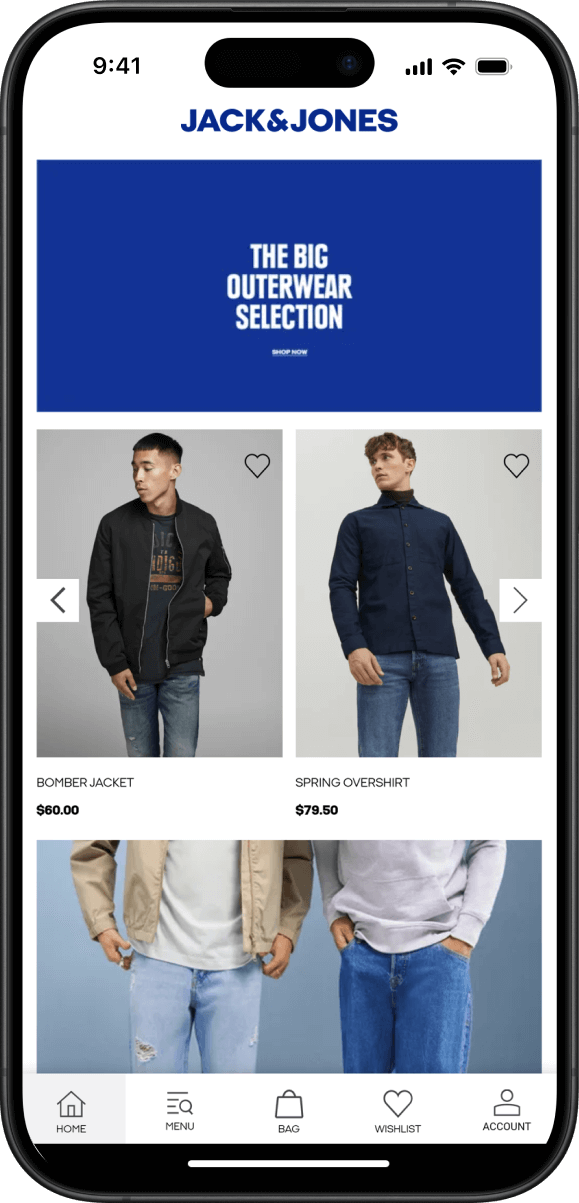
    Yeah, they are. Vendrux has worked great for thousands of businesses ranging from small startups and side projects to multibillion dollar global brands. 
    __wf_reserved_inherit
    The Jack & Jones app, built with Vendrux

    The only requirement is that you already have a website or web app. That’s why it works best for web startups, ecommerce brands, elearning platforms, content sites, and similar businesses. 

    It’s effectively zero risk compared to the massive organizational and financial commitment of developing with Flutter or Xamarin. You’ve already done the work building for the web – now with Vendrux you can leverage that onto the App Store and Google Play too!

    To learn more about Vendrux – our team of app experts are waiting to answer all your questions. 

    Book a demo call today.

  • Flutter vs Swift

    Flutter vs Swift

    You can build great apps with both Flutter and Swift, but which is better? Which should you choose for your own apps? 

    The short answer:

    You should choose Swift if you want to create very high performance apps for iOS, like demanding games and cutting edge use cases. If you want to build apps for iOS and Android, and your requirements are not extreme, you should probably choose Flutter. 

    Now for the long answer, in this article we’re going to break down the key differences, advantages and drawbacks of each. 

    What is Flutter?

    Flutter is a cross-platform app development framework created by Google. It’s cross-platform because it lets developers write apps for iOS and Android from a single codebase – which then compiles into native code for each platform. 

    Flutter uses the Dart programming language and a rich library of widgets to construct intuitive and rich UIs for a vast range of app types. 

    You can read about Flutter in much more depth in our Flutter 101 guide, in this article we’re mostly going to focus on comparing it with Swift. 

    What is Swift?

    Swift is a programming language created by Apple designed for the iOS and MacOS ecosystems, as well as Apple Watch and TV applications. 

    __wf_reserved_inherit
    Swift – the language of iOS

    Swift is used to build native iOS apps, and is known for its high performance and ability to tightly integrate with the hardware of Apple devices. 

    Flutter vs Swift – key differences

    Swift and Flutter are quite different technologies with a different purpose. Let’s compare them on a few different criteria.   

    Programming Language vs Framework 

    Swift is a programming language but Flutter is a framework that enables cross-platform development with the Dart programming language. 

    Flutter uses Dart, a language developed by Google for both mobile and web development. It’s a C like language suited to a declarative programming style – making it suitable for teams with experience of similar paradigms. 

    __wf_reserved_inherit
    Swift and Flutter – different programming languages

    Swift on the other hand, is a language created by Apple specifically for iOS, macOS, watchOS, and tvOS app development. Swift is known for its clarity, efficiency, and safety, making it a preferred choice for developers aiming for native Apple platform applications.

    Native vs cross-platform performance

    Flutter has great performance thanks to its ability to compile directly to native code, setting it ahead of some other cross-platform frameworks that “bridge” to native. It is used in countless high-end apps and can give a great level of performance. 

    However, the highest possible level of performance comes from the native languages of the platform themselves. 

    Swift can (potentially) offer the ultimate speed and performance for iOS development, which could be necessary if your app is a high end game or very computationally demanding. 

    Ecosystem

    Flutter has an established and growing community and ecosystem, thanks to its cross-platform flexibility and the backing of Google. Its widget library is very extensive and documentation is thorough. 

    Swift’s community is very mature and well-established, particularly for developers focused on Apple’s ecosystem. Apple’s continuous updates and the language’s popularity have spawned a huge range of resources, from libraries and frameworks to tutorials and professional support. 

    Investment

    When it comes to cost, Flutter is generally seen as the cheaper option. This is usually in the context of developing apps for both iOS and Android and the expensive nature of developing and maintaining two separate native codebases. 

    If you only want to build iOS apps, there is nothing inherently more expensive about using Swift – although this will depend on a wide range of factors. 

    Flutter vs Swift – which should you choose?

    A key consideration is that Swift is only for iOS development. Do you only want to release mobile apps for iPhone users?

    Some apps have gone that route, like Clubhouse, Overcast and Apollo. iPhone exclusive apps are a good way to specifically target a more wealthy, US-centric audience. 

    But most apps these days cast a wider net and enter the massive Android market too. 

    With Swift, you’d need to develop Android apps completely separately in the tech stack native to the Android OS. Flutter on the other hand would let you develop iOS and Android apps from the one single codebase. 

    Let’s look more closely at the ideal use cases of each. 

    When to use Flutter

    There are some situations where Flutter is the clear choice over Swift.

    1. Cross-platform Development: If your aim is to launch on both Android and iOS with a single codebase, Flutter it is. 
    2. UI-Focused Apps: for apps where a custom, aesthetically pleasing user interface is the most important thing, Flutter’s widget-based architecture allows for flexible and fast development compared with native 
    3. MVP and Rapid Prototyping: startups looking to quickly validate an idea will like Flutter’s developer productivity features and fast development cycles 
    4. Applications with Limited Native Integration: if you don’t need to interface very deeply with the native features of iOS and Apple hardware, Flutter will be great

    When to use Swift

    Swift really still shines over Flutter in a few scenarios. 

    1. iOS-exclusive apps: Swift is built for high-performance, robust iOS applications. If your target audience exclusively uses Apple devices, using Swift is the gold standard
    2. High-performance: apps that require very high performance and speed, such as advanced games or intensive computational apps, will see better performance from Swift
    3. Apple ecosystem features: projects that need to integrate with the Apple ecosystem (e.g., iMessage apps, Apple Watch extensions) will love Swift’s deep integration with Apple’s native APIs and SDKs

    Flutter vs other platforms 

    We compared Flutter with several other app development options as part of this series. 

    Check out how it compares to:

    For now, let’s wrap up our discussion of Flutter vs Swift.

    Flutter vs Swift – the bottom line 

    In summary – use Swift if you want to build iOS exclusive apps, apps that deeply integrate with Apple’s ecosystem, or apps that are very computationally demanding. 

    Use Flutter if you want to build more UI focused apps, for both iOS and Android, from a single codebase. 

    We also want to share our own platform, Vendrux, and how it can be better than either Swift or Flutter for the right business. 

    Convert your site to native apps instead

    Building apps with Swift or Flutter is no joke. It will cost $100k+ and take many months of work to get launched, and a serious ongoing investment to keep the apps updated and maintained. 

    We built Vendrux to bring down the barriers to app development. 

    Vendrux builds both iOS and Android apps from your existing website or web app. 

    You already did the hard work building for the web, we take that and convert it into native app form, adding in all the necessary features and UX elements to ensure the apps are a powerful asset to your business and a great experience for your users. 

    __wf_reserved_inherit
    Convert your existing site or web app with Vendrux

    It works perfectly for eCommerce stores, web apps, elearning platforms, content sites – and a wide range of other businesses. Check out some of the 2000+ brands that use Vendrux for their apps today. 

    With Vendrux, you can get apps in just weeks, for a fraction of the cost of Swift or Flutter. 

    There’s no risk, and nothing for you to do on the technical side – our team builds the apps for you, publishes them on the App Store and Google Play, and maintains and updates them forever. 

    You can just focus on your core web business and using the apps strategically – they will effectively run themselves. 

    So there you go – if you already have an established presence on the mobile web, Vendrux blows Swift or Flutter out of the water in terms of convenience and potential ROI. 

    To learn more and get all your questions answered – get in touch with one of our app experts and let’s start building your App Store presence. 

    Book a demo call today.

  • React Native vs Flutter for App Development in 2026?

    React Native vs Flutter for App Development in 2026?

    Cross-platform frameworks are emerging as the best way to build mobile apps today, and React Native and Flutter are the two most popular ways to build cross-platform apps.

    These two frameworks share a lot of similar qualities, but also have some important differences you’ll need to be aware of if you’re planning on choosing one to build your app.

    In this article, we’ll give you a crash course on React Native vs Flutter, how they compare, and which framework is more popular with today’s mobile app developers, before sharing whether there are any other options you should consider if you’re planning to build a cross-platform or hybrid app.

    Flutter vs React Native: Key Points

    Let’s start with a quick summary of the key points you need to know when comparing Flutter vs React Native:

    • Both are cross-platform development frameworks, which allow you to create apps for Android and iOS with a single codebase.
    • Both are free, open-source frameworks.
    • React Native is built and maintained by Meta (aka Facebook), and based on the JavaScript programming language.
    • Flutter is built and maintained by Google, and based on the Dart programming language.
    • Both Flutter and React Native come with a hot reload feature, which makes it easy to iterate on code and see the results in real time.
    • Each framework is used in a number of high-profile apps, including Meta’s and Google’s suite of mobile apps.
    • React Native is older and boasts a more extensive community, though Flutter is catching up in that regard.

    Flutter and React Native: Two of Today’s Most Popular Cross-Platform Frameworks

    React Native and Flutter are, by most estimations, the two most popular ways to build cross-platform apps today.

    What are cross-platform apps, or cross-platform frameworks?

    They are an alternative to building platform-specific apps using native code.

    Generally, iOS apps (apps for iPhone/iPad) are built in Swift, or Objective-C. Android apps are built in Java or Kotlin.

    This means, if you want to launch apps for both platforms, you’re going to need two completely separate codebases, as you can’t reuse code between each programming language.

    This makes it much more expensive and time-consuming to launch apps that are available to all mobile users, and also means it takes twice the work to update and maintain your apps.

    Cross-platform app development, with frameworks like Flutter and React Native, makes it easier. These frameworks let you write code that can be deployed on multiple operating systems. You can write once and build apps for both iOS and Android platforms. You’re also left with just one codebase to maintain, which cuts overhead in half compared to native app development.

    More and more, developers are starting to prefer cross-platform frameworks to fully native apps. Unless your app relies heavily on native device features, you can achieve great results for less effort and expense by going cross-platform.

    Alternative cross-platform frameworks include Ionic, Xamarin and NativeScript, along with no-code tools that let you deploy one app across multiple environments, but React Native and Flutter are the two with the highest profile (likely due to the big names behind each of them).

    Learn more here about tools and frameworks for developing cross-platform apps.

    Now let’s give you a rundown on both Flutter and React Native, before diving into an in-depth comparison between the two.

    Beginner’s Guide to React Native

    So what is React Native?

    React Native is a framework that allows developers to build mobile applications using JavaScript and React. 

    It lets developers create cross-platform apps that work on both iOS and Android devices, sharing a significant portion of the codebase between the two platforms. 

    React Native’s tagline is “learn once, write anywhere”. It speeds up development time and streamlines the process of app development by allowing developers to use one development framework for multiple platforms.

    The syntax of React Native is very similar to React.js, the original web-based JavaScript framework. The difference is that it uses native iOS and Android components, instead of outputting HTML and CSS code, as you would if you build for the web.

    This means you can’t simply deploy a React web app as a native app using React Native, but developers with experience in React will be able to easily learn React Native and use this to build native apps.

    React Native App Examples

    React Native was created by Meta (formerly Facebook), with the intention of being used in their ecosystem of apps, including Facebook, Instagram and Messenger.

    Alongside Meta apps, React Native is used by more of the biggest names in tech:

    • Microsoft (used in the MS Office, Outlook, Teams, Skype and Xbox Game Pass mobile apps).
    • Amazon (Amazon Shopping, Alexa and Amazon Photos apps, as well as supporting Kindle devices and the Amazon Appstore).
    • Shopify (the Shopify mobile app, as well as the customer-facing Shop app).

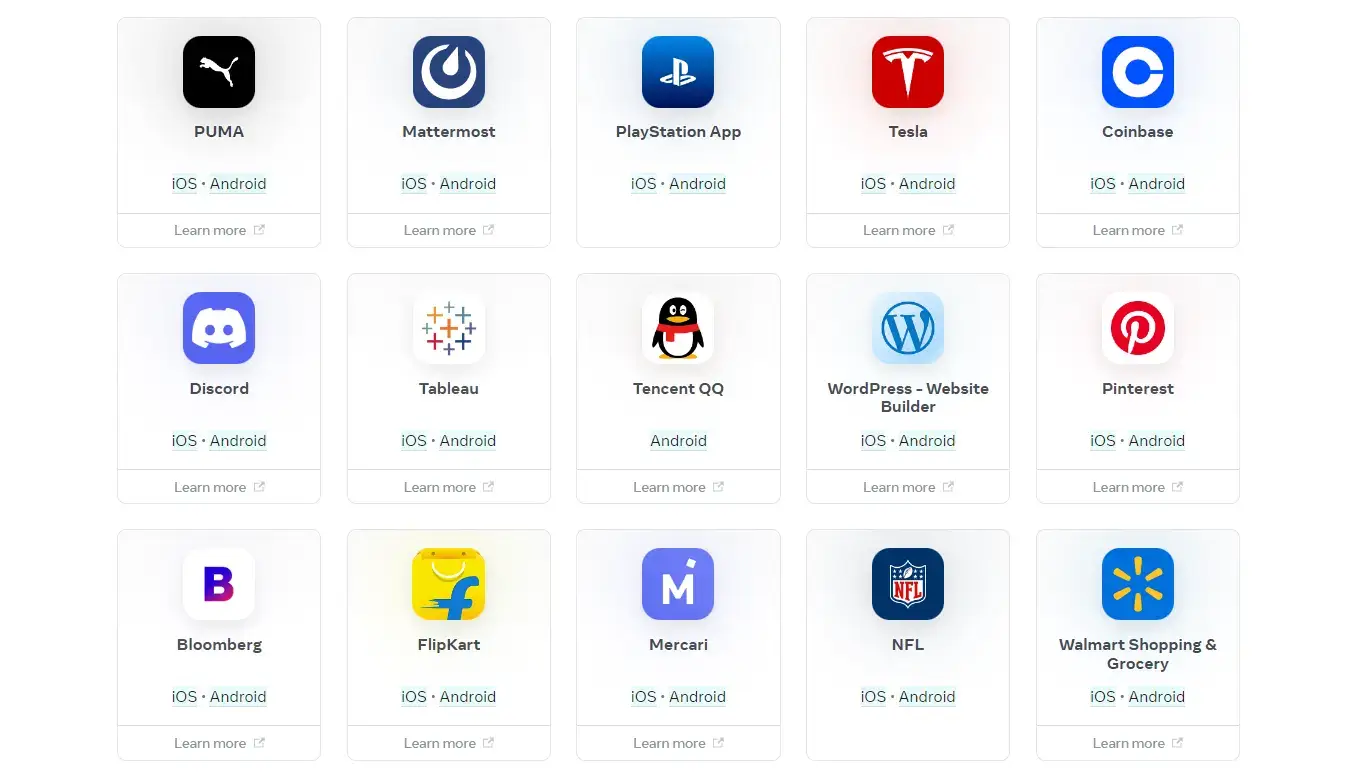
    Other high-profile React Native app examples include:

    • Coinbase
    • Discord
    • Wix
    • Pinterest
    • NerdWallet
    • Walmart
    • Tesla
    • Bloomberg
    __wf_reserved_inherit
    A few examples of notable apps built with React Native

    Learn more about React Native examples on their showcase page.

    Beginner’s Guide to Flutter

    Flutter could be seen as Google’s answer to React Native.

    Flutter is Google’s UI toolkit for building beautiful, natively compiled applications for mobile, web, and desktop from a single codebase.

    It empowers developers to create stunning user interfaces using a single language, Dart, while achieving cross-platform compatibility. With Flutter, you can build apps that look and feel great on iOS, Android, and the web, all while maintaining a consistent experience across different devices.

    Flutter is made up of pre-built and customizable widgets. The framework comes with many built-in widgets for things like layout, animations, UI elements and more.

    These elements can be deployed on multiple operating systems, again massively reducing the time it takes to build and launch mobile apps, as well as the time and effort required to maintain and update apps on multiple platforms.

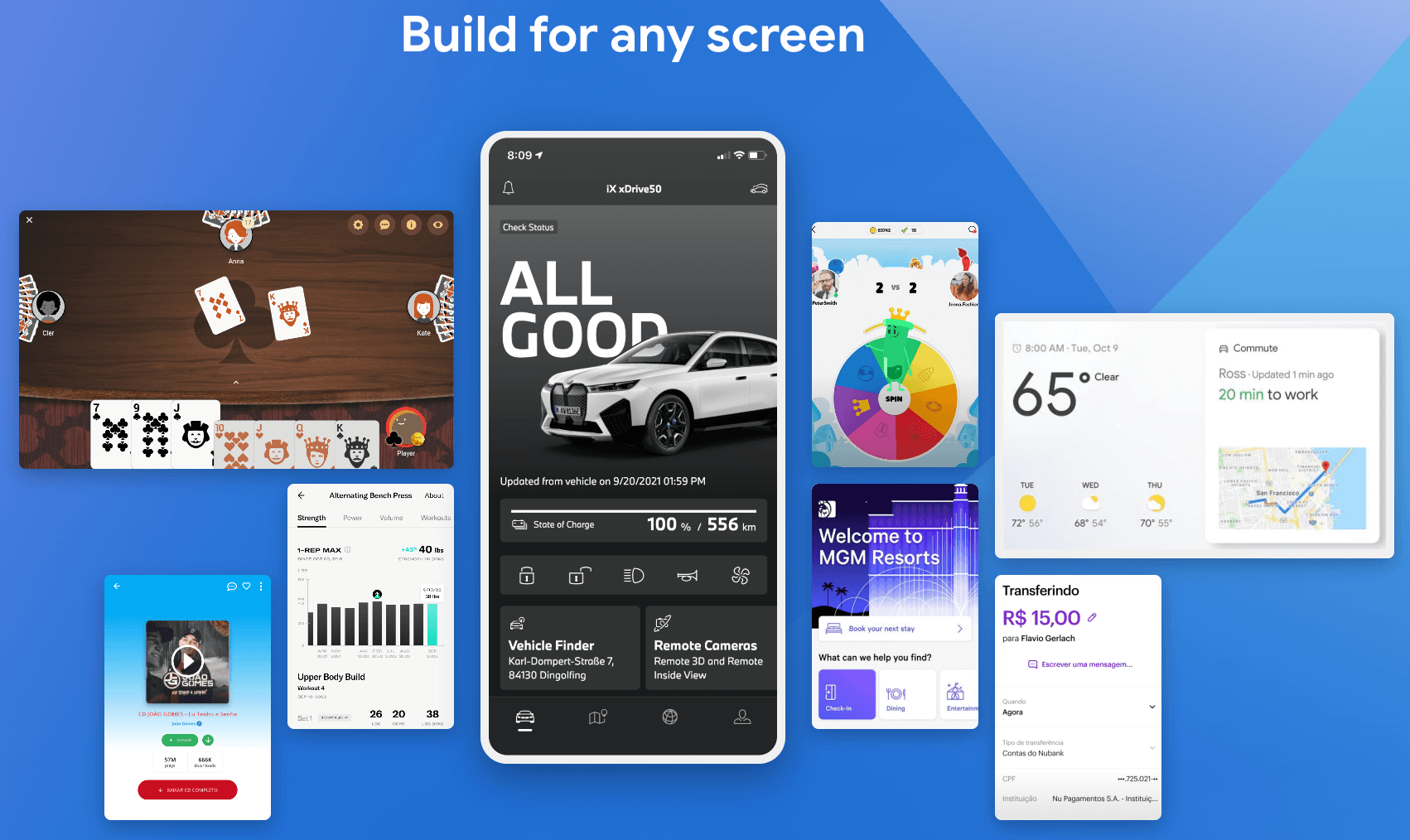
    Flutter can even be used to build apps and user interfaces for other types of devices with screens, such as smart appliances; hence their tagline, “Build for any screen”.

    Flutter App Examples

    Flutter, too, is currently being used in some of the world’s biggest apps.

    As expected, it’s used heavily in Google’s apps, including the Google Pay App.

    __wf_reserved_inherit

    It’s also being used by companies such as:

    • Tencent
    • BMW
    • Toyota
    • eBay
    • Alibaba

    A few other Flutter app examples include:

    SoVegan

    __wf_reserved_inherit

    Caribou Coffee

    __wf_reserved_inherit

    QuintoAndar

    __wf_reserved_inherit

    Learn more on the Flutter showcase page.

    Key Differences Between React Native and Flutter

    We’ve given you the one-minute pitch on both React Native and Flutter, and perhaps you now understand a little about each framework. 

    There’s a lot of overlap between the two frameworks from what we’ve discussed so far. So let’s take a deeper look at the differences between React Native vs Flutter, to help you understand the pros and cons of one and the other.

    JavaScript vs Dart

    One of the most notable differences is that React Native is built on the JavaScript programming language, while Flutter is built on Dart.

    JavaScript is one of the most well-known and widely used programming languages in web development, used in millions of web apps and websites, with React and React Native among many other frameworks built on top of it.

    Dart, on the other hand, is a newer programming language, which was created by Google in 2011. Dart has a lot of similarities with JavaScript, but less widely used and perhaps more challenging for beginners to learn.

    Meta vs Google

    Another difference is that React Native is built and maintained by Meta, while Flutter is built and maintained by Google. Whether this has any practical difference for you depends on your views on each company. Both frameworks are still open-source, with active communities and in-depth documentation, so it’s not like you’re going to be interacting directly with the frameworks’ creators.

    Third-Party Libraries vs Built-in Widgets

    A more practical difference is in the way you compile your app’s user interface with Flutter vs React Native.

    In Flutter, there are built-in widgets for just about everything, from the layout of your UI to components like nav bars and buttons.

    These widgets are customizable, but essentially work out of the box, working the same on multiple platforms.

    React Native uses third-party libraries, which allow developers to add native components to their apps. This means there’s less you can do out of the box, and library quality and availability can be inconsistent. 

    But on the plus side, it gives the ability to build apps with a more native feel, as there are more components that are specifically designed for certain platforms. There’s also more flexibility possible with React Native, though the tradeoff is that it may take longer to set up.

    Platforms

    React Native primarily supports building for iOS and Android apps.

    It can be used in Windows and MacOS apps, as well as for smart TVs, and the code used for React Native apps can have a lot of crossover with the code used to build React web apps. But it’s still primarily used for mobile apps.

    Flutter is easy to use for a wider range of platforms, including building web apps. So if you wanted to build apps that were accessible across web, iOS and Android, you could do so using only Flutter.

    If you were to use React Native, you’d need a separate codebase in React for your web app.

    That said, Flutter may not be ideal for web apps, as it’s hard to build SEO-optimized web apps in Flutter, and its performance in building for the web can be spotty. 

    Ecosystem

    Having been in existence for longer, React Native has a deeper community and a wider ecosystem.

    There’s a wider availability of resources and community-built features for React Native. There’s also more apps that use React Native, and a greater demand for developers with React Native expertise.

    Both frameworks have good documentation to follow, though React Native documentation is spottier, due to the number of third-party libraries you’re working with.

    Flutter, in comparison, has more structured and organized documentation, which makes it a bit easier to get up and running.

    Learning Curve

    React Native is generally perceived as having a shorter learning curve, as it’s based on a more popular programming language (JavaScript), with a more familiar syntax.

    Generally speaking, if you’re proficient in JavaScript, it should be relatively easy to pick up React Native. And if you have experience with React.js, the learning curve is even smaller.

    Flutter is based on a lesser-known programming language, Dart, so it’s not as easy for most web developers to pick up.

    However, the greater built-in capabilities of Flutter may make it easier to pick up for people who have no prior experience in JavaScript or Dart. 

    Time to Market

    The development process is typically faster with Flutter, again due to the built-in capabilities it provides via widgets.

    Not taking into account any time it takes to get your head around Dart, you should be able to go to market with a functional app quicker with Flutter. 

    The only thing that may hold you back is if you run into problems, or need to do something outside of the core capabilities of the framework.

    In this case, React Native may prove faster, as there is more community support and a wider range of third-party resources available.

    Performance

    Whether Flutter or React Native offers a higher level of performance is up in the air.

    Flutter apps tend to be faster than React Native apps, though it’s not a huge difference.

    This is due to React Native using a JavaScript bridge to communicate with native modules, while Flutter’s components are native by nature.

    However, React Native gives a greater ability to build apps that require deeper OS interactions or native features. 

    As Flutter components are shared across platforms, there may be some elements that don’t feel fully native on one platform or the other. React Native gives greater potential to optimize feel and performance for specific operating systems (though not as much as building fully native apps).

    Which Framework is More Popular?

    React Native and Flutter are largely considered to be the two most popular cross-platform development frameworks.

    In a 2022 study asking nearly 30,000 developers around the world which cross-platform frameworks they use, 46% responded with Flutter, compared to 32% for React Native.

    __wf_reserved_inherit

    It’s interesting to note that both frameworks trended in different directions. The study polled developers each year from 2019 through to 2022, with Flutter’s share increasing from 30% to 46%, while React Native decreased from 42% to 32%.

    Stack Overflow’s 2023 developer survey also includes numbers on the popularity of React Native vs Flutter.

    67,000 respondents were asked which frameworks and libraries they used, and 9.12% responded with Flutter, versus 8.43% for React Native.

    Flutter is more popular on Github, with 162k stars, versus 116k stars for React Native.

    These figures indicate that Flutter is, overall, slightly more popular than React Native. However, there are a lot more React Native job opportunities than there are for Flutter.

    At the time of writing, a LinkedIn job search for US postings found 1,068 Flutter jobs, versus 6,413 postings for React Native developers.

    A search on Indeed found 1,990 US React Native jobs, versus 388 for Flutter.

    Takeaways: more developers seem to prefer Flutter, but there are more job opportunities for React Native, likely due to the larger number of projects built using React Native, as it has been around longer.

    Why Developers Choose React Native

    To get a better idea of why some developers prefer React Native over Flutter, here are some responses to this exact question on the React Native subreddit:

    • “RN uses JSX syntax for building UI. Flutter uses these nested functions (?) which looks very ugly – with these ),),),), in the end of widgets. Functional components and hooks are a good way to go instead of Flutter classes as well.”
    • “RN uses real UI elements, not something drawn on canvas. The app behavior is truly native with React Native.”
    • “You can build desktop apps (Microsoft even uses RN in Windows in one of the screen in Settings) and web (react-native-web + familiarity with React.js) – it’s supported better than in Flutter (IMHO here)”
    • “Dart is unpleasant.”
    • “Jobs, career, more mature libraries, web support, less code for same result. Definitely more elegant.”
    • “Meta has spent decades on the react and native framework and has a lot of stakes in the success of the product. Microsoft has began showing support and is currently in alpha of their own component library Basically, I trust meta and their support of the product due to how heavily invested they are into it.”
    • “UI Flexibility – RN is designed as a mobile platform, so it uses the time battled tested native components that deliver years of bug solving and accessibility that is just thrown away with flutter.”
    • “Prominent companies like Shopify, Wix, Discord, Microsoft are choosing React Native, indicating their expertise and preference for RN over Flutter.”
    • “Easier to Learn – I don’t think there is something easier than JavaScript/TypeScript.”

    Overall, the most common responses mention preference for JavaScript over Dart, more job opportunities, more native UI components and the high-profile apps and companies that use React Native.

    Why Developers Choose Flutter

    Looking at the same question – why developers feel Flutter is better than React Native (and Xamarin, another popular cross-platform framework) – users on the Flutter subreddit said:

    • “The dev experience is easier because dart is a better language than javascript. It is type / null safe by default and supports many modern features like extensions.”
    • “Widgets make sense and have a defined lifecycle. React hooks and components are more confusing than Flutter state and widgets. Flutter is closer to traditional mobile dev here.”
    • “Flutter is a full render system with a UI library that works nicely. React Native is missing many things a dev needs (like sheets, alerts etc). This makes Flutter apps usually easier to build something higher quality.”
    • “Flutter apps compile to more than just ios / android. Web, macos, etc are all supported and usually just a few clicks away. Flutter web is not as nice as a nextjs/react app, but there is still a good use case.”
    • “Flutter apps are much smaller than React Native. A Flutter app is usually just a touch bigger in package size than a traditional mobile app. React Native apps are usually quite large.”
    • “Flutter feels polished, while react native is scrappy. Google maintains dart, pubdev and flutter, while Facebook maintains React Native, but not javascript and npm.”
    • “React was originally conceived for the web, for instance, it has bad roots. Flutter is half a decade new and it was originally thought for mobile.”
    • “In one word – off the shelf widgets. I just don’t see the set of widgets in RN as in Flutter. Also, animation is probably easier.”

    These responses generally prefer the built-in widgets Flutter comes with, the mobile app development experience, and in some cases a preference for Dart over JavaScript.

    React Native vs Flutter: Which to Choose?

    If you ask real developers, you’ll get a lot of different responses for whether they prefer React Native vs Flutter. As you can see above, different people will make the argument for different sides.

    There’s no clear answer we can give you as to which framework is the best. It largely depends on which one you have a better experience with.

    If you’re used to JavaScript and/or React, React Native will likely feel better to work with. React Native is also a good fit for projects with a high need for native functionality and flexibility.

    Flutter is better if you want a more structured approach, with more functionality available out of the box. It might also be a better fit if you don’t have any prior experience with JavaScript. As you’ll be learning a new language anyway, you may find it easier to pick up Dart and Flutter than JavaScript and React Native.

    React Native & Flutter vs Vendrux

    While React Native and Flutter are two of the best and most popular frameworks for building cross-platform apps, they are not necessarily the best options if you have an existing web app or website, and want to rebuild or extend it to mobile apps.

    You’ve already done the work to build it for the web, and rebuilding it as an app means duplicating all that effort, as well as adding multiple codebases to manage once your app launches.

    For this, there’s our platform, Vendrux.

    Vendrux is part software, part service. Our platform, built and perfected over more than 10 years of building apps, is designed to convert any website into high-quality, native-feeling mobile apps for iOS and Android.

    __wf_reserved_inherit
    Examples of a few apps built with Vendrux

    You manage everything from one codebase – your existing web code. The apps are synced with your website, meaning any changes or updates you make only need to be made once, and go live on your website, iPhone app and Android app automatically.

    Our team handles the conversion process, as well as technical maintenance for your mobile apps (which are built using Kotlin and Swift, native coding languages for Android and iOS.

    Launch Cross-Platform Apps with No Coding in Just Two Weeks

    React Native and Flutter are great, but they take a lot of work and specialized skills. Vendrux is a much simpler, much quicker, much cheaper way to get basically the same end result.

    With over 2,000 apps under our belt, we know what it takes to build apps that look and feel like custom native apps, which would otherwise cost six figures at a bare minimum.

    As long as your website or web app is mobile-friendly, turning it into mobile apps is a cinch. We’ll prove it to you by showing an interactive preview of your site as an app, when you book a free demo.

    As part of our process, we’ll put some minor but meaningful touches to your app to give it a seamless native experience, and once finished, we’ll handle the app store publishing process for you.

    Get in touch with us to schedule a free demo, and learn how Vendrux is a more efficient way to build apps than React Native, Flutter or any other cross-platform framework.

  • Flutter Apps vs PWAs – Which Should You Build?

    Flutter Apps vs PWAs – Which Should You Build?

    These days there are so many choices when it comes to creating a great mobile UX.

    The mobile internet is better than ever, building apps is more accessible than ever, and new tools, frameworks and services come out constantly. 

    A key question is whether you need to build mobile apps for iOS and Android or whether a mobile friendly web app is OK. 

    Researching this question will naturally lead you to progressive web apps (PWAs), and cross-platform app development frameworks like Flutter. 

    Although they may seem similar on the surface, Flutter vs PWA are two very different technology choices, with different advantages and drawbacks. 

    In this article we’re going to break down each, explain all the important considerations, and guide you through everything you need to know. 

    We’ll start off by explaining the basics of Flutter and PWAs, then we’ll get into the comparison. 

    What is a PWA? 

    Progressive web apps are the cutting edge in web app development. 

    They are built with web technologies like HTML, CSS and JavaScript – and run in web browsers on mobile and desktop. 

    __wf_reserved_inherit
    PWAs – modern and powerful web apps

    They behave like a cross between a website and a mobile app though. 

    By leveraging web technologies like service workers, PWAs bring many of the features traditionally associated with native mobile apps to the web, like:

    • Offline functionality 
    • Push notifications 
    • Access to device hardware

    There is no strict definition that helps us, but to put it simply: PWAs are modern web applications that behave in a similar manner to mobile apps. 

    A PWA isn’t something “separate” from your main website or web app, it’s better to think of it as a series of enhancements to your site that give it specific modern capabilities. 

    For a detailed breakdown, check out this article. 

    What is Flutter? 

    Flutter is a cross-platform app development framework.

    Cross-platform app development is building apps for multiple platforms from one single codebase. A framework is like a development “toolkit” that makes certain tasks vastly more efficient. 

    __wf_reserved_inherit
    Cross platform apps – iOS and Android in one!

    In the case of Flutter, it was released by Google in 2017. 

    It allows developers to use the Dart programming language to build apps once, writing code for them once, then “converts” that into machine code that can run natively on iOS, Android, the web, and even desktop programs. 

    This is very efficient, because traditionally you had to write separate code bases for each platform. You’d need to build specific apps for iOS and Android, effectively doubling the work (at least) compared to Flutter. 

    Though many businesses still opt for the traditional, expensive and laborious native development – many are embracing Flutter and other cross-platform frameworks like React Native in recent years. 

    Flutter is known for creating smooth and pleasing UIs, as well as making mobile app development much more efficient. 

    Flutter vs PWA 101 

    So we’ve seen that Flutter apps and PWAs are different things. 

    PWAs are web apps that run in browsers, and share several of the key characteristics of native mobile apps. Fundamentally though, they are a web technology that can be thought of as an “enhanced” and cutting edge website. 

    These days, they’re fast and efficient to build, especially if you already have a web app, and in recent years have led to more engaging web experiences. 

    Flutter is a tool for building “real” native mobile apps. The apps do not run on the browser, but rather on the chip of the iOS or Android device. 

    They go (far) beyond the capabilities of a PWA, can be deployed on the Apple App Store and Google Play, and can take full advantage of the capabilities of the device. 

    Ultimately – Flutter apps and PWAs are not really “alternatives” to one another, although there are overlaps in the business benefits.

    Flutter vs PWAs – the Tech Stack

    Let’s look at some of the more technical differences between Flutter apps and PWAs. 

    Flutter’s tech stack 

    Flutter is a framework for Dart.

    Dart was released by Google back in 2013, and was originally seen as an alternative to JavaScript for web development. 

    __wf_reserved_inherit
    Flutter is a framework for Dart

    While Dart is used for building both web and server applications, it has really found its niche as the language of Flutter development. 

    Dart is known for being great to work with and feature rich. 

    It is object oriented, meaning it uses “objects” – self contained units that have both data and methods. It’s also class defined, which means objects are made from “classes”, which are like reusable blueprints for objects. 

    Syntactically, Dart is similar to languages from the C family, but has some special features. One is hot reload, which allows developers to “preview” code changes in real time. 

    To build the UI, Flutter has a vast library of “widgets”.  

    Widgets are like pre-built components that developers can combine to create the UI and functionality of the apps. 

    When the apps are ready, the code is compiled into native code for the platform in question – for our purposes iOS or Android. 

    Finally, when the apps run, the widget-based UI is rendered onto the users’ screen via Skia, an open-source 2D graphics engine used extensively by Google. Flutter can control every pixel on the user’s screen – allowing very rich and sophisticated user experiences. 

    The PWA Tech Stack

    PWAs are simpler. 

    Like everything on the web – they leverage the most standard web technologies, including HTML, CSS, and JavaScript. 

    But the technological lynchpin of PWAs is the service worker, a handy script that runs in the web browser and manages requests, caching, and storage in a very efficient manner. 

    This allows PWAs to perform well regardless of even in areas with relatively poor network conditions, which can really improve UX. 

    PWAs can also use modern APIs for other powerful capabilities like push notifications, background data sync, and interaction with the device features like the camera and GPS. 

    Flutter apps vs PWAs – which is better? 

    As we mentioned earlier, Flutter apps and PWAs aren’t really alternatives. Both have pros and cons. 

    Why PWAs > Flutter apps

    For example – PWAs are easier and more affordable to build. 

    Because they use standard web technologies, and are relatively simpler on a technical level, you should be able to build (rough estimate):

    • A simple PWA for $5k – $20k
    • A sophisticated PWA for $20k – $50k

    If we’re talking about converting your existing website or web app into a PWA, the cost should be lower still. 

    They’re easier to launch, and also to push updates to, since you don’t need to go through the App Store or Google Play review process. 

    Flutter apps on the other hand are more complex to build, requiring more specialized expertise. Generally – they’ll cost $100k+ to build. They also require a significant ongoing investment to maintain and update. 

    Since they run in the browser, PWAs are cross-platform by default, and they can use some of the most useful app functionalities like push notifications and the ability to install on the users home screen. 

    PWAs are also more discoverable on the web through organic search. 

    Why Flutter apps > PWAs

    PWAs are great, and have made progress in leveling the playing field between native apps and the web. 

    But, they aren’t there yet. Far from it in fact. This is for a few reasons. 

    Compared to Flutter apps, PWAs fall short in the following ways:

    • Limited access to device features – they won’t be able to interact with the hardware capabilities and device APIs as deeply 
    • Performance – while PWAs are fast, they often can’t measure up to the speed and smooth UX of native
    • Offline capabilities – although PWAs can have some offline functionality, this is generally limited in comparison 

    With PWAs, you also lack a few critical aspects entirely. 

    Firstly, you have no presence on the App Store or Google Play. Only native apps can be deployed on the two major app stores. 

    Although the user can “install” a PWA on their home screen – but this is effectively only adding a shortcut to the web. You’ll have to get them to do it too, which isn’t an easy sell. 

    Speaking of hard sells, with PWAs it is harder to send push notifications. 

    Native app notifications have:

    • Higher opt in rates 
    • Better for iOS 
    • Better personalization (and therefore are more powerful)

    They’re also a much better way to target the lucrative iOS market, because the permissions are more forgiving. 

    With PWA web notifications, you first need the user to install on the homescreen, and only then can you ask for permission to send them. 

    This is high friction. 

    Giving permission for web notifications isn’t really a thing on mobile, although it can work on desktop. We covered all this in detail here

    There’s also the fact that a portion of your users and customers will just expect an app on top of a web presence, as well as trust it to a greater extent.

    A PWA is not an app in most people’s minds – rather a fancy website – and having Flutter apps on the App Store and Google Play taps into existing habits much better.

    Flutter vs other platforms 

    We compared Flutter with several other app development options as part of this series. 

    PWAs are one thing, but there are also many other cross-platform frameworks and programming languages for developing apps.

    You can take a read of these to learn about how Flutter stacks up against other the other mobile app options.

    For now though, let’s wrap up our comparison with PWAs.

    Why they aren’t actually alternatives

    PWAs and native apps aren’t really alternatives. They are different things. 

    A PWA is an upgraded version of your site, with new and improved features and UX. 

    A Flutter app is an entirely new channel that works in synergy but (somewhat) separately to your site. 

    We recommend you get both. 

    Start off with a PWA for your standard web experience, then build iOS and Android apps for deep engagement with your most loyal users. 

    You can do this with Flutter – but it will take a lot of work to both build the apps and share business logic between the apps and the web. 

    Think multiple six figures and months of effort to get something running smoothly. 

    A much better option, if you already have a PWA or web app, is Vendrux. 

    Convert your web app to native apps with Vendrux

    We’ve seen that Flutter apps are expensive and difficult to build, and that PWAs are no alternative to native apps. 

    Vendrux solves the problem by letting you convert your website or PWA into native iOS and Android apps. 

    __wf_reserved_inherit
    Vendrux converts your web app into native apps

    We build the apps for you, based on your website but with all the native elements – like push notifications, native navigation and much more.

    You’ll get apps that give you all the benefits of Flutter apps, but they’re much better. 

    For a start the cost is The apps will sync automatically with your site, updating with any changes you make on the web. Our team also handles all the updates and maintenance – so there’s nothing to add to your team’s workload. 

    A PWA and Vendrux iOS and Android apps is a powerful combination. 

    It has worked for thousands of businesses, from small startups to multibillion dollar brands.

    It can work for you too. 

    So if you already have a website or a web app, get in touch with one of our mobile app experts and learn about what Vendrux can do for you. 

    Book a demo call today. 

  • Flutter vs Native App Development

    Flutter vs Native App Development

    Back in the early days of mobile apps, Native development was the only way to get apps launched on the App Store of Google Play.  

    Technology evolves though, and now there are other options. 

    One is cross-platform app development

    Flutter has emerged as one of, if not the, top choices for cross platform development. It’s used in thousands of projects from small hobby apps to massive tech companies with millions of users. 

    But why would you choose Flutter over native development, and vice versa? When should you opt for one or the other? What are the key advantages and drawbacks of each? 

    In this article we’re going to break it all down. We’ll start with a brief introduction to both Flutter and native development, then we’ll go deep into the relative strengths of each. 

    By the end you’ll have a solid idea of when to go with one or the other.  

    What is native Development? 

    Unless you’ve been living under a brick – you know that there are two key mobile operating systems: iOS and Android. 

    Just like their desktop counterparts, Windows and MacOS, iOS and Android work very differently on a fundamental level – from the way the UI displays to how the software interacts with the chip. 

    The software and the hardware is very different on each – which means that the development tools and programming languages used to develop apps are very different on each too. 

    Traditionally this means:

    • On iOS: Swift (or Objective C) as a programming language, Xcode and Simulator for development and testing environments
    • On Android – Kotlin or Java for programming, Android Studio and SDK 

    For both platforms, you’ll work with the native APIs and build each app in a radically different manner – just like if you were developing desktop apps for MacOS vs Windows. 

    __wf_reserved_inherit
    Developing apps natively is a lot of coding

    You’ll need specialists skilled in each of these stacks, who will work on two separate codebases to develop and maintain the apps. 

    Practically this means iOS and Android developers, designers, PMs, and poentially dedicated backend developers too. 

    How is Flutter Different?

    Recall how native development has you working on two separate codebases. 

    These share nothing in common with each other, on the front end at least. You can’t reuse any of the code, and every single piece of the UI and functionality needs to be built separately for each. 

    As you can imagine, this is very expensive. Specialized talent costs top dollar, and you’ll need thousands of developer hours over 6+ months to build even relatively simple apps. 

    This is why native apps typically cost $200k+ to ship first versions on each platform. 

    Flutter simplifies things and makes them more efficient. 

    Flutter is a cross-platform framework. 

    This means you can build the apps once, and have them run on both iOS and Android.

    __wf_reserved_inherit
    iOS and Android apps – from one codebase

    It’s a UI kit and Dart framework for developing from one single codebase. Because it compiles into native code for each platform, you effectively halve your work. 

    At the core of Flutter is a set of pre-built widgets that are leveraged to build the UI. With these widgets and the Dart programming language, you can create sophisticated apps for practically any device size. 

    When the apps run on a device, Flutter uses Skia, an open source 2D graphics engine to “paint” whichever element, animation, or interaction needs to be rendered. 

    On both operating systems, this works in broadly the same manner. Flutter also allows you to customize the UI for each specifically, making sure the apps “look the part” on each platform. 

    Let’s summarize Flutter’s core features:

    • One codebase: Flutter lets you develop apps for iOS, Android, the web, and desktop from one codebase. You can typically reuse 90% of your code across platforms. 
    • Hot reload: Dart allows you to see changes to the code instantly, this is very helpful for developer productivity
    • Rich Widget Catalog: Flutter has over 14 categories of widget to work with .
    • Performance: Flutter apps compile Ahead Of Time (AOT) into native machine code for iOS and Android
    • Customizable and Flexible: Flutter’s layered architecture and “control” of every pixel on the screen gives plenty of design freedom 

    So, that’s an overview of Flutter. 

    The key point is that, compared to native development, it lets you build apps for multiple platforms from a single codebase. 

    We covered Flutter in more detail in this article – Flutter 101if you want a deeper dive.

    For now we’ll move on with the comparison. 

    Flutter vs Native development – which is better? 

    As with many things in tech, things aren’t “better” or “worse” in a blanket sense.

    Rather, different technology choices carry different costs, opportunities, advantages and drawbacks. 

    It’s no different when it comes to Flutter vs native development. 

    Generally, the overall theme is that Flutter is more efficient, faster and lower cost – and that native is (potentially) higher performance and can give access to more cutting edge tech. 

    But, the real life performance difference is probably only noticeable or relevant if you need really high end performance. 

    Let’s break it down. 

    Pros and Cons of Native Development

    The key advantages of native development boil down to 3 essential points. 

    1. Performance
    2. Features 
    3. Ecosystem 

    Because native apps are compiled into code that native to the platform, and use the native APIs, they can have the highest possible level of performance. 

    By “performance” we mean they have the potential to run the most computationally demanding applications fast and efficiently. 

    This isn’t a given, it’s a matter of potential, they need to be built optimally to harness it. 

    Also, we’re talking about a marginal difference for the average app. For most apps, you won’t see a huge performance difference between Flutter and native.

    But if we’re talking apps that rely on large amounts of real-time data or graphics processing, graphics requirements, or complex UI transitions – native might be necessary. Think high-end games, trading platforms, and other apps where a small lag could ruin the experience., 

    Native apps are also better for access to the latest platform features. 

    When a big update rolls out and some sophisticated new capability is released by Apple or Google – native app developers get immediate access. 

    Whether its new UI elements, security features, sensor capabilities – or anything else – they can be worked with and integrated as soon as they’re available. 

    This can be critical for apps relying on the cutting edge of tech, and with innovative and sophisticated products. 

    Now, Flutter can do almost all the same things – but there might be a lag for it to be integrated, and tradeoffs in how they’re used. 

    Finally, the native development ecosystem is rich and expansive. There are countless libraries, toolsets, and developers in the communities that you can leverage for your project. This is true for Flutter to a degree too – but native has the advantage here. 

    Now, there are of course drawbacks too. 

    Native apps are expensive, harder to develop, and take longer to build. 

    They typically require more expansive teams, cost twice as much (on average), and are far slower to market. The ongoing maintenance costs are also doubled compared to cross-platform. 

    Now move onto Flutter. 

    Flutter pros and cons

    The real key advantage of Flutter relative to native is that Flutter apps are:

    • Faster to develop 
    • Cheaper to develop 
    • Easier to update and maintain 

    It is an oversimplification – but essentially all work, both upfront and ongoing, is effectively halved due to the single codebase. 

    Other factors help too, Flutter’s hot reload for example boosts development speed and productivity, and the rich widget library makes it possible to quickly build sophisticated UIs. 

    Another advantage some developers note is UI consistency. 

    Flutter makes it easier to get a consistent, branded look and feel across platforms. This may or may not be important to you. 

    Flutter also comes with its downsides. 

    The biggest one is the potentially lower performance for demanding apps. As we’ve said, this probably only matters for a small subset of businesses, but it is significant. 

    Flutter is also somewhat notorious for resulting in a large app size, which could also be a downside for some users’ perspectives. This has improved though in recent versions. 

    __wf_reserved_inherit

    Finally – the range of third party libraries is smaller than for native development. This might mean that if you have some specific niche requirement you need to create custom solutions with native code. 

    Again, this is probably only going to be a problem if you have very unique requirements. 

    Flutter & Native App Examples 

    Now we know the key differences between these two app development approaches – let’s look at some examples of famous apps built with each. 

    Remember that there are countless thousands of apps built natively and with Flutter, these are just a few standout examples to show what’s possible. 

    Native App Examples 

    Many of the “big tech” apps you use are probably built natively, at least to a degree. Here are a few good examples:

    • WhatsApp native apps are lightning fast, integrating flawlessly with device features like the microphone, camera, and more 
    • Spotify’s native apps handle complex tasks like audio playback, real-time data synchronization, and deep integration with device hardware
    • Waze, a GPS navigation software, was developed natively to efficiently handle real-time GPS data, route mapping, user updates, and more 

    Flutter App Examples 

    The above apps could also have been built with Flutter these days, albeit with potential tradeoffs. Flutter powers thousands of high end apps like:

    • Google Ads allows users to manage ad campaigns, and showcases how Flutter can be used to build complex and data heavy business apps 
    • Reflectly uses AI to help users create a personal journal, leveraging Flutter to create a pleasing and consistent UX across iOS and Android
    • Philips Hue controls smart lighting and is built with Flutter, demonstrating Flutter’s potential in integrating with IoT devices

    As you can see, you can use Flutter for a wide range of applications, and its performance and features are only getting better. 

    Flutter vs Native use cases 

    There are still ideal use cases for each, situations in which Flutter or native is likely to be the best choice. 

    Let’s look at the most important ones. 

    • Cross-Platform Development without demanding requirements – if you want to keep things simple and work from the one codebase, Flutter is the way to go, and it will suit you fine for most applications. This is great for lean startups and bootstrapped businesses that want to keep things simple. 
    • Limited budget and tight deadlines – companies or individual developers working with limited budgets and tight timelines benefit from Flutter’s rapid development features. Using Flutter can potentially save hundreds of thousands and months of work. 
    • UI-Focused Applications – Flutter shines for custom, visually appealing UIs thanks to its widget-based architecture. For design and UX focused brands, this can be great.
    • Prototype Development – when the goal is to quickly validate an idea or a concept, Flutter’s development speed and ease of use make it a better choice. 

    So Flutter is probably the right choice if your requirements are not extreme, and budget and time to market are important to you. 

    When to choose Native Development 

    Native development is still the “gold standard” when it comes to some use cases. 

    • High-performance requirements – for computationally heavy apps like high-end games, augmented reality (AR), or video processing applications, native development is preferred.
    • Cutting-edge features – if you want to be first to market with the latest platform features as soon as they’re released, the native iOS and Android APIs are the way to do it 
    • Complex hardware interactions – applications that rely on intricate and extensive interactions with bluetooth, GPS, various sensors like the accelerometer and such, often benefit from being native. 
    • Regulatory requirements – in some industries like banking or healthcare, there are extremely stringent requirements for security and data handling. The fine control of native development might make compliance easier in some cases. 

    These are the only major reasons you might want to take on the additional cost and time investment to choose native over Flutter. 

    Flutter vs other options 

    Flutter vs native is only one angle.

    You can also compare Flutter itself to other app development methods and cross-platform frameworks.

    For example, React Native is the main cross-platform rival to Flutter which we compared here.

    We also compared Flutter to Android’s native language – Kotlin – and the native language of iOS, Swift.

    For now though, let’s wrap up the comparison with native development.

    Flutter vs Native: the bottom line 

    So to sum up. 

    Native development is for when you need something special or unusual. They’ll cost a couple of hundred thousand dollars, and take teams of specialists 6+ months to develop. 

    Flutter these days is good for almost everything, and is more affordable and faster to develop apps with. 

    We hope you enjoyed this primer on Flutter vs native development, and it helps you understand the options better. 

    Now to conclude, a shameless plug of our own platform, Vendrux, which is better than Flutter and native development for most businesses.  

    The efficient alternative – convert your site to native apps

    Flutter apps will still generally cost six figures though and take months to build. Even though you only have one codebase, it still requires constant and skilled maintenance.

    There’s a much better option for 90% of businesses – our service at Vendrux. 

    We build you high-end apps for iOS and Android in just weeks, for a fraction of the cost of both Flutter and native development. 

    We convert your existing website or web app into native apps – adding all the UI elements and features you need to leverage the apps fully and give your users a great UX. 

    It’s hyper efficient, results in fantastic apps, and is used by thousands of businesses including multi billion dollar brands. 

    __wf_reserved_inherit
    The Jack & Jones app – powered by Vendrux

    They take no effort on your part to maintain – our team handles all that for you – so you can just focus on making them work for the business. 

    Because you can get started right away, there’s no need to hire anyone, and the cost is small business friendly – Vendrux is effectively zero risk and all upside compared to Flutter or native development. 

    In summary – if you have a web app, site, or store already, Vendrux is probably the best option. 

    To get all your questions answered, and learn how Vendrux stacks up in more detail – get in touch with one of our team. 

    Book a demo call today!

  • Flutter vs Kotlin – How Do They Stack Up?

    Flutter vs Kotlin – How Do They Stack Up?

    Flutter and Kotlin – two important technologies in the app development world.

    What are the key similarities and differences? Which should you consider for your app development project? 

    In this article we’re going to answer these questions. We’ll introduce Flutter and Kotlin, go through their merits and drawbacks, and guide you through the essential features of each. 

    First let’s introduce the basics of Flutter (go here for more detail). 

    What is Flutter? 

    Flutter was released by Google themselves in 2017. 

    At the fundamental level – Flutter is a powerful framework for building cross platform mobile apps. 

    That means that you use Flutter to develop apps for iOS and Android from one single codebase. 

    This makes app development faster and more efficient than traditional native development – which involves writing separate codebases for each platform. 

    Flutter’s core features are:

    • Widget-Based Architecture: Flutter’s foundation is widgets, reusable and modifiable UI components that are combined to create the UI 
    • High Performance: Flutter apps compile to native code that runs on a low level on the device, giving great performance comparable to native apps 
    • Ecosystem: Flutter has a vast range of widgets, tools, and general resources thanks to support from Google and a large, growing community

    The key thing about Flutter – everything is a widget. 

    Widgets are just reusable pieces of Dart (Flutter’s programming language) code, that define UI components. They can be thought of as the basic building blocks of Flutter apps. 

    There are hundreds of core widgets for everything from the text and images to complex layout, animation and interactivity features. 

    The widgets are combined by Flutter developers into a tree. This builds the UI, which is rendered onto the device’s screen via Skia, Flutter’s own graphics engine, giving granular control of every pixel. 

    Flutter has shot to the top of the app development world over the past few years, powering countless apps including AliBaba, ByteDance, Google Classroom, and other huge brands. 

    You can read about Flutter in much more depth in our Flutter 101 article, but now let’s move on to Kotlin.

    What is Kotlin? 

    Kotlin is not a framework like Flutter, but is rather a programming language. 

    It was developed by JetBrains – a well known company behind several successful developer tools – and designed to fully interoperate with Java.

    Back in the early days of Android development, Java was king, and the foundation of every app’s codebase. 

    After Kotlin was released in 2016 though, it was steadily embraced by the Android community thanks to its elegance, concise syntax, and excellent safety features. 

    It seemed to solve a lot of the core pain points of Java when it came to app development. 

    In 2017, Google announced official full support for Kotlin, and since then adoption has been rapid indeed. 

    And because Kotlin is interoperable with Java, developers were able to incrementally introduce Kotlin into their apps without needing to rewrite them from scratch. 

    This interoperability is powerful. It means that Kotlin can leverage the vast ecosystem of Java libraries, frameworks, and the JVM too.

    Now, Kotlin has displaced Java as the king of Android programming. By 2021, 90% of active Kotlin developers had switched directly from Java according to JetBrains:

    Link

    Though Kotlin is famous for Android development – you can do a lot more with it too. 

    It supports backend development, web development, and even cross-platform mobile app development

    Though the majority of Kotlin developers use it for mobile development, other use cases aren’t far behind:

    So Kotlin is a versatile programming language, supported by Google and typically associated with Android development – although it can be used for much more. 

    Now let’s get a little deeper into the comparison. 

    Framework vs Language 

    The first thing to understand when comparing Flutter with Kotlin is that Flutter is a framework and Kotlin is a programming language. 

    Let’s define these terms. 

    A programming language is a bit like a human language, except it is for communicating with a computer. It has a set of rules like syntax, semantics, and grammar – that allow developers to write programs that run on computers. 

    The language defines the commands, operations and instructions that can be executed by the machine.

    You probably know plenty of programming languages like Python, JavaScript, C++, and many more. 

    Kotlin is one such language. 

    __wf_reserved_inherit
    Kotlin is the language of Android development

    Flutter, on the other hand, is a framework. 

    You can think of a framework as a set of tools for using a specific programming language for a specific purpose. 

    Frameworks typically have a set of libraries, APIs and tools for handling common tasks. 

    Flutter, as a framework, allows developers to use the Dart programming language for developing cross platform applications. 

    Which is better for Cross Platform Development? 

    Which is better for developing cross-platform applications? They both have cross-platform capabilities, but in a very different sense. Let’s find out how. 

    Flutter is the most popular cross-platform development framework around today. 

    Thousands of apps are built with it because of its amazing ability to write one codebase and have it compile to native code for iOS and Android. 

    Flutter gets this functionality from a few of its core components:

    • The Dart programming language: Dart’s just-in-time compilation enable features like hot reload, which allows developers to rapidly preview changes across platforms, and its ahead-of-time compilation for production builds compiles into native machine code for each platform, ensuring great UX and performance 
    • Widgets: everything in a Flutter app UI is a widget, and widgets are platform independent, allowing Flutter developers to build consistent UIs that look and perform the same across operating systems
    • Rendering engine: Flutter uses open-source 2D graphics engine Skia to render the UI from scratch across platforms, allowing for pixel-perfect replication of the UI independent of OS 

    There are other factors that contribute to Flutter’s powerful capabilities, but everything about the framework and its ecosystem is tailored toward this aim. 

    Flutter’s cross platform capabilities are all about the UI. You create the UI once, then it can look and perform the same not only on iOS and Android but across any screen size or device. 

    Kotlin Multiplatform is very different. It allows for the sharing of business logic, data models, and key functions across platforms – while the UI is left to be implemented in the native code of each. 

    __wf_reserved_inherit
    Kotlin multiplatform can be powerful

    If Flutter is “front end” multiplatform, then Kotlin Multiplatform is geared towards the backend. 

    This means that it is not possible to just “write once, deploy everywhere” in the same way. You can share the backend logic but still need to build the actual apps separately with separate codebases. 

    This could be particularly useful if you have an existing codebase in Kotlin, for example for an Android app. Kotlin Multiplatform could allow you to leverage existing code and expertise and extend it onto iOS.  

    You’d still need to build the iOS front end from scratch though!

    By contrast, Flutter is better for building cross-platform apps rapidly and efficiently, and allows complete reuse of 90%+ of UI code. 

    Performance

    When it comes to cross-platform frameworks, Flutter is known for excellent performance. 

    Unlike cross-platform alternatives like React Native, Flutter’s architecture allows it to communicate directly with the underlying platform, without the need to “bridge” to native components. 

    This results in fast and dynamic apps that feel native on iOS and Android. Kotlin performance is arguably even better. 

    Kotlin is a first-class language for Android, meaning it compiles into bytecode and executes on the JVM, giving Java-equivalent performance. 

    It is completely interoperable with Java – the language of Android’s standard libraries and SDK. This means that performance on Android can be truly optimal, and it can also fully access all native APIs and hardware features. 

    Through Kotlin multiplatform, it can also achieve excellent performance on iOS, although the actual iOS front end will not be written in Kotlin but rather in Swift, so this point is debatable. 

    Overall – both Kotlin and Flutter have excellent performance, but Kotlin could have the edge here on Android. 

    Flutter vs other platforms 

    If you’re hungry for more Flutter analysis – we also compared it to other app development options as part of this series.

    You can take a read of them to learn about how Flutter stacks up against other options too. For now though, let’s wrap up the comparison with Kotlin.

    Flutter vs Kotlin ideal use cases

    So we’ve covered the most important differences between Flutter and Kotlin. Let’s summarize by going over the ideal use cases. 

    Flutter is best suited for:

    • Projects that require rapid development 
    • Projects that require a single codebase for the UI on multiple platforms 
    • UI driven applications where very custom or sophisticated interfaces are key

    Use Flutter if you are building UI-focused apps from scratch, fast and more efficiently than native development. 

    On the other hand, Kotlin is ideal for:

    • Android app projects that require deep integration with native APIs
    • Applications that need to share a lot of back end business logic written in Java 
    • “Extending” existing Android applications to iOS through Multiplatform

    Kotlin can’t be beaten for Android development specifically, but you may well be able to achieve the same results with Flutter and get apps for iOS on top. Flutter on the other hand is more nimble, efficient, truly multiplatform, and powerful when it comes to animations and graphics. 

    Convert your site into native apps instead

    Although Flutter and Kotlin are very different, they share a few common downsides:

    • Cost – developing apps with either costs $50k+
    • Time – native app development takes many months 
    • Risk – can you get ROI? With such a high cost, it’s hard to say
    • Commitment – the apps require expensive updates and maintenance forever

    Vendrux is a way to offset these downsides, and still get fantastic apps. 

    With Vendrux, we convert your existing site or web app into high end, cross platform apps that we publish for you on iOS and Android. 

    If you have a solid web app, website, or online store – you already have everything you need. If it works for the web it’ll work in the apps and vice versa. With Vendrux you’ll keep everything from the web in the apps. 

    We take the web foundation, and we add all the native elements needed for a great app UX – including dozens of features like unlimited push notifications, native navigation, and much more. 

    __wf_reserved_inherit
    The Jack & Jones app, powered by Vendrux

    From your perspective, they’re a powerful extension of your existing tech stack, which will update with any changes you make on the web. From your users’ perspective, they’re high end native apps that could have been built with Kotlin or Flutter. 

    The apps will be ready in weeks not months, and will cost of the typical price tag. 

    The model works great – Vendrux powers thousands of apps with millions of users, from small startups to multibillion dollar brands. 

    Vendrux is a proven, hyper-efficient platform that gets you all the benefits of iOS and Android apps with practically none of the risk. We also handle all ongoing updates and maintenance as part of our full service. 

    You can even preview what your app would look like, or even better – get in touch with one of our app experts, and have all your questions answered. 

    Book a demo call today.

  • Flutter vs Ionic – Which Should You Choose?

    Flutter vs Ionic – Which Should You Choose?

    Flutter and Ionic are both used to build cross-platform mobile apps, but that’s about where the similarities end. 

    They’re fundamentally different technologies that operate in fundamentally different ways.

    Here at Vendrux we’ve developed thousands of apps, and make sure we keep up to date on all the latest mobile technologies. 

    In this article, we’ll share our thoughts on Flutter and Ionic. 

    We’re going to explain how they work, cover the pros and cons of each, and guide you through choosing the right one. 

    Let’s get started

    What are Flutter and Ionic?  

    Let’s start off by covering the basics of what Flutter and Ionic are, and how they work on a fundamental level. 

    What is Flutter?

    Flutter was released by Google in 2017, and is a powerful framework for cross-platform app development

    That means you can build apps for iOS and Android from one single Flutter codebase. 

    __wf_reserved_inherit
    Flutter official site

    With traditional app development you had to write completely different codebases for iOS and Android – so Flutter is a huge efficiency improvement in comparison. 

    You can read more about Flutter vs native development in this article.

    Flutter’s core features are:

    • Widget-Based Architecture: Widgets are reusable, modifiable UI components and are at the core of Flutter
    • High Performance: Flutter compiles to native machine code for each platform, giving superior performance
    • Ecosystem: Flutter has a vast range of widgets, tools, and general resources thanks to support from Google and a large, growing community

    The important thing to understand about Flutter is that everything is a widget. 

    Widgets are reusable pieces of Dart code (Flutter’s programming language) that define specific UI components for things like text, images, graphics, layouts, and everything else you could imagine. 

    They are the core building blocks that lay the foundation of every Flutter app. There are hundreds of core widgets alone, which Flutter developers combine into a tree

    This builds the UI, which is rendered onto the device’s screen via Skia, an open-source 2D graphics engine beloved by Google. This gives granular control of every pixel on the screen, and allows for complete consistency of UX across platforms. 

    Flutter has shot to the top of the app development world over the past few years, powering countless well-known apps for brands like AliBaba, ByteDance, Google Classroom, and many others. 

    If you want to read about Flutter in more detail, check out this article where we break everything down.

    Otherwise, let’s move on to Ionic.

    What is Ionic?

    In tech terms, Ionic is rather old, released in 2012 by developer and designer duo, Max Lynch and Ben Sperry. 

    Fundamentally, it is an open-source framework for building mobile apps using web technologies like HTML, CSS, and JavaScript.

    __wf_reserved_inherit
    Ionic official site

    Like Flutter, Ionic is a cross platform framework, allowing developers to build apps for iOS and Android from a single codebase. 

    Ionic is the UI layer, consisting of a rich library of customizable and reusable UI components that are designed to mimic native elements. 

    Like Flutter, it provides the basic building blocks for the interface, as well as tools for animations and gestures. It relies on other technologies, like Capacitor, to create the actual apps. 

    Ionic also powers countless apps, including many for global brands, which we’ll showcase in a later section. 

    For now let’s move on to some of the key distinctions between Ionic and Flutter. 

    Hybrid vs Native 

    Let’s clarify a key point: 

    Flutter creates (arguably) native apps, while Ionic creates hybrid apps. 

    What do we mean by this? 

    Why Flutter apps are native

    Well, native apps are native because they are built using the native languages of the platform – Kotlin/Java for Android and Swift/Objective-C for iOS. 

    These languages compile directly to native machine code, which the underlying operating system and processor architecture execute directly

    This direct compilation into machine code is what typically characterizes a language or framework as “native” to a platform, and is why native apps have the best performance and design freedom. 

    Flutter, as a cross-platform framework, is different in many ways from traditional native development. For example Flutter apps do not directly harness the native APIs or components, but rather draw the UI (made of Flutter widgets) onto the screen. 

    But, Flutter does compile to native machine code for each platform, and so Flutter apps are “native” in this key sense – especially when compared to Ionic. 

    Why Ionic apps are hybrid 

    Ionic apps are hybrid apps. 

    Hybrid apps are essentially web apps that run in a native “wrapper” called a webview. A webview gives a way to render web content in an app, using the same device’s rendering engine. 

    This doesn’t mean that all hybrid apps are just a “box” with a website running in them. An app is hybrid because some parts of it are from the web, but other parts can be built natively. 

    With Vendrux apps for example, the apps are based on your website or web app. But we add a ton of native features and UI elements on top to make the experience just like a high-end native app. 

    This lets you keep the best parts of your website, and blend them with the best parts of native app tech. Get a preview of what your Vendrux app could look like here.

    Coming back to Ionic, it works in a different way. 

    The apps are built with web technologies like Angular, HTML, and CSS. Typically, the entire UI is built like this and rendered within the webview. 

    This is possible because Ionic provides a large range of pre-designed components that mimic native UI elements such as buttons, toggles, nav bars, tabs, and much more. 

    This is similar to Flutter’s widgets, on a high level. 

    These components are combined and styled to create the UI, which behaves consistently across different platforms thanks to the fact that the web is universal. 

    In this way Ionic, like Flutter, is a cross platform framework. 

    Native vs Hybrid

    So because Flutter apps compile to native machine code, we can say they’re native. 

    Because Ionic apps are essentially web apps that run in a native “container”, they are hybrid apps. 

    Next, let’s evaluate them on performance and possible use cases. 

    Flutter vs Ionic – performance and features

    So we’ve seen that Ionic apps are essentially webviews with your entire app rendered as web pages. Let’s see how they stack up in terms of features and performance. 

    Flutter apps have better performance

    This introduces some of the problems of web pages too – like issues in touch detection, weird scrolling problems, and potentially limited performance. 

    Although the web has come on a lot in recent years, it still can’t compare with native level performance. 

    Flutter on the other hand is actually using your mobile device to render a specific kind of native UI. 

    Through Skia, Flutter has complete control over every pixel, opening up far more options than can be achieved through a browser. 

    For basic applications that do not require complex or performant UIs, you might not notice much difference. 

    But where Flutter really excels is with apps that involve complex animations and graphics. The compilation to native code and leveraging of Skia allows for very smooth frame rates and slick UIs even in very graphically demanding use cases. 

    Ionic is probably not suitable for some of the apps you could build with Flutter. The reliance on web tech can lead to slower frame rates and lags with demanding animations and high volumes of dynamic content. 

    Access to native features

    Although Ionic is fundamentally built with web technologies, it can access native features of the device. 

    This is thanks, these days, to Capacitor. 

    Capacitor is a runtime, which is basically an environment that provides the necessary infrastructure – like memory handling and API interactions – to manage the execution of a program. 

    Capacitor provides the webview “container” for the Ionic UI to run in, but also the crucial infrastructure for interacting with the device itself. If Ionic is for creating the UI, Capacitor is what makes it actually work and run as a mobile app. 

    __wf_reserved_inherit
    Read more about how Capacitor works

    Capacitor allows developers to call native code from the Ionic app, providing a wide range of plugins to interact with the native APIs. This allows Ionic to interact with the camera, GPS, and sensors for example. 

    In Flutter, the same is achieved through platform channels. 

    These are essentially communication mechanisms that allow Dart code to interact with native code for iOS and Android – allowing for access to native functionality in a direct way. 

    In this sense, both Flutter and Ionic have a similar ability to tap into the native features of the device. 

    Successful Flutter Apps

    There are tens of thousands of Flutter apps on the market, including many very high profile brands and success stories. 

    A few standout examples include:

    These are all top brands, with mature tech capacities and sophisticated requirements. 

    The apps are used by millions, and probably cost millions to develop too!

    Successful Ionic Apps

    Ionic has appealed to many businesses over the years in all industries and niches. 

    Here are a few successful apps built with Ionic:

    Ionic has many other well known users too – like the British NHS, Southwest Airlines, Diesel, and more

    Clearly, both Ionic and Flutter are capable platforms that are used by real, successful, high-scale businesses.

    Which should you use? 

    So should you choose Flutter or Ionic?

    Whether you choose Flutter or Ionic is dependent on a few factors. As we’ve seen, they are very different technologies. We will suggest a few scenarios that might swing you one way or another though. 

    When to choose Ionic

    As some general advice, Ionic might be better for you in these cases:

    • Web expertise: you’re a web focused company, with a lot of web development expertise, and don’t want to reskill or hire Flutter developers 
    • Web focused: you care more about the web, and the apps are an afterthought (Ionic apps can be deployed as PWAs)
    • Rapid prototyping: if you want to build a quick prototype or MVP to validate an idea, Ionic could enable this well 
    • Web infrastructure: if you need apps that tightly integrate with existing web infrastructure, Ionic fits well with web APIs, standards, and services

    Ionic is a technology intimately connected to the web, and so all the reasons you might choose it reflect that. 

    It is much easier, and typically cheaper, to develop for the web – and a lot more businesses have existing competence in web technologies. 

    If that’s you, you’re on a tighter budget, and you don’t need a fancy UI, then Ionic may be right for you. 

    When to choose Flutter

    Flutter also has a lot of key advantages, and is more suitable for:

    • High performance requirements: if you need a high level of performance, like in demanding and sophisticated apps, Flutter’s compilation to native code and overall architecture is preferable 
    • Advanced UI customization: if your apps require complex and highly custom interfaces, Flutter’s powerful rendering engine and range of widgets are ideal, allowing for more scope and control than what could be achieved through Ionic 
    • Graphics focus: for apps that depend on advanced animations, graphic elements, and transitions, this is Flutter’s bread and butter 
    • Scalability: for large and complex applications – Flutter has a wide ecosystem for powerful state management and other tools that can manage large-scale apps better than the plugin-reliant approach of Ionic 
    • Mobile focused: thought Flutter can be used to develop web apps from the same codebase, it is still very much app-first

    Essentially – if you care a lot about performance and scalability, and especially if you want to build graphically intensive apps, then Flutter is the clear choice. 

    Flutter vs other platforms 

    We compared Flutter with several other app development options as part of this series. 

    You can take a read of them to learn about how Flutter stacks up against other options too.

    For now though, let’s wrap up our comparison with Ionic.

    Flutter vs Ionic – the bottom line

    In this article, we’ve covered the core differences between Flutter and Ionic. We have not gone deep into the technical weeds, because that could take up an entire book. 

    Rather, we’ve focused on the practical considerations that matter to businesses, and explaining them on a high level. 

    We’ve seen that the real reasons you’d choose Ionic is that you want to stick to web based technologies. This is understandable, it is much easier (and cheaper) to source web talent – most businesses already have it, in fact. 

    With Ionic, you can build decent apps, and integrate them with your existing web stack. If performance and snazzy graphics aren’t important to you, this can work well indeed. 

    On the other hand – Flutter is the better choice for highly custom UIs, native level performance, and graphically intensive applications. 
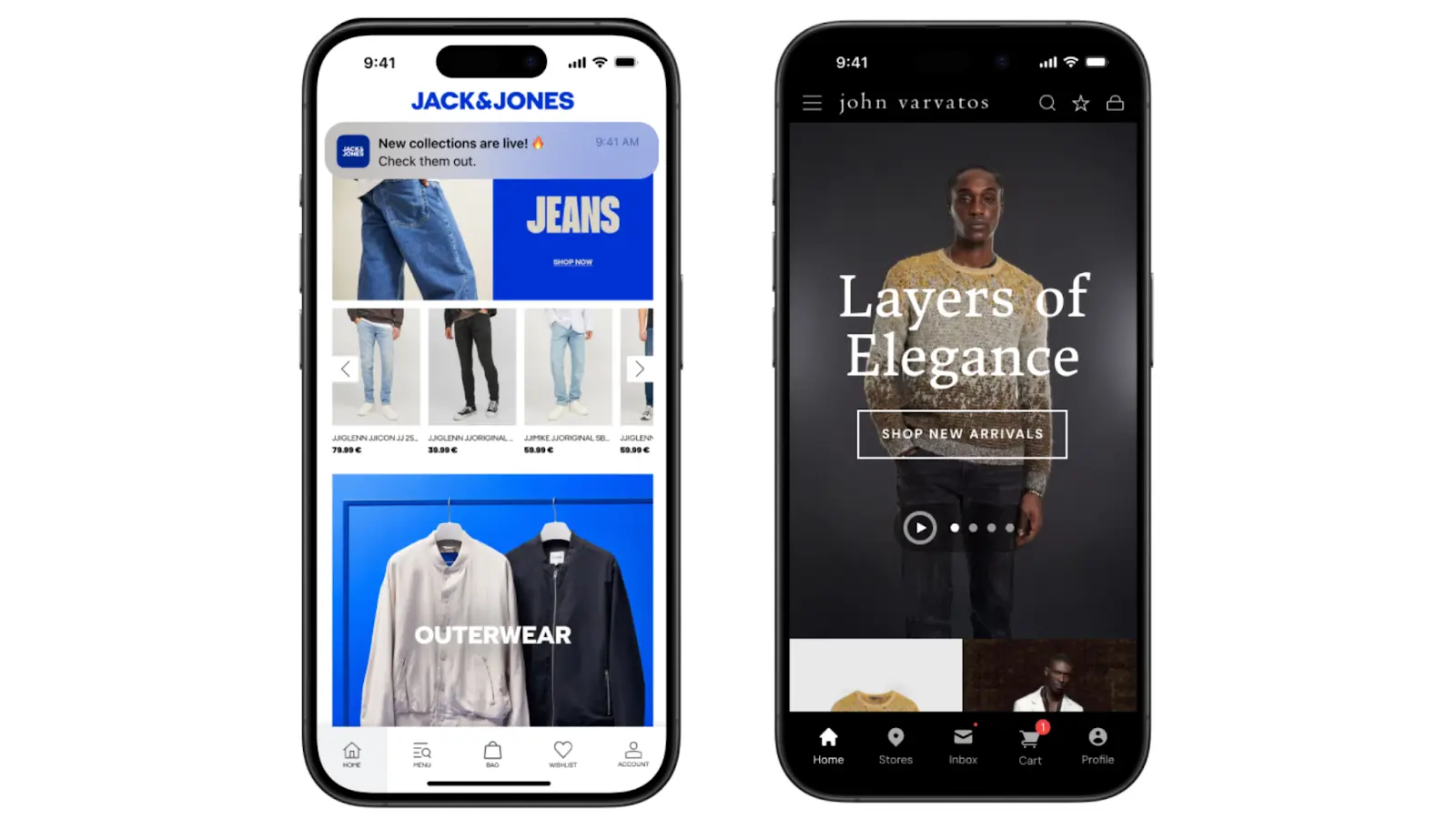
    You can read an interesting comparison by Ionic themselves here for a second opinion

    A better option: convert your site to native apps with Vendrux

    Our platform, Vendrux, is superior to Flutter and Ionic for a certain type of business. Let’s explain. 

    Vendrux isn’t a programming language or framework – we are a complete service. 

    We take your existing website or web app, and convert it into high-end iOS and Android apps.

    Vendrux apps, like Ionics, are technically hybrid. They display content from your website, via webviews, allowing you to give a consistent experience to app and web users. 

    But unlike Ionic apps, Vendrux apps are not all made from web technologies. We also add all the native elements required for you to both give your users a great UX, and to leverage the apps for full business benefits. 

    Think native navigation, push notifications, and dozens more powerful features

    Compared to both Ionic and Flutter, Vendrux has an excellent risk to reward ratio. 

    Both Flutter and Ionic will have you spend at least tens (or hundreds) of thousands of dollars and many months of effort to build decent apps. You’ll also saddle yourself with significant ongoing expenses for updates and maintenance. 

    This makes it a risky bet. 

    With Vendrux, the logic changes, and ROI becomes much more likely. 

    That’s because Vendrux costs 90% less, and the apps are ready to launch in just weeks. 

    __wf_reserved_inherit
    The Jack & Jones app – built with Vendrux

    Our team handles the entire process for you, and we also handle all ongoing updates and maintenance for the lifetime of the apps. 

    Vendrux apps update automatically with any changes you make on your site. They also allow you to reuse everything from your site, without needing to rebuild anything. 

    This, along with our full service, means that the apps will practically run themselves while you get all the benefits with virtually none of the costs. 

    Vendrux is a proven model that works great for thousands of businesses, from small startups to multibillion dollar multinationals. It works particularly well for ecommerce stores, elearning platforms, and content sites. 

    You can even preview what your app could look like, right now

    Basically – Flutter and Ionic can be good for building apps from scratch, and if you are starting off with an app. But if you’re already established on the web and have a great website – it’s a much better idea to convert it with Vendrux. 

    To learn more, get in touch with one of our app experts. They’ll answer all your questions, and help you decide if Vendrux is right for you. 

    Book a demo call today.

  • Flutter vs Expo: Which Cross-Platform Framework Should You Choose?

    Flutter vs Expo: Which Cross-Platform Framework Should You Choose?

    Flutter and Expo are two of the most popular ways to build mobile apps for iOS and Android from a single codebase. But they take fundamentally different approaches to the same goal.

    Flutter is a full framework from Google, with its own language and rendering engine. Expo is an extension of React Native, built to make React Native development faster and more accessible.

    At Vendrux, we’ve developed thousands of apps over the past 10 years, so we’ve learned a few things about the mobile world and mobile tech. 

    In this article, we’ll break down how both Flutter and Expo work, where they excel, and how to pick the right one for your project. 

    We’ll also explain when you might not need either – when converting your website into an app with Vendrux may be a better choice.

    What Is Flutter?

    Flutter is Google’s open-source framework for building cross-platform apps

    Released in 2017, it has grown into one of the most widely adopted mobile development frameworks in the world, with over 1 million monthly active developers and nearly 30% of new iOS apps built with it.

    Flutter uses Dart, a programming language originally created by Google. Dart compiles ahead-of-time (AOT) into native machine code for each platform, which is a big part of why Flutter apps perform as well as they do.

    What makes Flutter distinctive is its rendering approach. Instead of relying on the platform’s native UI components, Flutter draws every pixel on screen using its own rendering engine. 

    On mobile, this is now Impeller, a purpose-built engine that replaced Skia (which Flutter still uses for web and desktop). 

    Impeller eliminates shader compilation jank and delivers up to 50% faster frame rasterization compared to the old Skia pipeline.

    The result: pixel-perfect control over the UI, consistent rendering across platforms, and performance that rivals truly native apps.

    Flutter also supports web, Windows, macOS, and Linux from the same codebase, though mobile remains its primary strength. We covered Flutter’s fundamentals in more detail in our Flutter 101 guide.

    What Is Expo?

    To understand Expo, you need to understand React Native.

    React Native is Meta’s open-source framework for building mobile apps using JavaScript and React. Unlike Flutter, which draws its own UI, React Native translates your JavaScript components into actual native platform views: UIKit on iOS, Android Views on Android. 

    The end result uses real native components, not a custom rendering engine.

    Expo is built on top of React Native. It started as a way to simplify the setup and development process, but it has grown into something much more integral. 

    As of 2026, Expo is the officially recommended way to start new React Native projects, according to React Native’s own documentation.

    Here’s what Expo adds to the React Native experience:

    • Managed workflow and EAS (Expo Application Services): Cloud-based build, submit, and update services. You don’t need Xcode or Android Studio installed locally to ship an app.
    • Expo Router: A file-based routing system (similar to Next.js) that handles deep linking, navigation, and universal links out of the box.
    • Expo Modules API: A modern way to write native modules in Swift and Kotlin without ejecting from the managed workflow.
    • Over-the-air updates: Push code changes to users instantly, bypassing app store review cycles for non-native changes.
    • Expo Go: A companion app that lets you preview your project on real devices during development, without compiling a full build.

    Expo has matured well beyond a “convenience layer.” Over 2,200 top-trending iOS apps use Expo libraries, and the framework handles everything from build tooling to deployment pipelines.

    Flutter vs Expo: Key Differences

    Here’s a side-by-side look at the core differences.

    Flutter Expo (React Native)
    Language Dart JavaScript / TypeScript
    UI approach Custom engine (Impeller). Draws every pixel. Renders native platform UI components
    Backed by Google Meta (RN) + Expo team
    Platforms iOS, Android, Web, Windows, macOS, Linux iOS, Android, Web (experimental)
    Learning curve Moderate. Requires learning Dart + widget system Lower for JS/React devs. Steeper if new to React
    Hot reload Yes (stateful, incl. web) Yes (fast refresh via Metro)
    Native code access Full, via platform channels Full, via Expo Modules API or bare workflow
    OTA updates Not built-in (third-party options) Built-in via EAS Update
    Build system Local (Flutter CLI) Cloud (EAS Build) or local
    Community ~175K GitHub stars, strong in Europe/Asia ~121K GitHub stars (RN), dominant in US market

    Architecture

    This is where the two frameworks differ most fundamentally.

    Flutter compiles Dart code directly to native ARM machine code (or x64 for desktop). At runtime, Flutter doesn’t use the platform’s native UI toolkit at all. It renders everything through Impeller (on mobile) or Skia (on web/desktop), giving developers complete control over every pixel on screen.

    Expo / React Native takes a different approach. Your JavaScript code runs in a JavaScript engine (Hermes, by default) within the app. Since January 2026, React Native uses the New Architecture exclusively: JSI (JavaScript Interface) allows JavaScript to call native code directly through C++ bindings, Fabric handles UI rendering using real native components, and TurboModules provide lazy-loaded, type-safe access to native APIs.

    This is a significant change from React Native’s earlier design, which used an asynchronous “bridge” to serialize messages between JavaScript and native code. 

    That bridge has been completely removed as of React Native 0.82. The performance gap between the two frameworks has narrowed considerably as a result.

    Both approaches are “cross-platform native” in different ways. Flutter controls rendering at the pixel level. React Native delegates rendering to the platform’s own native components. Neither is a “hybrid” framework in the traditional sense (that term properly refers to WebView-based tools like Cordova or Ionic).

    UI and Design

    Flutter is known for design freedom. Its extensive widget catalog includes components that follow both Material Design (Android) and Cupertino (iOS) guidelines, plus the ability to build entirely custom UIs. 

    Because Flutter controls every pixel, you can create animations, transitions, and visual effects that would be difficult or impossible to achieve by relying on native components alone.

    Expo / React Native renders actual native UI components, which means your app automatically looks and feels like it belongs on each platform. This is an advantage for apps that should feel “native” to iOS or Android users. 

    The component library is solid for standard interfaces, and Expo’s UI library (heading toward 1.0 in mid-2026) aims for API parity with SwiftUI and Jetpack Compose.

    For most business applications, both frameworks produce clean, professional interfaces. Flutter has the edge for apps with heavy custom animations, complex graphics, or UIs that need to look identical across platforms. Expo has the edge when you want platform-native look and feel with less effort.

    Performance

    Flutter has traditionally held a performance advantage, particularly for graphically intensive workloads. 

    A SynergyBoat benchmark found Flutter iOS frame times of 1.72ms vs. React Native’s 16.65ms, with Flutter achieving 117.75 FPS at 120Hz on Android.

    That said, the New Architecture has closed a lot of this gap for typical app workloads. JSI’s synchronous native calls and Fabric’s optimized rendering mean most business apps built with Expo will perform indistinguishably from Flutter equivalents in real-world use. 

    The difference shows up primarily in:

    • High-frame-rate animations and transitions
    • Custom rendering and drawing
    • Apps with extremely complex, layered UIs
    • Games or media-heavy interfaces

    For standard ecommerce apps, content apps, productivity tools, and most B2B applications, both frameworks deliver smooth, responsive experiences.

    Learning Curve and Developer Experience

    Flutter requires learning Dart, which most developers won’t know already. Dart itself is approachable (similar to Java, Kotlin, or TypeScript in syntax), but Flutter’s widget-based architecture and reactive programming model have their own learning curve. 

    The payoff is a well-integrated development experience where the language, framework, and tooling were all designed to work together.

    Expo benefits enormously from the JavaScript/React ecosystem. If your team already builds with React on the web, the transition to React Native + Expo is significantly smoother. 

    You’re using familiar patterns (components, hooks, state management) in a familiar language, with an ecosystem of npm packages you already know.

    This is the single biggest factor in most teams’ decisions. The Stack Overflow 2025 survey shows React Native slightly ahead among professional developers (13.62% vs 12.56%), and React Native job postings outnumber Flutter’s roughly 6:1 in the US market.

    Ecosystem and Community

    Both frameworks have massive, active communities.

    Flutter: ~175,000 GitHub stars, 12,400+ contributors, and a strong package ecosystem through pub.dev. Google’s investment has been consistent, with eight stable releases shipped in 2025 alone. The ecosystem is particularly strong in Europe and Asia.

    React Native + Expo: ~121,000 GitHub stars for React Native, with Expo adding its own extensive library ecosystem. The npm ecosystem gives React Native access to a broader pool of JavaScript packages. Weekly npm downloads for React Native have grown to approximately 4.5 million. The ecosystem dominates in North America.

    Apps Built with Each Framework

    Both frameworks power apps at the highest scale.

    Expo / React Native apps include:

    Flutter apps include:

    These aren’t hobby projects. Both frameworks handle the performance, scale, and reliability requirements of apps with millions of daily active users.

    Which Should You Choose?

    The honest answer: it depends on your team and your project.

    Expo (React Native) is likely the better choice if:

    • Your team already works with JavaScript, TypeScript, or React
    • You want the fastest path from idea to app store
    • Your app uses standard UI patterns (lists, forms, navigation, media)
    • You need over-the-air updates for rapid iteration
    • You’re hiring in the US market (larger talent pool)

    Flutter is likely the better choice if:

    • Your app relies on custom animations, complex graphics, or pixel-perfect design
    • You need to target desktop platforms (Windows, macOS, Linux) alongside mobile
    • You’re building something visually distinctive that doesn’t follow standard platform patterns
    • You want a single framework that handles its own rendering end-to-end
    • Your team is open to learning Dart (or already knows it)

    Both are excellent, production-proven frameworks. For most business applications, either one will deliver a solid result. 

    The deciding factor is usually your team’s existing skills, not the frameworks’ technical capabilities.

    The Shared Challenge: Time, Cost, and Risk

    Whether you choose Flutter or Expo, you’re committing to a significant investment.

    Building a production-quality app with either framework typically means:

    • $100K+ in development costs (see our cost breakdown)
    • 3-6 months to reach the app stores with a v1
    • Ongoing maintenance, including OS updates, dependency management, and feature work, often costing $30K-50K+ annually
    • Separate QA, deployment, and monitoring processes for your mobile codebase

    For companies building something genuinely new, like a social platform, a game, a fintech tool, or an app with novel interactions, that investment makes sense. These frameworks exist to build things that don’t exist yet.

    But many businesses aren’t in that situation. If you already have a website or web app that does what your customers need, rebuilding that functionality from scratch in Dart or React Native may not be the best use of your budget.

    When Your Website Is Already the Product

    If your mobile app needs to deliver the same experience as your website (which is the case for most ecommerce brands, content publishers, SaaS products, and membership businesses) there’s a faster path.

    Vendrux takes your existing website and extends it into native iOS and Android apps.

    Your full site, including every feature, integration, and piece of custom functionality, works in the app from day one. 

    On top of that, you get the native capabilities that make apps worth having: push notifications, app store presence, native navigation, and deep linking.

    Jack & Jones and John Varvatos are two global brands that preferred Vendrux’s approach to convert their websites into apps

    Here’s the practical difference:

    Flutter / Expo Vendrux
    Timeline 3-6+ months Weeks
    Cost $100K+ build, $30-50K+/yr maintenance Predictable monthly pricing, no revenue share
    Your involvement Hire or manage a dev team We handle everything
    Feature parity with site Rebuild from scratch Automatic, real-time sync
    Ongoing maintenance Your team’s responsibility Fully managed by Vendrux

    This isn’t the right fit for everyone. If you’re building a game, a camera app, or something that doesn’t have a web equivalent, you need Flutter or Expo. 

    But if you already have a website that works well on mobile and you want that same experience in the app stores with push notifications and native UX, rebuilding it from scratch is hard to justify.

    Vendrux powers apps for 2,000+ businesses, from startups to global brands like Jack & Jones and John Varvatos. The model is straightforward:

    1. Book a strategy call. We’ll look at your site, talk about your goals, and assess whether it’s a good fit.
    2. Get a custom app preview. Our team builds a working preview so you can see exactly how your app will look and feel.
    3. Launch in 30 days. We handle the build, configuration, testing, and app store submission. You focus on your business.

    Want to see what your site would look like as an app? Get a free strategy call now – no commitment required.

  • Flutter vs Dart – What’s the Difference?

    Flutter vs Dart – What’s the Difference?

    These days when you start researching app development – you’ll come across Flutter and Dart. 

    This confuses some. Are they the same thing? Which one do I use? 

    Flutter and Dart are intimately related. While Flutter is a cross-platform framework for building apps for iOS, Android, and desktop – Dart is the programming language used to develop Flutter apps. 

    In this article we’re going to explain everything clearly, teaching you everything you need to know about Flutter vs Dart. 

    Frameworks vs Programming Languages

    The key difference between Flutter and Dart: Flutter is a framework while Dart is a programming language. 

    In software development – a programming language is a bit like a human language, except it is specifically for communicating with and sending instructions to a computer. It’s a set of syntactical and semantic rules that let programmers send specific tasks to the computer, which together create sophisticated programs and applications. 

    __wf_reserved_inherit
    Programming languages – how humans talk to machines

    There are many programming languages you’ve probably heard of, like Python, JavaScript, C++, and countless others. Though these are very different and suited to different tasks, on some level they are all just “languages” for telling computers what to do. 


    Dart is a programming language too. 

    Flutter on the other hand is a framework. 

    A framework is a set of tools and best practices designed to help developers build applications. They provide libraries, pre-written code, templates, and commonly used components to help with common development tasks and goals. 

    Frameworks are usually for a specific programming language and a specific purpose. 

    For example:

    • React is a framework for JavaScript, used to build user interfaces for web development
    • Angular is a framework for HTML and TypeScript, used to build single page apps 
    • Django is a Python framework used for web development 

    If the programming language is the building blocks of the language – nouns, verbs, syntax and so forth. The framework could be seen as the style guide or a specialized dictionary designed to help you write as efficiently and effectively for specific tasks. 

    In this context – Flutter is a Dart framework for cross-platform app development. 

    In the next section, we will look more closely at each for deeper context. 

    What is Dart?

    Dart is now best known as the programming language of Flutter, but it has a more complex history. 

    Released by Google way back in November 2013, Dart was originally intended as a replacement for JavaScript for building web apps. 

    It never fulfilled this lofty goal, JavaScript is still the undisputed king of the web, but Dart has found its place as the language of cross-platform app development through Flutter. 

    __wf_reserved_inherit
    Dart is known for its hot reload

    Broadly, Dart is known for its intuitive syntax and great developer productivity features. We can understand it better by looking at its key features. Dart is:

    • Object Oriented: Dart is designed for a programming style that relies on “objects”, which are self-contained “entities” consisting of both data and methods. Think of them as “things” in the code which have both specific characteristics and “actions” they can perform
    • Class Defined: objects in Dart are defined by “classes”, which is like a recipe or blueprint for making an object. Classes define what data an object can hold and what it can do with it
    • C style Syntax: this just means that the way the language is written is similar to C, which is known for curly braces { } and semicolons. If you have experience in languages like C++ or Java you’ll have an easier time learning Dart
    • Sound Type System: Dart is very careful about types of data, this helps programmers to catch mistakes quickly and make code less buggy 

    A programming language is compiled when it is transformed by a compiler into machine code – the famous 1s and 0s. This compiled code is directly executable by the computer’s hardware.

    Dart has two types of compilation:

    • Just-in-time (JIT): used in development, allows parts of the code to be compiled in “real time” so developers can see changes instantly 
    • Ahead-of-time (AOT): used when the app is ready for production build and to be compiled into an entire codebase for different platforms

    JIT is great for the developer experience, allowing for features like hot reload, which lets you see changes in the code instantly.

    AOT, along with Flutter, gives Dart its powerful cross-platform capabilities. Traditionally when you built iOS and Android apps for example you’d need to write two separate codebases in the (very) different native languages of each. You’d also need to maintain them completely separately. 

    With Dart (and Flutter) compiling into native code for each platform, you can work from a single codebase which is far more efficient. 

    Now let’s move on to take a look at Flutter. 

    What is Flutter? 

    Flutter is a cross platform framework that uses Dart as its programming language. 

    You can think of frameworks a bit like “toolkits” that make specific programming languages much more practical to use for certain purposes. 

    Flutter is the toolkit that lets you use Dart to create iOS, Android, web, and even desktop applications from a single codebase. 

    It provides a comprehensive UI toolkit, with a rich set of widgets and tools designed to build user interfaces. 

    __wf_reserved_inherit
    Flutter is used for many famous apps

    With Flutter, everything the user sees in the interface is a widget – from simple elements like text and buttons to complex structures like scrollable lists. 

    The widgets are “made” with Dart code, and are “drawn” aka rendered onto the device’s screen with Skia, a 2D graphics engine relied on heavily by Google. Widgets are also organized hierarchically – Flutter apps are fundamentally a tree of widgets.

    Flutter has really taken the app development world by storm in recent years.

    To build high-end apps from a single codebase is a major time and money saver for countless businesses, and Flutter powers thousands of successful apps like AliBaba, ByteDance, and Google Classroom. 

    You can learn about Flutter in much more depth in this article.

    Now we understand Flutter vs Dart at the fundamental level. Let’s look more specifically at how they interact. 

    How do Flutter and Dart work Together? 

    With Dart and Flutter together, you can create iOS, Android, web, and even desktop applications from a single codebase. 

    An important point to note though – Dart itself isn’t only for Flutter. 

    Recall that it was originally intended as a replacement for Javascript? 

    Dart is a Turing complete, general purpose programming language. This essentially means that it can be used for a wide range (theoretically any) range of programming tasks and challenges. 

    For example, you can use Dart to build web applications with Dart Web to compile Dart to JavaScript so it can run in a web browser. Dart can also be used for server-side programming, allowing Dart programmers to write sophisticated back ends. 

    So, Dart doesn’t “need” Flutter. 

    But, Flutter does need Dart, and indeed Dart has gained popularity and fame through its association with Flutter. 

    Dart is perfect for Flutter. Many of its features, like JIT and AOT compilation, make it very suitable for the high performance, efficiency, and fast development cycles Flutter aims for.

    Dart is the foundation, which Flutter then extends to make it perfect for cross-platform app development. Flutter’s extremely rich library of pre-designed, customized widgets (written with Dart) make it easy to create almost any UI element conceivable. 

    This gives Dart developers an “out of the box” set of building blocks to create the UI, building blocks that would be highly tedious and laborious to write in Dart from scratch. 

    Flutter goes further in enabling Dart’s cross platform power. 

    Every widget is designed to look good and behave naturally on multiple platforms, giving a consistent UX on iOS and Android. 

    Flutter also uses Skia to render or “paint” the widgets and UI written in Dart onto the device’s screen, allowing the apps to look good and be easy to use. 

    Basically – Flutter and Dart work together in synergy to form an ecosystem for cross platform app development. 

    Ready to Build Apps?

    Hopefully, you now understand Dart vs Flutter. You know that Dart is the programming language, Flutter is the framework, and they work together to form a powerful app development combo. 

    Still though, developing apps with Flutter and Dart isn’t a cakewalk. 

    Even though it is twice as efficient as true native development from scratch, it is still a complex and expensive process requiring highly skilled specialists. 

    You’ll burn through tens of thousands and months of work to get good apps ready to launch on the App Store and Google Play. They’ll also need significant ongoing investment to keep them maintained over time.

    The same goes for any other cross-platform framework like React Native.

    An even more efficient way to get apps for both iOS and Android is Vendrux

    With Vendrux we build the apps for you. We publish them and maintain them too. 

    Our method involves converting your existing website or web app into native mobile apps. This means that you get to keep all the cool parts of your site, with all the most important native app parts added on top to give users a great experience.

    __wf_reserved_inherit
    The Jack & Jones app – built with Vendrux

    It’s of app development with Flutter, and you don’t need to hire anyone or manage anything new since the apps will update automatically.

    Check out some of 2000+ businesses using Vendrux, or get in touch with one of our team to get all your questions answered. 

    Book a demo today.

  • The DTC Operator’s Guide to First Order Profitability

    The DTC Operator’s Guide to First Order Profitability

    If you’re running a direct-to-consumer brand in 2026, you’ve probably felt the ground shift beneath your feet more than once. 

    The days of cheap Facebook ads and endless VC cash infusions are long gone, replaced by a landscape where profitability isn’t just a buzzword – it’s necessary if you’re going to survive.

    Enter first order profitability, a metric that’s been thrust into the spotlight as DTC operators grapple with rising costs and shrinking margins. 

    But what does it really mean, why should you care, and how do you balance it with the holy grail of retention? Let’s dive in and learn more.

    Want the latest insights into how 7, 8 and 9-figure brands are driving sustainable growth? That’s what you get with our weekly newsletter, The Retention Edge. Subscribe for free today.

    What is First Order Profitability?

    First Order Profitability is the ability to make a profit on a customer’s very first purchase after factoring in:

    • Customer Acquisition Costs (CAC) – Ad spend and other costs to acquire a customer.
    • Cost of Goods Sold (COGS) – What it costs to produce and fulfill the product.
    • Shipping & Logistics Costs – Delivery, packaging, and potential returns.
    • Payment Processing Fees – The unavoidable percentage platforms like Shopify, Stripe, or PayPal take.

    Picture this: a customer lands on your site, lured by a killer ad or a glowing recommendation. They buy your product (say, a $50 skincare set). 

    You celebrate the sale, but then the math kicks in. After subtracting CAC, COGS, and operational expenses like shipping or payment processing, are you still in the black? 

    If yes, congrats—you’ve achieved first order profitability. 

    If not, you’re banking on that customer coming back (preferably soon), or else you’ve lost money.

    Brands that can profit on the first sale have a major advantage:

    • They don’t rely on risky long-term payback periods.
    • They reinvest profits into scaling faster, without burning cash.
    • They have a clearer idea of the health of their business.

    For years, DTC brands played the “spend now, profit later” game, assuming strong Lifetime Value would make up for high acquisition costs. 

    But post-iOS 14, the old playbook of “lose money now, make it up later” started looking like a shaky bet, leading to much more talk about the importance of making immediate profit.

    Why First Order Profit is a Key Lever for DTC Brands

    Cash flow is the lifeblood of any business, and first order profitability is like a turbocharger for your cash conversion cycle. 

    When you’re profitable on that very first sale, you’re not just waiting around for months (or years) to recoup your investment. 

    That money can go straight back into inventory, ads, or hiring the next rockstar team member. 

    In an era where venture capital isn’t raining down like it did in the 2010s, bootstrapped brands and cash-efficient operators are leaning hard into FOP to keep the lights on.

    Retention is key for long-term profit and sustainability; but it can be hard to bank on revenue you haven’t realized yet.

    There’s no guarantee that a new customer will meet your current LTV benchmarks, and there’s no guarantee that they’ll come back in the near future.

    Thus if you can achieve a profit straight away, you’re in a safer spot to start thinking ahead to your next scaling move.

    When First Order Profit Comes Second

    While you’d always love to make a profit on your initial sale, there are situations where taking a loss on the first order makes strategic sense.

    Some categories can afford to take a hit upfront because the backend payoff is so juicy.

    It’s not that they don’t want to make a profit immediately; but competition in these industries tends to make it necessary to spend more to acquire new customers.

    Here are the kinds of business which might not be thinking about first order profit as a priority.

    Subscription & Consumables Brands (e.g., Supplements, Skincare, Coffee)

    These brands know that if a customer buys once, they’re likely to buy again and again.

    The real money is in LTV, not the first sale.

    There’s also a predictable re-up cycle (e.g. a daily supplement might contain 30 servings, giving you a clear idea of when someone’s likely to repurchase), so it’s easier to plan ahead for when you’re likely to see CAC paid off.

    High-LTV, Habit-Forming Products

    With products like haircare, pet food, meal kits, coffee pods, razors, once a customer is in, they tend to stick.

    These brands can afford a loss on the first sale if they’re confident in retention (and are big enough that they can weather those losses long enough for LTV to pay off).

    Brands with Low CAC via Organic/Referral Growth

    Then there’s the lucky few with strong organic acquisition. 

    If your brand’s killing it with user-generated content, referrals, or SEO, and customers are practically falling into your lap at low cost, negative first order profitability might not keep you up at night.

    Think brands like Feastables (MrBeast’s chocolate); high organic traffic = lower CAC = easier to sustain lower first order profitability on paid ads.

    These brands will often use that advantage to pump more money into paid ads and run aggressive acquisition strategies that lose money up front, but drive wide brand recognition that scales long-term.

    Brands Playing with VC Money

    Brands with millions of VC backing, can afford to throw buckets of money at ads to drive growth at whatever cost is necessary.

    However this is becoming rarer and rarer in DTC today. Funding is drying up, and those brands that did follow the “growth at all costs” playbook are finding it difficult to transition to a profitable operating model.

    Where First Order Profitability is Essential vs Where It’s Optional

    Where your brand sits on the business model spectrum dictates how much you should obsess over making a profit on the initial sale. 

    For some, it’s non-negotiable. For others, the winning strategy may be to overpay for acquisition, because the long-term repeat purchase value is so high.

    For example, Matthew Bertulli, CEO of Pela Case, explained how first order profitability is vital for his business, as they don’t have the reliable repeat purchase rates to justify losses on the initial sale.

    ✅ Must-Have FOP:

    • One-Time Purchase Categories
      • Mattresses (Casper, Purple)
      • Luxury goods (high-end watches, jewelry)
      • Wedding-related products (rings, accessories, gifts)
    • Low-Repeat Categories
      • Novelty products (customized gifts, holiday items)
      • Niche DTC (one-off high-ticket gadgets)
    • Businesses with Weak Retention Pathways
      • If your AOV is low and there’s no strong upsell, FOP is non-negotiable.

    ❌ Can Lose on First Order:

    • Subscription-heavy brands (e.g., Daily Harvest, Ritual, Hims)
    • CPG with strong repeat purchase behavior (e.g., Magic Spoon, Athletic Greens)
    • Membership-based models (e.g., Costco, ButcherBox)

    Why You Won’t Scale With First Order Profitability Alone

    Making a profit on the first sale is great, but you don’t want to fall into the trap of optimizing everything around this, and ignoring LTV.

    First order profitability keeps the lights on, but LTV is how your brand scales, and withstands bumps in Meta ad costs and underperforming ad campaigns.

    Obsess over the initial profit too much, and you risk building a business that’s all about short-term wins, but falls apart when the landscape gets tougher and CAC goes up.

    Without retention, you’re stuck on an acquisition treadmill—constantly chasing new customers to replace the ones you couldn’t keep.

    The most successful brands find a balance between both initial profit and long-term revenue, and once they have enough of a buffer, start to funnel more focus (and investment) into retention.

    The Sustainable Scaling Playbook

    Here’s how you keep your brand in business, but build the stage for long-term, sustainable growth and high LTV.

    Do the following to improve first order profitability:

    • Boost AOV with bundles, cart drawer and post-purchase upsells and personalized product recommendations.
    • Constantly test new ad creatives to optimize ads and get CAC down.
    • Limit discount offers (experiment with other incentives, such as free content or gifts).
    • Don’t offer blanket free shipping (optimize your free shipping threshold to increase AOV). 
    • Invest in UGC and affordable traffic channels (e.g. SEO) that drive cheap traffic and offset more expensive acquisition campaigns.

    At the same time:

    • Add complementary product lines and subscription offers that increase repeat purchases.
    • Work on bottom of funnel traffic generation to build your email & SMS lists.
    • Set up automated email & SMS sequences (welcome sequences, abandoned cart, post-purchase, winback campaigns) that run on autopilot.
    • Funnel your top customers into branded communities and mobile apps (driving more engagement from your top spenders).

    If you have healthy first order profitability and dependable retention revenue, DTC is a great game to be in.

    Final Thoughts: Play to Your Strengths

    So, as you tweak your ad budgets, rethink your pricing, and test those checkout flows, keep the big picture in mind. 

    First order profitability matters. It’s your ticket to cash flow and stability in a brutal market. 

    But in the long-term, retention matters just as much.

    If your brand can balance the two, you’ve got a good chance at not just staying afloat, but winning.