Category: Ecommerce

  • 19 Tips for Your Black Friday Ecommerce Strategy

    19 Tips for Your Black Friday Ecommerce Strategy

    Black Friday is a huge opportunity for ecommerce businesses to boost revenue, create extra cash flow, and take steps towards building a bigger business long-term.

    But you need to approach Black Friday (and the days/weeks surrounding Black Friday) with a carefully planned strategy. You can’t simply expect sales to go through the roof just because it’s Black Friday.

    If you fail to plan, you plan to fail, as the saying goes. This article is here to help you plan. Read on as we help you build a powerful Black Friday ecommerce marketing strategy that will deliver a long-term boost to your store.

    Want to learn how to drive low-cost sales and better retention this Black Friday? Get the 2025 BFCM Mobile App Playbook to learn why apps are a competitive advantage, and how to ace Cyber Week with mobile apps & push notifications.

    Why is Black Friday Such a Big Deal for Ecommerce?

    Over the years, Black Friday has morphed into the shopping event of the year.

    It’s no longer just the “Friday after Thanksgiving”. Thanksgiving is now the “Thursday before Black Friday”.

    Consumers have become accustomed to finding great Black Friday deals, along with deals the days before and after. And for more and more people, online shopping (ecommerce sites and shopping apps) is the first place they look when they want to buy something.

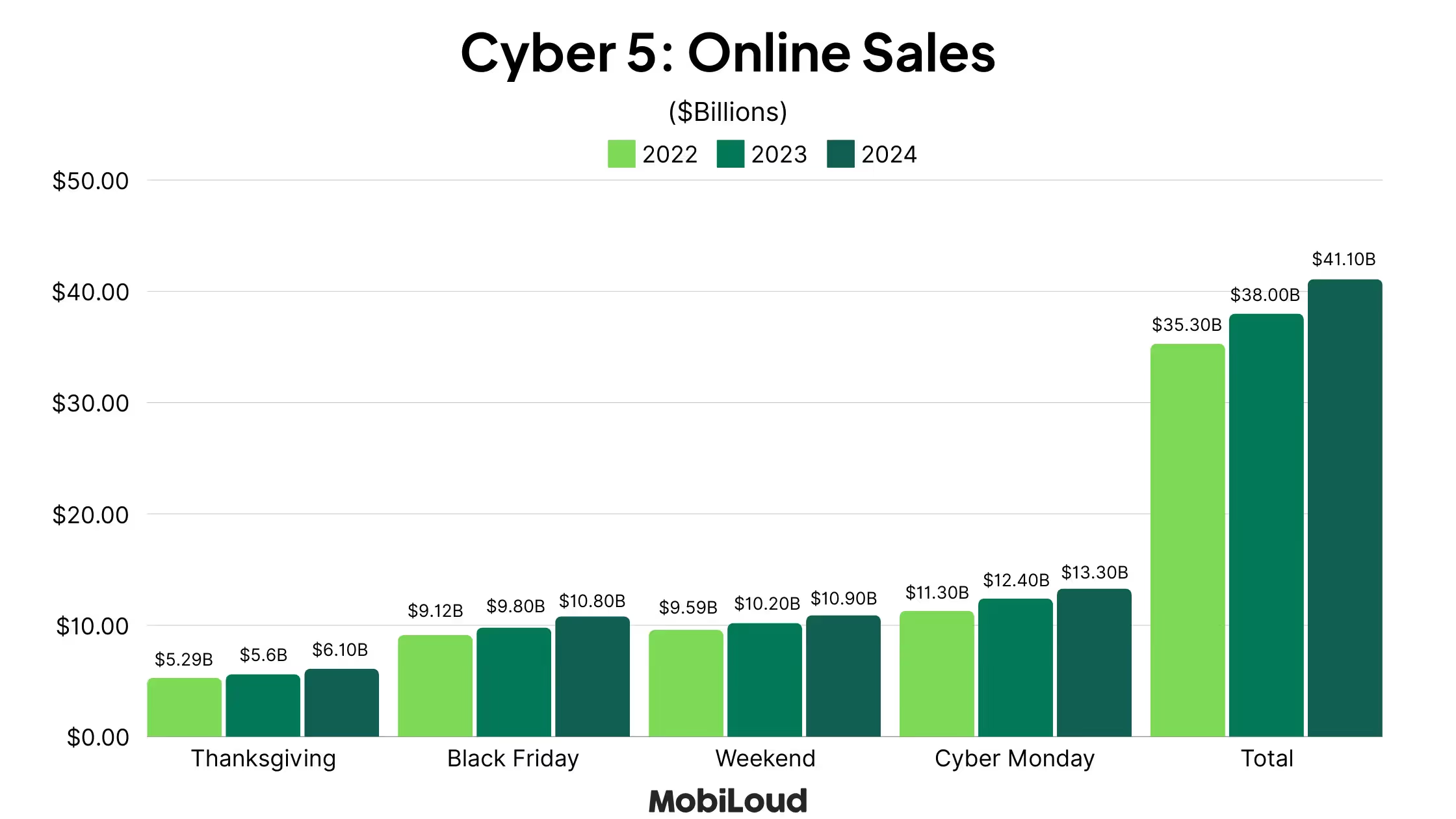
    They come with a herd mentality that leads to huge amounts of money spent online. In 2022, Black Friday accounted for $9.12 billion in ecommerce sales. 

    In addition, conversion rates are significantly higher, with Adobe Analytics showing average conversion rates of 5.6% on desktop and 3.3% on mobile during Black Friday.

    According to Shopify, conversion rates for Shopify Plus merchants were even higher, at 7.38% on average over Black Friday.

    To put these figures in perspective, the average ecommerce conversion rate year-round is 1.89%.

    More active online shoppers means a big opportunity for your store. But it also means more competition which is why a smart Black Friday marketing strategy is important.

    Check out more Black Friday statistics

    “Black Friday” is No Longer Just Friday

    When we say “Black Friday”, we’re not only talking about one day.

    At one point, this was a one-day shopping event, but as Prime Day is now a two-day event, Black Friday has morphed into a week-long gold rush.

    Cyber Monday is actually a bigger day for ecommerce merchants than Black Friday. Cyber Monday sales totaled $13.3 billion in 2024, $2.5 billion higher than Black Friday and the highest single day of the holiday shopping season.

    The increase in conversion rate is bigger as well, with 6.9% on desktop and 3.6% on mobile.

    Overall, “Cyber Week” generated $41.1 billion in sales in 2024. And each year, more merchants are starting earlier and extending the BFCM (Black Friday-Cyber Monday) excitement later, to further capitalize on the benefit they get out of the year’s top shopping event.

    Some even refer to “Black November” instead of Black Friday, as a lot of retailers run sales over the whole month, instead of waiting for Cyber Week to begin.
    Thinking Long-Term About BFCM

    Similar to how Black Friday is not just a one-day event, smart brands don’t approach BFCM as an isolated event, only seeking a short-term boost. It’s an opportunity to build long-term momentum and bring new, loyal customers into your brand.

    Short-sighted businesses see BFCM as a cash grab. Smart businesses use BFCM to build relationships and leverage the excitement of Black Friday into long-term benefits.

    With the December holiday season coming up right after Cyber Week, you really need to be thinking long-term. A five-day increase in revenue and a spike in cash flow is great, but bringing new fans in for your brand who continue to shop with you through December is better.

    19 Black Friday Ecommerce Strategy Tips

    Now let’s move on to a bumper list of proven tips to help you get the most out of Black Friday, Cyber Monday and the surrounding days for your ecommerce business.

    1. Make Sure Your Site is Fast and Responsive

    Before you start thinking about how to win Black Friday, first make sure you don’t lose it.

    You’ll lose Black Friday if your site is too slow or if there are technical issues with your site that drive shoppers away. Speed and responsiveness are always important, but with more people shopping during BFCM, their importance is magnified.

    Longer time for a page to load has been proven to increase bounce rate, potentially by as much as 123%. You can expect an even shorter leash during Black Friday with the competition for consumers’ attention.

    And as responsiveness goes, any site that’s not mobile-friendly today is missing out on a huge share of their audience. Expect the share of mobile vs desktop traffic to skew even heavier in favor of mobile over Black Friday/Cyber Monday. Data from Shopify stores in 2021’s BFCM period showed 71% of purchases were made on mobile, as more people go for the convenience of being able to shop from their phone.

    2. Be Prepared for Increased Activity

    There’s no point dreaming up a list of unique Black Friday marketing ideas if you can’t actually handle the increased activity. So spend the time leading up to Cyber Week making sure you’re ready for a hectic sales week.

    There are a number of facets to this. Inventory is one. You need enough stock to handle more sales. Many unprepared retailers cap their Black Friday gains by running out of stock because they didn’t plan ahead.

    Your website also needs to be able to handle an increase in traffic. Make sure your hosting and the technical architecture of your site is not going to give out if you end up getting 4-5x your usual traffic numbers.

    Finally, make sure you have enough staff to keep business operations running smoothly. Get all hands on deck from your support team, and have team members ready to answer customers’ questions immediately. You can’t leave customers waiting 24 hours to get an answer – by then they’ll have already taken a similar deal from a competitor.

    3. Audit Your UX and Checkout Flow

    With more traffic on your site, the shopping experience becomes all the more important. Small issues are magnified. Things that may have cost you a few hundred in lost sales in an ordinary weekend could cost you tens of thousands during Black Friday/Cyber Monday.

    Before Black Friday, do a self-audit of the customer journey and look for any areas you can improve. You need to ensure the navigation is smooth, intuitive and easy to locate. Make your CTAs big, bold and obvious. Look through every part of your site from a CRO angle. Minimal improvements will make a big difference come late November.

    Look at your checkout flow and see if there are any opportunities to make this smoother and more streamlined. During BFCM, customers will be rushing to finish their purchase and start looking for the next deal. Anything you can do to remove friction from the buying process and make impulse purchases easier will result in a lot of extra sales.

    4. Automatically Apply Discount Codes

    As part of your checkout flow, it’s a good idea to cut out the friction of having to enter discount codes.

    This just adds hassle for the customer. They might forget the code, they might enter the wrong code, or they might not realize they need to enter a discount code, check out, and come back upset when they realize they paid full price.

    Discount codes are a good marketing tool – they make the promotion feel more exclusive and are great for generating shares and helping your Black Friday sale go viral. But during a big promotional period like Cyber Week, they can also be a barrier to conversions.

    If you use codes, have them automatically applied at checkout, or do away with codes entirely (but still show the savings in the checkout flow).

    5. Supersize Your Deals

    Black Friday is not the time to offer 5% off. Even 10-20% off is unlikely to raise many eyebrows.

    Shoppers will be seeing big discounts all over the internet during BFCM, so you need to up your game to stay competitive. As long as your margins can afford it, Black Friday is the time to go big.

    Discounts in the range of 35% off, 45% off or 50%+ get people excited.

    This might temporarily hurt your profit margins, but you get a range of benefits to make up for it, such as increased cash flow. More importantly, you introduce people to your brand and acquire new customers who you can market to in the future for full-price, high-margin sales.

    6. Offer Exclusive Discounts to Your Top Customers

    Leverage BFCM to boost loyalty with customers who have already shown an inclination towards your brand. Along with promotions to a wide audience, you can run exclusive, higher value promotions specifically for your “VIP” customers.

    How you define your VIPs is up to you – it could be people who have spent over a certain threshold, those who have made multiple purchases, or even everyone on your email list who has bought from you in the past.

    For these customers, getting an exclusive discount cultivates good vibes, making them feel special and appreciated. Many will remember this feeling later, and come back to buy from you again, as well as providing positive reviews and testimonials that further boost your brand.

    7. Run Strategic Promotions

    There’s no getting around the fact that running high-discount promotions will put a bit of a dent in your margins.

    A lot of merchants try to hedge their bets and offer smaller discounts to maintain margin, and end up with little benefit while still losing out on profit.

    A better way to do it is to use high-discount promotions strategically to help boost sales of higher-margin products. You essentially make these promotions your Loss Leaders – products that get customers in the door, where you can market other products to them or make a cross-sell which makes you more money.

    For example, you could run a big promotion on one product, then advertise accessories for this product in the checkout flow or as a follow-up email. Or you could heavily discount consumable products, with the idea that customers will come back and re-order at full price at a later time.

    8. Push Subscription Products

    Subscriptions are another way to use big promotions in a strategic way. Consumable subscription products bring their value not from just a single order, but from the long-term value of customers who subscribe and pay you every month, 90 days, or whatever the subscription term is.

    Things like supplements, beauty products, food products and even clothing in some cases work well as regular subscriptions. For BFCM you can offer these subscriptions at a huge discount – potentially even giving the first month free, or close to it, with the idea that the deal will be too good to pass up on, and then once you’ve got them hooked, a lot of customers will keep paying the regular subscription price.

    Just make sure you have some previous data for your subscription products that shows the churn rate (the rate of customers who cancel their subscription) is relatively low. You can expect a higher churn rate from people who got a discount on the initial purchase, so if this number is already high you might make a loss from your promotion in the end.

    9. Promote Bundles and Threshold Discounts

    Another great discount strategy is to offer attractive discounts for people who spend above a certain threshold.

    The higher the order value, the higher the discount you can afford to give. So instead of just offering a blanket 50% discount across your store, you can offer a big money-off discount for people who spend $100, or $150, for example (check your average order value and set this threshold comfortably above what people regularly spend).

    Similarly you can promote bundles or deals that require multiple products in an order, such as a Buy Two Get One deal, or a discount that unlocks when a customer buys X number of products.

    Learn more about the average order value in ecommerce and how to increase it in this article.

    10. Use Scarcity and Urgency

    You need to make your promotion feel exclusive and make potential buyers feel like they need to act now if they want to take advantage.

    That’s why most successful online retailers lean heavily on scarcity and urgency tactics.

    Scarcity is the idea that there are only a certain number of discounts available, while urgency is the idea that there discount will only be around for a limited time.

    Both achieve the same goal: to make the shopper take action. This helps you close the sale when you have the customer’s attention – more often than not, if they leave, they’re not coming back.

    You may need to manufacture these two states somehow. Though there is some innate sense of urgency with BFCM (it doesn’t last forever), five days (for a promotion running from Thursday to Monday) doesn’t really convey the kind of urgency that tells people it’s now or never. And as far as scarcity goes, you might actually want as many people to participate in the promotion as possible, but customers will be more likely to take action if they feel like there’s only a limited number of discounts available.

    11. Rotate Promotions Throughout BFCM

    Rotating promotions are a great way to manufacture scarcity and urgency without making anything up, as well as keeping things fresh for people who visit your store multiple times over Cyber Week.

    For example, you might start with a 12 hour promotion offering 50% off on a particular product line. When the 12 hours are up, it could be Buy One Get One on a different set of products. Later, you run a flash one-hour discount offering 75% off on one product, limited to X number of redemptions.

    This generates excitement, along with the scarcity and urgency you want, making customers feel like a deal will be gone soon if they don’t act fast. It also incentivizes people to keep coming back to regularly check your store and see what the next deal is going to be.

    Amazon executes this strategy brilliantly during Prime Day. They constantly change promotions over the 2-day event, with deals only available for a limited time.

    If you’re wondering whether this works, Amazon did an estimated $12 billion in sales for Prime Day 2023, doing almost as much as Black Friday + Cyber Monday on their own.

    12. Run Gamified Promotions

    Another way to make your Black Friday marketing campaigns stand out is to use gamification.

    Gamification means using game mechanics in your promotions to make them more fun and engaging. Common gamification strategies in marketing include “spin to win” games, mystery coupons, and challenges that unlock more discounts.

    A gamified “spin to win” promo on Temu.com

    An example you could use for BFCM is a ticker tracking how many discounts have been redeemed over the week. When you reach certain thresholds, new (or higher) discounts get unlocked.

    This encourages customers to spend more to unlock better deals, and also functions as social proof when shoppers see that other people have been spending big.

    If your gamified promotion is novel enough, it can even generate publicity and drive additional customers to your store.

    13. Lean On Owned Traffic Channels

    Moving from promotion strategy to customer acquisition strategy for Black Friday/Cyber Monday, the first tip is to heavily utilize owned traffic channels.

    Email is the most likely owned traffic channel you’ll have to work with, but you could also have push notifications, an SMS list or an owned audience on social media.

    Push notifications are a powerful and largely underutilized Black Friday promo channel

    Paid channels are incredibly competitive during Cyber Week, which makes them extremely expensive as well. The more owned channels you have, which allow you to get in front of people without paying, the more you can afford to offer heavy discounts without crippling your profit margins.

    14. If You Run Ads, Run Them Early

    Though competitive and expensive, paid ads are not necessarily a no-go for Cyber Week. They’re still a great way to get your Black Friday deals in front of new people. 

    But if you’re going to use paid ads as part of your Black Friday strategy, start early – perhaps even before Cyber Week.

    As it gets to Black Friday, ad prices shoot up. You can get in at more reasonable prices the earlier you run your campaigns, along with getting in front of customers before the floodgates open and every brand is competing for attention.

    This also gives the algorithm more time to optimize your ads and serve the right ads to the right people come crunch time, and allows you to build an audience that will cut costs down during the busiest part of Cyber Week.

    15. Run Personalized Ads and Promotions

    Shoppers see thousands of ads and promotions during Cyber Week. You need something to make yours stand out.

    Personalization is a great tool for ecommerce stores, particularly during BFCM. The more you can make your promotions speak directly to the customer, the better your chance of standing out from all the other “save 50% this Black Friday” emails and ads.

    If it takes more time to segment your audience and create unique offers for each customer, it’s worth it. According to Klaviyo, a high level of segmentation on marketing campaigns has the potential to return over 3x the revenue of a broad, unsegmented campaign.

    16. Use BFCM to Recover Abandoned Carts

    Black Friday and Cyber Monday are a great opportunity to capture people who were on the fence but didn’t end up completing their purchase.

    You can reach out to abandoned carts during Cyber Week to let them know the product they were looking at is now on sale, giving them a great incentive to come back, pushing them over the finish line to becoming a customer.

    17. Refresh Creatives Often

    Ad fatigue is leveled up to the nth degree during Black Friday. Ads and deals are everywhere someone looks when they go online, from their social media feed to their email inbox, and even on their phone’s lock screen.

    It’s vital you mix it up and avoid showing the same images, video or copy over and over. Potential customers will quickly become blind to your ads, automatically passing them over for fresh ads from other brands.

    18. Use Social Media to Build Excitement

    Your social media channels can help drum up excitement in the weeks leading up to Black Friday. Utilize hashtags, giveaways, teasers that promise things like “The Biggest Black Friday Ever!”

    You could run competitions to unlock limited, “early access” on upcoming Black Friday deals, or start promoting a Black Friday landing page that slowly reveals more details as it gets closer to launch.

    It’s all about building buzz and anticipation. Make it so that people are counting down until 12:01 on Friday to jump on your site or app and see what awesome deals are available.

    19. Offer App-Specific Discounts

    Black Friday is a great opportunity to build long-term revenue by setting the stage for customers to spend more over their lifetime as a customer. And getting people to download your app is one of the best ways to boost LTV.

    When someone downloads your app, they’re likely to shop with you more often and spend more in each transaction. It also lets you reach out to them with mobile push notifications, a great tool to increase engagement and order frequency.

    During Black Friday you can offer exclusive discounts only available in the app. It’s a no-brainer for the customer to download the app to get the deal, and you get a powerful touchpoint with the customer you can use to drive sales after the holidays.

    The Value of Having an App During BFCM

    There are a number of big benefits to having an app as an ecommerce store, but brands who have an app are particularly well positioned to have a great Black Friday.

    As explained in the last point, Black Friday presents the perfect situation to run app-specific discounts to get new downloads.

    An app also gives you an owned communication channel, with push notifications, that help you break through the clutter and noise on social media and email during Cyber Week.

    And when you get people into your app, it’s a contained, mobile-optimized shopping experience that will convert a higher rate of shoppers on mobile devices.

    If you don’t have an app yet, building an app for your site is easy (and fast) with Vendrux. We help you convert your entire site, as is (including any custom features or modifications) into apps for iOS and Android.

    You’ll still manage everything from the same backend (e.g. Shopify, WooCommerce, Squarespace), and anything you change your site will reflect automatically in your app.

    Examples of ecommerce Apps built with Vendrux

    You can go live with your app in as little as a month, for less than you’ll spend on ads in an hour on Black Friday. And it’s totally hands-off – our team does all the technical work for, even as far as submitting your app to the app stores.

    Book a free, personalized demo to learn more, and get the ball rolling in time for Black Friday.

    Are You Ready for BFCM 2026?

    The holiday shopping season makes or breaks retailers every year. Smart brands take advantage of Black Friday/Cyber Monday to increase online sales and generate momentum they can take into December and get more valuable holiday shoppers.

    The list of Black Friday marketing strategies presented in this post are all easily actionable tips to help you get a bigger boost during Black Friday. It’s vital you plan ahead, because a half-hearted effort at building excitement is not going to cut it when all your competitors are running their own Black Friday sales.

    It’s best to start preparing your Black Friday marketing strategy as soon as possible. Plan out your Black Friday promotions and figure out what’s going to make you stand out. Start building the assets you’re going to need during Black Friday, such as owned traffic channels (including building and launching your own app), and fix any issues with your ecommerce site (e.g. site speed and customer experience improvements).

    Do the hard work to prepare and you’ll come out of Thanksgiving weekend with a bigger and more profitable online store than ever.
  • The World’s Best Shopping Apps in 2026

    The World’s Best Shopping Apps in 2026

    US mobile commerce generates nearly $500 billion in annual spending, and shows no signs of slowing. 

    Consumers spend over 100 billion hours per year inside ecommerce apps, and the number of mobile shoppers is projected to reach 5.29 billion by 2027.

    So which apps are winning the lion’s share of the market?

    Temu has held the #1 spot on the App Store for three consecutive years. Whatnot, a live shopping platform most people hadn’t heard of in 2023, is now the fourth most-downloaded shopping app in the US. Secondhand marketplaces like Depop have cracked the top 10. And TikTok Shop generated $15.8 billion in US sales in 2025 without even having a standalone app.

    All these apps are clear signals of how modern shoppers prefer to browse and buy on mobile.

    Let’s dive in – here are the 15 best shopping apps right now, what makes each one stand out, and what brands can learn from them.

    Want weekly insights into how 7, 8 and 9-figure brands are driving sustainable growth? That’s what you get with our value-packed newsletter, The Retention Edge. Subscribe for free today.

    Types of Shopping Apps

    Not all shopping apps are the same. The shopping app market covers a range of different types of apps, big and small, branded apps and utility apps. Let’s take a quick look at these different types of shopping apps.

    Marketplace Apps

    Example: Amazon, eBay

    Marketplace apps connect buyers and sellers of all kinds of products and services. Amazon and eBay are great examples, which offer products for sale from a large number of individual sellers and small businesses.

    Because of the variety and competitive nature of sellers on online marketplaces, they typically have a wide variety of items to choose from, and offer competitive prices.

    Learn More: How to Build Your Own Marketplace Mobile App

    Brand Apps

    Example: Nike, Zara

    Brand apps are created by individual brands to sell their own products. They often provide exclusive deals and discounts to shoppers on the app, above what’s offered to in-store customers or shoppers on their website.

    Multi-Brand Retail Apps

    Example: ASOS, Target

    Multi-brand apps are retailers offering products from a range of different brands. All products are sold by a single retailer (unlike marketplace apps, which have many individual sellers), but there’s a wider selection of branded products available than with a single brand app.

    Grocery Apps

    Example: Instacart, Shipt

    These are only grocery stores, right there on your mobile device. Grocery apps are not too different from multi-brand retail apps, but specialize in groceries and household essentials. They generally allow users to create digital shopping lists and order groceries online to be delivered to their door or picked up in-store.

    Buy and Sell Apps

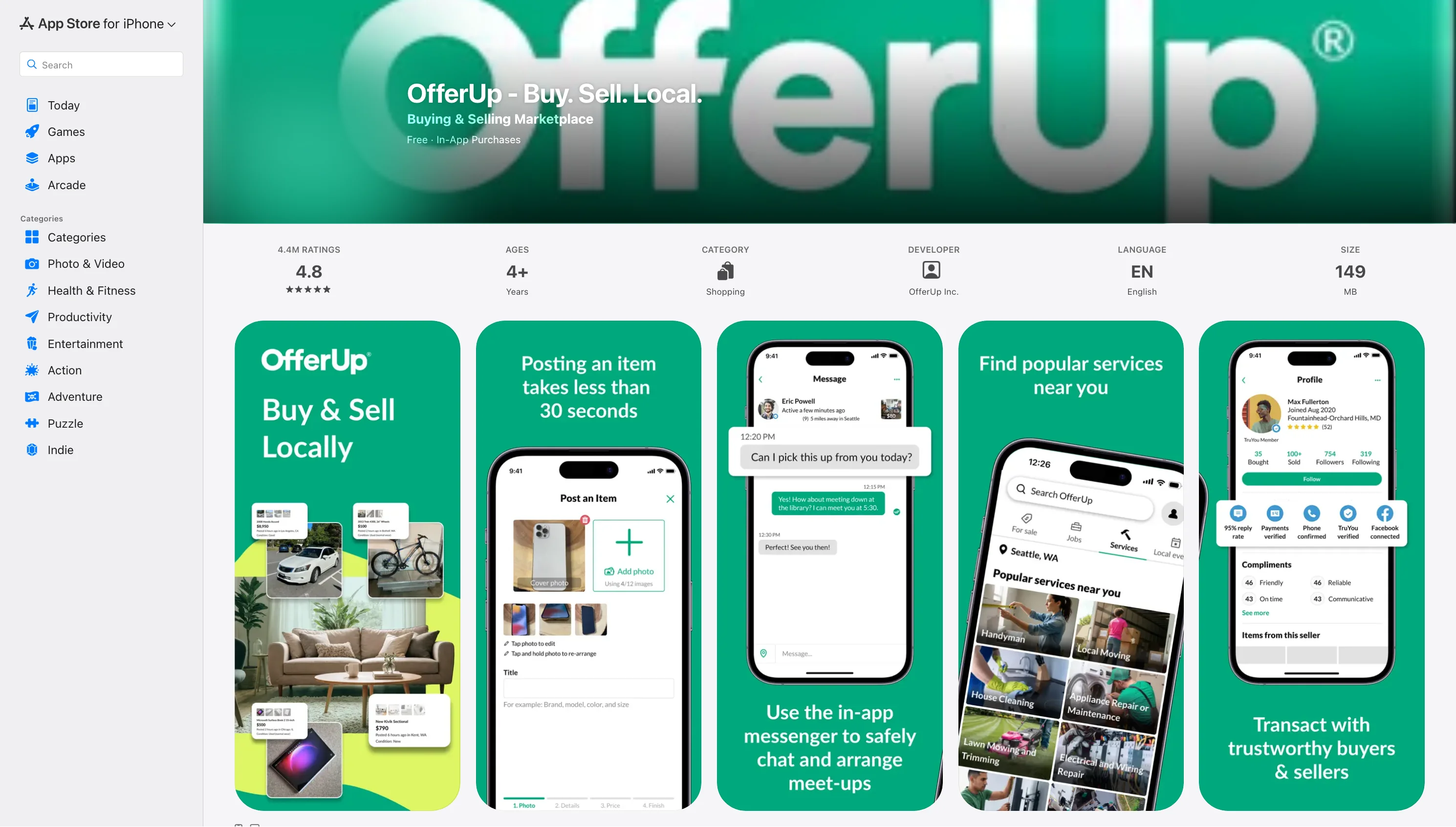
    Example: Poshmark, OfferUp

    These are apps that directly connect buyers and sellers in a less formal setting than with marketplace apps like Amazon. Like a digital thrift store, buy and sell apps are focused on used items, letting users sell old or unwanted items to other users.

    Coupon, Deal & Cashback Apps

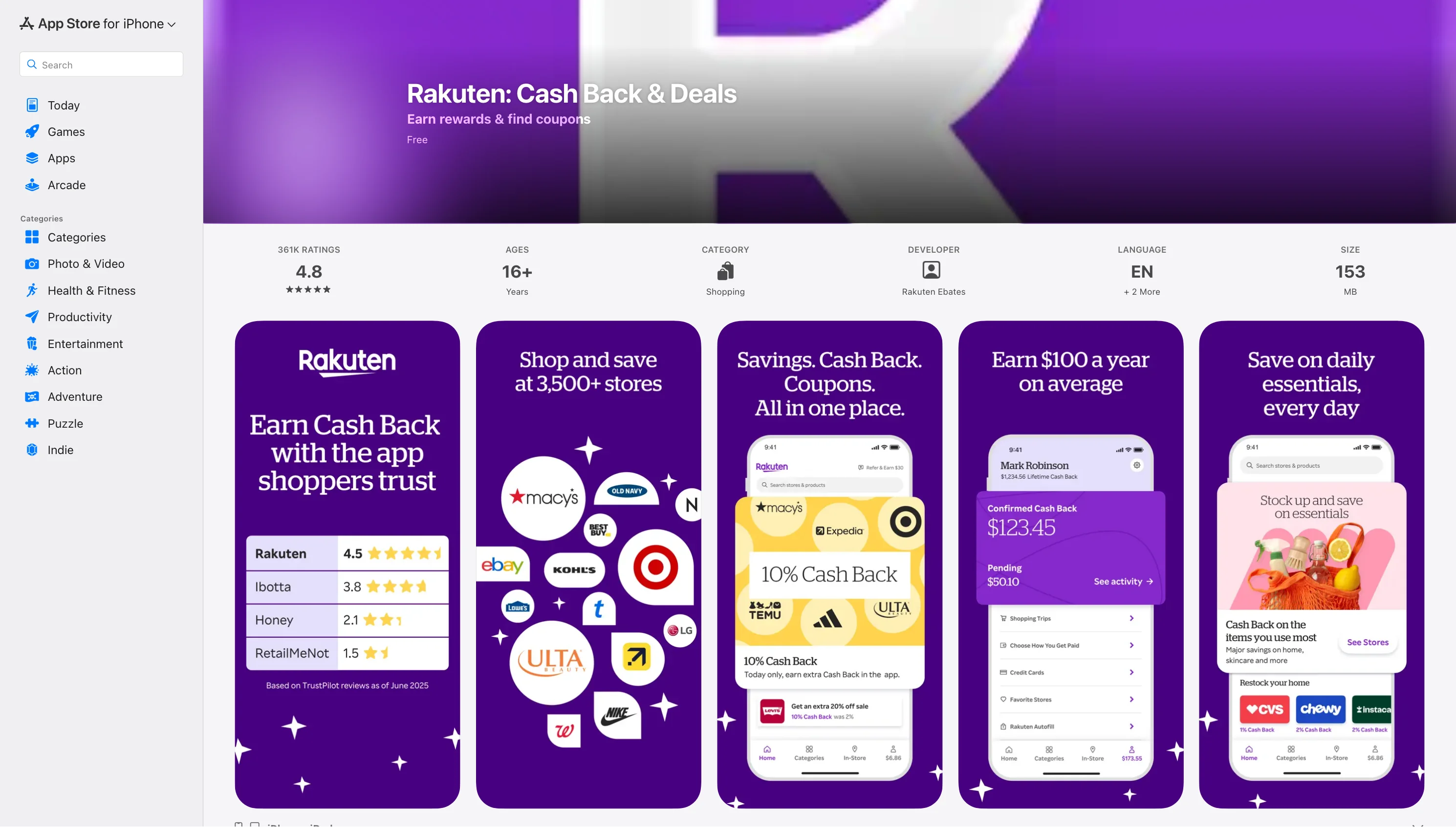
    Example: Rakuten, Groupon, Capital One Shopping

    These apps offer cashback, deals, coupons and rewards on a wide variety of products and services. They may be used in-store, on retailers’ websites, or in some cases allow shoppers to buy products on the app as well.

    Mobile app users spend more, shop more frequently, and are more loyal to your brand. Use our eCommerce App Revenue Calculator to see just how much you stand to gain by launching an app.

    Most Popular Shopping Apps on iOS

    There’s a lot of overlap between the best shopping apps and those which are most popular on the app stores.

    With that in mind, let’s take a look at the most popular shopping apps, starting with shopping apps for iPhone/iOS.

    Most Popular Shopping Apps on Android

    Here are the most popular shopping apps in the Google Play Store.

    Rank App
    1 Temu
    2 Shein
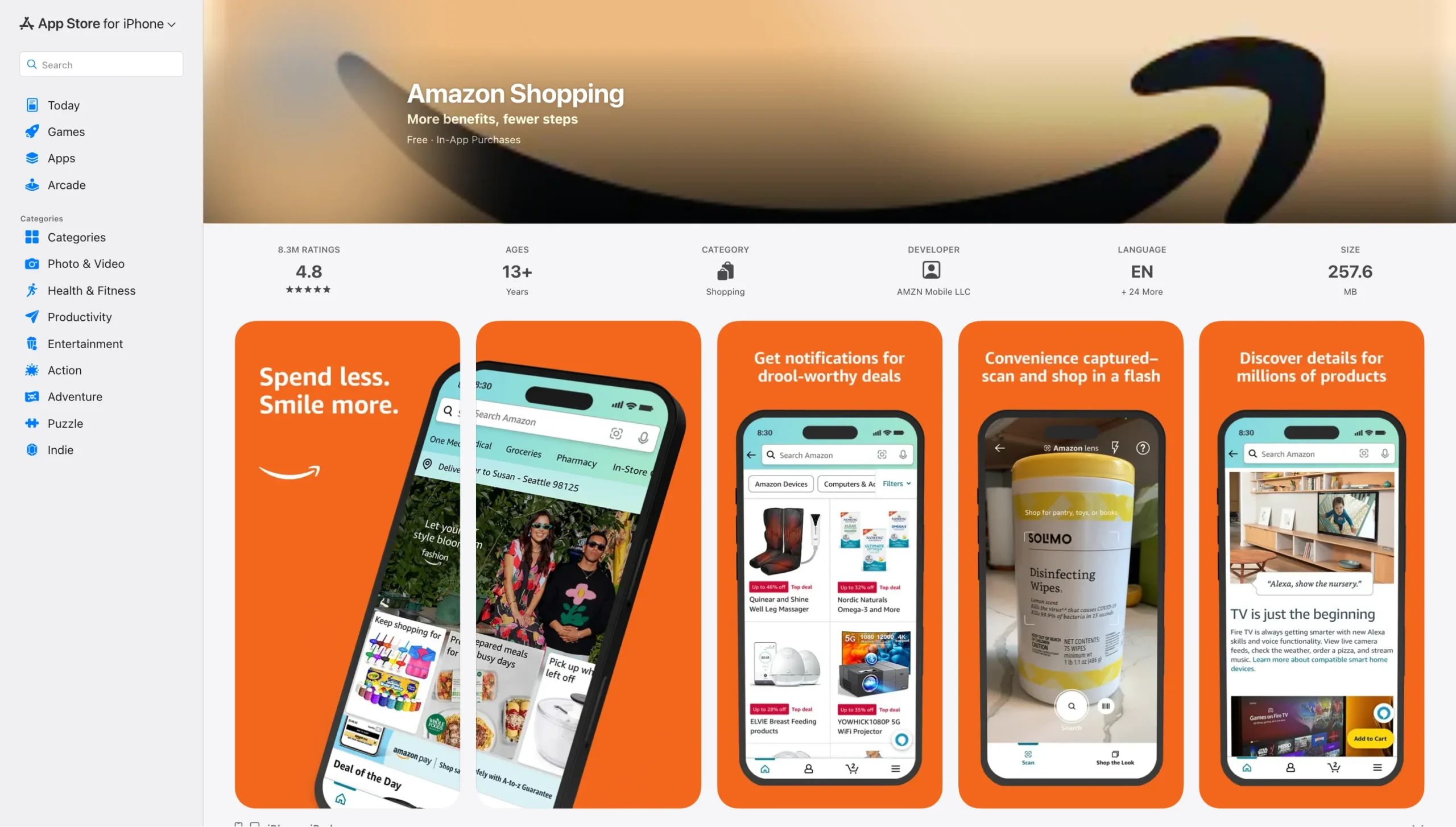
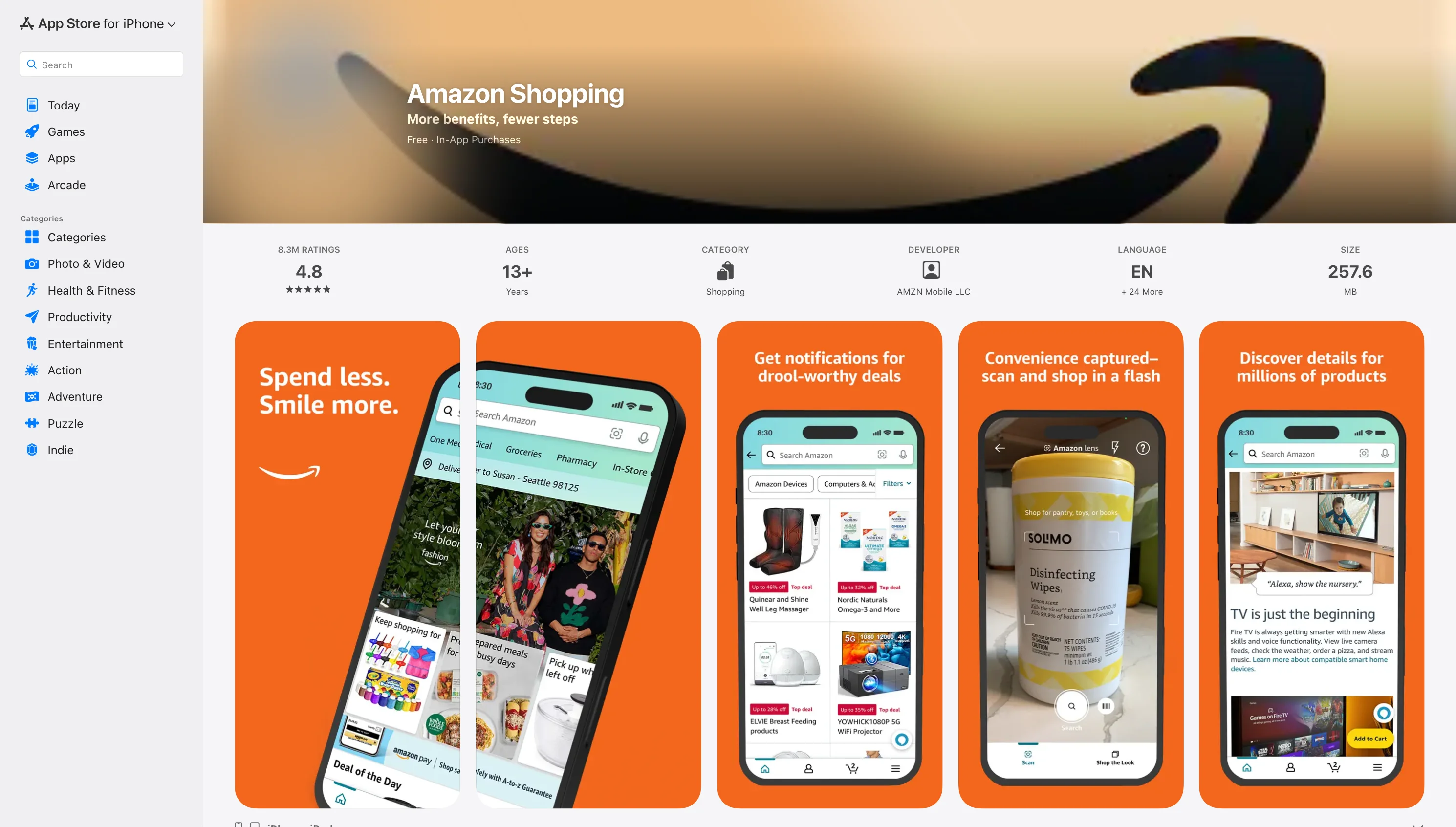
    3 Amazon Shopping
    4 Walmart
    5 AliExpress
    6 eBay
    7 Whatnot
    8 Shop (by Shopify)
    9 OfferUp
    10 Etsy
    11 Dollar General
    12 Alibaba.com

    Source: Google Play Store, Shopping category

    The Top Shopping Apps in 2026

    There are the top download charts – which we showed above. Then there are the “best” shopping apps. The apps that consistently dominate the charts (across both mobile operating systems), maintaining high ratings, and massive profiles.

    That’s what this list is – the 15 shopping apps that come first in any “best shopping apps” debate.

    Now let’s take a deeper look at the world’s best shopping apps today.

    1. Amazon

    App Store rating: 4.8/5 | Play Store rating: 4.3/5 | Downloads: 500M+ (Play Store)

    App StorePlay Store

    Amazon remains the default shopping app for most US consumers, with 105+ million monthly active mobile users. The app’s strength isn’t any single feature; it’s the combination of Prime shipping, one-tap purchasing, and a product catalog that covers practically everything.

    The app experience leans heavily on personalization: recommended products, reorder suggestions, and deal alerts based on browsing history. Subscribe & Save, same-day delivery, and in-app Alexa integration keep users coming back.

    Why it works: Convenience and trust. Amazon has trained consumers to start their product searches in the app rather than a browser.

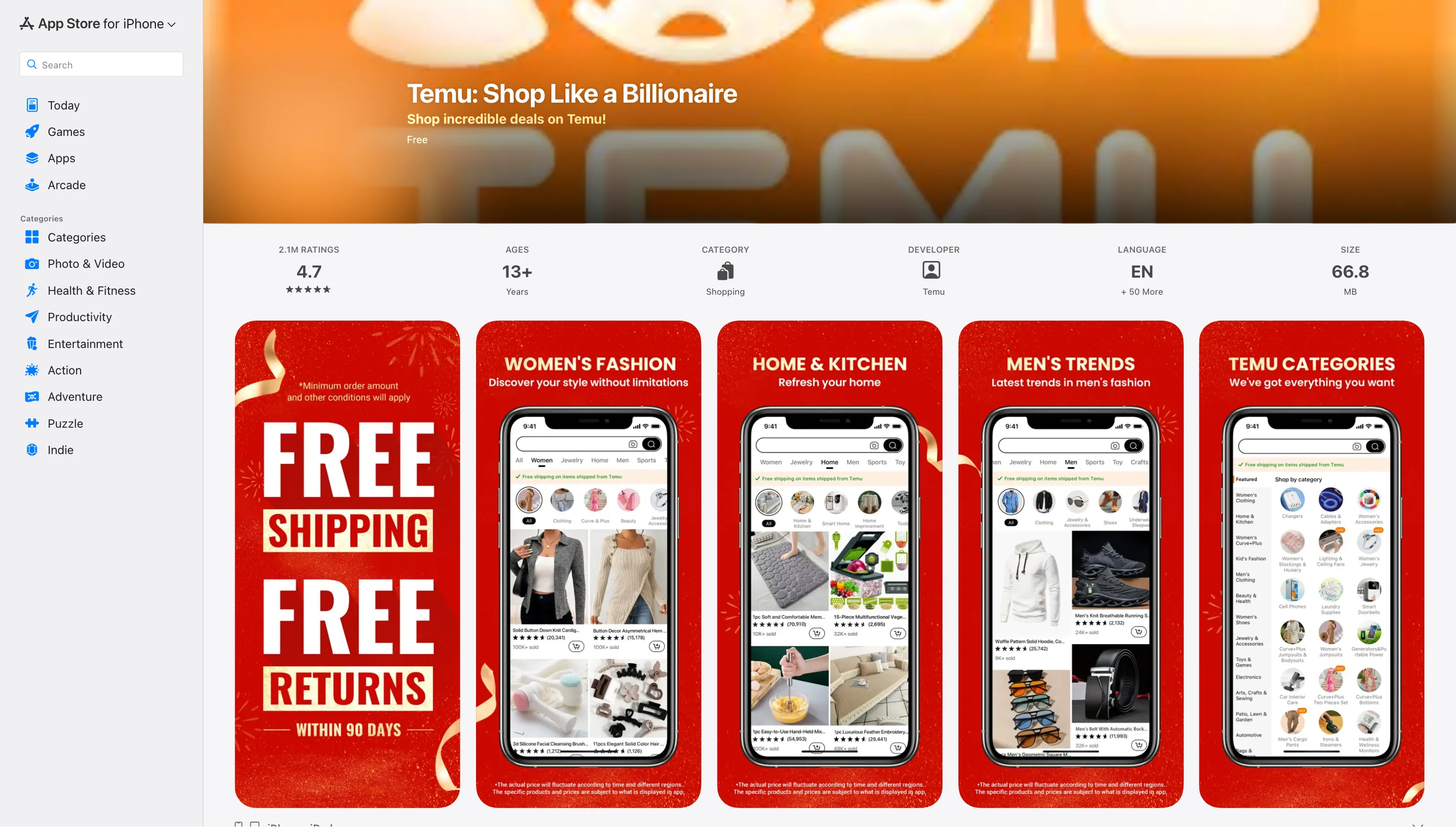
    2. Temu

    App Store rating: 4.6/5 | Play Store rating: 4.6/5 | Downloads: 500M+ (Play Store)

    App Store | Play Store

    Temu has been the #1 most-downloaded shopping app globally for three consecutive years, with 1.2 billion cumulative downloads and 530 million monthly active users at its peak. The app connects buyers directly with manufacturers, cutting out middlemen to offer prices that undercut most competitors.

    What sets Temu apart is engagement. Users spend an average of 21 minutes per session, more than double Amazon or eBay. Gamified features like spin-the-wheel discounts, group buying, and daily check-in rewards keep people opening the app.

    Why it works: Rock-bottom prices combined with addictive app mechanics that drive daily engagement.

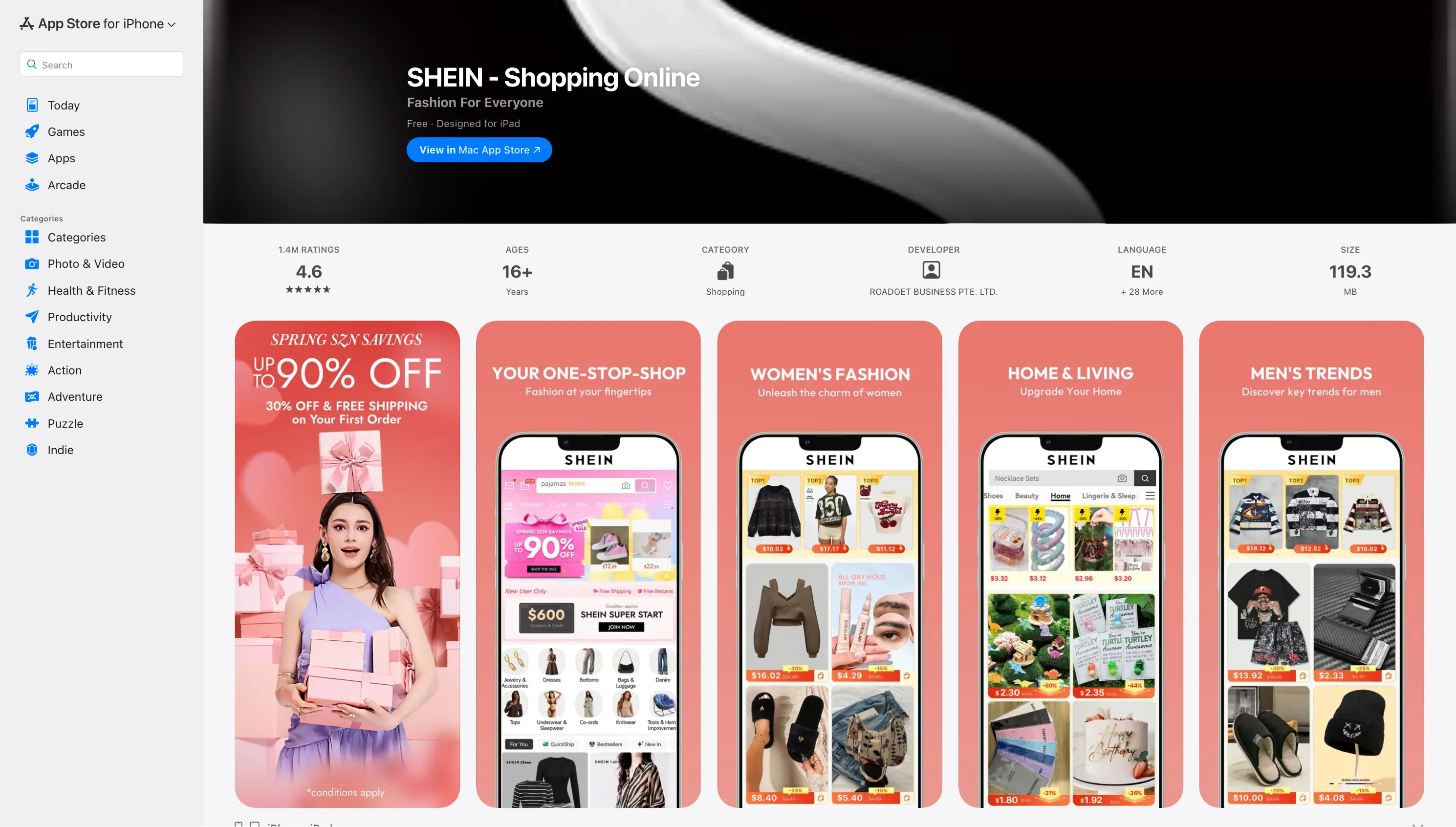
    3. Shein

    App Store rating: 4.7/5 | Play Store rating: 4.7/5 | Downloads: 100M+ (Play Store)

    App Store | Play Store

    Shein pulled in 74 million downloads in the first half of 2025 alone and maintains 215 million monthly active users globally. The app adds thousands of new styles daily, powered by a vertically integrated supply chain that moves from trend identification to finished product in as little as two weeks.

    The app experience is built around discovery. Personalized feeds, style recommendations, and user-generated outfit photos make it feel more like a social platform than a traditional store.

    Why it works: Speed-to-trend and price, delivered through a social-first app experience that resonates with Gen Z shoppers.

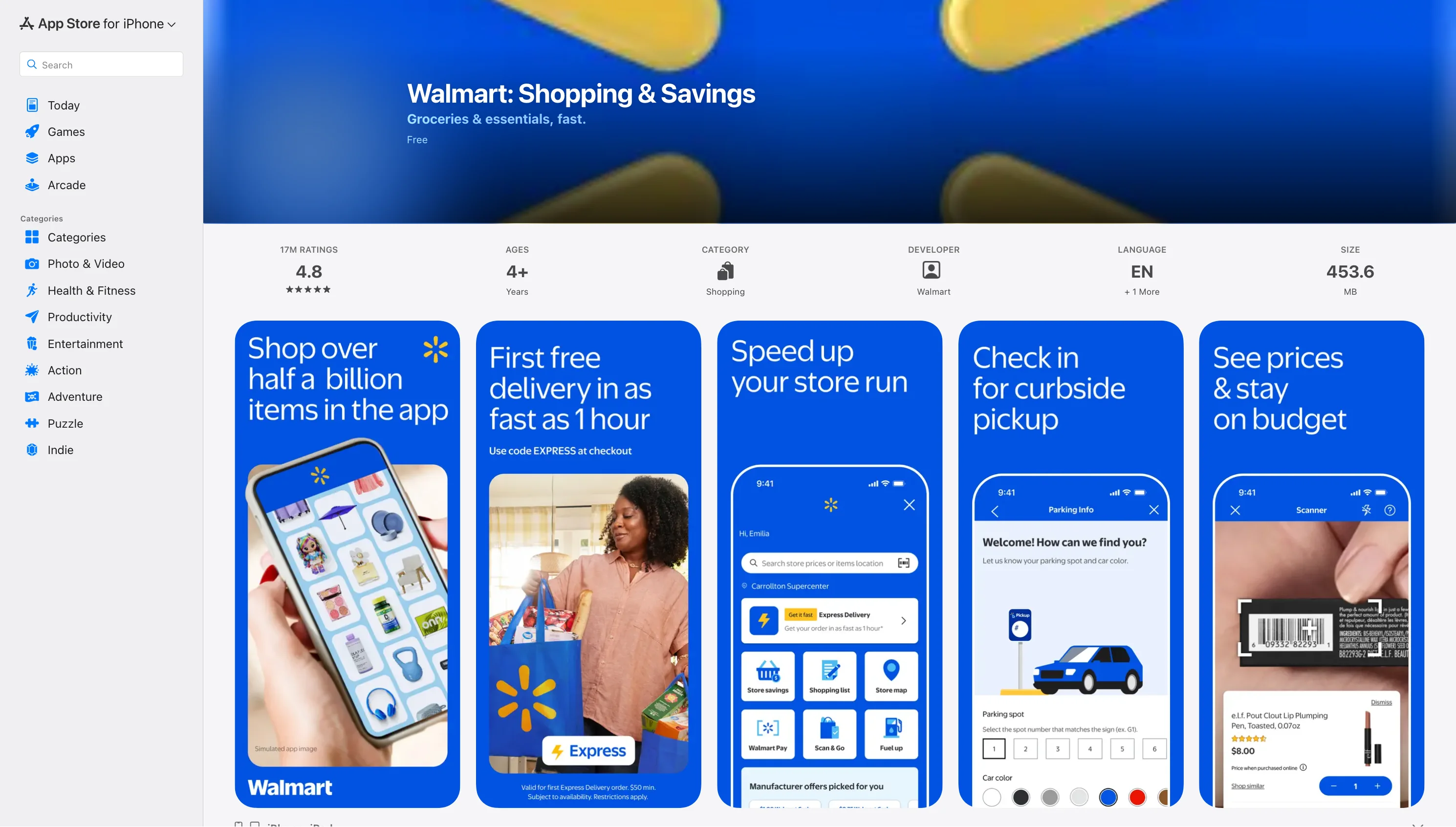
    4. Walmart

    App Store rating: 4.8/5 | Play Store rating: 4.7/5 | Downloads: 50M+ (Play Store)

    App Store | Play Store

    Walmart’s app benefits from something most pure-play ecommerce apps can’t match: 4,700 physical stores. The app bridges online and in-store seamlessly, with features like curbside pickup, in-store maps, pharmacy management, and Walmart+ membership perks including free delivery.

    With 64+ million monthly active users and a growing third-party marketplace, the app has become a genuine multi-category competitor to Amazon, particularly for groceries and everyday essentials.

    Why it works: Omnichannel integration. The app makes Walmart’s physical footprint a competitive advantage rather than a legacy burden.

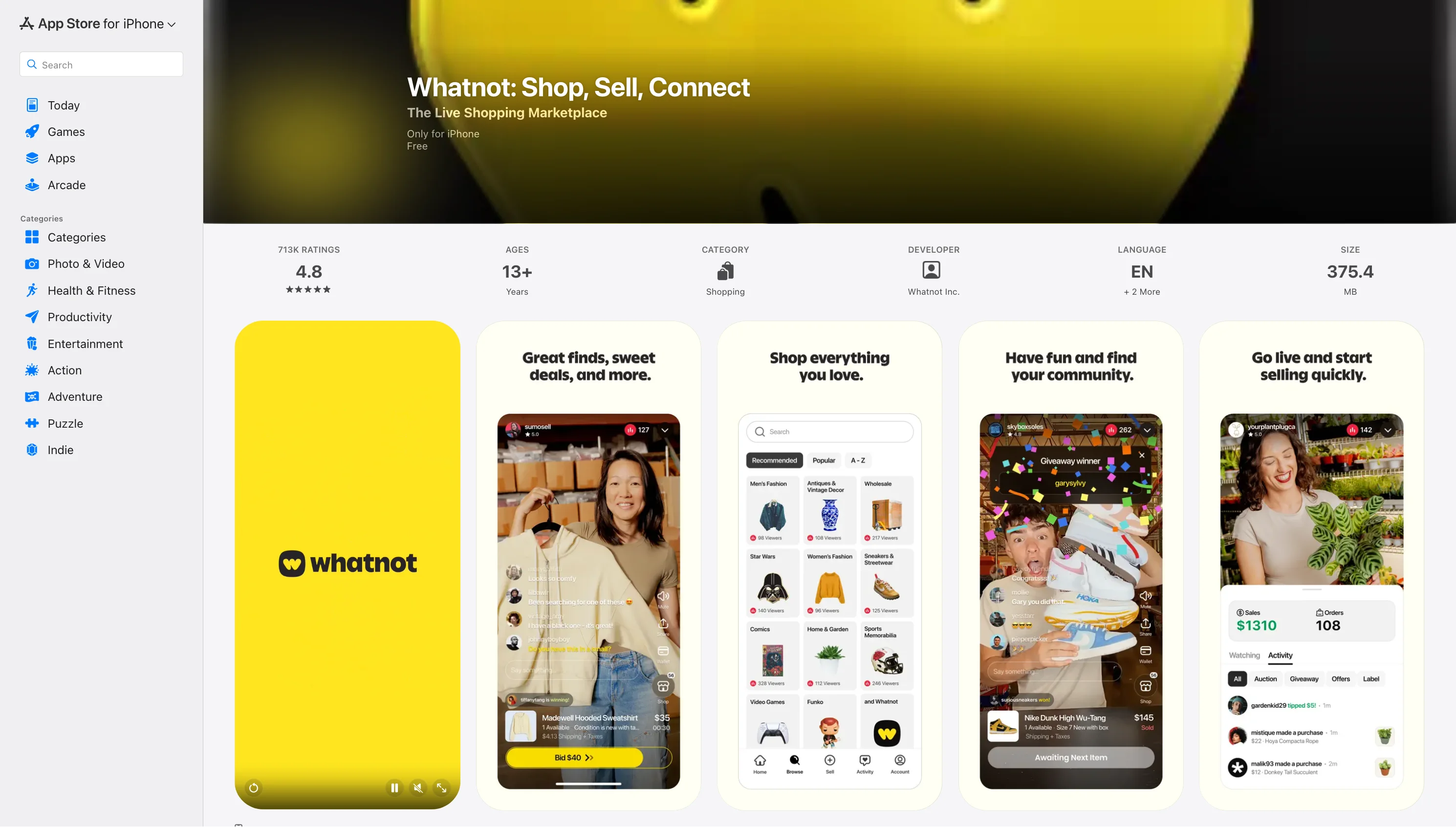
    5. Whatnot

    App Store rating: 4.9/5 | Play Store rating: 4.6/5

    App StorePlay Store

    Whatnot is the breakout shopping app of the past two years. The live auction and shopping platform saw 541% year-over-year download growth and hit $6 billion in gross merchandise value in 2025, doubling from $3 billion the year prior. Users spend an average of 80+ minutes per day on the app.

    Originally focused on collectibles like trading cards and sneakers, Whatnot has expanded into 15+ categories including food, luxury goods, and cars. The format, live video with real-time bidding, creates urgency and entertainment value that static listings can’t replicate.

    Why it works: Live commerce combines entertainment with shopping, creating engagement levels that traditional apps struggle to match.

    6. Shop (by Shopify)

    App Store | Play Store

    App Store rating: 4.8/5 | Play Store rating: 4.5/5 | Downloads: 10M+ (Play Store)

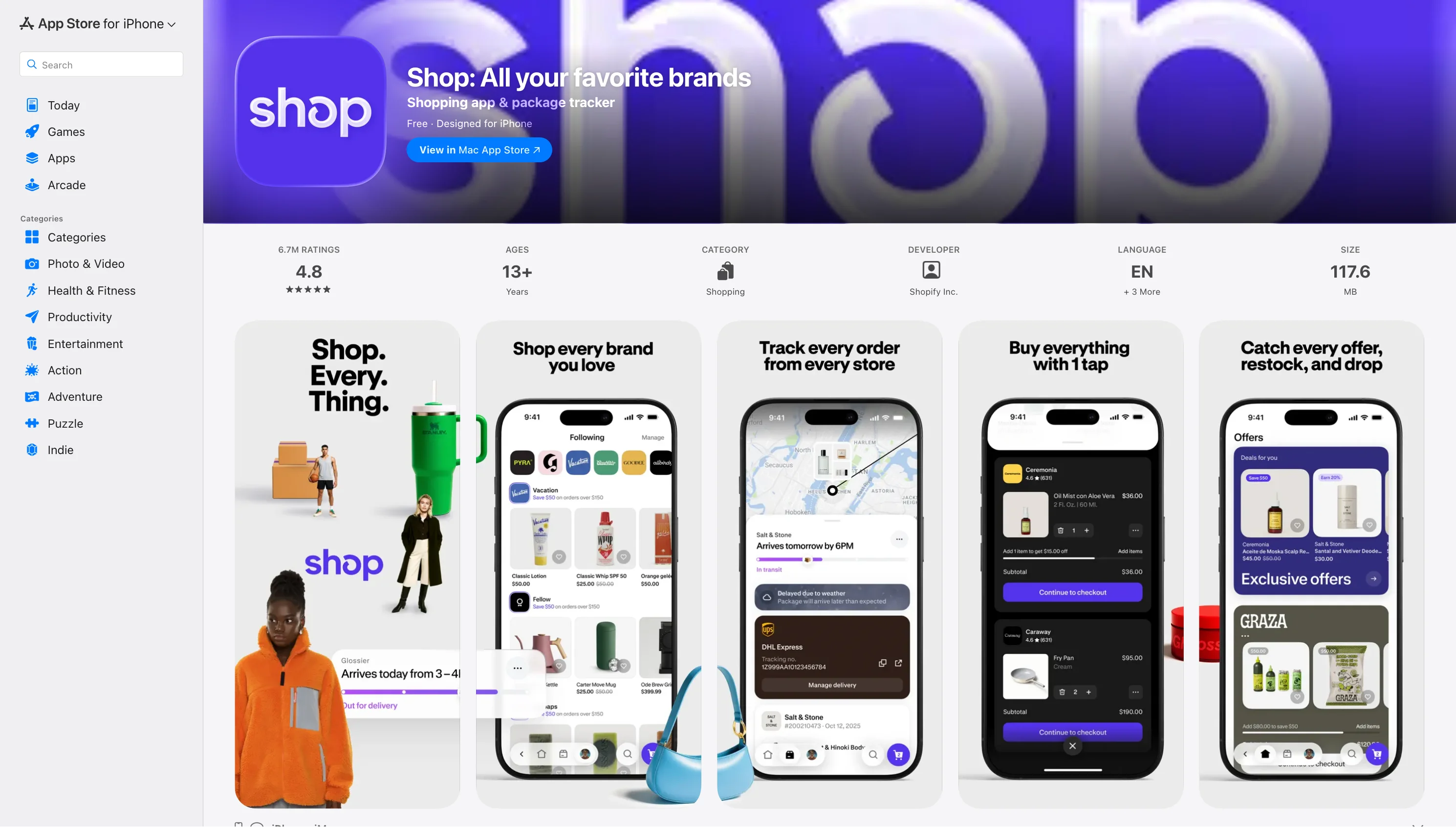
    Shop aggregates the Shopify ecosystem into a single consumer-facing app. Users can browse and buy from thousands of independent brands, track orders across all Shopify-powered stores in one place, and discover new products through personalized recommendations.

    For consumers, it’s a unified inbox for independent brand purchases. For Shopify merchants, it’s a discovery channel that puts their products alongside other brands without the competitive pressure of a traditional marketplace.

    Why it works: It gives independent brands marketplace-level visibility while letting them keep their own branding and customer relationships.

    7. eBay

    App Store rating: 4.8/5 | Play Store rating: 4.3/5 | Downloads: 500M+ (Play Store)

    App StorePlay Store

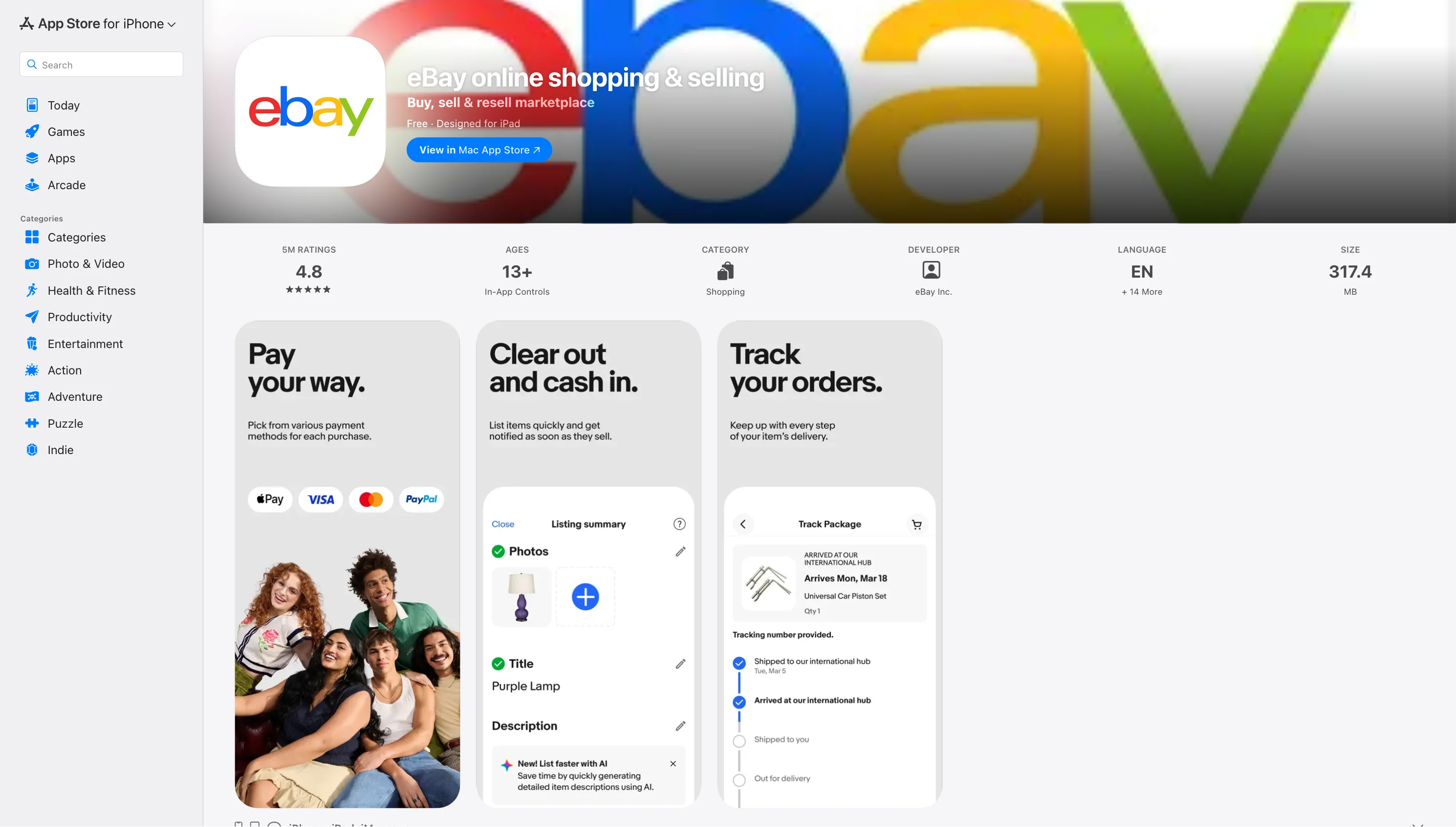
    eBay has carved out a durable niche in collectibles, vintage goods, refurbished electronics, and hard-to-find items. The auction format still drives engagement for certain categories, while Buy It Now serves everyday shoppers who want fixed pricing.

    The app’s Authenticity Guarantee program, which verifies sneakers, watches, handbags, and trading cards, has helped the platform maintain trust in categories where counterfeits are a concern.

    Why it works: Unique inventory you can’t find anywhere else, backed by buyer protections that make high-value purchases less risky.

    8. Etsy

    App Store rating: 4.9/5 | Play Store rating: 4.9/5 | Downloads: 10M+ (Play Store)

    App Store | Play Store

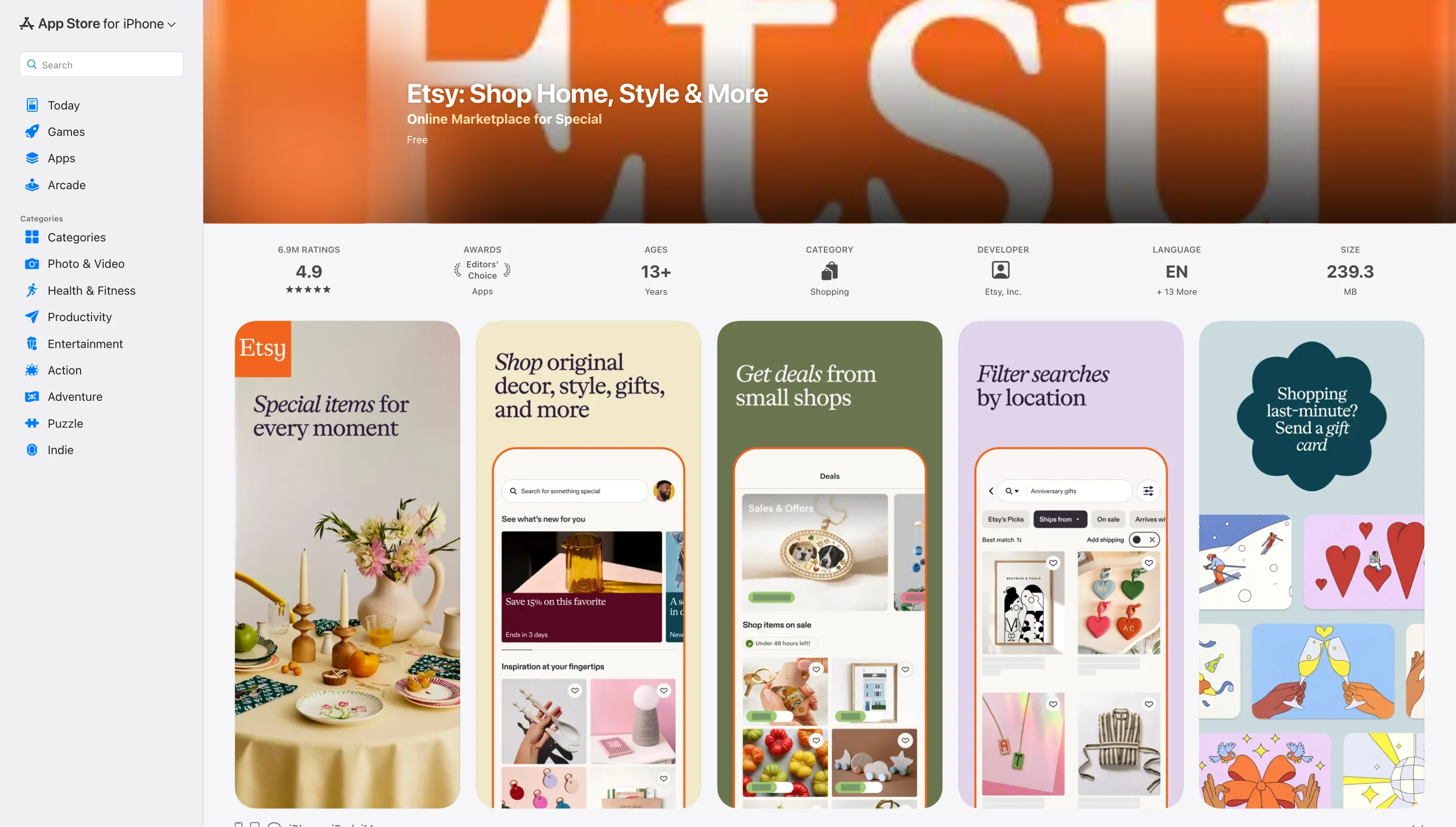
    Etsy remains the go-to marketplace for handmade, vintage, and one-of-a-kind goods. The app experience highlights the maker behind each product, with shop stories, process photos, and direct messaging that create a personal connection between buyers and sellers.

    Gift shopping is a major use case: Etsy’s personalization options (custom engravings, monogramming, made-to-order items) give it an edge that mass-market platforms can’t easily replicate.

    Why it works: Differentiated inventory and an emotional connection to makers that turns browsing into discovery.

    9. Depop

    App Store rating: 4.8/5 | Play Store rating: 4.3/5 | Downloads: 10M+ (Play Store)

    App StorePlay Store

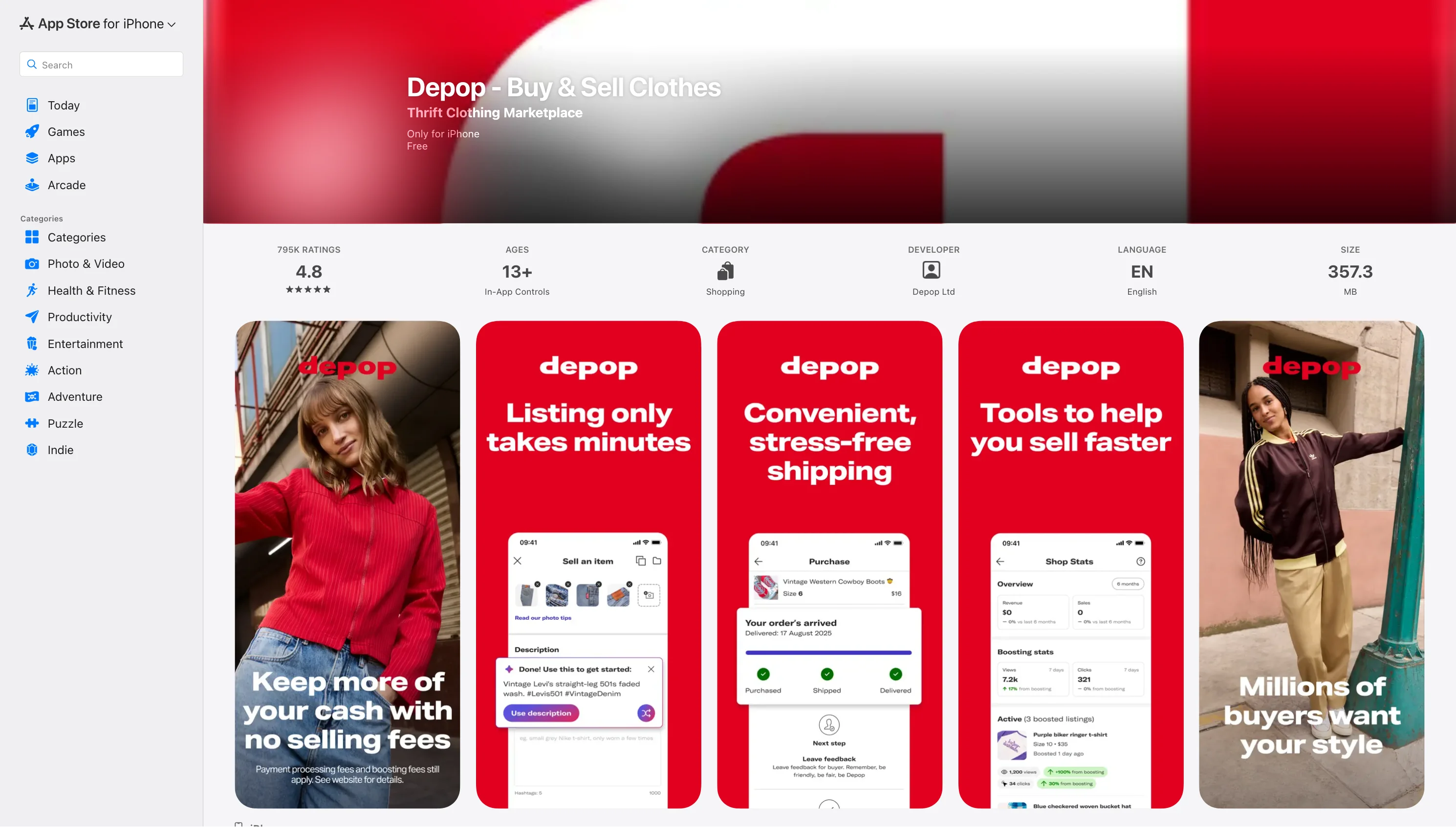
    Depop has climbed to #7 on the App Store shopping charts by making secondhand shopping feel like scrolling a social feed. The app’s interface borrows heavily from Instagram: profile pages, follower counts, and a discovery feed that surfaces items based on your style preferences.

    Popular with Gen Z buyers and sellers, Depop has become a cultural platform as much as a shopping one. Sellers build personal brands, and limited drops create the same urgency you’d see from a streetwear label.

    Why it works: It made resale feel aspirational rather than budget-driven, turning secondhand shopping into a lifestyle.

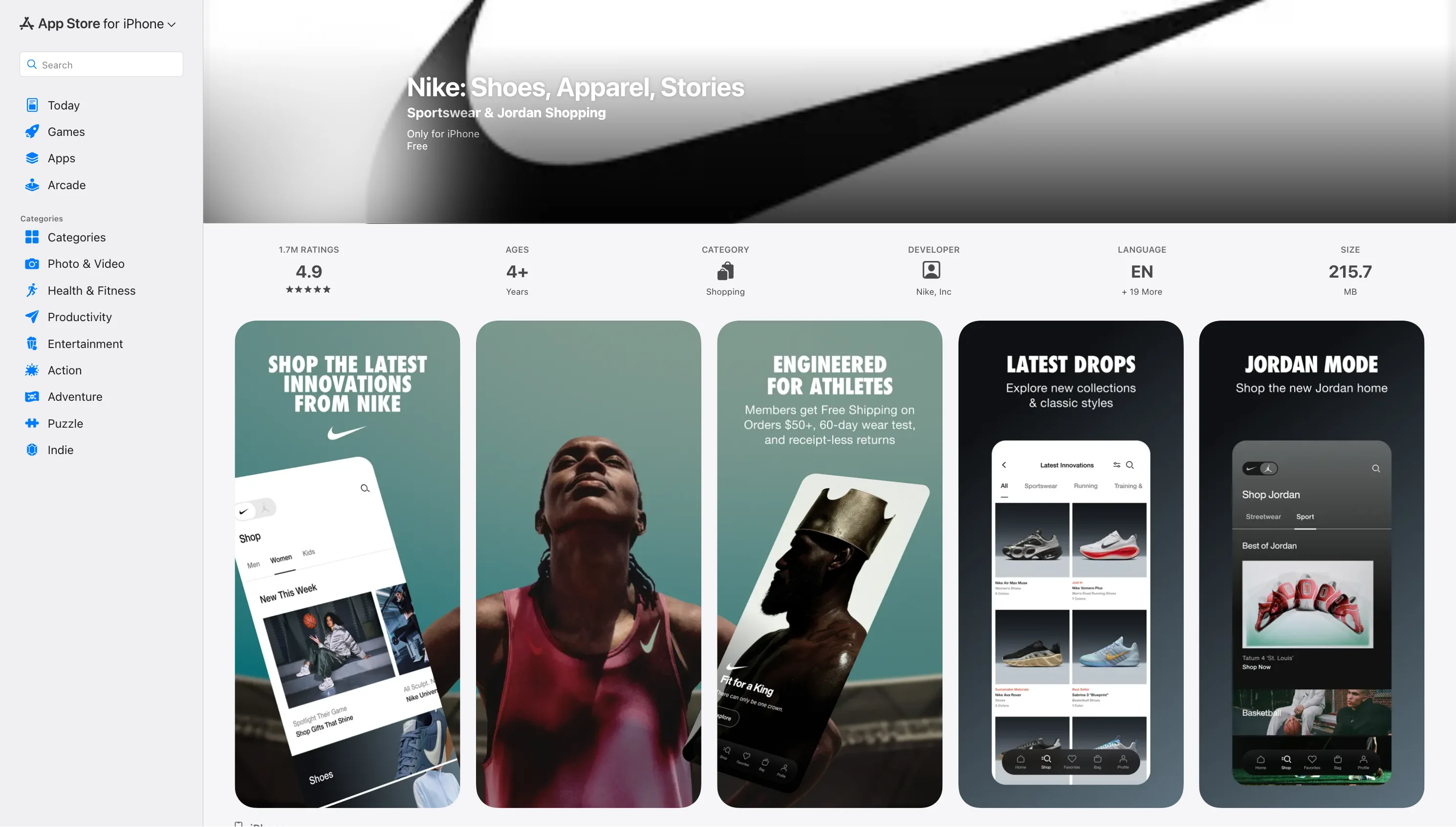
    10. Nike

    App Store rating: 4.9/5 | Play Store rating: 4.5/5 | Downloads: 50M+ (Play Store)

    App Store | Play Store

    Nike’s app is the gold standard for branded retail apps. Members get early access to new releases, exclusive products, and personalized recommendations based on sport preferences, size, and purchase history.

    The app goes beyond transactions: workout tracking, style guides, and member-only events create reasons to open the app even when you’re not buying. This keeps Nike top-of-mind and drives repeat purchases.

    Why it works: It blends shopping with content and community, creating ongoing engagement that extends well beyond checkout.

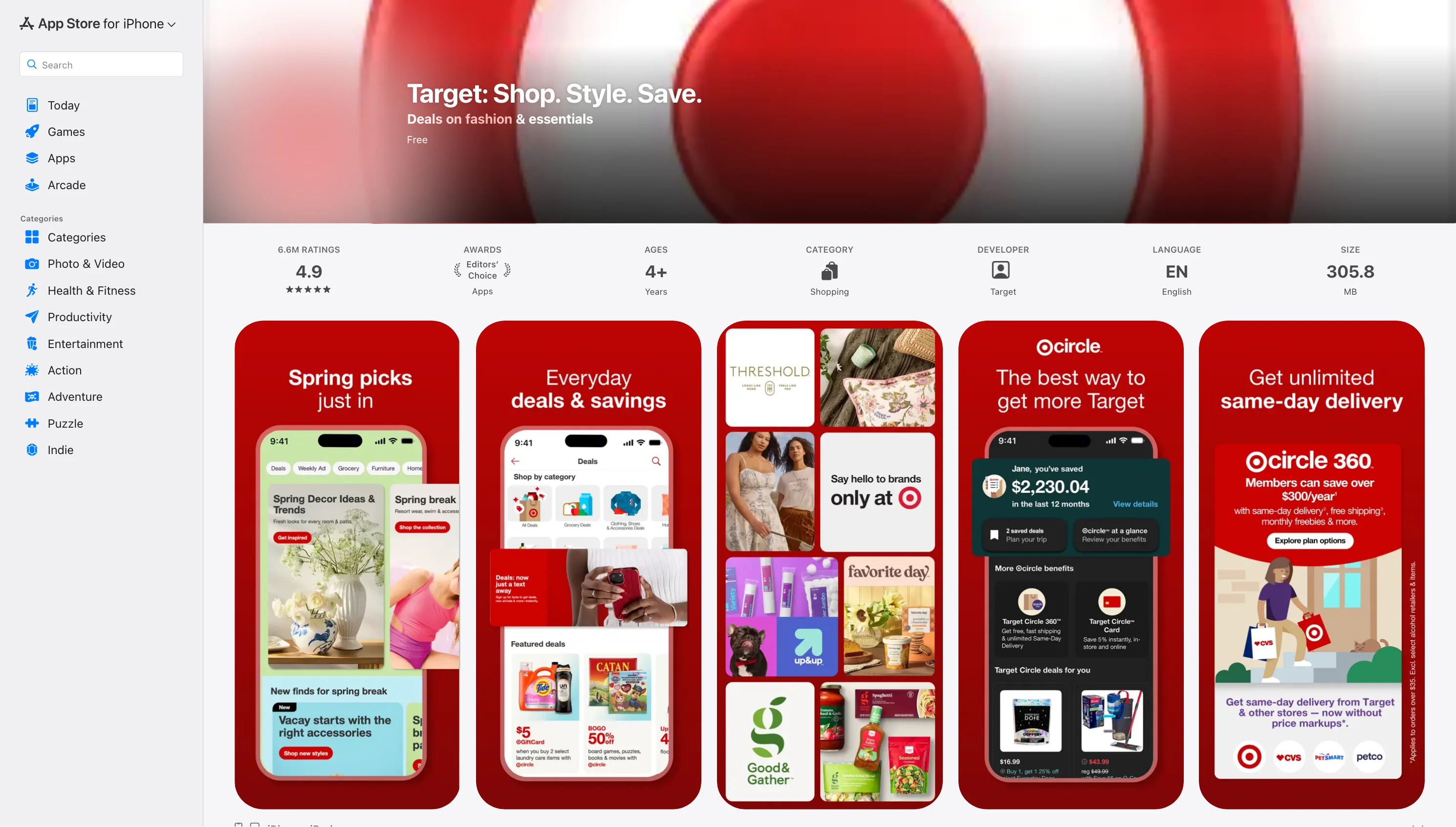
    11. Target

    App Store rating: 4.9/5 | Play Store rating: 4.8/5 | Downloads: 50M+ (Play Store)

    App StorePlay Store

    Target’s app ties together its digital and physical retail experiences with features like same-day delivery (via Shipt), in-store order pickup, and the Target Circle loyalty program, which offers personalized deals and 1% earnings on every purchase.

    The Wallet feature consolidates Circle offers, gift cards, and payment methods, making checkout fast both online and in-store. Drive Up, which brings orders to your car, has become one of the most popular features.

    Why it works: A seamless bridge between online browsing and in-store convenience, with loyalty rewards that keep customers in the Target ecosystem.

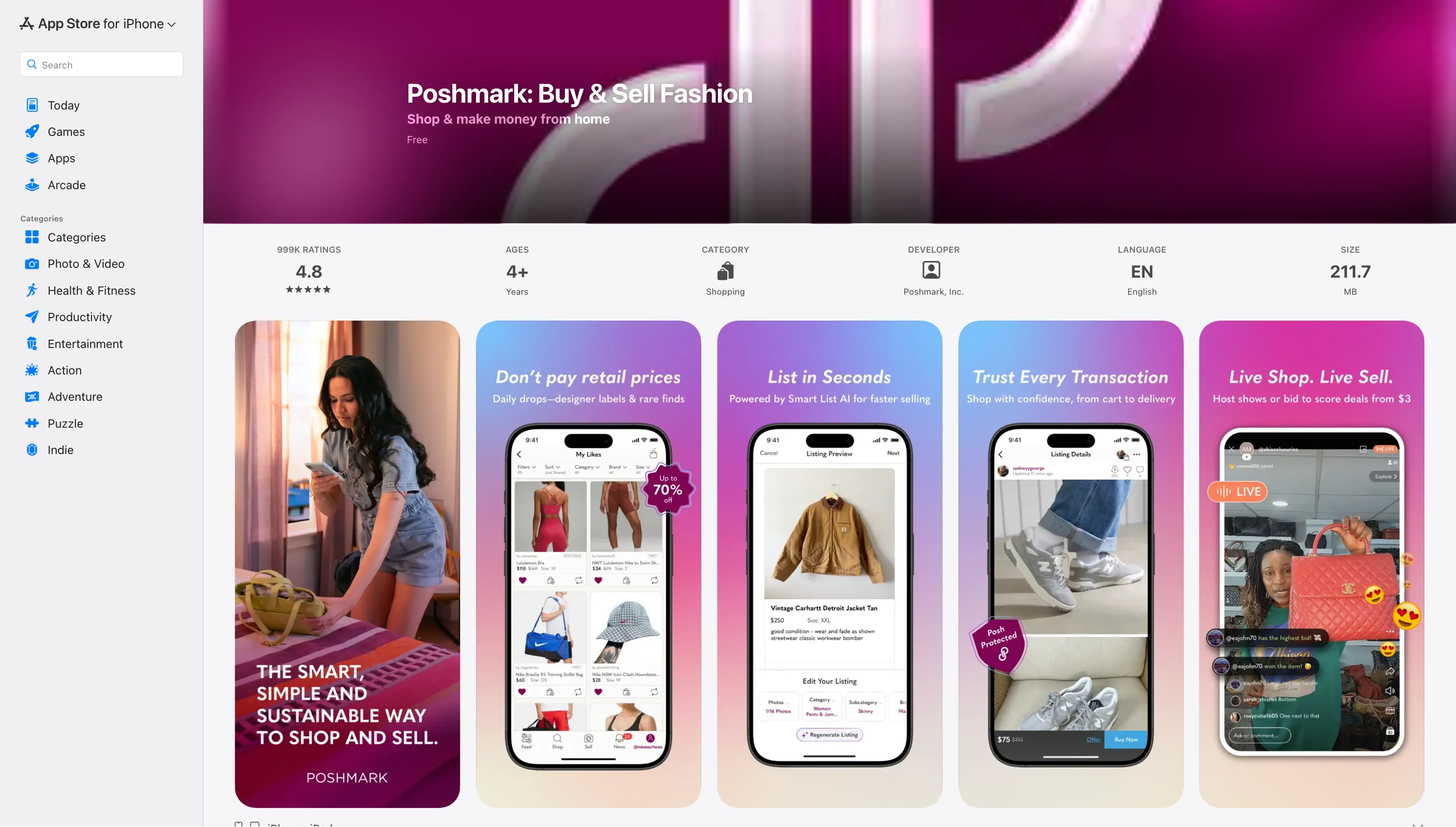
    12. Poshmark

    App Store rating: 4.8/5 | Play Store rating: 4.7/5 | Downloads: 10M+ (Play Store)

    App Store | Play Store

    Poshmark combines social commerce with resale, offering both secondhand items and new products from over 9,000 brands. Posh Parties, live virtual shopping events organized by category or brand, add a community layer that static listings lack.

    Seller tools are a differentiator: listing takes about 60 seconds, and Poshmark handles shipping logistics with a prepaid label for every sale.

    Why it works: It turned resale into a social experience, making it easy for casual sellers to participate while giving buyers a curated, community-driven marketplace.

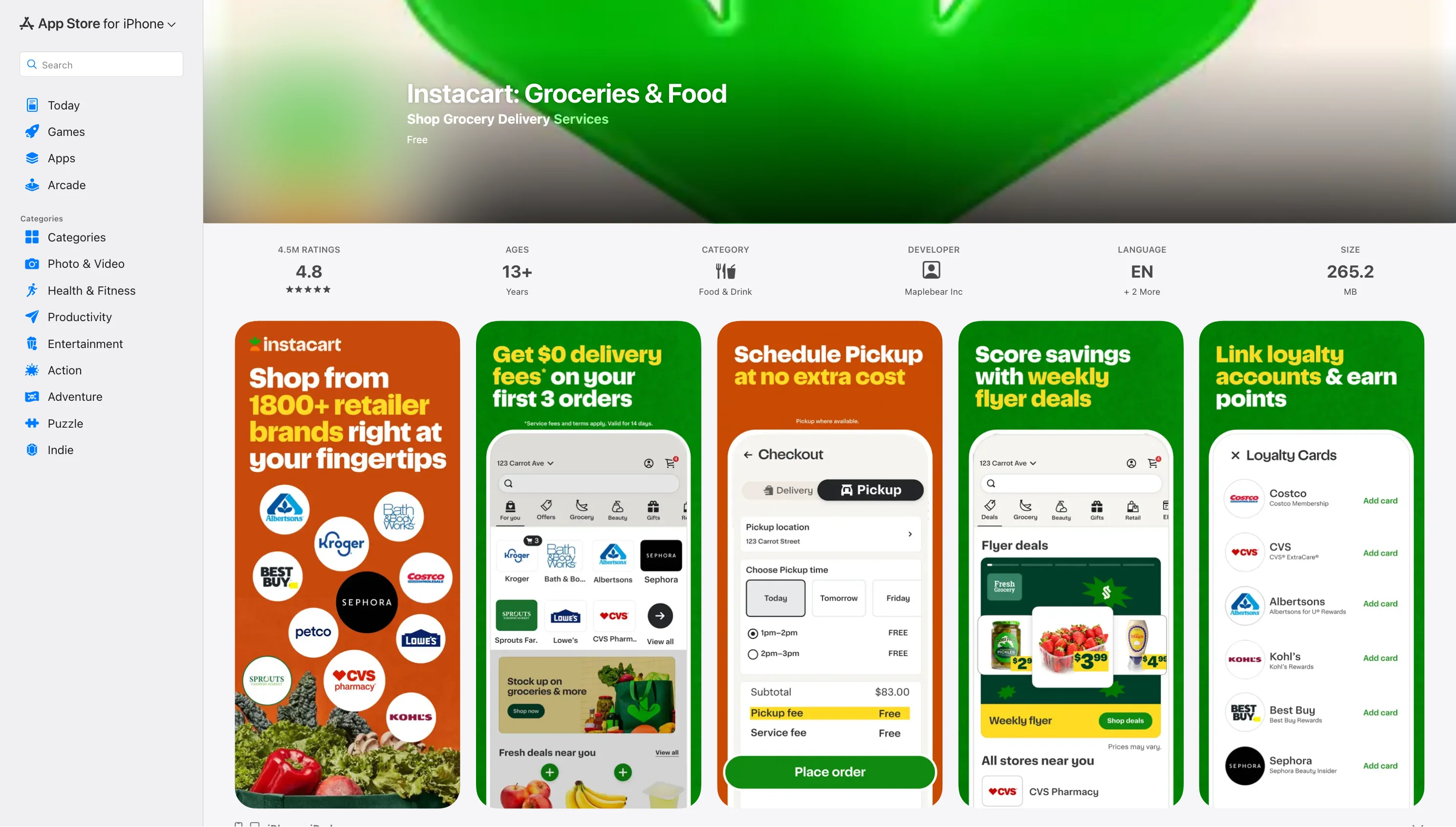
    13. Instacart

    App Store rating: 4.8/5 | Play Store rating: 4.3/5 | Downloads: 10M+ (Play Store)

    App StorePlay Store

    Instacart connects shoppers with personal shoppers across 1,500+ retail partners, including grocery chains, convenience stores, and specialty shops. Same-day delivery and curbside pickup are available in most US markets.

    The app’s strength is selection across stores. Rather than being locked into one retailer, users can compare prices and shop from multiple stores in a single order.

    Why it works: Aggregation. One app to shop from virtually every grocery chain in your area, with the convenience of delivery or pickup.

    14. OfferUp

    App Store rating: 4.8/5 | Play Store rating: 4.4/5 | Downloads: 50M+ (Play Store)

    App StorePlay Store

    OfferUp (which absorbed Letgo) is the leading local buy-and-sell app for furniture, electronics, vehicles, and other items you’d rather not ship. Location-based browsing shows what’s available nearby, and in-app messaging makes it easy to arrange meetups.

    TruYou verification and community meetup spots at police stations add safety features that differentiate it from older classifieds platforms.

    Why it works: Simple, fast listings and local discovery make it the easiest way to buy and sell in your area.

    15. Rakuten

    App Store rating: 4.8/5 | Play Store rating: 3.9/5 | Downloads: 10M+ (Play Store)

    App StorePlay Store

    Rakuten offers cashback of up to 10% at over 3,500 partner retailers, including major brands like Nike, Sephora, and Walmart. The app also surfaces deals, coupon codes, and price comparisons.

    It works as a layer on top of your existing shopping habits. Link a card, shop at participating stores, and cash back accumulates automatically. Quarterly payouts via check or PayPal keep users engaged over time.

    Why it works: Passive savings. Once set up, users earn cashback without changing how they shop.

    What the Top Shopping Apps Have in Common

    What makes each of these apps so successful?

    Part of it is simply the broad reach of each ecommerce platform. Amazon, Walmart, Shopify are at the top of the charts because they’ve already built up ecosystems with massive userbases.

    But that’s not the whole picture.

    Looking across these 15 apps, a few patterns stand out:

    • Personalization drives engagement. Every top app uses browsing history, preferences, and behavior to surface relevant products. Generic catalogs don’t hold attention.
    • The line between content and commerce is blurring. Whatnot’s live streams, Depop’s social feeds, and Nike’s workout content all create reasons to open the app beyond buying.
    • Omnichannel wins. Walmart and Target’s apps succeed because they enhance the in-store experience rather than competing with it.
    • Trust features matter. eBay’s Authenticity Guarantee, OfferUp’s TruYou, and Poshmark’s shipping labels all reduce friction and risk.

    Takeaways for Brands

    The common thread? The best shopping apps create habits, not just transactions

    They give customers reasons to come back daily, whether that’s new inventory, exclusive content, cashback rewards, or community features.

    For ecommerce brands looking at this list, the lesson isn’t to compete with Amazon or Temu on selection or price. 

    It’s that having your own mobile app, one that delivers a native experience with push notifications, personalized content, and frictionless checkout, is one of the best moves you can make for serious retention and repeat revenue.

    Building a native app doesn’t have to mean a six-figure development project. Vendrux lets you extend your existing website into a fully native iOS and Android app, complete with push notifications, native navigation, and your full ecommerce experience, without rebuilding your stack. 

    Vendrux has helped over 2,000 businesses enter the App Stores and launch their own apps, including hundreds of high-end ecommerce brands.

    Want to do the same? Book a free demo to see how your store would look and perform as a native app.

  • Average Page Views Per Visit: How Many Should Your Ecommerce Site Get?

    Average Page Views Per Visit: How Many Should Your Ecommerce Site Get?

    Average page views per visit is one of a number of metrics that provide insight on how well your website is performing.

    This metric is one of the best ways to tell how engaged your users are – i.e. how actively they interact with your website. More engaged users almost always leads to a higher conversion rate and more revenue.

    In this article we’ll share the benchmark you should shoot for in terms of average page views per visit, along with explaining a little more about this metric and why it matters. To finish up, we’ll give you a few key tips on increasing it in your business, including one that could turn out to be a home run for your eCommerce store.

    Average Page Views Per Visit by Industry

    Key Statistics
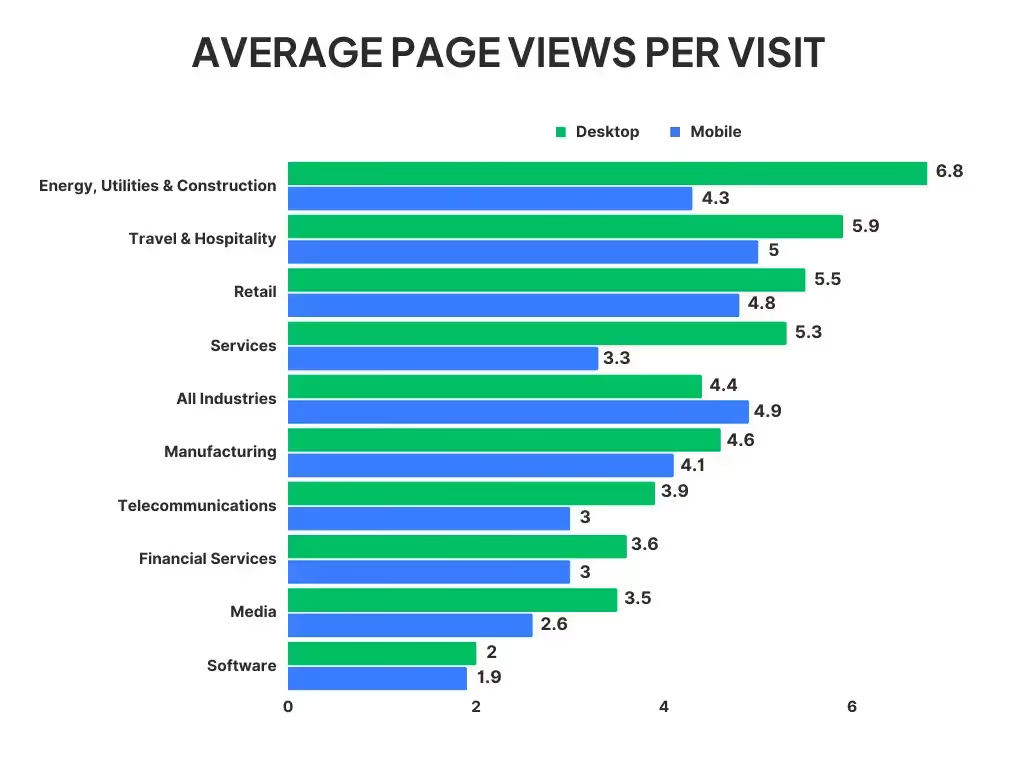
    – Average Page Views Per Visit (all websites): 4.9 (desktop), 4.4 (mobile)
    – Average Page Views Per Visit (retail websites): 5.5 (desktop), 4.8 (mobile)

    Most sources put the average page views per visit for all websites at around 4-5 page views. But the benchmark to aim for will look very different depending on which industry the website is in.

    Here are the averages per industry, separated between desktop and mobile:

    Data source: Statista

    How to Calculate Average Page Views Per Visit

    Average page views per visit is pretty self-explanatory. It’s the average number of pages a user views each time they visit your website.

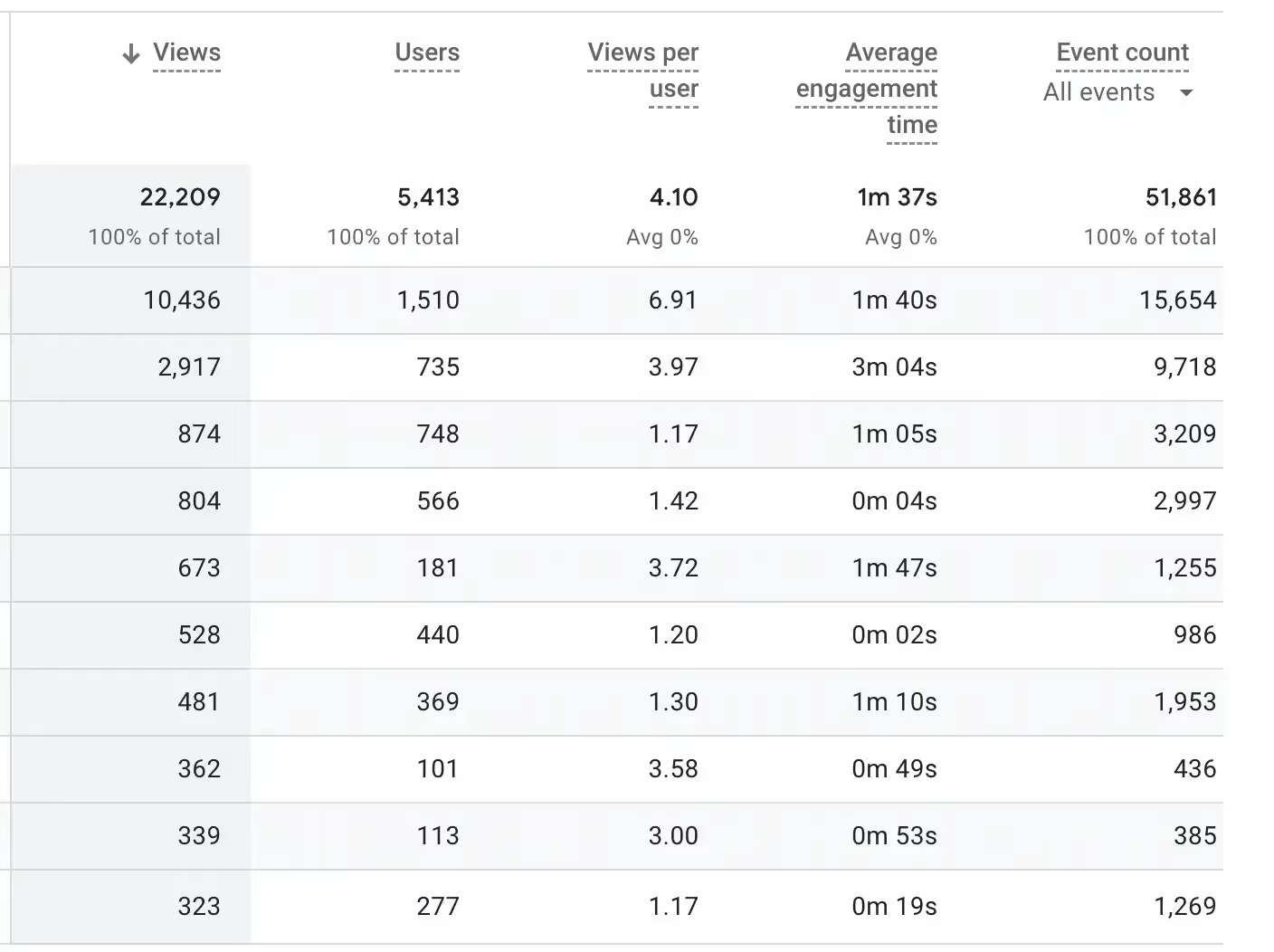
    The best way to figure out your site’s average is to pull up the reports in Google Analytics (or whichever analytics tool you prefer).

    First, figure out how many page views you had over the given period. If you’re using Google Analytics 4, you can find this under Life Cycle > Engagement > Pages and screens.

    Then find how many visits you had for the same period. A quick way to find this is under Life Cycle > Acquisition > Traffic acquisition.

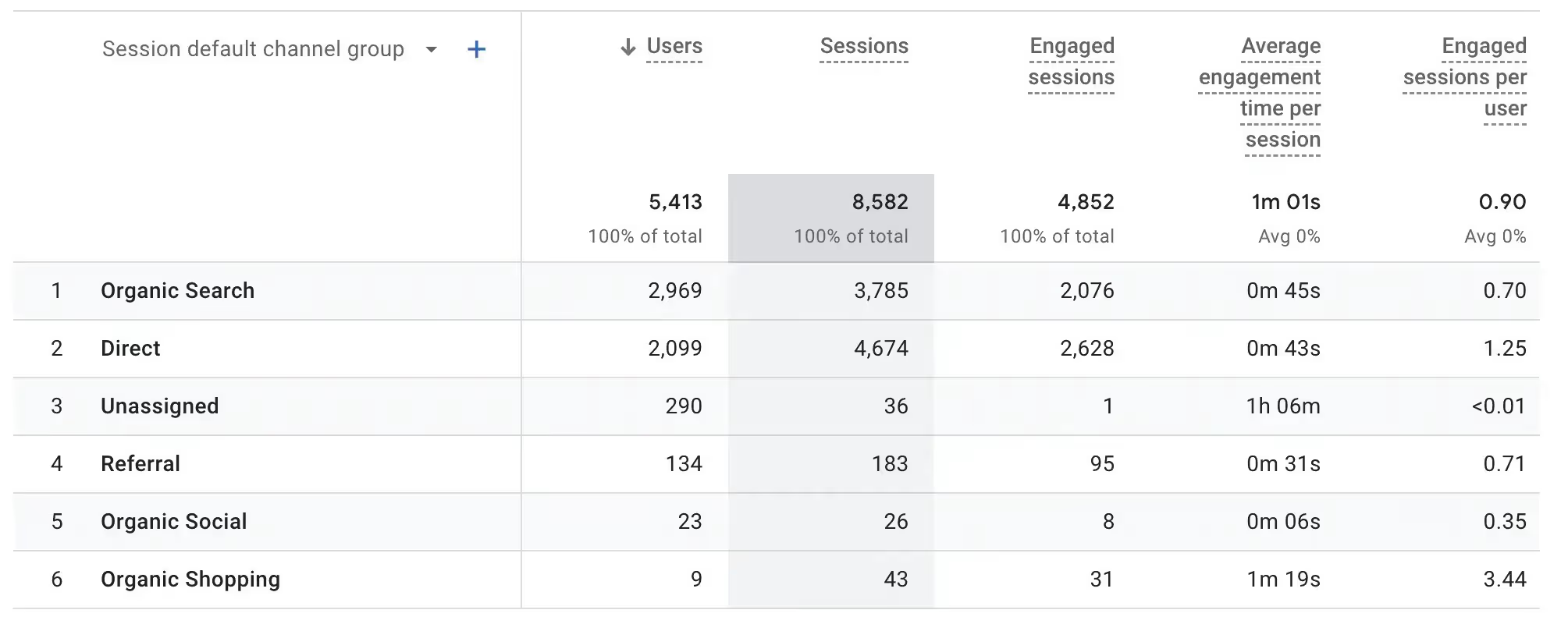
    The number you want here is that for sessions. Don’t mistake this for users, which is the total number of unique users who viewed your site over the selected period, some of whom may have had multiple visits.

    Once you have these two figures, make a simple calculation.

    In the example above, there were 22209 page views and 8582 sessions (i.e. visits).

    That gives us an average page views per visit of 2.59 (22209 / 8582).

    Why This Metric is Important for eCommerce Sites

    Page views per visit can vary in importance depending on the industry. For eCommerce/retail sites, it’s an extremely important metric.

    When a user views multiple pages on your site, it generally means they’re more interested in your site and your products, and more likely to make a purchase.

    It also gives you more opportunities to get in front of the shopper and convince them to buy something when they view more pages and spend longer in your store.

    The top 100 eCommerce sites in the world average 7.8 page views per visit, according to Similarweb, above the overall average for retail websites. This shows a correlation between page views per visit and success for eCommerce stores.

    Page views per visit is not everything, but then again, neither is any metric if you don’t take it in context. Doing millions of dollars in revenue, for example, can be great – or it can be not so great, if it turns out your expenses are more than your revenue.

    How Many Page Views Per Visit Should an eCommerce Site Get?

    Based on current benchmarks, a good number of page views per visit for retail eCommerce websites is anything above 5.5 on desktop and 4.8 on mobile.

    However, you can’t take this alone as an indicator of success or failure. Other factors can come into play.

    For example, if your conversion rate optimization is really, really good, you might end up converting a lot of users in their first or second page view.

    Thus you might have a low average pages per visit, but it’s fine because you have a high conversion rate.

    On the other hand, you may average a large number of views per visit, but struggle to convert users into customers, even after spending a lot of time on your site.

    Generally, you should be invested in trying to boost your average page views per visit. But be careful about viewing this metric on its own, without viewing the wider context.

    How to Get More Page Views From Each Visit

    Though you need to be careful of optimizing solely for one metric, increasing the number of page views that come from each visit is likely to correlate with higher sales and revenue.

    Here are a few tips to help you increase this metric for your website.

    Build a Fast, Bug-Free, Responsive Website

    The quickest way for someone to leave your site is if it doesn’t work properly.

    If each page on your site loads fast, users will be much more likely to jump around to different pages. On the other hand, if they’re left waiting 10 seconds each time they click a link, most will give up.

    The same goes for bugs – make sure everything on your site works as intended. And finally, ensure it looks and works great on all devices, as an increasing number of shoppers today prefer to go online on their mobile devices.

    If you’re using WordPress, reliable SEO plugins can help you monitor site speed, fix technical issues, and improve mobile responsiveness to enhance user experience and search visibility.

    Deliver a Great UX

    Your site needs to feel smooth, intuitive and pleasant to navigate.

    A great user experience means not making the user think. Everything should come naturally, whether it’s finding more information about a product, adding it to their cart, or finding a specific product or category.

    If the user starts getting frustrated or confused, or has trouble finding what they want, they’ll be fast to close the tab and go to another store to get what they need.

    Experts’ POV: For ecommerce sites, well-structured storefront layouts, with clear collection grouping, consistent sections, and obvious paths to related products, help guide shoppers between pages and increase the likelihood they view multiple pages in a single visit.

    A/B Test

    Seemingly minor changes can make a big difference to user engagement. But the only way to find these small but significant changes is to test.

    Run isolated tests where you change minor details in your UX, such as your navigation, how you order collections, which products you recommend, and so on.

    Compare your average pages per visit for each variable. Often you’ll find that small changes can actually have significant results, which can deliver a lot of extra revenue if your site is doing a lot of traffic.

    Drive the Right Traffic to Your Site

    A common reason for low pages per visit is that you’re attracting a lot of low-intent or irrelevant traffic.

    These people land on your site, realize it’s not something that interests them, and leave straight away.

    If you’re putting resources (i.e. time, money, or often both) into getting these people to your site, these resources will be going to waste. Making positive changes to your user targeting will often show itself as higher on-site engagement metrics, such as average time spent on site and more page views per visit.

    Get People to Shop In Your App

    Distractions are another common reason for below average pages viewed per visit.

    At any given time, the typical internet user has a number of tabs open in their browser. You’re competing with those tabs for the user’s attention.

    But if you get people to shop in your app, there are no longer any browser tabs to contend with. You give the person a contained shopping experience, which is more conducive to extended shopping sessions.

    If you have an app, try incentives like app-only discounts to get more people to download and shop in your app. If you don’t have an app for your store, create one now to enjoy the benefits you get for user engagement and retention.

    Boost Engagement With Your Own Mobile App Today

    If you don’t have your own app, and thought launching an app was something only the biggest ecommerce stores were capable of, you’ll be surprised how easy it is with Vendrux – our full-service ecommerce app builder.

    With Vendrux you can go live with an app that looks and feels like what you’d get from some of the world’s biggest brands, all in less than a month.

    All you need is a mobile-optimized website. Vendrux converts your website into apps for Android and iOS, ready to engage and convert users.

    It works with eCommerce sites built on any platform (Shopify, WooCommerce, Squarespace, etc), and lets you fully replicate your website in the app, including all apps, integrations, and even custom-built features (something many eCommerce mobile app builders don’t do).

    Mobile shopping apps built with Vendrux

    We do all the work for you, including shipping your app, submitting it to the app stores and keeping it bug-free and up-to-date after launch.

    Get a free preview of your site as an app, to see how easily you can build a high-quality and professional shopping app. If you want to learn more, or you’re ready to move forward, schedule a free demo and see how Vendrux can elevate your eCommerce store.

  • What is the Average Order Value for eCommerce? (Plus 5 Tips to Boost AOV)

    What is the Average Order Value for eCommerce? (Plus 5 Tips to Boost AOV)

    One of the most important metrics to track in your eCommerce business is Average Order Value, or AOV.

    In this article, we’ll share the definition of average order value, followed by the eCommerce AOV in a range of categories.

    We’ll finish up with some easily applicable tips to boost your store’s AOV.

    Read on if you’re ready to start making more from your eCommerce business.

    Mobile app users spend more, shop more frequently, and are more loyal to your brand. Use our eCommerce App Revenue Calculator to see just how much you stand to gain by launching an app.

    What Does Average Order Value (AOV) Mean?

    Average Order Value, or AOV, is the average amount spent with each purchase on your site.

    To calculate average order value, simply divide your total revenue by the total number of orders in the same period.

    For example, if in one month you had $80,000 in revenue with 2,000 orders, your average order value would be $40 (80,000 divided by 2,000).

    AOV is one of the top KPI’s (key performance indicators) for any online store.

    It’s a sign of how much value you get from each conversion, which is a crucial part of understand your marketing ROI.

    What is the Average Order Value for eCommerce Stores?

    Wondering how your average order value stacks up?

    According to the latest data from IRP Commerce, the average order value across the entire eCommerce market is £98.38, or $125.66.

    Here are a few other key metrics:

    • Average conversion rate: 1.89%
    • Average item sale price: £49.42 ($63.12)
    • Average revenue per visitor: £1.47 ($1.88)

    Of course, there are a lot of variables to consider here, so don’t take it as an ultimate pass/fail if your store is above or below this figure.

    eCommerce AOV By Category

    Comparing your AOV to the industry average in your particular category is a better way to judge how well you’re doing.

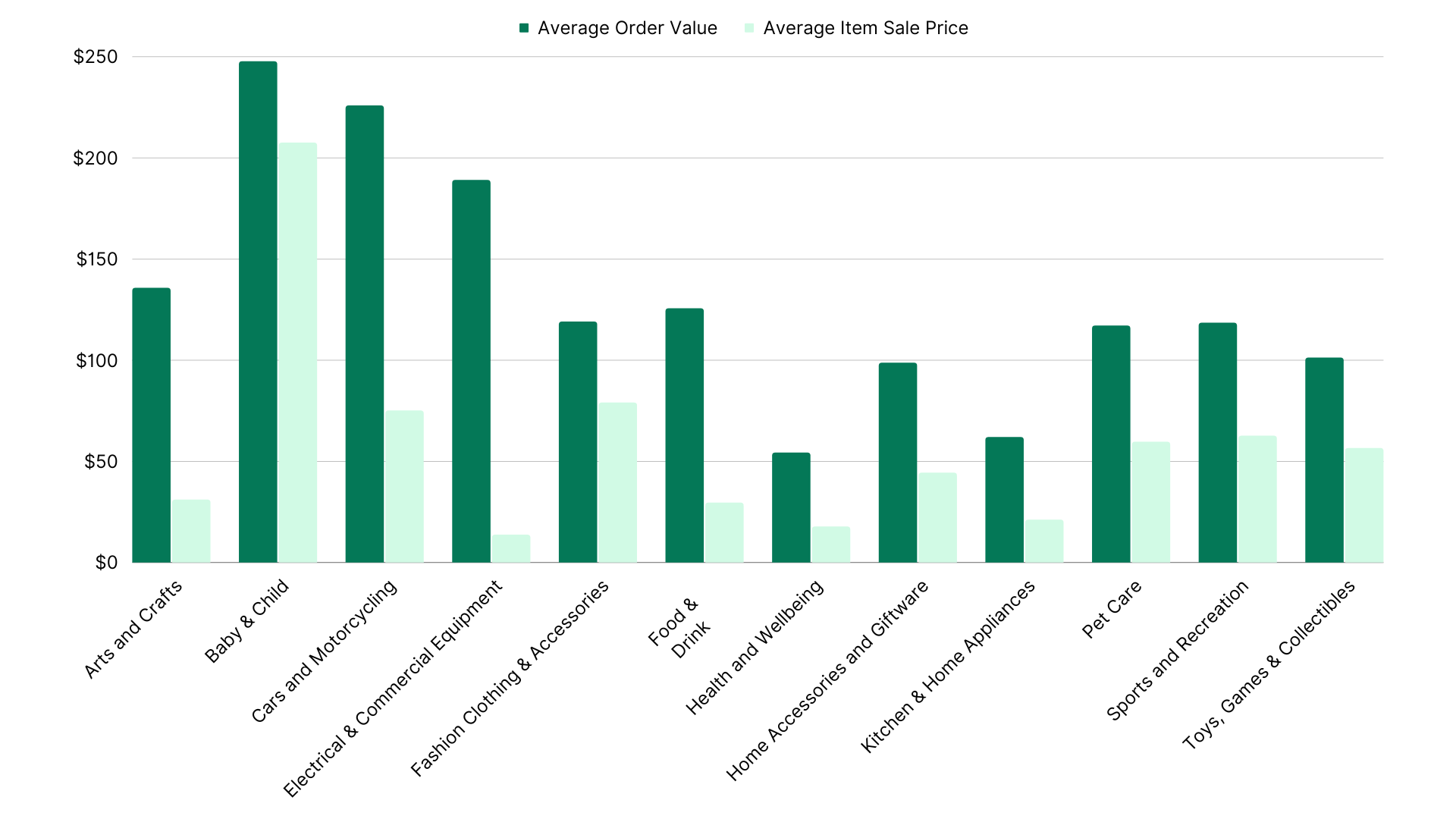
    The figures below show the average AOV in several different product categories.

    Arts and Crafts

    • Average order value:  $135.57
    • Average item sale price: $31.08

    Baby & Child

    • Average order value: $247.63
    • Average item sale price: $207.47

    Cars and Motorcycling

    • Average order value: $225.74
    • Average item sale price: $75.10

    Electrical & Commercial Equipment

    • Average order value: $188.92
    • Average item sale price: $13.73

    Fashion Clothing & Accessories

    • Average order value: $118.89
    • Average item sale price: $78.91

    Food & Drink

    • Average order value: $125.52
    • Average item sale price: $29.51

    Health and Wellbeing

    • Average order value: $54.17
    • Average item sale price: $17.74

    Home Accessories and Giftware

    • Average order value: $98.56
    • Average item sale price: $44.32

    Kitchen & Home Appliances

    • Average order value: $61.87
    • Average item sale price: $21.05

    Pet Care

    • Average order value: $116.97
    • Average item sale price: $59.59

    Sports and Recreation

    • Average order value: $118.39
    • Average item sale price: $62.54

    Toys, Games & Collectibles

    • Average order value: $101.11
    • Average item sale price: $56.51

    Takeaways

    Here are a few things we can learn from the average AOV and average sale price per item shown above.

    • Baby & Child, Cars and Motorcycling are the two categories with the highest average AOV.
    • Arts and Crafts and Electrical & Commercial Equipment are both also significantly higher than the overall average.
    • Health and Wellbeing and Kitchen & Home Appliances are less than half the overall average.
    • The average AOV for Home Accessories and Giftware and Toys, Games & Collectibles are not as drastic, but still significantly lower than average.
    • Many product categories rely on multiple products in each purchase to make up their AOV, with Arts and Crafts, Electrical & Commercial Equipment, Food & Drink, Health & Wellbeing and Kitchen & Home Appliances all averaging 3+ items in each sale.

    Is Average Order Value the Best Success Metric for eCommerce Stores?

    Average order value is an important and valuable metric.

    You could make the argument that it’s the best success metric for an online store.

    But it doesn’t necessarily tell the whole picture on its own.

    For example, a high average order value doesn’t matter much if you have few total orders.

    On the other hand, a low AOV may not be such a bad thing if you have a lot of orders, each customer makes a lot of separate purchases, or you have high profit margins.

    Other metrics that play a large part in revenue and profitability include:

    • Number of orders
    • Conversion rate
    • Customer lifetime value (CLV)
    • Customer acquisition cost (CAC)
    • Cost of goods sold (COGS)

    Improving any of these metrics (including AOV) will boost revenue and/or profit.

    To boost revenue, there are three things you can do:

    • Get more customers (through more traffic or a higher conversion rate)
    • Sell more in each order (higher AOV)
    • Sell to each customer more often (higher CLV)

    Reducing CAC and COGS, on the other hand, will increase profitability.

    Average order value, conversion rate, and customer lifetime value all have a positive impact on profitability as well.

    So, since increasing AOV increases both revenue and profitability, we can be safe in saying it’s at least one of the most important eCommerce KPIs.

    5 Ways eCommerce Stores Can Increase AOV

    Increasing average order value is the low-hanging fruit for boosting your store’s total revenue and profitability.

    It’s easier to get a little more revenue out of your existing traffic than to get more customers or make your customers come back and shop more often.

    But what can you do to get a higher AOV for your store?

    Here are five proven and effective ways to increase eCommerce AOV.

    Set a Free Shipping Threshold (or Increase It)

    AOV is the reason why so many companies set a minimum spend to be eligible for free shipping.

    People are strongly averse to spending money on shipping.

    If there’s an easy way to get free shipping we’ll take it, even if that means buying more than we initially planned to.

    When our cart is at $30, and we see that we can get free shipping if we spend $40, most people will add another $10 worth of products to make it up to the free shipping threshold.

    Rowan, like most eCommerce stores, offer free shipping above a certain amount

    If you don’t have a free shipping threshold, look at your average order value and offer free shipping on orders that reach a threshold around 30% above your AOV.

    If you already have a free shipping threshold in place, think about running a test to raise the threshold and track the results on your AOV.

    Promote Product Bundles

    Getting customers to buy more products in each purchase is key to increasing average order value.

    Bundles are a great way to do that.

    Pair products that go well together, such as knife and knife sharpener, or a shampoo and conditioner set, and offer them at a slight discount compared to the cost of buying them separately.

    Customers who came to buy just one product will figure they might as well buy the bundle instead, spending more than they would have originally.

    A simple product bundle from Fresh Heritage

    You could also offer discounts or a free gift when people buy multiple products, such as a “Buy 3 get 1 free” promotion, to encourage customers to spend more in each order.

    Show Cross-Sells and Up-Sells

    Cross-sells and up-sells are the simplest, most cost-effective way to increase average order value.

    It doesn’t cost you anything (like offering free shipping or discounts), and it works at getting customers to buy more a lot of the time.

    Amazon has huge success with this, with their “Frequently Bought Together” section, which makes it extremely easy to add additional items to your order.

    Cross-sells in action on Amazon

    Cross-promoting complementary products is a powerful tactic.

    Alternatively, you can promote smaller impulse buys. These work great as part of the checkout flow, just like how grocery stores place confectionery next to the register.

    Set Up a Loyalty Program

    Aside from the promise of free shipping, there’s nothing that’s better at convincing us to spend more money than earning points.

    Loyalty programs are used all over retail, from earning points with your credit card, to Starbucks, to Uber.

    A loyalty program (aka rewards program) from Meow Meow Tweet

    The main function of a loyalty program is to boost return customers (and thus lifetime value), but it’s also a strong incentive to spend more in a single order, as we feel like we’re getting more for the money we spend.

    Launch a Mobile App

    If you want a more creative way to increase average order value, while getting a host of other benefits, launch your own branded mobile app.

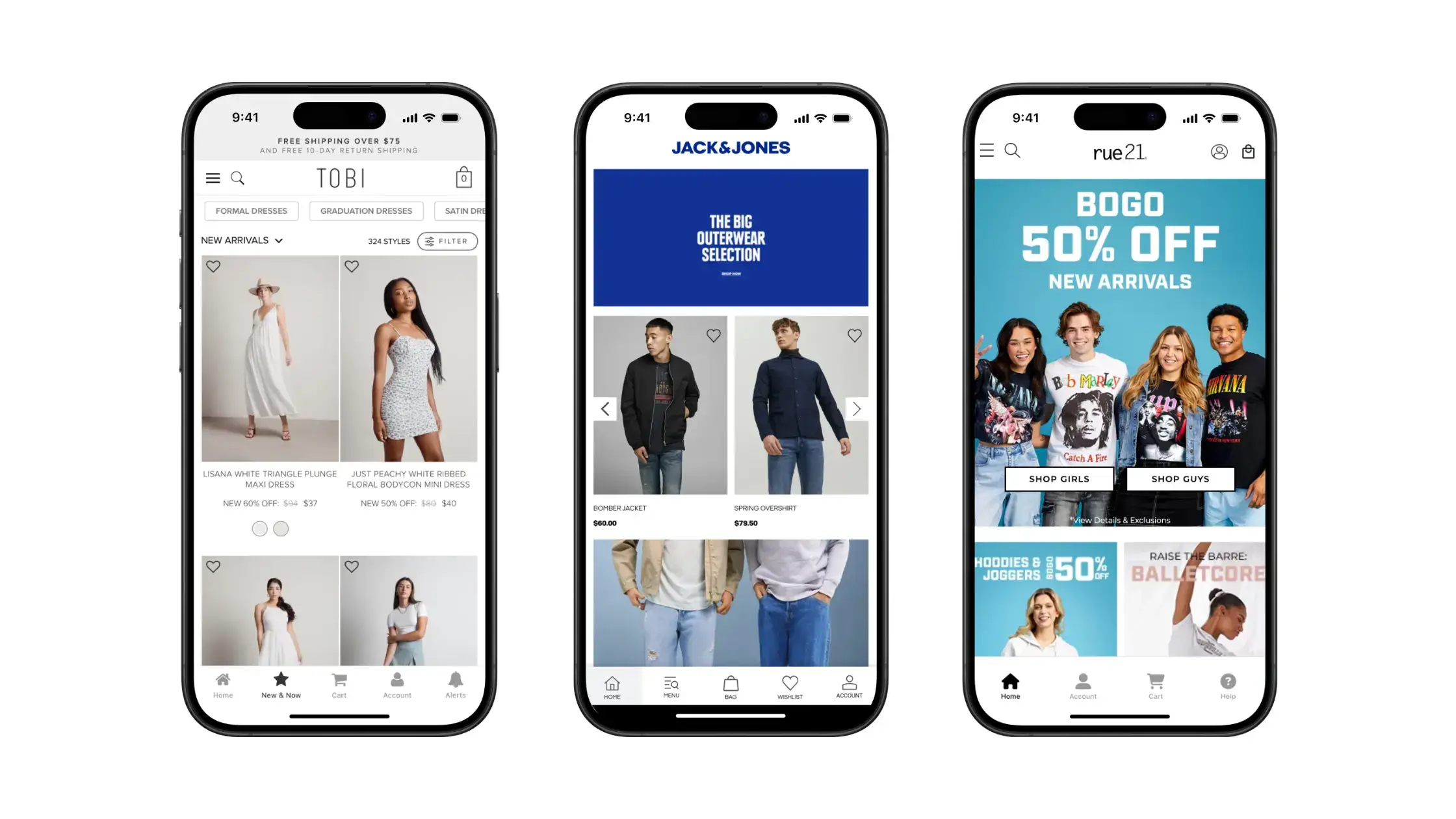
    The Jack & Jones branded mobile app

    Data from IRP Commerce shows 56% of eCommerce revenue comes from mobile devices. According to Statista, Smartphones account for 74% of retail website visits, and 63% of orders.

    This data shows us a couple of things.

    • More people shop and buy on mobile than desktop.
    • Desktop has a comparatively higher average order value, as mobile’s revenue share is lower than their share of visits and orders.

    The takeaway is that it’s harder to convert visitors on mobile, mostly due to the suboptimal user experience offered by mobile websites.

    You can fix that by launching an app. The app experience is smoother, faster and more immersive than mobile websites, resulting in more time spent shopping in apps, more products viewed and higher conversion rates.

    The better customer experience correlates to a higher AOV.

    Besides AOV, there are many additional benefits you can get from launching your own app, such as increased retention (and thus higher CLV), increased trust (which leads to a higher conversion rate), and the ability to get into the app stores, which provides a low-cost acquisition channel and makes your brand look more authoritative.

    How to Easily Create a Mobile App for Guaranteed ROI

    The prevailing notion is that only high-level brands with huge budgets can afford to make their own app.

    If you’re talking about coding custom native apps from scratch, this is true.

    But with another development approach, any eCommerce store can launch their own app.

    __wf_reserved_inherit

    Vendrux is a tech-enabled service that lets you directly convert your website into Android and iOS apps.

    Your website and app are totally in sync, and the app fully replicates everything you’ve built for the web, with some small touches (such as native navigation and menus, plus native push notifications) to make it feel like a true native app.

    This is all for a very minimal investment, something that any eCommerce store making consistent monthly revenue can afford.

    Many online stores have launched apps this way and found excellent results.

    “The only reason more people haven’t done it [built apps] is because everybody’s experience with apps is that they’re very expensive and a pain to maintain. Vendrux knocks both of those hesitations down.”
    – David Cost, VP of eCommerce & Marketing at Rainbow Shops

    The Rainbow Shops App, built with Vendrux

    With Vendrux, you:

    • Don’t need any technical expertise to do with mobile app development.
    • Don’t need a big budget or outside investment to launch an app.
    • Can launch an app in less than two weeks.
    • Get ongoing support to keep your app up to date and maintained (which will cost you tens of thousands per year, at least, if you build a custom app)
    • Will get your brand into the app stores, which is a huge show of social proof (Vendrux even handles the app store submission and publishing process for you).

    To explore the process deeper, book a personalized demo with a Vendrux project manager.

    Once you move forward, it’s more or less hands-off from there, as the Vendrux team builds, tests, compiles, and ships your app for you.

    With minimal work required and a low cost, there’s almost no risk in launching a mobile app for your brand.

    Even if you get zero app users, the brand authority you get from an app store presence alone could increase your average order value and deliver a positive ROI.

    Get a free demo of Vendrux now!

    Wrapping Up

    Increasing the average dollar amount of each transaction is one of the best ways to simultaneously boost your store’s revenue and profitability.

    While you still need to take into account other metrics, such as customer lifetime value, total orders and revenue, and profitability metrics like COGS and CAC, increasing average order value is the holy grail for online businesses.

    In this article we gave you a few ideas for how to increase average order value, from harnessing the attractiveness of free shipping, to volume discounts and cross-selling, to launching a loyalty program.

    But if you want to do something that none of your competitors are, launch a mobile app.

    Your customer base is already skewed towards mobile users, and that share is only going to rise as mobile commerce becomes more mainstream.

    Get the most out of your mobile customers by giving them what they want – an app.

  • What is the Average Mobile Ecommerce Conversion Rate? (And How to Beat It)

    What is the Average Mobile Ecommerce Conversion Rate? (And How to Beat It)

    Mobile is the biggest growth opportunity for ecommerce brands today.

    The share of ecommerce sales on mobile continues to grow each year, yet the mobile shopping experience for many stores is lacking.

    With many sites built primarily for desktop, along with the natural limitations of the mobile browser in terms of user experience, conversion rates are typically lower on mobile than on desktop.

    That just means there’s a huge opportunity to increase your sales, and set your brand apart, if you can get this right.

    Keep reading and we’ll explain more about the mobile conversion rate problem with most ecommerce stores, and a bumper list of tips to help your brand turn this around.

    Did you know that mobile app users spend more, shop more frequently, and are more loyal to your brand?
    Use our Ecommerce App Revenue Calculator to see just how much you can gain by launching an app.

    What is the Average Mobile Ecommerce Conversion Rate?

    The average conversion rate for ecommerce stores on mobile devices is 1.8%.

    In comparison, the average conversion rate on desktop is more than double, at 3.9%.

    Each year, this becomes a bigger problem, as the market share for mobile commerce continues to grow.

    More people worldwide shop on mobile than desktop, and this share is projected to increase further.

    Yet the average mobile ecommerce conversion rate continues to lag behind, as many stores haven’t caught up to the fact that the majority of their customers are mobile-first.

    What is a Good Mobile Ecommerce Conversion Rate?

    If 1.8% is the average mobile ecommerce conversion rate, should this be the bar you’re aiming for?

    Considering most ecommerce brands are stuck in a desktop-first mindset, forward-thinking brands should be able to attain a conversion rate significantly higher.

    There’s no reason you can’t convert visitors on mobile at close to the same rate as desktop.

    This means you should be aiming for at least 2.5-3% conversion rate on mobile – perhaps even higher, if you really dial in on mobile-first CRO.

    With 5.22 Billion Mobile Users, Fixing Mobile Conversion Rates Should Be Your Top Priority

    Why do mobile shoppers convert at a lower rate?

    Desktop sites have more real estate to work with. 

    Bigger screens means it’s easier to fit key, conversion-driving elements, without making the page feel cramped.

    Mobile users are typically more prone to distractions, too. Notifications appear, and people are already conditioned to bouncing around between multiple actions on their phone, more so than on desktop.

    Then, some consumers just have a higher level of trust when using a desktop site than a mobile site.

    Whatever the reason, there’s almost certainly something you can do to fix the problem and boost your conversion rate on mobile.

    Next, we’ll list more than 20 things you can do to turn more mobile shoppers into paying customers.

    How to Beat the Average Mobile Ecommerce Conversion Rate of 1.8%

    Let’s explore best practices to optimize your mobile ecommerce conversion rate. Focusing on creating a better customer experience, particularly on mobile, is key to getting a higher conversion rate.

    A large part of this is to build better, more optimized PDPs (product detail pages). If you want to dive deeper into this topic, our Ultimate Guide to Ecommerce PDPs is the best resource for this on the internet.

    Here are 21 strategies to significantly improve your mobile ecommerce conversion rate and close the mobile-desktop conversion rate gap. 

    1. Launch a Mobile App

    One of the best ways to increase conversion rates for mobile shoppers is by launching a mobile app.

    Mobile apps drive 3x higher conversion rates than mobile websites (and our data shows as much as 6-10x higher conversion rates in some cases).

    Mobile apps are tailor-made for higher conversion rates.

    By removing the browser tabs and serving shoppers a more immersive, contained experience, you remove a lot of the distractions that lead to lost sales.

    If the cost has you thinking a mobile app is out of reach, think again.

    By simply converting your existing website into a mobile app with Vendrux, you can launch an app for a small expense, in as little as two weeks.

    A few examples of ecommerce apps built with Vendrux

    Click here to learn more about how to convert your website into an app, and why Vendrux is the best way to do it.

    Want to launch your own app in less than 30 days, with zero effort and minimal investment?
    Get a free preview of your app to see what’s possible.

    2. Make Call-to-Action Buttons Stand Out

    Optimizing your calls to action (CTAs) is important for your CRO strategy.

    Test and analyze various elements of your CTAs, such as buy and add-to-cart buttons, to stop your customers from scrolling and get them to take action.

    Tools like HotJar can help track the effectiveness of your buttons. Make your buttons visible and “sticky” to improve mobile conversion rates.

    3. Make Navigation as Easy as Possible

    It’s vital you make navigation easy for mobile users.

    An expandable, hamburger-style menu is standard on mobile. But along with this, you should ensure key sections of your site are easy to find.

    It should take zero thought to get to wishlist, add to cart, account, and category sections.

    On category pages, make product filters clearly visible, and easy to use.

    All in all, just make your mobile shopping experience easy.

    4. Show Product Recommendations (in the Right Place)

    Display product recommendations on all mobile product pages.

    Product recommendations help boost AOV, but can also increase conversion rates.

    When someone views a product which is not quite what they’re looking for, you may be able to convert them by showing a few similar options.

    Just be careful where you place these product recommendations.

    Shoppers still want to see the key details for the product they clicked on first.

    Below that, below important details like pricing, product description, shipping and return information, display your recommendations.

    This ensures the shopper’s journey doesn’t stop at that page, but doesn’t obscure anything that will help you close the sale then and there.

    5. Optimize Load Speed

    Reduce load times and optimize the speed of your mobile store to improve CRO.

    The longer shoppers have to wait for a page to load, the more likely they’ll get fed up and go somewhere else.

    Make sure your images are optimized, and the underlying architecture of your website is clean.

    If you have an app, reduce app launch time by delaying resource-intensive tasks until after the first screen is rendered.

    Load data when required instead of when the app launches.

    6. Simplify Mobile Forms

    Mobile forms should be simple to fill out by design – from sign-up forms to booking forms.

    Optimize mobile forms with clear labels and use single-column layouts and larger form fields.

    Additionally, forms should be as concise as possible to minimize user effort and make them easy to complete on mobile devices.

    Pre-fill information, if you have it (e.g. if the user has an account and is logged in), and in general, do anything you can do reduce friction with user input.

    7. Shorten Mobile Processes With Smartphone Features

    Design your app to make autofill available, especially for payment details and mobile forms.

    Autofill can also save users time and make checkout processes quicker.

    66% of consumers expect online checkout to take four minutes or less.

    If yours takes longer than this, you’ll almost certainly be losing out on sales.

    8. Provide Different Payment Methods

    Entering payment details on a mobile device is time-consuming, and requires a lot of trust from the customer.

    Offer shortcuts by saving customer payment details or providing alternative payment options like PayPal, Amazon Pay, Apple Pay, or Google Pay.

    Not only does this make it quicker and easier for the customer, but there’s an higher level of trust when they’re not giving a store their actual credit card details.

    9. Offer Guest Checkout

    To reduce friction for mobile customers, offer a guest checkout option, where you allow users to complete their purchase without creating an account.

    This eliminates an additional step that may deter customers from completing a purchase – even if you’d prefer to have someone’s contact details, to be able to market to them in the future.

    10. A/B Test Your Checkout Process

    Optimize your ecommerce checkout process and prevent customer drop-offs by tweaking and testing the process continuously.

    A long and complicated checkout process can deter customers from completing their purchases – but you often won’t know what the problem is until you test and gather data.

    Things like adding guest checkout, reducing the number of input fields, or changes in copy or page design, might bring an improvement – or they might not.

    Continuously test factors like this, to come up with the perfect formula to get the highest conversion rate possible for your audience.

    11. Use Mobile Conversion Messaging

    To increase mobile commerce sales, try being pro-active about communicating with your site/app visitors.

    Browse abandonment notifications can recapture shoppers who let their attention drift away, while abandoned cart notifications are a great way to recover abandoned carts.

    Otherwise, in-app messages and customer service prompts may help solve questions or objections that otherwise would result in lost sales.

    Apps provide the perfect way to communicate with your customers, via push notifications. Check out our complete guide to Push Notifications for Ecommerce to learn just how powerful a tool this can be.

    12. Use Color Blocks to Highlight Promotions

    Make your best deals stand out!

    Implement color block items to highlight ongoing sales in your mobile storefront.

    Use vibrant and eye-catching colors for sale items to help them stand out, create a sense of urgency, and catch the attention of mobile shoppers.

    You could also use pop-ups or push notification to improve mobile conversions (just avoid being too intrusive).

    This visual distinction is crucial in a digital landscape saturated with numerous sales and promotions.

    13. Use Video Content to Keep Shoppers Engaged

    Mobile shoppers are conditioned to watch video.

    Hours of Reels, TikToks, and Shorts have trained customers to expect video-first feeds on their phones. When they land on a static product page, the experience feels flat by comparison, and their thumb keeps scrolling.

    Adding video is one of the easiest ways to hold their attention on mobile. And attention = higher chance of conversions.

    Product demos, UGC clips, AI UGC, shoppable videos, unboxings, and creator videos give shoppers something to stop for. Instead of skimming text and bouncing, they watch, linger, and spend more time with your product, which gives you more chances to answer questions and convert.

    Learn more: Why Video Commerce is a Winning Strategy for Brands in 2026

    14. Build Trust With Mobile Audiences

    Design your mobile app with trust signals in mind. According to Marqeta’s 2021 Fraud Report, 67% of all consumers think shopping online puts them at a higher risk of scams.

    To increase trust, ensure all mobile data is safe by offering user authentication, displaying your data privacy policy, and integrating with trusted payment methods.

    Making the buying experience safe can build trust in your brand and improve mobile conversions.

    15. Let Users Zoom and Swipe

    Most image sections on product pages are designed for desktop first, and fall short on mobile.

    Mobile shoppers use pinch and swipe actions to zoom in on or navigate between product images.

    If this functionality is unavailable or poorly implemented, it can put a big dent in your CRO.

    Images are absolutely vital for conversions, so ensure that mobile shoppers have no difficulty getting up close and personal with products they’re considering buying.

    16. Let Users Go ‘Back’ Easily

    The ‘back’ button is a crucial and often overlooked UI element.

    On many apps or mobile websites, interactive experiences and desktop-first navigation leads to unexpected behavior when a user hits the back button.

    As a result, they get lost, they can’t get back to where they’re supposed to be, and leave your store in frustration.

    Make sure your back functionality works intuitively, and include a “previously viewed products” section to make it even easier for shoppers to find their way around.

    17. Improve Copy and Product Descriptions

    Persuasive copy, detailed, and easy to skim are important for conversion rate.

    Find the ideal mix of readability and sales-oriented copy.

    Proactively address pain points and common objections, and use real, functional benefits to sell your products.

    You should also include important information such as:

    • Dimensions,
    • Sizing (with links to size guides if applicable),
    • Materials or ingredients,
    • Compatibility details,
    • Included accessories.

    However, don’t lead with the technical details. Focus on emotion first, and go into more detail lower down the page for shoppers who want to learn more.

    18. Create Mobile-Only Exclusive Coupons, Discounts, and Offers

    Creating special promotions for mobile users can incentivize mobile users and website visitors to purchase through your mobile app.

    Mobile-only promotions, such as free shipping, can create a sense of exclusivity and urgency.

    This drives customers to act and purchase on their mobile devices.

    Whether it’s a limited-time discount, a coupon code, or a special offer for mobile users, these incentives can get mobile shoppers over their trust or usability issuesand boost mobile ecommerce conversion rates.

    19. Improve Post-Purchase Mobile Experience

    Improving the post-purchase mobile experience can improve your CRO on mobile.

    Allowing customers to track the progress of their orders easily is one way of doing this.

    Offer real-time updates on order status and estimated delivery time via push notifications or messages in their account, and be clear and prompt with any post-purchase communication.

    Do what you can to minimize frustration and provide a more inviting, end-to-end shopping experience, and you’ll get more return customers (who will convert at a higher rate than new visitors).

    20. Make Reviews and Social Proof Visible

    It’s important to establish credibility from the moment someone enters your ecommerce store.

    Include customer testimonials or other forms of social proof below product descriptions, around CTA, and in your checkout flow, that highlight your product’s benefits and value.

    Real customer reviews, UGC, and social feeds all help built more trust and credibility, and break down the barriers that stop customers from going through with a purchase.

    21. Offer In-App or On-Site Customer Support

    You can offer in-app customer support through chatbots or chat support software to quickly answer user questions and objections.

    Most people won’t go through the effort of emailing you or calling you up, so you want to make it extremely easy for them.

    An on-site chat widget with live chat can achieve this, and oftentimes answer very minor questions that otherwise would have resulted in a lost sale.

    22. Personalize the In-App Experience

    Personalization can have a big influence on a consumer’s journey towards purchasing.

    This is true for any device, including mobile.

    80% of consumers are more inclined to purchase when brands provide personalized experiences.

    Personalization strategies can range from how content is displayed in the customer’s local language or currency to product recommendations.

    Tailored in-app experiences ultimately drive higher conversions, improve customer satisfaction, and improve app engagement.

    Building an app is the best way to boost mobile conversion rate, AOV and LTV. If you’re new to app development, and don’t know where to start, we made a full guide on building an ecommerce app, that shows you that launching your own app might be a lot easy than you think.

    Increase Mobile Commerce Conversions and Optimize CRO with Vendrux

    By following these tips to beat the average mobile ecommerce conversion rate, your business can set itself apart and capitalize on the growing share of mobile-first shoppers.

    Many CRO issues can be solved by offering mobile shoppers the option to shop through an app.

    All ecommerce businesses should have their own mobile app, and Vendrux is the best way to do it.

    Vendrux requires little to no effort from you, minimal overhead, minimal investment, yet allows you to ship a full-featured app that looks and feels like a fully native, custom app.

    We’ve created thousands of apps, including apps for high-revenue ecommerce brands such as Rainbow Shops, Jack & Jones and John Varvatos.

    Let’s beat the average mobile ecommerce conversion rate and boost mobile conversions together.

    Get in touch with us and book a free consultation now to see how we can help you build and launch your own mobile app.

  • What’s the Average eCommerce Conversion Rate in 2026?

    What’s the Average eCommerce Conversion Rate in 2026?

    Understanding the average eCommerce conversion rate (CVR) is important for you to get an idea of how well your site is performing and how you can improve.

    As we’ll establish later, there are a number of factors you should consider when you compare your conversion rates to others.

    Still, conversion rate is one of the most important metrics for an ecommerce store. The better your conversion rate, the more effective you are at converting your hard-earned visitors into paying customers.

    Read on and we’ll show you the average eCommerce conversion rate, average conversion rates for different categories and a few factors to take into account, before sharing some conversion rate optimization tips for your business.

    What’s a Good Conversion Rate for an eCommerce Store?

    According to IRP Commerce, the average eCommerce conversion rate across all industries and categories is 1.89%.

    Before you start cheering (or crying) because your store’s conversion rate is above (or below) that average, understand that the market average conversion rate is far too broad to paint a picture of how well your site is performing.

    You’ll be better to compare your site to the average for your industry – but even then, there are many other things that influence whether your conversion rate is good or not, which we’ll share a little later.

    How to Calculate Conversion Rate

    You calculate conversion rate by dividing your total number of orders by the total number of site visitors.

    Using the average eCommerce conversion rate as an example, this would mean that for every 10,000 visitors, 189 make a purchase.

    189 / 10,000 = 0.0189 (1.89%)

    Completed orders per site visit is the generally accepted formula if we’re talking about eCommerce conversion rate. But you can use conversion rate for a lot of different metrics and conversion events, such as:

    • Add to carts
    • Email signups
    • Form submissions
    • App downloads
    • Customer service inquiries
    • Video views
    • Landing page views
    • Clicks from a specific traffic channel

    For example, you could use conversion rate to define how many people claimed a coupon code after viewing a landing page, if this is what you wanted to test and optimize for.

    The point being that conversion rate is a very broad and flexible term. For the purposes of this article, though, we’ll keep it simple and just talk about your basic purchase conversion rate.

    Average eCommerce Conversion Rates by Industry

    You want to know what a good eCommerce conversion rate is? This figure can vary greatly depending on the product category. So you’ll be better off comparing your store’s CVR against the average CVR from your industry/category, rather than taking the overall average conversion rate.

    Here’s the benchmark for a few of the most popular eCommerce categories:

    • Arts and Crafts: 4.60%
    • Baby & Child: 0.78%
    • Cars and Motorcycling: 1.33%
    • Electrical & Commercial Equipment: 1.44%
    • Fashion Clothing & Accessories: 1.57%
    • Food & Drink: 1.36%
    • Health and Wellbeing: 3.56%
    • Home Accessories and Giftware: 1.49%
    • Kitchen & Home Appliances: 2.97%
    • Pet Care: 2.01%
    • Sports and Recreation: 1.72%
    • Toys, Games & Collectibles: 1.68%

    These figures show why it’s so important to compare your conversion rate to the industry average, rather than the average eCommerce conversion rates across the market as a whole.

    If you were selling a product in the Health and Wellbeing market with a conversion rate of 2%, you might think that your conversion rate is above average if you only look at the broad average. Yet by looking at the average for this category, you’ll find you’re actually below average.

    Still, this is not the be all and end all. This conversion rate might actually be ok, depending on certain factors we will establish very shortly.

    Mobile vs Desktop Conversion Rates

    We need to consider device type when looking at average eCommerce conversion rates as well.

    According to Retail Touchpoints and Endertech, the average conversion rate on desktop is 3.9%, compared to 1.8% on mobile.

    This is most likely due to the sub-par user experience many websites offer on mobile, as well as the distractions and usability issues present with most mobile websites.

    This presents a clear opportunity for growth if you can improve your user experience and conversion rate on mobile. We’ll share a great way to do this later on in the article.

    Why eCommerce Conversion Rate Benchmarks Don’t Tell the Whole Story

    Conversion rate is important, no doubt.

    Improving conversion rate is almost always going to result in better revenue and profitability. But there are a number of reasons why comparing your conversion rate to the industry average, or to another store, can be deceiving.

    A “good” conversion rate for one store may be not-so-good for another. Or it could be incredible for one store and alarming for another.

    That’s because of the range of factors that influence conversion rate. You need to take all these factors into consideration before deciding whether or not your conversion rate is acceptable or not.

    Price Point

    Higher priced items usually have a lower conversion rate. These products require more thought and deliberation from customers before making the decision to buy or not.

    Often you’ll find people take a look at the product, shop around, check reviews and recommendations, and if they decide to buy, it will be after a longer period of time.

    A lower conversion rate is expected and acceptable for high-ticket items. The value of each purchase is higher, so you can be ok with a lower volume of sales.

    Traffic Source

    You also need to consider where your customers are coming to you from.

    Customers from different traffic sources have different levels of awareness and intent. Customers from some sources are hyper-focused on making a purchase and thus will have a higher average conversion rate. While others will be less focused, and you can expect them to convert at a lower rate.

    Here are some conversion rate benchmarks for various traffic sources, according to the same data from Retail Touchpoints/Endertech we shared above:

    • Direct: 2.2%
    • Email: 5.2%
    • Search: 2.1%
    • Facebook: 0.9%
    • Adwords: 1.4%
    • Referral: 5.4%
    • Social: 0.7%

    To know how well you’re doing, consider where you get the majority of your traffic from, and even consider segmenting your conversion rate by traffic source.

    If you’re converting 2% of your traffic from Facebook and social media, for example, you’re probably doing very well. A 2% conversion rate from email or referral traffic, however, is not so good.

    Platform

    Some platforms are better suited for conversions than others.

    We’re generally referring to your own, branded website in this article. But you may be selling products on other platforms, which are better or worse for conversion.

    For example, shoppers on a marketplace like Amazon, or on your own mobile app, have higher intent and thus convert at a higher rate than new visitors to your site. While other platforms – like your shopping page on a social media site like Instagram or TikTok – may naturally have a lower conversion rate.

    Retention

    You also want to think about how good your retention rate is. How often do people come back to your site? Do most of your visitors land on the site, look around and leave?

    Or do people visit, leave, but come back and potentially buy later?

    The better your retention rate for visitors and buyers, the lower you can afford your conversion rate to be. You can still benefit from increasing that rate, but you may be able to maintain good revenue and profitability with a lower than average CVR.

    Retargeting

    Similar to the section above, think about what you’re doing to retarget site visitors and market to them after they leave your site.

    If you’re not doing any retargeting, it’s extremely important that you convert people the first time they land on your site. But if you have a good retargeting funnel, you can get by with a lower conversion rate.

    Secondary Conversions

    Finally, take into account any “secondary” conversions, other than purchases.

    Do you have a newsletter or VIP list signup form? Is there anything else, such as a demo or a pre-sale inquiry form, that signals intent and higher likelihood of the customer ultimately making a purchase?

    You prefer to get the purchase, of course, but a very high secondary conversion rate can make up for a lower than average purchase rate.

    How to Increase Your Conversion Rate

    Now onto what you really want to know: how to increase your conversion rate.

    A higher conversion rate is something that benefits any eCommerce store. Generally, this means more revenue, more profit and a lower average customer acquisition cost.

    There’s no shortage of ways that eCommerce websites can increase their conversion rates. Here are some of our top eCommerce conversion rate optimization tips.

    Improve site speed

    A slow website is one of the top reasons people bounce and don’t convert. So one of the first things you should look at when it comes to eCommerce conversion rate optimization is site speed.

    A few things you can do to improve your site speed includes optimizing the images on your site, getting rid of any bloated plugins or apps, and using a CDN (content delivery network).

    You may even want to move your site to a different host if your load speed is significantly slower than average.

    Build more social proof

    In ecommerce (and all business), social proof is king. Customers want to see proof that other people bought the product and loved it in order to be comfortable making a purchase themselves.

    Reviews are the most common way to display social proof in ecommerce. Make sure you’ve got reviews on your product pages – the more positive reviews, the better.

    Consider other ways you can show social proof as well, such as recommendations from influencers or other brands, or more impactful reviews, like video reviews.

    Get better (or more) product images

    Images are another key for ecommerce sites. Since customers can’t see or feel the product, they rely on images to get a good understanding of what they’re about to buy.

    If your images are unclear or unconvincing, the customer isn’t going to buy. Make sure you have clear, high-quality images, showing the product from a variety of angles and in different use cases and environments.

    Add video to product pages

    Videos are even more effective than images for showing off your product to potential buyers.

    A video gives a more immersive look at the product and a better demonstration of what the customer is about to buy. Many customers prefer to consume content in video form too, so adding a video explaining the features and benefits of your product may help convert a wider range of visitors.

    Cut down your copy

    Written content is still important, and a lot of ecommerce sites have room for improvement in their copywriting.

    Most commonly, this means condensing your copy. Online shoppers don’t want to read walls of text, especially with today’s shortening attention spans.

    The more concise you can be with your copy, while still communicating why the reader should buy your product, the better.

    Add product FAQs

    Potential customers often have a few questions about the product. They can get these questions answered when shopping in-store, but ecommerce sites aren’t always as convenient.

    Shoppers often have to take a leap of faith and make a purchase with these questions unanswered, or search around online for answers (which gives the opportunity for other sites to jump in and steal the sale).

    Do your best to answer any common questions on the product page, and give the customer everything they need to comfortably make a purchase (like Amazon does in their Q&A section).

    Put a live chat on your website

    If you want to take your conversion rate optimization efforts a step further, provide a live chat bubble for customers to interact with a member of your team and get any questions answered in real time.

    The added cost of having someone on hand to answer questions all the time won’t be worth it for some stores, but for higher priced items it may be a smart move.

    Test different CTAs

    A/B tests are a great way to make small, low-effort changes to your site and assess what difference they make to conversion rate.

    One of the easiest areas to test are your call-to-actions (CTAs). Switch up the text on your CTA buttons, the color, position, and more.

    You might find the difference is not statistically significant, or you might find a small change makes a big impact on your conversion rate.

    Streamline the checkout process

    In general, less friction means more conversions. The longer and more complicated it is to check out, the more chance there is of a potential customer dropping off and leaving.

    You want to make this process as simple as possible. Many checkout flows require a lot of additional information from the customer, which is valuable to you, but weigh up the choice of collecting this information vs shortening the checkout process.

    You might want to allow guest checkout, where people can make a purchase without creating an account, or integrate with mobile payment solutions like Google/Samsung/Apple Pay.

    Build an app

    Our last tip to help you increase your conversion rate is to create a mobile app for your store.

    This is one of the best ways to increase conversion rate for users on mobile devices, which as we established, is around half that of desktop.

    A mobile app provides a better, smoother user experience than a mobile website, leading to higher conversion rates. On top of this, without other browser tabs in the picture, there are fewer distractions and less chance for the user’s attention to be diverted to other sites.

    The data backs this up, as apps convert on average 3x as much as mobile websites.

    In addition, getting your app into the app stores is a big social proof signal. Just being able to display the “Available on the App Store” badges on your site may even boost conversion rate for your desktop website visitors, by showing them that your brand is legitimate and trustworthy enough to have your own app.

    Apps provide even more benefits, such as increased retention and higher AOV. But the increased conversion rate alone may be worth the decision to create your own app.

    Want to read more about eCommerce mobile apps and why you need one for your business? This Ultimate Guide has everything you’ll ever need to know about eCommerce apps and mobile commerce.

    How to Build an App for Your Site

    Building your own shopping app is easier and more affordable than you might think. Gone are the days when the only way to do it was to pay developers tens (or hundreds) of thousands of dollars for a custom mobile app.

    With Vendrux, you can launch native apps for a fraction of the cost, in less than a month. Instead of building custom apps from scratch (which is expensive and time-consuming), Vendrux converts your existing website, with all your existing themes, plugins, apps and custom features, into mobile apps.

    This lets you get into the app stores and onto your user’s home screen, contact users with push notifications and give customers a better mobile UX.

    Your apps and website are fully synced, meaning you still just have one platform to manage moving forward.

    Rainbow Apparel is just one of many examples of eCommerce websites who launched an app with Vendrux. VP of Marketing David Cost had this to say:

    “The expense isn’t that big, and operationally, there’s not that much we have to do for the app. It’s a no-brainer, especially when you add push notifications on top.”

    They also found that their conversion rate increased after launching their Vendrux app – proof that this can be a great way to increase conversion rate for your store too.

    The Rainbow Shops mobile app

    Not sure whether an app is right for you? Get a free preview of your app and book a free demo to get a first-hand look at Vendrux’s capabilities with one of our app experts.

    Wrapping Up

    Increasing your conversion rate is one of the key steps to building a more profitable and successful online store. The average conversion rates across all eCommerce businesses shows there’s a lot of room for growth here.

    Understand the eCommerce conversion rate benchmarks for your industry and calculate how your website’s conversion rate compares. Just be sure to take into account the other factors we mentioned, like price point, traffic source and retention rate.

    Even if your conversion rates are above average, it’s still worth putting effort into improving it. Use the tips from this post as a guide – a faster site, with better images and a more streamlined checkout flow is a good start.

    If you want to go a step further, build an app. This is the best way to boost conversion rates on mobile, and also increases retention, unlocks the power of push notifications and positions your brand as an authority in your field.

  • Average Customer Acquisition Cost for Ecommerce (2026 Benchmarks)

    Average Customer Acquisition Cost for Ecommerce (2026 Benchmarks)

    Ecommerce customer acquisition costs have been rising steadily for years, and 2025-2026 data confirms the trend isn’t slowing down. 

    Between iOS privacy changes, ad auction inflation from mega-retailers like Temu, and Google Ads CPCs climbing 12.88% year-over-year, every dollar spent acquiring a customer buys less than it did a year ago.

    This article breaks down what ecommerce brands are actually paying to acquire customers in 2026, across industries, channels, and business models, and what the data says about where those numbers are headed.

    Like this kind of thinking? You’ll like the Retention Edge. Every week, we break down what separates DTC brands that grow from the ones that just spend more. Free, practical, no BS. Check it out →

    What Is Customer Acquisition Cost (CAC)?

    Customer acquisition cost measures the average amount your business spends to convert someone into a paying customer. It includes everything that goes into getting that sale: ad spend, marketing team salaries, agency fees, creative production, software tools, and sales costs.

    The formula:

    Total sales & marketing spend / Number of new customers acquired = CAC

    For example, if you spend $15,000 on marketing in a month and acquire 200 new customers, your CAC is $75.

    CAC on its own doesn’t tell you much. A $75 CAC is excellent if your average customer spends $400 over their lifetime. It’s terrible if they buy once for $50 and never come back. The benchmarks below give you a starting point, but the real question is always how your CAC relates to what each customer is worth.

    Average Ecommerce CAC: The Overall Benchmark

    No one has complete data on average ecom acquisition costs – that’s why we gathered data from a range of sources.

    Most sources converge on a similar range for ecommerce retail:

    The practical takeaway: if your ecommerce CAC falls between $50 and $90, you’re within the normal range for most verticals.

    Anything above $130 warrants a closer look at your channel mix and conversion funnel, unless you’re selling high-ticket items where the unit economics still work.

    CAC by Industry

    Vertical matters more than most brands realize. A beauty brand and an electronics retailer operate in completely different cost environments, even if they’re running ads on the same platforms.

    Industry Avg CAC CAC Range LTV:CAC Ratio
    Food & Beverage $45-$53 $25-$80 4.5:1
    Pet Supplies $52 $30-$90 3.8:1
    Household Goods $58
    Beauty & Personal Care $61-$68 $28-$120 3.2:1
    Fashion & Apparel $66-$72 $32-$250 2.5:1
    Sporting Goods $67
    Cannabis / CBD $72
    Consumer Electronics $76-$85 $35-$150 2.1:1
    Furniture $77
    Home & Lifestyle $98 $45-$300 2.8:1
    Jewelry $91
    Luxury Goods $175 $120-$400 5.2:1

    Sources: First Page Sage (2025, 80+ clients), Upcounting (2025). Where both sources report data for the same vertical, ranges reflect both.

    A few things stand out. 

    • Food and beverage brands consistently have the lowest CAC across sources, likely because the purchase decision is low-risk and repeat purchases happen naturally. 
    • Luxury goods have the highest CAC but also the highest LTV:CAC ratio (5.2:1), which means the unit economics still work despite spending $175 or more per customer. 
    • Fashion and electronics sit in a tighter spot, with above-average acquisition costs and below-average LTV ratios.

    Learn more about LTV:CAC ratio and why it’s one of the most important metrics you can track.

    CAC by Marketing Channel

    Where you spend your budget changes your CAC dramatically. The gap between the cheapest and most expensive channels can be 10x or more.

    Channel B2C CAC B2B CAC Notes
    Referral Programs $40-$65 ~$150 Lowest CAC channel overall
    Social Media (organic + paid) $212 $658 Facebook avg: $230
    Email Marketing $287 $510 Lowest for owned audiences
    SEO / Organic Search $298 $647 Compounding returns over time
    Paid Search (Google Ads) $50-$130 $802 CPC up 12.88% YoY
    Paid Social (LinkedIn) $982 Primarily B2B

    Sources: First Page Sage (2025), Phoenix Strategy Group (2025)

    To put these numbers in some context:: The SEO and email figures look high because they include all the upfront investment (content production, list building, tooling) divided across customers acquired. 

    Over time, both channels compound: the content you create and the list you build keep generating customers at near-zero marginal cost. 

    Paid search and paid social, by contrast, stop producing the moment you stop spending.

    Referral programs consistently deliver the lowest CAC. Referred customers also have 16% higher lifetime value and are 4x more likely to refer others, creating a compounding effect.

    Influencer and Affiliate Marketing

    Influencer-generated content delivers roughly 30% lower cost per acquisition than brand-produced content, according to Impact.com’s 2026 data. 

    Micro-influencers cost 60-70% less than macro-influencers while producing higher engagement rates, making them particularly interesting for brands watching their CAC closely.

    US affiliate marketing spending crossed $10 billion for the first time in 2024, reflecting how seriously brands are investing in performance-based acquisition channels.

    CAC by Business Model

    How you sell matters as much as what you sell.

    Business Model Avg CAC Notes
    DTC / B2C ecommerce $68 First Page Sage (startup avg)
    B2B ecommerce $84 First Page Sage (startup avg)
    Marketplace (Amazon) ~50% lower than DTC Built-in traffic (eMarketer)
    Wholesale Lowest acquisition cost Uses retailer’s traffic (Yotpo)

    DTC brands face a particularly challenging environment right now. 69% are increasing their marketing spend in 2025, but 88% of subscription-based brands report higher acquisition costs compared to last year. 

    The DTC share of total retail ecommerce has plateaued around 19%, suggesting the easy growth phase is over.

    The marketplace advantage is real but comes with tradeoffs. 

    Amazon sellers benefit from built-in traffic that cuts CAC roughly in half, but they give up margin, customer data, and brand control. 

    Wholesale is the cheapest acquisition channel of all, but the same limitations apply. 

    For brands that want to own their customer relationships and build long-term value, DTC remains the right model. It just requires a sharper approach to both acquisition and retention.

    CAC by Company Size

    Geography also plays a role. Southeast Asian markets see CAC 40-60% lower than the US, while Australia runs 20-35% higher

    Even within the US, West Coast brands tend to pay 15-25% more than the national average, likely reflecting higher competition density in those markets.

    How Ecommerce CAC Has Changed Over Time

    This is where the data gets uncomfortable. CAC isn’t just high, it’s been climbing faster than most brands’ margins can absorb.

    That SimplicityDX stat is worth sitting with. Ecommerce brands now lose an average of $29 on every new customer they acquire, after accounting for marketing costs and returns. 

    The only way to make up that loss is through repeat purchases, where profits average $39 per transaction.

    In other words: the first sale is a loss leader. If your customers don’t come back, you’re paying to lose money.

    Ad Platform Cost Trends

    The major ad platforms tell a consistent story of rising costs.

    Meta (Facebook/Instagram)

    Meta’s Q1 CPM hit an all-time high of $10.88 in 2025, up 19.2% year-over-year, based on benchmarking data from Varos (6,000+ companies, $4B in annual ad spend). 

    During Q4 2025, CPMs averaged $22.98, with November peaking at $25.22 during Black Friday/Cyber Monday.

    The lead generation picture is similarly inflated. The average cost per lead on Meta rose to $27.66 in 2025, up 20.94% from $22.87 the year before, while conversion rates dropped from 8.67% to 7.72%.

    Google Ads

    87% of industries saw CPC increases in 2025, with an overall average CPC of $5.26, up 12.88% year-over-year. 

    Shopping ads specifically jumped 33.72% to $3.49, and beauty/personal care saw the steepest climb at +60.11%.

    TikTok

    TikTok remains the most affordable major ad platform with an average CPM of $4.26, roughly 49-53% cheaper than Meta during peak holiday periods

    CPCs range from $0.20 to $2.00, with optimized in-feed and Spark ads landing around $0.40-$0.70. 

    The trade-off is typically lower purchase intent: TikTok’s ecommerce conversion rates range 0.5-5%.

    What’s Driving CAC Up?

    Four structural forces are pushing acquisition costs higher. These aren’t temporary blips; they’re shifts in the landscape.

    1. iOS App Tracking Transparency

    Apple’s ATT update in April 2021 was the single biggest shock to ecommerce advertising economics. 96% of US iPhone users opted out of tracking in the first month. The effects cascaded quickly:

    The global ATT opt-in rate has settled at around 13.85% as of Q2 2024. This isn’t getting better. 

    Brands that relied heavily on Meta’s pixel-based targeting in the pre-ATT era have had to fundamentally rethink their acquisition strategies.

    2. Temu and Shein Flooding Ad Auctions

    Between them, Temu and Shein spent an estimated $2.7 billion on digital advertising in 2023 alone, with Temu reportedly funneling $1.2 billion into Meta

    As Etsy’s CEO put it, these companies were “almost single-handedly impacting ad costs” across the industry.

    3. Google Ads Inflation

    Google’s ad costs have been rising steadily, with CPCs up 12.88% year-over-year in 2025 and 87% of industries seeing increases

    Shopping ads, the bread and butter for many ecommerce brands, saw a 33.72% CPC jump to $3.49

    Meanwhile, overall ROAS declined 10.03% in 2025, meaning you’re paying more and getting less back.

    4. The Privacy Landscape

    Google ultimately reversed its plan to phase out third-party cookies in April 2025, keeping them enabled by default. 

    But the damage was already done in terms of market direction: roughly 90% of marketers have shifted toward first-party and zero-party data strategies. 

    Even under Google’s alternative Privacy Sandbox, early testing showed ~30% lower publisher revenue per impression compared to traditional cookie-based targeting.

    The overall direction is clear: targeting will continue getting less precise and more expensive, regardless of what happens with cookies specifically.

    What Makes a “Good” CAC?

    Raw CAC numbers are meaningless without context. The metrics that matter are how your CAC relates to what each customer is worth, and how quickly you earn that investment back.

    The LTV:CAC Ratio

    The universally cited benchmark is 3:1, meaning you earn $3 in customer lifetime value for every $1 you spend on acquisition. Here’s how to think about different ratios:

    LTV:CAC Ratio What It Means
    Below 2:1 Unsustainable. Spending too much relative to customer value.
    2:1 to 3:1 Acceptable but tight. Little room for operational costs.
    3:1 The standard target. Healthy, scalable growth.
    4:1 Strong. Some experts recommend this over 3:1.
    Above 5:1 Potentially underinvesting. Leaving growth on the table.

    That last point surprises people. A 10:1 ratio sounds great, but it often means you’re not investing enough in growth and a competitor who’s willing to spend more aggressively will eventually take your market share.

    LTV:CAC by Vertical

    Not every industry can hit the same ratios. Here’s how current benchmarks break down:

    Vertical LTV:CAC Ratio
    Luxury Goods 5.2:1
    Food & Beverage 4.5:1
    Pet Supplies 3.8:1
    All Categories Avg 3.4:1
    Beauty & Personal Care 3.2:1
    Home & Lifestyle 2.8:1
    Fashion & Apparel 2.5:1
    Electronics 2.1:1

    Source: Upcounting (2025)

    Luxury and food brands have the best ratios for different reasons: luxury because of high order values, and food because of high purchase frequency. 

    Electronics brands sit at just 2.1:1, which means they need either higher-margin products, better retention programs, or both to build a sustainable business.

    CAC Payback Period

    How quickly you recover your acquisition cost matters as much as the ratio. Current benchmarks from Qubit Capital:

    • Typical ecommerce payback: 3-6 months
    • Elite operators: 5-7 months (at scale with healthy margins)
    • Maximum healthy target: 12 months

    If it takes longer than 12 months to earn back what you spent acquiring a customer, your cash flow will struggle to support growth, even if the lifetime unit economics eventually work.

    How to Reduce Your CAC

    There are a number of ways to get your CAC down.

    • Improve your conversion rate. If you’re spending $10,000/month on ads and converting at 2%, moving to 3% cuts your effective CAC by a third, without spending an extra dollar. Audit your product pages, checkout flow, and mobile experience.
    • Shift budget toward lower-CAC channels. Referral programs ($40-$65 CAC) and email marketing to existing audiences are dramatically cheaper than paid social or search.
    • Narrow your targeting. Broad audiences feel like they cast a wider net, but they also mean your ads reach people who are unlikely to buy. Tighter targeting around your highest-value customer segments typically reduces waste and lowers CAC.
    • Invest in SEO and content. Organic search has a high upfront cost but compounds over time. The content you publish today will still generate traffic and customers a year from now at near-zero marginal cost.

    But focusing all your efforts on lowering acquisition costs is not always the best way.

    Get More Value from Each Customer

    There’s only so much you can do to reduce CAC.

    The real boost for your acquisition economics: increasing the value of each customer.

    This is where the math gets interesting. If your average customer buys once and never comes back, even a low CAC might not save you. But if you can turn one-time buyers into repeat customers, the economics shift in your favor quickly.

    Consider: it’s 5-25x more expensive to acquire a new customer than to retain an existing one. A 5% improvement in retention can drive 25-95% more profit. 

    The probability of selling to an existing customer is 60-70%, compared to just 5-20% for a new prospect.

    This is why the smartest ecommerce brands are shifting their focus from acquisition to retention. Not abandoning acquisition, just recognizing that the fastest path to profitability runs through the customers they’ve already paid to acquire.

    Why a Mobile App Changes the CAC Equation

    When acquisition costs keep rising and you can’t meaningfully control the forces driving them up (privacy changes, ad inflation, competition), the highest-leverage move is getting more lifetime value from each customer. A mobile app is one of the most effective ways to do that.

    Here’s why.

    Push notifications are a free, owned marketing channel

    Every time you want to reach a customer through paid ads or even email, there’s a cost. Push notifications go directly to their phone’s lock screen at essentially zero marginal cost. They’re also harder to ignore than an email sitting in a promotions tab, which translates to higher engagement and more repeat purchases.

    Apps drive higher order values and purchase frequency

    Mobile app users consistently spend more per order and buy more often than mobile web visitors. That’s partly because of the frictionless experience (saved payment, one-tap checkout) and partly because of the ongoing relationship a home screen icon creates. When your brand is on someone’s phone, you’re part of their daily environment.

    Retention compounds against rising CAC

    If your CAC is $75 and a customer buys once for $90, you’ve barely covered your acquisition cost. But if that same customer buys four times over the next year because they have your app on their phone and you’re reaching them with relevant push notifications, that $75 CAC now returns $360 in revenue. You didn’t lower your CAC; you made it matter less.

    Launching Your Mobile App

    Vendrux is the most effective way for an ecommerce brand to launch a mobile app.

    You’re not rebuilding anything, you’re not managing a new system, you’re not making a $100K gamble on a new channel.

    You’re simply converting your existing website – the website that works, that you’ve spent countless hours and dollars perfecting – into a mobile app.

    All your integrations work, all your features work, everything works as it does on the site, with the addition of native features that make your app feel like a real, professional, native mobile app.

    If you want to see what your store looks like as a native mobile app, book a free strategy call. We’ll show you what’s possible, share some examples of other brands we’ve helped to launch their own mobile app, and help you understand if this is the right way forward for you.

  • Average Ecommerce Bounce Rate in 2026 (and How to Improve It)

    Average Ecommerce Bounce Rate in 2026 (and How to Improve It)

    Of all the metrics to track for your ecommerce website, bounce rate is one that can make the biggest impact.

    Getting website visitors to stick around on your site longer is usually going to translate to more revenue and profit. If profit and revenue is important for your ecommerce business, stick around to learn more.

    What is Bounce Rate, and How Is It Calculated?

    Bounce rate is the percentage of one page visits, i.e. site visitors who leave without viewing any more pages than the one they originally land on.

    As long as you know the number of pages each visitor views per session, calculating bounce rate is pretty straightforward. Just divide the number of sessions with just one page view by the total number of sessions.

    For example, if you have 100 user sessions on your site, and 40 result in just a single page view, your bounce rate is 40%.

    What is the Average Bounce Rate for Ecommerce Sites?

    The average bounce rate for ecommerce websites is 45.68%, according to bounce rate data from CXL.

    Other sources may return different results, and there will be different benchmarks depending on niche and a number of different factors. But on the whole, the average for ecommerce websites generally falls between 20 and 45%.

    With that knowledge, we can conclude that a “good” bounce rate for ecommerce is anything below 45%, though again, there are more factors you need to take into account before throwing a celebration or hitting the panic button.

    Average Bounce Rate by Industry

    Let’s take a look at a few more granular bounce rate benchmarks.

    First, we’ll take a step back and see the average bounce rate by industry.

    You’ll see “Shopping” comes in near the bottom of the list, with the average of 45.68% we mentioned earlier.

    That means online shopping websites traditionally have lower bounce rates than all other types of websites, aside from real estate sites. This makes sense, as both ecommerce and real estate sites are designed to get people to browse multiple pages (product pages/collections on ecommerce sites, and listings on real estate sites).

    Average Ecommerce Bounce Rate by Traffic Source

    Traffic source is one of the most important things to take into account when assessing your website’s bounce rate. Where someone came to your site from has a big difference in their interest level and the likelihood of them browsing multiple pages in their session.

    The sources with the lowest average bounce rate for ecommerce sites are email and referral. Visitors from these sources are traditionally warmer, with higher intent to buy.

    The traffic channels with the highest average bounce rate are social and display. The opposite is true for these sources. Generally, these visitors are less familiar with your site, not necessarily in the mood to browse or buy, and more likely to leave quickly.

    Average Ecommerce Bounce Rate by Device

    Finally let’s look at how the user’s device (mobile devices vs desktop vs tablet) affects bounce rate.

    Mobile users bounce most often, and desktop visitors the least (tablet in the middle, closer to the average number of desktop).

    Is a High Bounce Rate Bad?

    Let’s say you have a 50% bounce rate, or even higher. Is this cause for concern?

    Generally speaking, yes, you don’t want to have a high bounce rate. But you should also consider the context.

    For one, think about where the majority of your traffic comes from. As we showed, there’s a big difference between the expected bounce rate for email traffic vs social, for example.

    If the majority of your traffic comes from display ads and social media, a 50% bounce rate might actually be pretty good.

    There are also some situations where a bounce (i.e. the visitor leaving after viewing just one page) is not necessarily bad. If you get the visitor to subscribe to email updates or push notifications, for example, this is a big win, and allows you to build more touch points and grow the relationship with this visitor.

    On the flip side, a low bounce rate is good, but doesn’t bring in revenue on its own. You need to combine a low bounce rate with an average or above average conversion rate. Don’t optimize solely for bounce rate without thinking about the ultimate goal (conversions).

    Why Do Visitors Bounce?

    Let’s look at some of the most common reasons website visitors bounce, so you can start to understand the problem in more depth and thus understand how to fix it and improve bounce rate in your online store.

    Slow load speed

    One of the most common thing contributing to bounce rates is how fast the site loads.

    No one wants to wait around for a slow website. According to Google, an increase in page load time increases the probability of a bounce from 32% to 123%.

    Image Source

    15 years ago a user might have been ok waiting 3 seconds for a page to load, but today they’re going to bounce and go straight for another option.

    Poor UI

    First impressions are important. If a user lands on your website and it looks bad, most will be out of there ASAP. You need to capitalize on your first impression and get the visitor excited to view more of your site.

    Ensure your website looks clean and inviting on first glance, and meets the standards of what online shoppers expect today.

    Poor, confusing or unclear UX

    It’s also important to guide website visitors towards the actions you want them to take, such as adding a product to their cart or shopping around for more products on your site.

    If visitors are unclear or confused about where to go next, they’re not going to stick around for a while to figure it out. They’re going to bounce and find a site with better UX.

    Lack of trust

    For ecommerce in particular, trust is a big deal. When you’re looking to buy something, you need to have a good feeling that the site you’re on is legitimate and isn’t going to scam you.

    Your site needs to convey a feeling of trust and safety to the visit right away. At this stage, it’s not so much about positive trust signals (like reviews and testimonials), but avoiding negative trust signals like spammy popups and intrusive banner ads.

    Irrelevant content

    If a user lands on your site and feels like it’s irrelevant to them, they’ll probably close the tab or hit the back button. Think someone who’s looking for men’s shoes, and when the site opens all the products showing are womens’ dresses.

    With an ecommerce website you may have a brief opportunity to direct people to find the content or products relevant to their desires, but don’t expect them to dig around to find it.

    Distractions

    Another very common reason people bounce today is not so much a conscious decision to leave your site, but from the user’s attention being pulled away somewhere else.

    Most people have multiple tabs open when they’re browsing the web. One study of Firefox users found that one half of users averaged 2.38 tabs open at one time, and one quarter had an average of 3.59 tabs open.

    On top of this, one quarter of users in the study had more than 11 tabs open at one time during the week in which data was collected.

    All these tabs are other websites competing for your potential customers’ attention. If you’re not able to capture the user’s attention and hold on, you’re going to lose them.

    Bad traffic or misleading directions

    The quality of your traffic is a common factor that affects bounce rate. If you’re sending a lot of cheap, spammy traffic to your site, you can expect low bounce rates as a result. An example would be a paid traffic campaign with an incredibly broad audience that includes a lot of people who aren’t your target customer.

    The same thing goes if you try to cut corners or mislead people in getting them to click to your site, such as promising one thing in an email, social media post or display ad, and serving a page that gives them something else.

    The visitor got what they wanted

    Some of the time there’s not necessarily something wrong, it’s just that the user got what they wanted and had no need to view another page.

    Think of someone who Googled a specific question (“can my dog eat pineapple?”). They click on a result, get their answer, and bounce.

    This one is more common for content sites than ecommerce sites. Still, it can lead to high bounce rates if your site is targeting a lot of informational queries rather than just transactional keywords. This is not necessarily bad (you may be pixeling these visitors and retargeting them with ads, or getting them to opt in to email or push notifications), but if informational keywords are part of your strategy, make sure to separate site-wide bounce rate from page-level bounce rate when assessing how well you’re doing.

    How to Improve Bounce Rate for Ecommerce Stores

    Now onto the important part: how ecommerce stores can improve (i.e. decrease) bounce rates.

    Once you understand the reasons people bounce (as outlined above), it’s pretty easy to reverse-engineer and figure out ways to solve these issues and decrease bounce rate. That’s what we’ll give you below.

    Make sure your site is fast and responsive

    The first thing to do is ensure your site meets modern standards for speed and responsiveness.

    Check your pages using tools like GTmetrix and Google’s Core Web Vitals report, and fix any issues. Additionally, ensure your site loads fast and works fine on mobile, including a variety of different devices and screen sizes.

    If you need to, hire a web developer to come in and fix any technical problems with your site. With modern users’ demand for fast-loading sites, along with the impact of load speed for ranking in search engines, it’s simply not acceptable to have a slow website today. 

    Build a clear, focused UI

    Put some effort into building a clean, inviting and professional first impression. Standards for how websites look have gone up. If your site looks like it’s stuck in the 1990s, don’t be surprised if you have a high bounce rate.

    Avoid distractions, confusing UI elements, and center everything on the areas of the page you want your users to focus on.

    Use clear and obvious CTAs

    We could go in-depth into building the perfect UX, but the 80/20 of it is to optimize your call to actions.

    Generally speaking, every page should have a CTA. It might be to opt in to an email list, add a product to a cart or sign up for a demo call – whatever the next step is you want users to take.

    Make these CTAs clear and obvious (users should know exactly what’s going to happen when they click the button), and ensure they stand out, so there’s no confusion that may lead to users bouncing.

    Build in personalization

    Personalization is key for modern ecommerce sites. Give users a personalized experience and serve content that’s tailored to them.

    With email, segment your users and send them to pages geared towards their interests. If you’re running display ads or social media ads, create a personalized landing page for each ad and/or each audience, and ensure when someone lands on your site they feel like the site is speaking directly to them.

    Drive high-quality traffic

    Don’t get caught in the trap of blindly chasing traffic, without considering the quality of the traffic you send.

    It’s easy to trick someone into coming to your site via an ad, or to rank on Google for low-competition keywords that aren’t relevant to your brand, but these visitors do nothing but make you feel good when your traffic numbers look good in Google Analytics.

    By focusing only on high-quality traffic, your overall numbers may be lower, but the metrics that actually make a difference will be higher.

    Convert your site into an app

    Finally, you can fight the issue of a high bounce rate by removing distractions and getting your store’s visitors into a contained, stickier experience. You can do that by launching an app for your ecommerce store.

    When someone shops in your app, you get a greater share of their attention. You don’t need to contend with other browser tabs open, so people are more likely to view multiple pages and go deeper along the buying journey.

    It also provides a better, faster mobile user experience than what you get in a browser (the lower quality mobile UX is a big reason why ecommerce bounce rates are higher on mobile than desktop).

    Being able to show you have an app, and that you’re published in the app stores, is also a great trust signal and can help convince website visitors to stick around on your site longer.

    Learn more: Check out all the features of Vendrux’s Ecommerce App Builder

    Convert Any Ecommerce Site to Mobile Apps with Vendrux

    Building your own, branded shopping app used to take a huge investment in time and money, but not anymore. With Vendrux, you can go live with an app in less than a month, for a cost that’s negligible for any ecommerce store making steady revenue.

    Vendrux converts your site as is, including any custom features, apps, theme alterations built into your site. It works with sites built on any platform, from Shopify to WooCommerce, Magento, Squarespace, etc.

    Examples of ecommerce apps built with Vendrux

    You’ll still manage everything from the backend of your website, and any changes you make to the site will be synced with your mobile apps.

    To get an idea of what your app will look like, get on a demo call, and we’ll show you a free, interactive preview of your app.

    The process is simple and requires zero coding experience, yet doesn’t fit you into limiting templates like so many other app builders. Best of all, you get the support of our team for everything from app store submission to routine updates and maintenance.

    Get started and book a free, personalized demo with one of our ecommerce mobile app experts today to learn more about how Vendrux can solve your bounce rate problem.

  • What Is the Average Add-to-Cart Rate in eCommerce? (And How to Increase It)

    What Is the Average Add-to-Cart Rate in eCommerce? (And How to Increase It)

    There are a few important metrics to track and optimize for in your eCommerce business, one of which is your add-to-cart rate.

    Improving this is a clear way to boost your store’s revenue and profitability. But first, you’ll want to know what the average add-to-cart rate is for eCommerce stores, so you know how much room you have to grow.

    Stick with us and we’ll share all you need to know, including what is a good add-to-cart rate, and how to maximize it for your business.

    What is Add-to-Cart Rate?

    Add-to-cart rate means the percentage of website visitors who added a product to their cart after browsing your eCommerce website.

    Add-to-cart rate is calculated by taking a ratio of the total number of website sessions by the total number that resulted in a product being added to a cart.

    It doesn’t take into account purchases or abandoned carts – only the shopper clicking the “add-to-cart” button.

    Why Does Add-to-Cart Rate Matter?

    This is one of the most important metrics to track in your business because it represents a clear statement of interest and intent from the shopper. Many of your visitors will view a few pages and bounce without doing anything. Adding a product to their cart instantly signifies they are further along in the buyer’s journey.

    Adding a product to their cart also gives you more data you can use to market to the customer, as you have a clear idea of what kind of products the shopper is interested in. Even if they don’t purchase, you can now send abandoned cart notifications, emails or retargeting ads personalized towards that shopper.

    What is a Good Add-to-Cart Rate?

    The average add-to-cart rate in eCommerce is 7.52%, according to data from Dynamic Yield.

    This means that for every 10,000 sessions, 783 will result in a product being added to a cart, on average.

    In comparison, the average eCommerce conversion rate is 1.89%, meaning that less than a third of add-to-carts actually end in purchases.

    The data can vary greatly depending on a few factors. So let’s look a little deeper now.

    Predictably, high-ticket industries such as Home & Furniture and Luxury & Jewelry have lower average add-to-cart rates, while Food & Beverage and Consumer Goods, which have more repeat purchases and necessity items, are above the overall average.

    In terms of regional averages, the Americas score slightly above average, Asia-Pacific slightly below, and add-to-cart rates in Europe, Middle-East & Africa the lowest.

    Tablet, interestingly, has above-average add-to-cart rates, though the sample size of people shopping on tablet is considerably smaller.

    Between desktop and mobile, desktop has a higher reliability that people will add a product to their cart, similar to how desktop has higher average conversion rates than mobile.

    How to Improve Your Add-to-Cart Rate

    There’s little reason why you wouldn’t want to improve your add-to-cart rate. Even if your add-to-cart rate is already above average, there’s probably still potential for you to increase it further, which will mean more leads, and likely more purchases and revenue from your existing traffic.

    Here are six tips to help you boost your add-to-cart conversion rate.

    Use Clear and Obvious Call-to-Action Buttons

    Don’t leave anything up to the customer to figure out when it comes to taking actions you want them to take. CTA buttons (e.g. “Buy Now” or “Add to Cart”) should be big, bold and easy to notice. Any confusion here will result in lost sales.

    Provide Complete Product Details

    A lot of people leave without adding a product to their cart because they didn’t get the information they needed. This could be product specs, pricing, images or video, or more details the shopper feels they need to be comfortable making a purchase.

    Display Reviews & Testimonials

    Social proof is another key necessity for eCommerce sites. You can say that your product is top of the line, but shoppers are less inclined to believe brands talking up their own product than hearing the experiences of past customers. Use customer testimonials and reviews to provide this, and convince potential customers that your product is going to meet their expectations.

    Improve Your Customer Experience

    If your store is frustrating to navigate, takes too long to load, or for any other reason has a poor customer experience, people are going to leave without taking meaningful actions. Improve your customer experience and many other things will improve, starting with your add-to-cart rate.

    Cut Out Noise

    Similar to a poor user experience, excess “noise” on your site and product pages will cause people to bounce without adding anything to their cart.

    This includes excess copy on your product pages, distracting popups or confusing visual elements. “Noise” can even come from other browser tabs, and if you can find a way to get people to focus on your store and your store only, you’ll get fewer shoppers pulled away to other websites who leave your store without purchasing.

    Optimize Your Site for Mobile

    Average add-to-cart rates and conversion rates are both lower on mobile devices, showing the impact of many sites’ suboptimal mobile user experience.

    That leaves a clear opportunity for you to increase add-to-cart rate by improving how mobile shoppers navigate your site. And the impact of improving your mobile UX is only going to get bigger, with mobile commerce predicted to increase by 50% over the next two years.

    Let Vendrux Help You Boost Add-to-Cart Rate

    Vendrux is the best way to improve your mobile user experience and provide a contained environment that leads to higher add-to-cart rates, along with delivering many other benefits, such as increased conversion rate, average order value and retention.

    Vendrux converts your eCommerce store into mobile apps for Android and iOS. With a mobile app, you can provide a better mobile UX, by ensuring that mobile shoppers are getting an experience tailored for mobile phones.

    This also lets you cut out the noise of other browser tabs, as people only see your store, nothing else, when they’re shopping with you.

    The clear benefits you get from launching your own app, coupled with the minimal cost and time investment to do it with Vendrux means there’s little downside and incredible upside.

    Just hear what David Cost from Rainbow Apparel had to say about building an app with Vendrux:

    “The expense isn’t that big, and operationally, there’s not that much we have to do for the app. You’re essentially offering an app for free, there’s no reason not to try it.”

    The Rainbow Shops app, built with Vendrux

    To see how easy it is to convert your online store into an app, book a demo now.

    We’ll show you an interactive preview of your site as an app, and walk you through the process of turning your web store into a mobile app.

    Launching an app is the number one way for eCommerce sites to boost key revenue and engagement metrics, take control of their customer’s journey, and build a business that’s fully optimized for mobile commerce.

  • App Store Requirements, Avoiding Common Pitfalls, and Ensuring a Smooth Submission Process

    App Store Requirements, Avoiding Common Pitfalls, and Ensuring a Smooth Submission Process

    The Apple and Android app stores get you in front of a huge base of potential app users, and also offer powerful benefits for your brand’s image.

    Yet getting past the extensive requirements for app store submissions can be hard. When you build an app with Vendrux, we handle all of this for you, and with the experience of launching over 2,000 customer apps, we know what needs to be done to get your apps accepted.

    If you’re doing it yourself, read on to learn what’s to be expected from each of the major app stores’ requirements, and the most common ways that publishers slip up and lose valuable time by having their submissions rejected.

    One-Minute Summary:
    -The guidelines for Apple’s App Store and the Google Play Store are fundamentally very similar (though Apple’s are more strict).
    -Follow best practices in regards to content, minimum functionality, design, data security and legality to comply with both app stores’ requirements.
    -Before you launch, make sure your app and its information are complete, and that you’ve double checked the app store requirements, to avoid any delays in your listing going live.

    Check out the following video for a summary of our top tips to follow when submitting your app to the app stores:

    The iOS App Store vs Google Play Store

    Though there are other mobile app stores you can consider launching on, the iOS App Store and Google Play Store are the big two. Any e-commerce publisher should be looking to get their app on these two platforms at a minimum.

    The core principles of submitting apps to each of these app stores are largely the same. Though there are some differences in the guidelines and regulations for each, much of it involves following a few best practices to ensure your app submission gets accepted.

    Apple is generally considered to be more strict than Google in terms of app store requirements, though it’s important you check through both thoroughly to ensure you don’t run into problems.

    Pre-Submission Checklist

    The app store submission process can take a while even when everything runs smoothly. If you submit your app before it’s ready, or forget to include key information, it’s going to take even longer, and it’s easy for this process to drag out and become a huge time and money sink.

    To avoid unnecessary delays, check these items off before you begin the submission process:

    • Thoroughly test your app for bugs and usability issues.
    • Make sure you have all the necessary information and metadata required by the app stores.
    • Provide up to date contact information.
    • Ensure everything in your app is complete, live and ready for actual users.
    • If your app requires an account or login to use, create a demo account for app reviews to use (that enables them to test all the features of your app).
    • Write up explanations for how to use any non-obvious features in your app.
    • Double check the app store guidelines and documentation.

    Rushing to start the process is likely to cost you more time and money in the long run, so check and double check everything is in order before you submit.

    Complying with App Store Requirements

    When you go through the submission process for each app store, check the official guidelines in-depth for both Apple and Google. 

    You can read through these guidelines here for the iOS App Store and here for the Google Play Store.

    There’s a lot of overlap in each store’s requirements. Here we’ll summarize what you should aim for in terms of best practices, to increase the chance of your app being accepted on the first attempt.

    Content

    Apple and Google both have certain standards for content in apps in their app stores. Apps should not have content that can be deemed objectionable, offensive, risks physical, mental or emotional harm, puts users in danger, or encourages any behavior that may do so.

    Content should not facilitate or promote illegal activities, and should not exploit or abuse users.

    This also covers user-generated content, with app publishers needing to take steps to prevent users from sharing any content that goes against guidelines as well.

    Minimum Functionality

    Apps need to meet a minimum level of functionality to be accepted to the app stores. The most notable example of this is an app that is a simple copy of a website, with nothing else added.

    Apple and Google (Apple particularly) want to see an “app-like” experience, not a repackaged website. This is particularly important to note if you’re converting an e-commerce store into an app. It’s vital to add some small touches to make your app feel like an app, such as mobile navigation features, a native tab menu and push notifications.

    Design & Performance

    Apps should also meet a minimum standard for design (UI & UX) and performance. If an app is an incoherent mess, if it has broken or incomplete features, it will likely be rejected.

    The same goes if it crashes constantly, if it’s riddled with bugs or if it causes the user’s battery to drain particularly fast.

    Data Security & Privacy

    Apps’ handling of data is particularly important today, for both app stores. The app needs to be secure in how it handles data, that data is collected and used with permission, and that certain steps are taken to keep user data safe.

    Monetization

    Both platforms have regulations regarding how in-app payments (e.g. in-app purchases, subscriptions, paid app purchases) work. These payments generally need to happen through the Apple/Google payment systems, and users can’t circumvent this (and thus avoid their payment fees) by taking payments off-platform.

    E-commerce apps are excepted from this, however. For both Apple and Google, payments for goods and services used outside the app (e.g. physical product sales) should use an external payment method (e.g. credit cards).

    IP, Deception & Impersonation

    Apps must not violate any intellectual property (IP) laws. They shouldn’t represent a relationship with a person or brand (unless they have the right to do so), and shouldn’t attempt to impersonate another app, or in any way deceive users.

    Malware/Harmful Software

    Apps should not contain any malware, viruses, or software that may harm users or their devices. This includes harvesting/transmitting information without a user’s knowledge and software that is abusive, harmful or deceptive.

    Common Pitfalls & Things to Avoid

    If you want to cut down the time from submitting your review to going live, watch out for a few common issues that cause apps to be rejected and have to be re-submitted.

    Incomplete Apps/Information

    Don’t submit beta builds, partial builds, or anything else that could cause your app to appear incomplete. Also ensure you’ve got all the necessary information and metadata required for submission.

    Broken Links & Placeholder Text

    Make sure all links work, and you don’t have any placeholder text (e.g. lorem ipsum) left anywhere in the app. It should work exactly as you intend for real users.

    Meeting Minimum Functionality for an App

    Don’t submit a direct copy of your website. This is probably the most common reason for apps to be rejected. Apple specifically mentions that apps should have features, content, and UI that elevate it beyond a repackaged website.

    Google Play is a bit more lenient in this area, but they still don’t like apps that have very little utility or value.

    If you use Vendrux, you can be safe knowing that we’ve found the sweet spot for website-to-app conversions that adds enough to get your app approved while maintaining what makes your website great.

    Poor UI & UX

    This is likely to be an issue if your website is not optimized for mobile before you start. If your app looks bad or is awkward to use, it’ll likely be rejected. This is especially true if you try to convert a website that’s not responsive and optimized for mobile screens.

    Not Giving Reviewers the Ability to Test Your App

    Many publishers have lost valuable time having to regather and re-submit their app because they didn’t provide the necessary information, permissions and resources to allow full testing of their app. This includes giving an explanation of non-obvious features and how to test them, and creating a demo account for testers to review account-specific features.

    Mentioning Other Platforms

    Finally, don’t mention any competing platforms in your app store listing. This is mostly an issue when submitting to the iOS app store, and often results in app submissions being rejected because the publisher mentioned Android or Google in their listing.

    How to Submit Your App

    For the iOS app store, you’ll submit everything through your App Store Connect account, including all the information, metadata and listing details. When you’re ready to submit your app, hit “Add for Review”. Make sure this is the full, complete, release-ready version of your app.

    For the Google Play Store, submit your app through the Play Console. Go to the “All apps” tab and hit “Create Application”. From here you’ll give your app a title, provide information about your app’s content, category, tags and other details (including your listing copy, title, description etc). Finally you’ll upload the files of your app (app bundles or APK).

    In the Google Play Store you can upload a beta version of your app for closed or open testing, or go straight to submitting the final version for review.

    Final Thoughts

    Unless you’re building an app that’s specifically for private use, you’re going to want to get in the app stores. There’s minimal downside – very little expense, no risk – yet big benefits for your brand and huge upside as a user acquisition channel.

    The only downside is the time and effort you put into getting your app past the app store review. And though a lot of what’s required lines up with simple best practices for launching an app, the app store submission process can certainly be frustrating and difficult for first-time publishers.

    This is one of the most valuable parts about launching your app with Vendrux. We’ve done this countless times, and know the process inside and out. As part of our service, we submit your apps to the App Store and Google Play for you. Our knowledge of the process means you can get approved much faster, and start enjoying the benefits of launching your own shopping app to the public.

    Want to learn more about Vendrux? Get started with a free preview of your app, or schedule a free, personalized demo and get a first-hand look at the platform’s possibilities with one of our app experts.

    In the next article we’ll dive deeper into how to optimize your app store listing for visibility and downloads, as well as a few other ways you can start getting users after launch.