Category: Ecommerce

  • The DTC Operator’s Guide to First Order Profitability

    The DTC Operator’s Guide to First Order Profitability

    If you’re running a direct-to-consumer brand in 2026, you’ve probably felt the ground shift beneath your feet more than once. 

    The days of cheap Facebook ads and endless VC cash infusions are long gone, replaced by a landscape where profitability isn’t just a buzzword – it’s necessary if you’re going to survive.

    Enter first order profitability, a metric that’s been thrust into the spotlight as DTC operators grapple with rising costs and shrinking margins. 

    But what does it really mean, why should you care, and how do you balance it with the holy grail of retention? Let’s dive in and learn more.

    Want the latest insights into how 7, 8 and 9-figure brands are driving sustainable growth? That’s what you get with our weekly newsletter, The Retention Edge. Subscribe for free today.

    What is First Order Profitability?

    First Order Profitability is the ability to make a profit on a customer’s very first purchase after factoring in:

    • Customer Acquisition Costs (CAC) – Ad spend and other costs to acquire a customer.
    • Cost of Goods Sold (COGS) – What it costs to produce and fulfill the product.
    • Shipping & Logistics Costs – Delivery, packaging, and potential returns.
    • Payment Processing Fees – The unavoidable percentage platforms like Shopify, Stripe, or PayPal take.

    Picture this: a customer lands on your site, lured by a killer ad or a glowing recommendation. They buy your product (say, a $50 skincare set). 

    You celebrate the sale, but then the math kicks in. After subtracting CAC, COGS, and operational expenses like shipping or payment processing, are you still in the black? 

    If yes, congrats—you’ve achieved first order profitability. 

    If not, you’re banking on that customer coming back (preferably soon), or else you’ve lost money.

    Brands that can profit on the first sale have a major advantage:

    • They don’t rely on risky long-term payback periods.
    • They reinvest profits into scaling faster, without burning cash.
    • They have a clearer idea of the health of their business.

    For years, DTC brands played the “spend now, profit later” game, assuming strong Lifetime Value would make up for high acquisition costs. 

    But post-iOS 14, the old playbook of “lose money now, make it up later” started looking like a shaky bet, leading to much more talk about the importance of making immediate profit.

    Why First Order Profit is a Key Lever for DTC Brands

    Cash flow is the lifeblood of any business, and first order profitability is like a turbocharger for your cash conversion cycle. 

    When you’re profitable on that very first sale, you’re not just waiting around for months (or years) to recoup your investment. 

    That money can go straight back into inventory, ads, or hiring the next rockstar team member. 

    In an era where venture capital isn’t raining down like it did in the 2010s, bootstrapped brands and cash-efficient operators are leaning hard into FOP to keep the lights on.

    Retention is key for long-term profit and sustainability; but it can be hard to bank on revenue you haven’t realized yet.

    There’s no guarantee that a new customer will meet your current LTV benchmarks, and there’s no guarantee that they’ll come back in the near future.

    Thus if you can achieve a profit straight away, you’re in a safer spot to start thinking ahead to your next scaling move.

    When First Order Profit Comes Second

    While you’d always love to make a profit on your initial sale, there are situations where taking a loss on the first order makes strategic sense.

    Some categories can afford to take a hit upfront because the backend payoff is so juicy.

    It’s not that they don’t want to make a profit immediately; but competition in these industries tends to make it necessary to spend more to acquire new customers.

    Here are the kinds of business which might not be thinking about first order profit as a priority.

    Subscription & Consumables Brands (e.g., Supplements, Skincare, Coffee)

    These brands know that if a customer buys once, they’re likely to buy again and again.

    The real money is in LTV, not the first sale.

    There’s also a predictable re-up cycle (e.g. a daily supplement might contain 30 servings, giving you a clear idea of when someone’s likely to repurchase), so it’s easier to plan ahead for when you’re likely to see CAC paid off.

    High-LTV, Habit-Forming Products

    With products like haircare, pet food, meal kits, coffee pods, razors, once a customer is in, they tend to stick.

    These brands can afford a loss on the first sale if they’re confident in retention (and are big enough that they can weather those losses long enough for LTV to pay off).

    Brands with Low CAC via Organic/Referral Growth

    Then there’s the lucky few with strong organic acquisition. 

    If your brand’s killing it with user-generated content, referrals, or SEO, and customers are practically falling into your lap at low cost, negative first order profitability might not keep you up at night.

    Think brands like Feastables (MrBeast’s chocolate); high organic traffic = lower CAC = easier to sustain lower first order profitability on paid ads.

    These brands will often use that advantage to pump more money into paid ads and run aggressive acquisition strategies that lose money up front, but drive wide brand recognition that scales long-term.

    Brands Playing with VC Money

    Brands with millions of VC backing, can afford to throw buckets of money at ads to drive growth at whatever cost is necessary.

    However this is becoming rarer and rarer in DTC today. Funding is drying up, and those brands that did follow the “growth at all costs” playbook are finding it difficult to transition to a profitable operating model.

    Where First Order Profitability is Essential vs Where It’s Optional

    Where your brand sits on the business model spectrum dictates how much you should obsess over making a profit on the initial sale. 

    For some, it’s non-negotiable. For others, the winning strategy may be to overpay for acquisition, because the long-term repeat purchase value is so high.

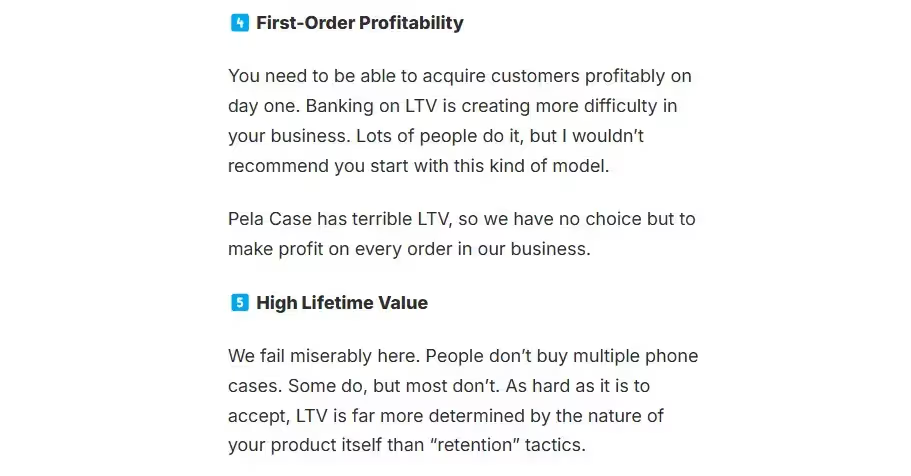
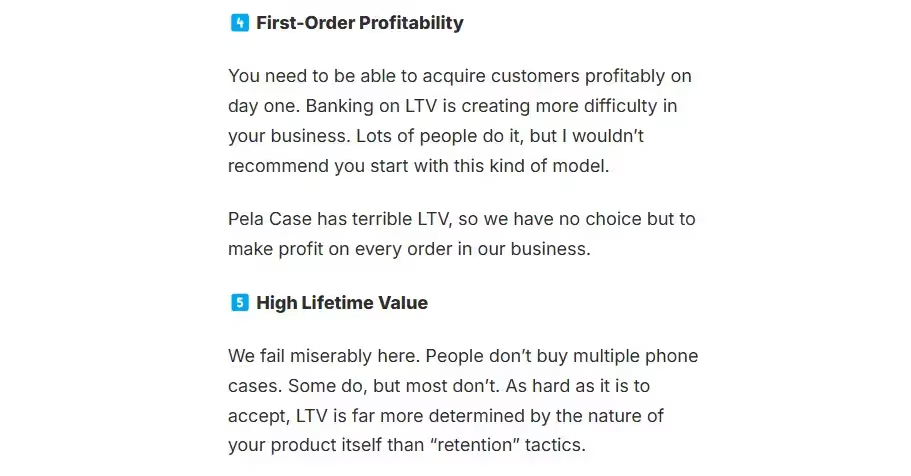
    For example, Matthew Bertulli, CEO of Pela Case, explained how first order profitability is vital for his business, as they don’t have the reliable repeat purchase rates to justify losses on the initial sale.
    ✅ Must-Have FOP:

    • One-Time Purchase Categories
      • Mattresses (Casper, Purple)
      • Luxury goods (high-end watches, jewelry)
      • Wedding-related products (rings, accessories, gifts)
    • Low-Repeat Categories
      • Novelty products (customized gifts, holiday items)
      • Niche DTC (one-off high-ticket gadgets)
    • Businesses with Weak Retention Pathways
      • If your AOV is low and there’s no strong upsell, FOP is non-negotiable.

    ❌ Can Lose on First Order:

    • Subscription-heavy brands (e.g., Daily Harvest, Ritual, Hims)
    • CPG with strong repeat purchase behavior (e.g., Magic Spoon, Athletic Greens)
    • Membership-based models (e.g., Costco, ButcherBox)

    Why You Won’t Scale With First Order Profitability Alone

    Making a profit on the first sale is great, but you don’t want to fall into the trap of optimizing everything around this, and ignoring LTV.

    First order profitability keeps the lights on, but LTV is how your brand scales, and withstands bumps in Meta ad costs and underperforming ad campaigns.

    Obsess over the initial profit too much, and you risk building a business that’s all about short-term wins, but falls apart when the landscape gets tougher and CAC goes up.

    Without retention, you’re stuck on an acquisition treadmill—constantly chasing new customers to replace the ones you couldn’t keep.

    The most successful brands find a balance between both initial profit and long-term revenue, and once they have enough of a buffer, start to funnel more focus (and investment) into retention.

    The Sustainable Scaling Playbook

    Here’s how you keep your brand in business, but build the stage for long-term, sustainable growth and high LTV.

    Do the following to improve first order profitability:

    • Boost AOV with bundles, cart drawer and post-purchase upsells and personalized product recommendations.
    • Constantly test new ad creatives to optimize ads and get CAC down.
    • Limit discount offers (experiment with other incentives, such as free content or gifts).
    • Don’t offer blanket free shipping (optimize your free shipping threshold to increase AOV). 
    • Invest in UGC and affordable traffic channels (e.g. SEO) that drive cheap traffic and offset more expensive acquisition campaigns.

    At the same time:

    • Add complementary product lines and subscription offers that increase repeat purchases.
    • Work on bottom of funnel traffic generation to build your email & SMS lists.
    • Set up automated email & SMS sequences (welcome sequences, abandoned cart, post-purchase, winback campaigns) that run on autopilot.
    • Funnel your top customers into branded communities and mobile apps (driving more engagement from your top spenders).

    If you have healthy first order profitability and dependable retention revenue, DTC is a great game to be in.

    Final Thoughts: Play to Your Strengths

    So, as you tweak your ad budgets, rethink your pricing, and test those checkout flows, keep the big picture in mind. 

    First order profitability matters. It’s your ticket to cash flow and stability in a brutal market. 

    But in the long-term, retention matters just as much.

    If your brand can balance the two, you’ve got a good chance at not just staying afloat, but winning.
  • Ten Major Trends to Watch in Ecommerce

    Ten Major Trends to Watch in Ecommerce

    The eCommerce world is constantly evolving. There’s no guarantee that what worked yesterday will continue to work tomorrow, or even today.

    As we enter 2025, expect certain trends to emerge and dominate the online retail industry.

    To stay competitive, brand owners need to be informed and up to date with these latest eCommerce trends.

    Based on our own experience, and the opinions voiced by numerous eCommerce thought leaders, we predict the following list of eCommerce trends will define 2025 when it’s all said and done.

    10 Trends to Watch for eCommerce in 2025

    Here are the top ten eCommerce trends we’re thinking about, coming into 2025.

    AI

    We couldn’t start any article without mentioning AI.

    AI, by now, is far from a new trend. We all know the scale at which AI is taking over online content, whether by generating web and social content with LLMs or AI writing tools, or AI overviews and AI search engines changing the way we find information.

    The crazy thing is, there’s still so much room to grow with AI.

    AI tools are getting better every day, and consumers are slowly starting to trust AI more, after some shaky early experiences.

    Expect AI to keep growing in 2025, especially for eCommerce.

    It will become standard for brands to use AI in many different capacities, including:

    • Creating optimized web and social copy
    • Creating visuals for various marketing channels
    • Personalizing product recommendations
    • Answering basic questions and assisting buyers
    • Optimizing inventory management, logistics, pricing
    • Providing insights to boost conversion rate, retention, and other key metrics
    __wf_reserved_inherit
    Amazon’s “Rufus” AI shopping assistant

    Realistically, we’re just scratching the surface of what AI can do.

    In 2025, businesses not leaning into AI will have a hard time competing with the speed and agility of those who do.

    Human experiences

    The second big eCommerce trend for 2025 will be a direct response to the first.

    The bigger and more ubiquitous AI gets, the more people will crave for human interactions and human experiences in eCommerce.

    People want to buy from other people, not from nameless, faceless robots. 

    Thus, the brands that succeed will be those who embrace their human side.

    That’s not to say you shouldn’t use AI in your business. There are many ways AI can provide value, as mentioned above.

    But don’t become so in love with AI that you let it replace the human side of your brand.

    Make sure your brand still has a human face, and a human voice, and let your customers know there is a team of real people behind the products they love.

    Mobile commerce

    Mobile is another trend that’s not new, but that will continue to grow and take over a larger part of the eCommerce game.

    Mobile commerce has been growing steadily each year.

    Worldwide, Statista estimates that $2.51 trillion, or 59% of all eCommerce sales, will be spent on mobile devices in 2025.

    __wf_reserved_inherit

    By the end of 2024, 77% of retail site traffic around the world came on smartphones, contributing 68% of all online shopping orders.

    In the US, mobile is a little further behind, contributing approximately 45% of total retail sales.

    But tentpole events such as BFCM show the potential mobile has in the US, as 57% of all Cyber Monday sales in the US ($7.6 billion in total) came on mobile.

    If mobile is not a focus for you yet, it should be.

    Ensure your user experience is fully optimized for mobile shoppers, reducing friction and usability issues in your conversion flow.

    Invest in mobile-friendly marketing strategies, and consider launching an app, if you haven’t already, to capture more repeat traffic and more revenue on mobile.

    Read more: Why Top DTC Brands Are Going All-In on Mobile Apps

    Social commerce

    Like with mobile, social commerce will continue to grow in 2025.

    Social commerce was estimated to have generated $699.4 billion worldwide in 2024 – and experts predict that social commerce sales will top $1 trillion by 2028.

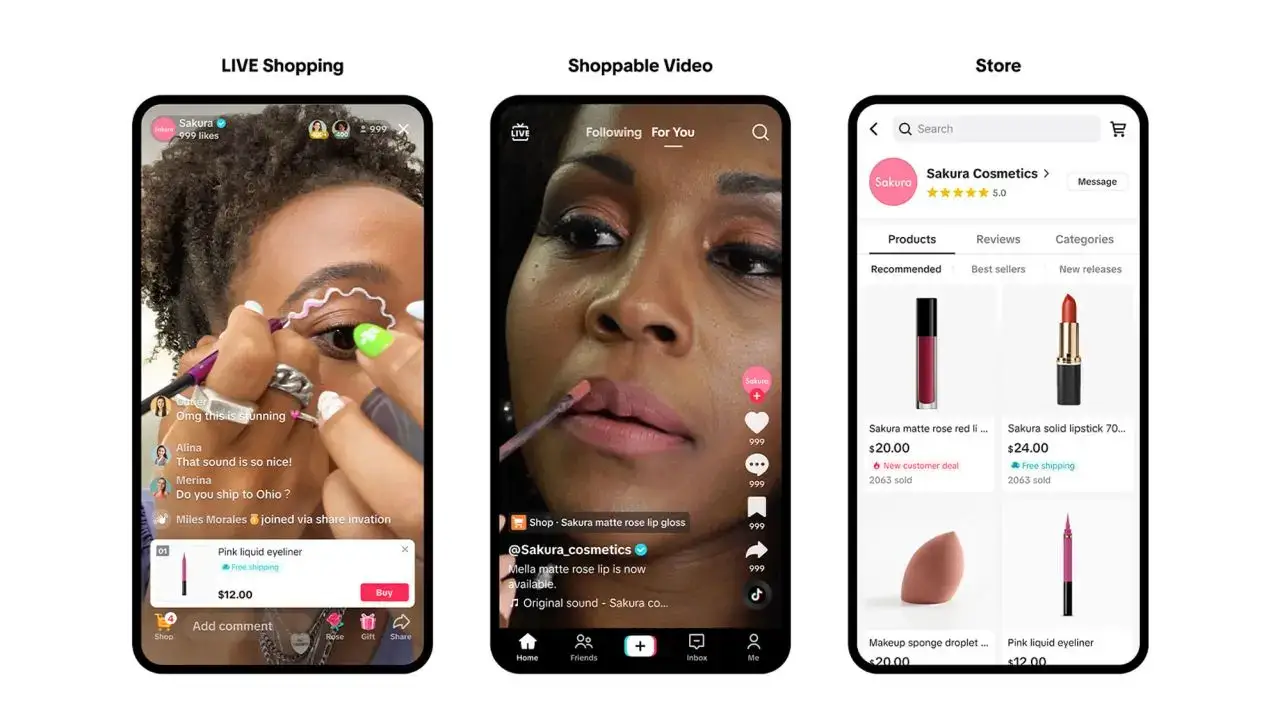
    We saw social come to play in a big way in 2024 with TikTok Shop.

    __wf_reserved_inherit
    Image source

    After first making an impact in other markets, the platform blew up in the US to drive over $600 million in monthly sales.

    __wf_reserved_inherit
    Image source

    The outcry, particularly from eCommerce brands, influencers and content creators, when TikTok was banned (at least temporarily) in January of this year shows the impact it’s had.

    Whether or not TikTok survives in the US remains to be seen, but the key takeaway shouldn’t be TikTok. 

    It’s that the kind of online shopping experience that resonates with customers today is a blend of social media and eCommerce.

    Just look at the rise of Shein and Temu if you want another example – two shopping apps that could be mistaken at times for social media or gaming apps.

    __wf_reserved_inherit

    These apps harness the power of small dopamine spikes to get shoppers coming back more often, and hanging around for longer, ultimately driving serious long-term revenue.

    Focus on retention and LTV

    2024 was a rocky year for many brands, as the customer acquisition landscape has become increasingly unpredictable.

    Paid acquisition channels are getting more expensive, while low-cost, organic channels are harder to rely on.

    Google search has been a mess for some time. Email deliverability is down. Organic social reach is down.

    All this leads to rapidly rising customer acquisition costs. To offset this rise, brands need to put more focus into customer retention and LTV.

    Higher retention and repeat purchase rates allow brands to weather higher CAC, and provides a safety net against the unpredictability of traditional acquisition platforms.

    You need to spend less time, energy and money on finding new customers, and more on selling to your existing customers.

    While brands are disappearing from Google, losing tens of thousands in revenue from the TikTok ban, and spending more on paid traffic for the same return, you’ll have a competitive advantage if most of your customers are coming back and buying again and again.

    Read more: How to Boost Loyalty and Retention with a Mobile App

    Ownership of data and customer interactions

    In 2025, more brands will cotton on to the danger of renting your audience, and relying fully on third-party platforms for a large chunk of your sales.

    Driving the bulk of your revenue from social commerce and eCommerce marketplaces leaves you vulnerable to platform risk, and gives you little ability to personalize your customer experiences.

    Add in the increasing difficulty for brands in getting data from web visitors, as modern browsers cut down the effectiveness of third-party cookies.

    In 2025, any brand with first-party data and ownership of their audience will have a major leg up.

    Focus on building direct, owned touchpoints with your customers.

    Build and grow channels like email, mobile apps and push notifications, where you don’t have to rely on a third party, and you have the ability to build real customer relationships with direct access to your audience.

    Convenience becomes a non-negotiable

    Modern shoppers want convenience.

    They don’t just want it – they want it easy, and they want it now.

    That’s why mobile shopping is rising, and cart abandonment is rising.

    Shoppers want the customer experience to be frictionless. They don’t want to have to get up and switch devices, find their wallet and type in their card details, or spend time typing in their address.

    With so much competition, shoppers will leave at the first sign of unnecessary friction, and buy from somewhere else.

    The same applies for shipping. No one, in 2025, is waiting around for weeks for their impulse TikTok buy to show up.

    They want it now.

    __wf_reserved_inherit
    Image source

    Expect a stronger focus on speed and convenience.

    Fast delivery times. Frictionless checkout processes. Customers’ info saved for quick checkout, and multiple payment options available (particularly mobile payment wallets).

    If you fall short, don’t be surprised if the competition overtakes you, simply by making the customer’s life easier.

    Rising demand for sustainability in eCommerce

    Another growing customer trend is the desire for sustainability.

    A rising number of people care about the impact their purchase has on the environment, and showing that your brand supports and cares about sustainability may positively impact your brand’s image.

    According to PwC, 75-80% of consumers today are willing to pay up to 5% more for locally sourced, eco-friendly, fair trade, biodegradable or ethically sourced products.

    __wf_reserved_inherit
    Image source

    50-55% of consumers are willing to pay 6-10% more, while 30-33% say they will pay a sustainability premium of more than 10%.

    You can meet consumers’ demands (not to mention being kinder to the planet, and its inhabitants) by switching to eco-friendly packaging and sustainable sourcing and production of your products.

    Sustainable business practices

    Sustainability is important in more ways than eco-friendly packaging and ethical sourcing.

    It’s also vital to keep overhead and operational complexity down, and maintain a sustainable business.

    The unpredictability of acquisition puts brands in a risky position if they constantly need to bring in waves of new customers to stay above water.

    With lower overhead, you have a better chance of weathering the storm that will inevitably come at some point in 2025.

    Additionally, the leaner your business is, the faster you can adapt to market changes (which, if 2024 was anything to go by, will come thick and fast in 2025 as well).

    With the help of AI to automate or speed up a lot of tasks, don’t be surprised if lean, independent brands with lower headcounts are in the best position to win in 2025.

    Omnichannel brand building

    There are so many more ways for customers to shop, or consume content today.

    Your audience is likely on multiple social media platforms. They consume content on YouTube, podcasts on Spotify, they search on Google and with Chat GPT, and they use dozens of apps.

    They use their mobile phone and smart TV at home, and their laptop during work hours.

    They buy things on Amazon, from a social post, from an email or push notification, or from a Google search.

    Brands need to be where their customers are. And today, your customers are everywhere.

    Your brand must be too.

    Build as many touchpoints as possible for your customers, to increase reach and decrease the number of ideal customers who slip through the cracks.

    Let people buy from your website, social media, or mobile app.

    Reach out to your audience on social, push, email and SMS.

    Show up on Instagram, TikTok, and Google.

    There’s more competition for attention today than ever before. More touchpoints means more shots on goal for your brand.

    __wf_reserved_inherit
    Mobile apps and push notifications are two powerful ways to capture more of your customers’ attention

    What eCommerce Trends Are You Betting On?

    Above, we introduced ten major eCommerce trends to be aware of in 2025.

    As a brand owner, you know the value of staying up to date with the latest consumer trends. But there’s no easy playbook for how to approach a new year in eCommerce, and it’s always a little like making a bet on how the year will play out.

    So, what are you betting on?

    Some brands are all-in on AI, or other rising tech trends such as AR (augmented reality) and voice search.

    Others may be betting on mobile, social, or a return to human-focused content and human experiences.

    If you’re betting on mobile, and on the importance of retention, data ownership and control over your audience, launching a mobile app is a must.

    Vendrux helps you do it by converting your website into an app, building deeper relationships with your customers, increasing AOV and LTV, and adding push notifications as an engagement channel – all for a low cost.

    __wf_reserved_inherit
    We helped high-revenue brands like Tobi, Jack & Jones and Only & Sons launch amazing mobile apps, fast

    Learn more about how Vendrux helps here – and if you want to explore building an app for your brand, feel free to book a free app strategy call to discuss your vision for the app and how Vendrux can make it happen.

  • What Is eCommerce Retention Rate? (and How to Improve It)

    What Is eCommerce Retention Rate? (and How to Improve It)

    Retention is key for the success of eCommerce businesses. The better you can retain and sell to existing customers, the less you’re likely to spend acquiring customers, and each customer you get becomes more valuable.

    In this article we’ll show you what a good eCommerce retention rate is, along with various factors that you should take into account when comparing your rate to the overall average. We’ll explain why focusing on increasing retention is a winning strategy, and finish up with some tips to help you do it.

    What is Retention Rate in eCommerce?

    In eCommerce, retention rate is the percentage of your customers who make more than one purchase.

    Retention rate is the percentage of your users or customers who continue to use your service or buy your products over a certain period of time.

    Retention rate can be different depending on the type of business, along with the criteria you choose to set. For example, an app’s retention rate would usually be the percentage of users who keep the app installed over a period of time, such as 7 days, 30 days, 90 days, etc.

    In eCommerce, retention rate is generally used to show the percentage of customers who make more than one purchase. It can also be called “repeat customer rate”.

    How to Calculate Retention Rate

    You can find your retention rate by taking the total number of customers and dividing this number by the number of customers who made more than one purchase.

    For example, if you had 100 unique customers make a purchase from your store, and 20 of those customers purchased more than once, your retention rate would be 20%.

    What’s the Average Retention Rate for eCommerce Stores?

    According to a rough estimation of a number of sources, the average customer retention rate for eCommerce is 28.2%.

    This means 28.2% of eCommerce customers buy from a brand more than once.

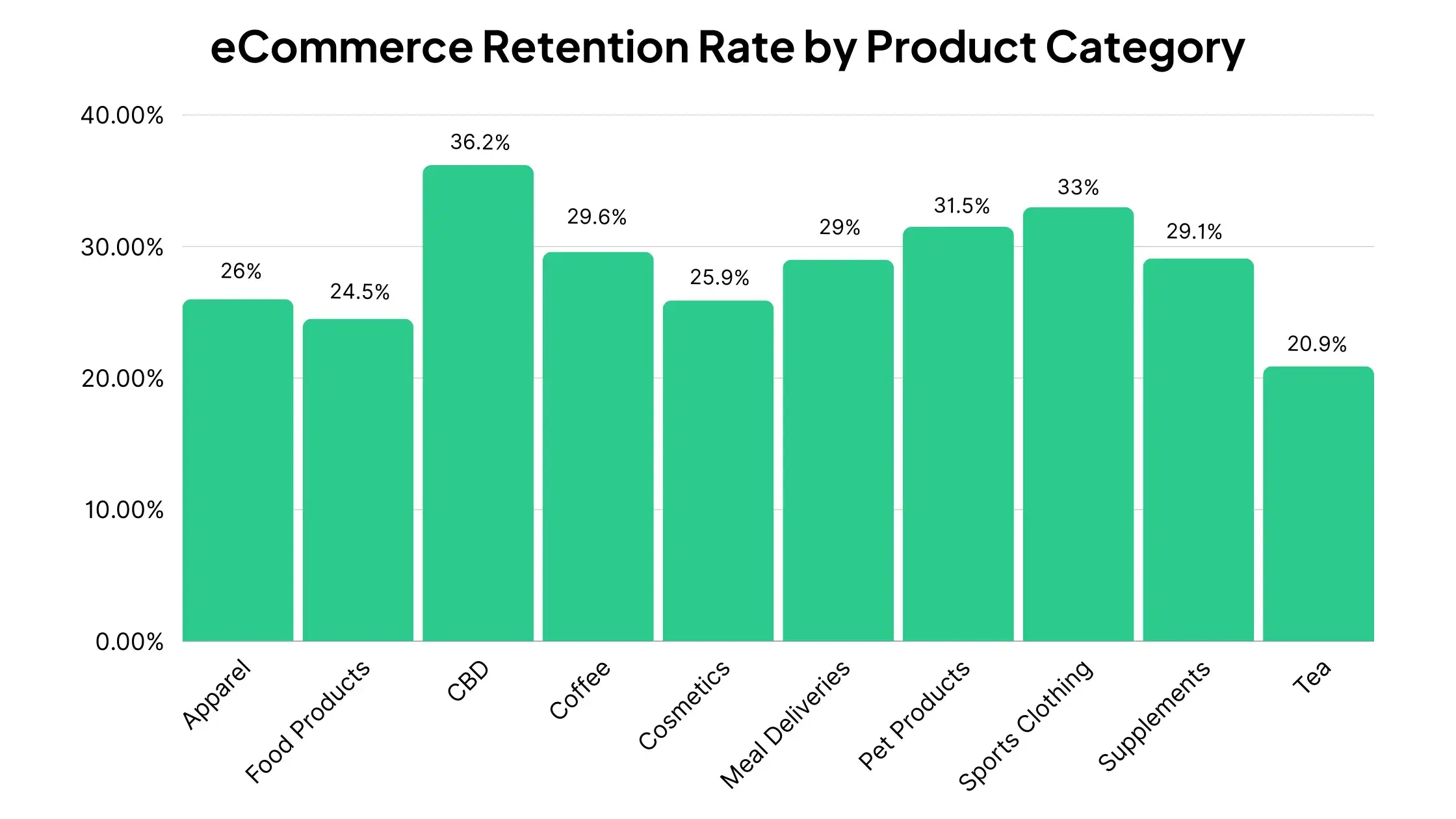
    This data varies by industry and product category. One study found the following averages:

    • Apparel: 26%
    • Branded Food Products: 24.5%
    • CBD: 36.2%
    • Coffee: 29.6%
    • Cosmetics: 25.9%
    • Meal Deliveries: 29%
    • Pet Products: 31.5%
    • Sports Clothing: 33%
    • Supplements: 29.1%
    • Tea: 20.9%
    __wf_reserved_inherit

    [Data Source: Metrilo]

    In this data set, Tea, Food Products and Apparel scored low in customer retention, while Sports Clothing, Pet Products and CBD Products all had higher repeat customer rates.

    Other sources give a range of answers for what a good ecommerce customer retention rate is, from as low as 15% to as high as 38%.

    How to Assess eCommerce Customer Retention in Context

    Like any metric, customer retention rate can be misleading if you look at it on its own, out of context.

    For example, let’s say you have a 10% retention rate. This is far below the average ecommerce retention rate. But it might not be something to worry about.

    You could sell products in a category where repeat purchases are very rare (i.e. people usually buy once, and have no need to buy another product).

    You could have very low customer acquisition costs (CAC) and a wide target audience, meaning you can generate a lot of revenue and profit just from new customers.

    You could also have a particularly high customer lifetime value (CLV), despite your low retention rate, meaning those customers who do come back tend to make a lot of purchases and spend a lot of money.

    It’s important to assess retention rate in context. Some products or industries just aren’t naturally suited for return customers. Or you may have made a conscious decision to focus on other metrics, like lowering CAC, or increasing conversion rate and prices to increase average order value (AOV).

    Whatever the case, it will still be beneficial to increase retention rate, but this one metric alone doesn’t tell the whole story of your business’ performance.

    Why Retention Rate is a Powerful Metric

    Though there are certainly other things that matter, a good retention rate is almost always a great sign for your business. It makes a lot of sense to make this one of your key focus metrics.

    For most businesses, it costs a lot more to attract a new customer than to sell to an existing one. Experts believe it is 6 to 7 times more expensive to get a new customer than to retain those you already have.

    It’s also believed that a 5% increase in retention can boost revenue by as much as 25 to 95%, as returning customers tend to buy more often and spend more than new customers

    Then there’s the loyalty and word of mouth factor. Repeat customers tend to be loyal brand advocates, those who will tell their friends about your brand, write reviews for your brand, and deliver more benefits than simply their own spending.

    How to Boost eCommerce Customer Retention

    It’s never a bad idea to put effort into improving your retention rate. Here are some of the best eCommerce customer retention strategies to help you retain customers and build a higher CLV through repeat purchases.

    Sell High-Quality Products with Great Customer Service

    First of all, get the fundamentals right. Customer loyalty comes from doing the basic things right.

    Happy customers will be more likely to come back and buy from you again. You make customers happy by selling good products and providing a high level of customer service.

    Create a Loyalty Program

    A loyalty or rewards program is a great way to entice people to come back and make multiple purchases.

    Just see how many places utilize loyalty programs for evidence of how effective they are. From Amazon to Starbucks to punch cards on your local coffee shop, almost everyone you shop with is competing to get you on their loyalty program, because they know that the incentive of eventually earning discounts or free stuff will make you want to shop with them again and again.

    Set Up Post-Purchase Marketing Campaigns

    You shouldn’t stop marketing once someone converts and becomes a customer. In fact, it makes sense to step up your marketing, as someone is more likely to buy if they already trust you and have bought from you in the past.

    Set up automated marketing campaigns (e.g. email, SMS, push notifications or retargeting ads) to push cross-sells, up-sells or restocks to existing customers, using the info from their previous purchase to personalize each campaign specifically for that customer.

    Save Customer Info for Low-Friction Login and Checkout

    Make it as easy as possible for customers to become repeat customers. When they buy from you the first time, you can give them the option to save their login and payment information to allow them to check out fast, with minimal friction.

    Offer Returning Customer Discounts & Subscription Deals

    Incentivize people to buy from you multiple times. A lot of stores offer discounts for first-time customers, but returning customer discounts can be even more effective, as encouraging people to buy multiple times can lead them to become loyal customers who buy over and over again, spending a huge amount over their lifetime as a customer.

    You can do the same with subscriptions for consumable products (e.g. supplements, beauty products). Make it cost-effective for someone to set up an automatic subscription and a lot of people will choose that option and become regular customers.

    Schedule Emails or Notifications Near Expected Restock Dates

    For consumable products that aren’t on a subscription, estimate the length of time someone’s likely to need a restock, and send reminders close to this time via email, SMS, push etc.

    Hitting a customer with a restock notification at just the right time makes it easy for them to buy with you again.

    For particularly competitive product categories, you might want to offer an incentive, such as a discount, if they restock with you.

    The idea is to help them build a habit of buying from you each time, to where they become a loyal customer who always comes to you each time they run out of this product.

    Push notifications are a powerful tool to boost loyalty and retention and generate more repeat purchases, and Vendrux makes it easy to integrate native mobile push notifications with your online store.

    Book a demo now to learn more about setting up push notifications for your store.

    Build a Mobile App

    Finally, launching your own mobile app is a phenomenal way to boost your customer retention rate.

    Customers who download and buy from your app are far more likely to become repeat customers than those who shop on your website. That’s because your app remains on their phone, and in their consciousness, even after the purchase is over.

    Even better, you’ll be able to send push notifications to these users to invite them to come back, open the app and shop again. Push notifications have 2.5x higher open rates than email, higher click-through rates than email and SMS combined, and a lower cost than both SMS and email.

    With their affordability, personalization, trust and convenience, push notifications are the perfect tool to reach out to customers with promotional offers, restock reminders and content that helps make them loyal, repeat customers. And you only have full access to mobile push notifications with an app.

    Mobile push notifications are a powerful tool for eCommerce stores

    Want to Boost Retention Rate, Conversion Rate and AOV By the End of the Month?

    Vendrux can boost your retention rate, along with mobile conversion rate and average order value, all in less than a month.

    We do this by helping you turn your eCommerce website into a mobile app, published in the app stores and able to be downloaded to your customers’ mobile devices.

    This lets you start turning regular customers into hyper-loyal repeat customers, who use the app to shop with you over and over.

    It takes minimal investment to launch your app, and as long as your site is already mobile-friendly, there’s very little work left for you to do. You’ll just talk to a product manager, sign up, and wait while we turn your mobile website into a professional, high-quality app.

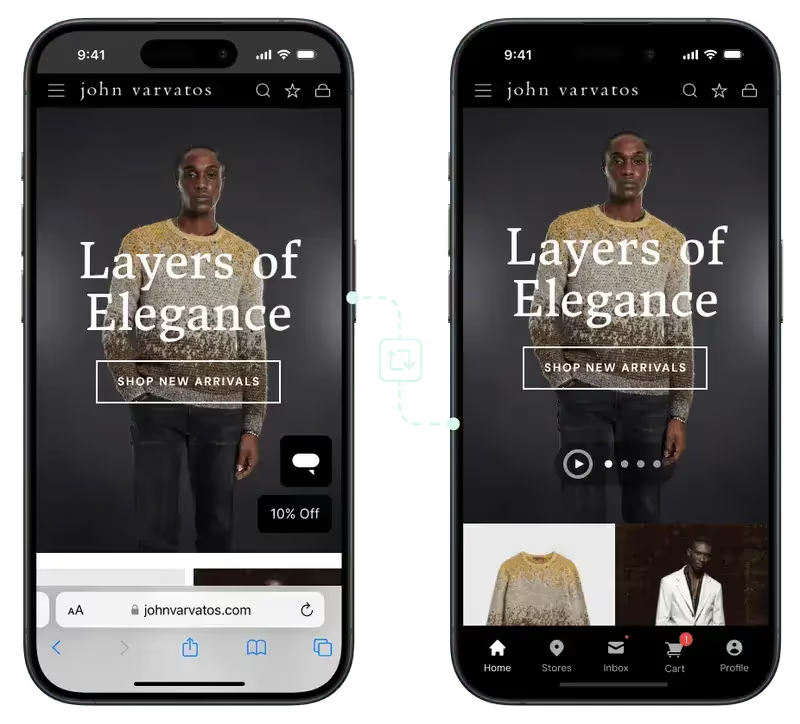
    Many successful eCommerce stores, including Rainbow Shops, John Varvatos, ONLY and more, have used Vendrux to create their apps, with incredible results.

    The ONLY app, built with Vendrux

    Try it out now – book a free, personalized demo with one of our team members to get a closer look at the process, and get a preview of your app designed by our team.

    In less than a month, you could have your own mobile app, live and published in the app stores.

    Launching an app is the best thing you can do to increase retention for your eCommerce store. Get in touch with us now to learn more.

  • Ecommerce PWAs: A Viable Alternative to Native Apps?

    Ecommerce PWAs: A Viable Alternative to Native Apps?

    If your ecommerce platform offers PWA capabilities, you’ve probably considered using them. 

    Adobe Commerce has PWA Studio. Salesforce Commerce Cloud has its Composable Storefront (PWA Kit). Shopify has Hydrogen

    The message from every platform is the same: PWAs are the modern way to deliver mobile commerce.

    And they’re right, up to a point. PWAs are powerful, and they represent the modern capabilities of mobile websites. The issue? When you get to thinking a PWA is a substitute for a native app.

    If you’re in ecommerce, your site should be a PWA. We can say that pretty confidently.

    But that’s not all it should be.

    What Is an Ecommerce PWA?

    A progressive web app (PWA) is a website built with modern web technologies, that mimics some behaviors of a native app – like offline caching, push notifications, and home screen installation – while still running in the browser.

    In practice, it means your ecommerce store loads faster, feels more responsive, and offers a few features that regular mobile websites can’t match. 

    Users can add your store to their home screen without downloading anything from an app store. Pages can load even on spotty connections. You can send push notifications through the browser (on Android).

    How PWAs Differ from Regular Mobile Websites

    A standard mobile website is a collection of server-rendered pages. Every tap sends a request to the server, waits for a response, and renders a new page. 

    It works, but it can be slow. And a little clunky.

    PWAs are designed to improve on that.

    If you put a regular mobile website and a PWA side by side, you’d notice a few things:

    • Speed on return visits. A PWA caches content locally, so pages you’ve already visited load almost instantly the next time. A regular website fetches everything from the server on every visit.
    • No full page reloads. Tap a category or product on a PWA and the content swaps in smoothly, like an app. On a regular site, the whole page flashes white and reloads.
    • “Add to home screen” prompt. A PWA can prompt users to install it as an icon on their phone. Launch it from there and it opens full-screen, with no browser address bar or navigation buttons. It looks and feels like an app (even though it’s still running in the browser under the hood).
    • Working offline or on bad connections. Lose your signal on a regular website and you get a dead page. A PWA can still display cached content: product pages you’ve browsed, your cart, category listings.

    Under the hood, these capabilities come from technologies called service workers (background scripts that handle caching and offline behavior) and a web app manifest (a config file that defines the home screen icon, splash screen, and display mode). 

    But from the user’s perspective, the difference is simple: a PWA feels faster, smoother, and more like an app.

    PWA vs Headless Commerce: What’s the Difference?

    These terms get conflated, but they’re not the same thing. 

    Headless commerce is an architecture where your frontend (what the customer sees) is decoupled from your backend (your product catalog, checkout, order management). The frontend communicates with the backend through APIs, typically GraphQL or REST.

    A PWA is a type of frontend. You can build a PWA on a headless architecture (this is what Adobe Commerce PWA Studio and Salesforce’s Composable Storefront do), but you can also add PWA features to a traditional, non-headless website.

    Headless gives you architectural flexibility. PWA gives you a specific set of browser-based capabilities. 

    Many enterprise platforms now combine both, offering headless architectures with PWA-ready frontend tooling.

    What Does a PWA Do for Your Ecommerce Store?

    PWAs deliver measurable improvements across several dimensions that matter for ecommerce.

    Faster Page Loads and Better Core Web Vitals

    Speed is the most tangible benefit. Service worker caching means returning visitors get near-instant page loads because assets are served from the local cache rather than the network. Code splitting and lazy loading reduce initial load times for new visitors.

    Pinterest rebuilt their mobile experience as a PWA and reduced Time to Interactive from 23 seconds to 5.6 seconds. First Meaningful Paint dropped from 4.2 to 1.8 seconds. The result: a 44% increase in user-generated ad revenue and a 40% increase in time spent on site.

    For ecommerce, faster pages mean lower bounce rates and higher conversion. Google’s data shows that as page load time goes from 1 second to 3 seconds, the probability of bounce increases 32%. From 1 to 5 seconds, it increases 90%.

    App-Like Mobile UX Without an App Download

    PWAs offer an “app-like experience”, without the friction of app store downloads. 

    When launched from the home screen, a PWA runs in a full-screen window without browser chrome, making it visually indistinguishable from a native app for basic interactions.

    This matters because most ecommerce traffic today comes on mobile, and while apps provide a much better user experience, the average site visitor isn’t going to download your app. 

    A PWA lets you deliver a better-than-web experience to users who would never visit an app store for your brand.

    Push Notifications

    PWAs support web push notifications, which let you re-engage users with promotions, back-in-stock alerts, or abandoned cart reminders directly on their device. 

    Push is powerful. Push notifications contributed to the impact of Lancôme’s PWA, which generated a 17% increase in conversions.

    It is worth noting that web push is different from native push, which is what you get from a “real” mobile app. PWAs can’t match the impact of a push notification that lights up your customer’s lock screen, no matter where they are or what they’re doing.

    Offline Browsing and Reliability

    Service workers can cache product pages, category listings, and other static content so users can browse your catalog even when their connection drops. This is particularly valuable for brands with customers in regions with unreliable connectivity.

    Jumia, Africa’s largest ecommerce platform, built a PWA specifically to serve customers on 2G networks. The result: 33% higher conversion rates and 50% lower bounce rates.

    For most Western ecommerce brands, offline browsing is a nice-to-have rather than a core need. 

    Users can browse cached pages, but they can’t complete a purchase offline – and today, most people have an internet connection wherever they go, anyway. But it may still be a useful feature for some brands.

    Home Screen Installation

    Users can “install” your PWA to their home screen, creating a persistent shortcut that looks like a native app icon. 

    This reduces the steps between intent and purchase for repeat visitors.

    Rakuten 24 reported a 450% increase in visitor retention after enabling home screen installation, along with a 150% increase in sales per customer.

    It’s not as intuitive or as easy as downloading an app from the app store; but it can make your website a little more sticky.

    Which Ecommerce Platforms Support PWA?

    Most major enterprise ecommerce platforms now offer PWA tooling, either built-in or through their headless architecture. Here’s what the main platforms provide.

    Adobe Commerce (PWA Studio)

    Adobe Commerce PWA Studio is a set of open-source developer tools for building a React-based, headless PWA storefront on top of Adobe Commerce (formerly Magento 2). It replaces the aging Luma theme with a modern single-page application that communicates with the backend through GraphQL APIs.

    Key components include Venia (a reference storefront), Peregrine (React hooks for commerce logic), and UPWARD (a proxy server for routing). The result is dramatically faster page loads and a fluid mobile experience compared to traditional Magento storefronts.

    Riddle’s Jewelry saw a 47% increase in web traffic and a 5.7% boost in conversion rate after migrating to PWA Studio. Accent Group (Platypus Shoes) reported a 14% lift in AOV and a 68% increase in add-to-cart rate.

    Salesforce Commerce Cloud (Composable Storefront)

    Salesforce’s Composable Storefront, built on the PWA Kit framework, is a React-based headless frontend for B2C Commerce. It runs on Managed Runtime, Salesforce’s serverless hosting infrastructure, which handles scaling and deployment.

    Recent additions include social login, address autocomplete, Order Management integration, and Node 22 support. Salesforce also released a PWA Kit MCP Server in late 2025 for AI-assisted development.

    Shopify (Hydrogen)

    Hydrogen is Shopify’s React-based framework for building custom headless storefronts, hosted on Shopify’s Oxygen infrastructure. 

    While not strictly a “PWA builder,” Hydrogen supports all the building blocks for a progressive web app: service workers, offline caching, and the web app manifest.

    Hydrogen is optimized for speed with server-side rendering, edge deployment, nested routes, and progressive enhancement. It integrates directly with Shopify’s Storefront API and includes pre-built commerce components.

    The Winter 2026 update added Storefront MCP support, letting brands build AI agents directly into their storefronts.

    commercetools and Other Composable Platforms

    Composable commerce platforms like commercetools, Elastic Path, and Spryker are API-first by design, which means they work with any PWA frontend framework. 

    Vue Storefront (now Alokai) has emerged as the most popular open-source PWA frontend for these platforms, supporting multiple backends through a unified SDK.

    Ecommerce PWAs vs Mobile Apps: Is a PWA a Viable Alternative?

    There’s very little reason not to turn your standard website into a PWA. Cost would be the only thing – but PWAs are not oppressively so. If you’re an enterprise brand with a web development team, it’s not a massive project.

    The issue is that many people look at the “app-like experience” part and start to compare PWAs and native apps.

    The thought is that you can save on the cost of mobile app development and make do with a PWA, instead of a true native app.

    A PWA is not the same as a native app. It doesn’t give you the same benefits a mobile app does.

    Why a PWA is Not an App Replacement

    The thinking that you can replace your mobile app with a PWA is flawed. In this context, PWAs have real limitations.

    • They can’t be published to the App Stores
    • PWAs can’t send native push notifications (only web push; which requires the browser to send, and have limited opt-in/delivery rates)
    • Cannot send push at all on iOS (PWAs are very limited on iPhone in general)
    • Home screen installation is not intuitive (very few people will realistically “download” your PWA)
    • They can’t tap into native device features (which you may not really need from an ecommerce app; though native push is the one major exception)

    PWAs are powerful. But they’re web apps, not mobile apps.

    The home screen “installation” is more like a shortcut or bookmark to the web app. And running through the browser means it doesn’t have the same functionality as an app that runs on its own.

    Capability PWA Native App
    Page load speed FastCached assets, service workers FastCompiled code, local storage
    Push notifications (Android) YesVia web push YesVia FCM
    Push notifications (iOS) LimitedRequires home screen install, auto opt-out, no background sync Full supportStandard prompt, background delivery, badges
    App Store presence No YesApple App Store + Google Play
    Offline browsing YesCached pages YesFull offline support possible
    Offline checkout No PossibleVaries by implementation
    Home screen icon YesVia “add to home screen” YesVia app install
    Hardware access LimitedNo NFC, Bluetooth, or geofencing FullNFC, Bluetooth, biometrics, camera, GPS
    Development cost LowerSingle codebase, web technologies HigherPlatform-specific or cross-platform
    Update deployment InstantNo app store review 1-3 daysApp store review required
    SEO impact Pages indexable Not indexedApp content not indexed by default
    Customer retention / LTV Good for acquisitionWeaker for retention StrongBest for retention and repeat purchase
    Discoverability Search, links, social App Store, recommendations, ads

    Does Your Ecommerce Brand Need More Than a PWA?

    The flaw is thinking of it as PWA vs mobile app.

    Think of it as a progression:

    • Standard website
    • Progressive Web App
    • Mobile app

    A PWA can carry your mobile strategy for a time. But when you want to take retention and mobile engagement to the next level, you’ll want a true mobile app.

    A mobile app lets you:

    • Offer a simple download path
    • Get discovered on the App Stores
    • Reach customers at any time with push notifications
    • Build a more custom experience for your best shoppers

    The “Available on the App Store” badges hit different.

    One tap to download your app works a lot better than giving customers a set of instructions for how they can put your website on their home screen.

    And push is the big one. Push is the reason to launch an app; but with a PWA, you just don’t have the same reach.

    When a PWA Is Enough

    A PWA could be enough if:

    • You’re earlier-stage and mobile revenue is a small share of your total
    • Your audience skews heavily Android (emerging markets, certain demographics)
    • You don’t have the budget for a native app yet (though it probably costs less than you think)
    • You sell to an audience or in a category where a mobile app doesn’t make sense

    For brands in this position, a well-built PWA on your ecommerce platform is a genuine upgrade that will improve mobile performance and conversion rates – and it’s a powerful cornerstone for your mobile commerce strategy.

    Ecommerce PWA Examples and Results

    The world’s biggest brands use PWAs as part of their mobile strategy. Here are some examples:

    Alibaba

    The world’s largest B2B ecommerce platform rebuilt its mobile experience as a PWA and saw conversions increase 76% across browsers. Monthly active users grew 14% on iOS and 30% on Android. Alibaba notably runs both a PWA and native apps, using each for different segments of its user base.

    AliExpress

    AliExpress’s PWA increased new user conversion rates by 104%, with 2x more pages visited per session and 74% more time spent per session. Like Alibaba, AliExpress maintains both a PWA and native apps.

    Lancôme

    Lancôme’s PWA addressed a major conversion gap: mobile conversion was 15% compared to 38% on desktop. After launching the PWA, conversions increased 17%, mobile sessions grew 53% on iOS, and push notifications became a meaningful revenue driver, contributing to an 8% uplift.

    Accent Group (Platypus Shoes)

    Running on Adobe Commerce PWA Studio, Accent Group reported a 14% lift in AOV and a 68% increase in add-to-cart rate after migrating from a traditional Magento storefront. This is a more recent example than the commonly cited 2016-2017 case studies and demonstrates the performance gains available from modern PWA architecture on Adobe Commerce specifically.

    Starbucks

    Starbucks built a PWA for its ordering experience that’s 99.84% smaller than the iOS app (233KB vs 148MB). This was designed for users on slow connections or limited storage who couldn’t download the full native app, while the native app remains Starbucks’ primary mobile channel for its loyalty program and highest-value customers.

    The Complete Approach: PWA + Native App

    PWAs and native apps aren’t competing alternatives; they’re complementary channels that serve different parts of the customer journey.

    • A PWA optimizes your mobile web experience for the largest possible audience: organic search visitors, social media traffic, ad clicks, and anyone who lands on your site from a browser. It’s your acquisition and first-impression layer.
    • Native app creates a dedicated retention channel for your most valuable customers: repeat buyers, loyalty members, and brand fans who want a faster, deeper experience. It’s your LTV and retention layer.

    As David Cost from Rainbow Apparel puts it: “There are users who prefer to buy on the app and users who prefer using the browser. You can’t convince one to go the other way, you need to meet them where they are.”

    That’s the relationship between PWAs and native apps in a nutshell. PWAs for people who don’t want to download the app; native app for those who do.

    The gap? Turning your PWA into a mobile app.

    How Vendrux Bridges the Gap

    What makes PWAs and mobile apps so complementary is building a PWA makes it easy to turn your site into a mobile app.

    That’s what we do at Vendrux. We extend your website into iOS and Android apps – real mobile apps with push notifications, home screen icons, the works.

    And if you already have a PWA, this process is so simple.

    The app inherits the bulk of your mobile website’s UI and UX, so if you’ve already built that into a PWA, you’re 95% of the way to having an app already.

    Vendrux literally bridges the gap between your PWA and it functioning as a proper mobile app.

    What we do at Vendrux – turning your responsive website into a full-featured mobile app

    Whether you’re on Adobe Commerce with PWA Studio, Salesforce Commerce Cloud, Shopify, or any other platform, Vendrux works alongside what you already have. And it lets you launch a mobile app for potentially 1% of the cost of a typical custom mobile app (with much lower overhead to boot).

    It’s the best way to build a fast, powerful PWA, and extend that work to launch a legit mobile app for your best customers.

    If you want to see how it works for your store, book a free strategy call and we’ll walk you through everything.

  • Ecommerce Product Detail Page Best Practices: The Complete Guide (2026)

    Ecommerce Product Detail Page Best Practices: The Complete Guide (2026)

    Your product detail page is where buying decisions happen. It’s the last stop before “Add to Cart” or the back button.

    A shopper who lands on your PDP has already shown intent. They searched, clicked, browsed, and chose a specific product. Now they need enough information to commit, and they need it presented clearly, quickly, and on whatever device they’re using.

    The problem is that most PDPs fall short. Baymard Institute’s research across hundreds of ecommerce sites found that only 18% of product pages earn a “good” or “acceptable” UX rating. The rest lose sales to preventable issues: missing size information, buried shipping details, slow load times, or product images that don’t show what the customer actually needs to see.

    This guide covers every element of a high-performing PDP, from visuals and copy to technical SEO and mobile optimization, with sourced data and real examples so you can audit your own pages and make specific improvements.

    What Is a Product Detail Page (PDP)?

    A product detail page is the individual page on an ecommerce site dedicated to a single product. It’s where a shopper evaluates whether a product is worth buying. 

    In ecommerce terms, the PDP sits between the product listing page (PLP), which shows a category or search results grid, and the cart/checkout flow.

    The PDP’s job is simple: give shoppers everything they need to make a confident purchase decision. That includes:

    • Visual confirmation (does this look like what I want?)
    • Specification details (will it fit, work, or match?)
    • Social validation (do other people recommend it?)
    • Logistical clarity (when will it arrive, and can I return it?)

    A PDP that answers all four of those questions converts. One that leaves gaps loses the sale to a competitor who answers them better.

    Why PDP Optimization Matters More Than You Think

    Improving your PDP conversion rate from 2.0% to 2.5% means a 25% revenue increase from the same traffic. No extra ad spend, no new campaigns. Just better pages.

    Consider what’s at stake:

    • Cart abandonment starts here. When shoppers can’t find the information they need (shipping cost, return policy, sizing), they leave before they ever reach checkout.
    • Returns start here too. Vague descriptions, insufficient images, or unclear sizing lead to wrong purchases. Returns cost 15-30% of the item price to process and erode customer trust.
    • SEO visibility depends on PDP quality. Google evaluates product pages for E-E-A-T (experience, expertise, authoritativeness, trustworthiness). Well-structured PDPs with rich content, reviews, and structured data earn better rankings and rich snippets.
    • Mobile shoppers are less patient. Mobile commerce accounts for over 57% of all ecommerce sales, and mobile shoppers scroll faster, tap less precisely, and abandon more quickly when pages are confusing or slow.

    The opportunity is real: most of your competitors have mediocre PDPs. Fixing yours is one of the highest-leverage things you can do.

    The Essential Elements of a High-Converting PDP

    Product Images and Video

    Product imagery is the single most influential element on a PDP. 67% of online shoppers cite image quality as the top factor in their buying decision, more than product descriptions, reviews, or pricing.

    What high-performing product images look like:

    • 6-8 images minimum showing different angles, close-up details, and scale references
    • Lifestyle shots showing the product in use (worn, styled, placed in a room)
    • Zoom functionality so shoppers can inspect textures, stitching, materials, and finishes
    • Consistent lighting and backgrounds across your catalog for a professional, cohesive feel
    • Color-accurate photography to reduce returns from “it looked different online”

    Video content is a conversion multiplier. Shoppers who watch product videos are 144% more likely to add a product to their cart. Product demos, 360-degree views, and styling videos give shoppers confidence that static images alone can’t provide.

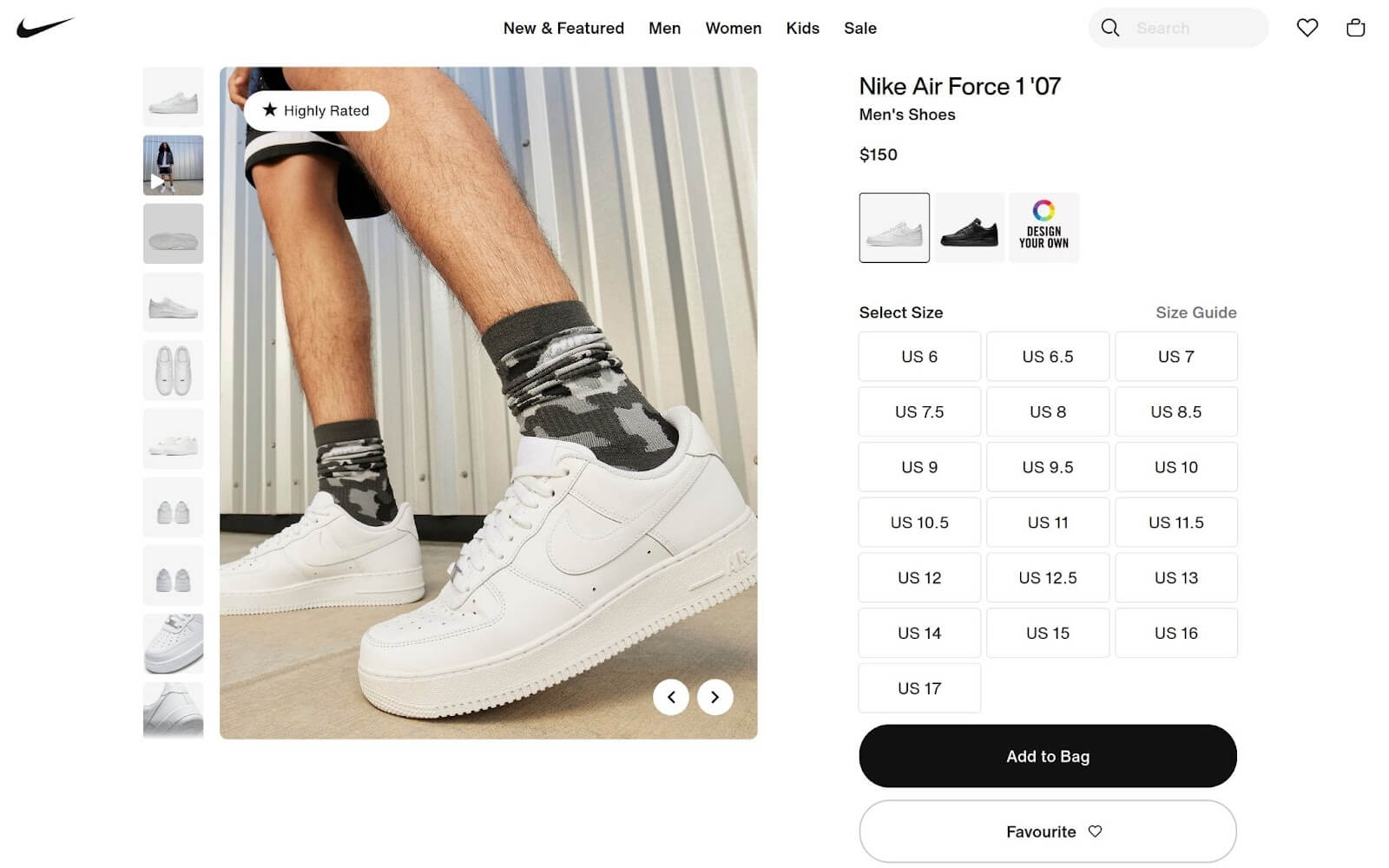
    Nike does this well: their PDPs include large hero images, multiple angle shots, on-model lifestyle photography, and embedded video for key products, all viewable without leaving the page.

    Note: Image SEO matters too. Use descriptive file names (blue-linen-blazer-front.jpg, not IMG_3847.jpg) and write alt text that describes the product for accessibility and search engines.

    Product Titles and Descriptions

    Your product title is the first piece of text a shopper reads, and it’s what search engines use to match your page to queries. A good title is descriptive, specific, and includes the key attributes a shopper would search for.

    Title formula: Brand + Product Name + Key Attribute (Color, Size, Material, Use Case)

    Example: “Patagonia Better Sweater Fleece Jacket – Women’s” works better than “Better Sweater.”

    For product descriptions, lead with benefits, then support with features:

    • Open with 1-2 sentences explaining what the product does for the customer and why it matters
    • Follow with a scannable bullet list of specifications (materials, dimensions, weight, compatibility)
    • Use natural language, not marketing fluff. Nielsen Norman Group’s research found that shoppers want “complete but not wordy” descriptions that prioritize substance over salesmanship.

    Formatting tips:

    • Keep the main description to 100-200 words
    • Use bullet points for specs and features
    • Add expandable/accordion sections for detailed information (care instructions, warranty, technical specs) to avoid overwhelming the page
    • Include keywords naturally for SEO, but write for humans first

    Pricing and Payment Options

    Pricing transparency directly affects conversion. Unexpected costs, especially shipping, are the top reason for cart abandonment.

    Best practices for PDP pricing:

    • Show the final price clearly including any taxes or fees the shopper will pay
    • Display shipping cost or free shipping threshold on the PDP itself, not just at checkout. “Free shipping over $75” is a conversion driver and an AOV booster.
    • Show original and sale prices together with the percentage saved. Make the savings concrete: “$120 $160 (Save 25%)” is more compelling than just showing the sale price.
    • Include buy now, pay later (BNPL) options. Services like Klarna, Afterpay, and Shop Pay Installments can increase conversion by lowering the perceived price barrier. Display the installment amount directly: “or 4 payments of $30 with Afterpay.”

    Variant Selection: Size, Color, and Customization

    When a product comes in multiple variants (sizes, colors, materials), the selection experience can make or break the sale.

    UX guidelines for variant selectors:

    • Show all variants on a single page. Don’t create separate URLs for each color or size unless there’s a strong SEO reason to do so.
    • Use color swatches, not dropdowns, for visual options. Shoppers should see available colors at a glance.
    • Gray out or cross out unavailable variants rather than hiding them. Hiding options causes confusion (“I thought this came in blue?”).
    • Update the main product image when a shopper selects a new color or style variant.
    • Display availability per variant. “Only 3 left in Medium” creates legitimate urgency without feeling manipulative.

    Size Charts and Fit Guides

    For apparel, footwear, and accessories, sizing uncertainty is one of the biggest conversion killers. A shopper who isn’t sure about fit simply won’t buy, or will buy multiple sizes and return the rest.

    • Include a size chart on the PDP (accessible via a link or modal, not buried in a separate page)
    • Add model measurements and what size the model is wearing
    • Consider a fit recommendation tool (True Fit, Fit Analytics) that suggests a size based on body measurements or past purchases
    • Include customer-contributed fit feedback: “Runs small,” “True to size,” “Runs large”

    Call-to-Action Design and Placement

    The “Add to Cart” button is the most important element on your PDP. Everything else on the page exists to get a shopper confident enough to click it.

    CTA best practices:

    • Place it above the fold on desktop, immediately visible without scrolling
    • Use a sticky/floating CTA on mobile that follows the shopper as they scroll through product details
    • Make it the most visually prominent element on the page. High-contrast color, large tap target (minimum 44x44px for mobile), clear label.
    • Use direct language: “Add to Cart” or “Buy Now” converts better than clever alternatives like “Get Yours” or “Treat Yourself”
    • Show a confirmation when an item is added. Either a mini-cart overlay, a slide-out drawer, or a clear notification. NN/g’s research found that unclear add-to-cart feedback caused shoppers to either add items twice or believe items weren’t added at all.

    Trust Signals: Returns, Guarantees, and Security

    Trust signals reduce purchase anxiety, especially for first-time customers and higher-priced items. They answer the subconscious question: “What if I don’t like it?”

    Include these on or near the PDP:

    • Return policy summary (e.g., “Free returns within 30 days”). Don’t make shoppers hunt for this on a separate page.
    • Shipping and delivery estimate (“Arrives by March 28” or “Ships within 1-2 business days”)
    • Security and payment badges (SSL, payment provider logos, “Secure checkout”)
    • Satisfaction guarantee if you offer one
    • Contact availability (live chat, phone number, or email) visible on the page

    Place these near the CTA. Shoppers evaluate trust signals in the moments before clicking “Add to Cart.”

    Social Proof: Reviews, Ratings, and UGC

    98% of online shoppers read reviews before making a purchase, and adding ratings and reviews to PDPs delivers a 32% average conversion lift.

    Review best practices:

    • Show the star rating and review count near the top of the page (next to the product title). Don’t bury reviews at the bottom.
    • Allow filtering and sorting by rating, recency, verified purchase, and relevance
    • Include reviewer context: What size did they buy? What body type? How long have they used the product? This helps shoppers find reviews from people like them.
    • Don’t hide negative reviews. A mix of ratings actually builds more trust than a perfect 5.0. Shoppers are suspicious of products with only positive reviews.
    • Respond to negative reviews publicly. It shows you’re engaged and willing to make things right.

    User-generated content (UGC) goes beyond text reviews. Customer photos and videos showing the product in real-life settings are more persuasive than professional photography for many shoppers. 

    A large number of ecommerce sites still lack buyer-generated visuals, which means adding UGC is a competitive advantage.

    Platforms like Yotpo, Bazaarvoice, Loox, and Judge.me make it straightforward to collect and display customer photos and video alongside text reviews.

    Cross-Selling and Product Recommendations

    Product recommendations on PDPs typically increase average order value. Personalized recommendations can boost sales by up to 20% and profits by 30%.

    Common recommendation patterns:

    • “Complete the look” / “Frequently bought together” – Suggest complementary products (a belt with trousers, a case with a phone)
    • “You may also like” – Show similar products in case the current one isn’t quite right
    • “Recently viewed” – Help shoppers navigate back to products they’ve already considered

    Keep recommendation sections to 4-6 products. More than that creates decision fatigue rather than helpful guidance.

    How to Optimize PDPs for Mobile

    With mobile commerce representing 57% of ecommerce sales and growing, your PDP experience on a phone isn’t secondary, it’s primary.

    Here’s what to consider for mobile shoppers.

    Responsive Layout and Thumb-Friendly Design

    Your PDPs should firstly adapt properly to mobile screens, and should also be easy to use for someone scrolling through their phone.

    Mobile PDP design principles:

    • Stack content vertically. On mobile, the natural flow is: image gallery > title/price > variant selector > CTA > description > reviews.
    • Make tap targets large. Buttons, variant selectors, and interactive elements should be at least 44×44 pixels with adequate spacing between them.
    • Use swipeable image galleries. Horizontal swipe for product images is an expected mobile pattern. Include a visual indicator showing how many images are available.
    • Collapse secondary information. Use accordions for specs, shipping details, and care instructions to keep the initial view focused.

    Sticky Add-to-Cart on Mobile

    On longer mobile PDPs, the add-to-cart button scrolls out of view quickly. A sticky CTA bar at the bottom of the screen keeps the purchase action accessible at all times. Include the price and a compact CTA button in the sticky bar.

    Page Speed and Core Web Vitals

    Page speed directly affects both conversion rates and SEO rankings. Google’s Core Web Vitals (LCP, CLS, INP) are ranking factors, and slow-loading PDPs lose shoppers before they see the product.

    PDP-specific speed optimizations:

    • Lazy-load images below the fold. The hero image should load immediately; gallery images can load as the shopper scrolls.
    • Serve images in modern formats (WebP or AVIF) with responsive sizing (srcset) so mobile devices don’t download desktop-sized files.
    • Minimize layout shifts (CLS). Reserve space for images, variant selectors, and dynamic pricing before they load. Nothing frustrates shoppers more than the page jumping as they try to tap.
    • Target LCP under 2.5 seconds. The Largest Contentful Paint is typically the hero product image on a PDP. Optimize it aggressively.

    Turn your bespoke website into a high-performing mobile app.
    Minimal lift. No sacrifices.

    Get a Free Demo

    Technical PDP Optimization

    Structured Data and Schema Markup

    Product schema markup tells search engines exactly what your page contains and enables rich snippets in search results, including price, availability, star rating, and review count.

    Essential schema types for PDPs:

    • Product schema – Name, description, image, brand, SKU, price, availability, condition
    • AggregateRating – Star rating and review count
    • Offer – Price, currency, availability, price valid until
    • Review – Individual review snippets
    • BreadcrumbList – Navigation path to the product

    Validate your markup with Google’s Rich Results Test and monitor in Google Search Console. Products with rich snippets typically see higher click-through rates from search results.

    SEO Best Practices for Product Pages

    • URL structure: Keep it clean and descriptive. /products/blue-linen-blazer outperforms /products/item-38472.
    • Title tag: Include the product name and a key attribute. “Blue Linen Blazer – Women’s | Brand Name” is better than “Product Page | Brand Name.”
    • Meta description: Write a unique, compelling description for each product (under 160 characters) that includes the product name and a value proposition.
    • Image alt text: Describe the product accurately for accessibility and image search. “Blue linen blazer front view with pearl buttons” is better than “product image.”
    • Internal linking: Link to related products, category pages, and buying guides from within the PDP. Breadcrumb navigation provides both UX and SEO value.
    • Canonical tags: If a product exists under multiple categories or with different URL parameters (filters, tracking), use canonical tags to prevent duplicate content issues.

    Accessibility and Inclusive Design

    An accessible PDP serves more customers and meets legal requirements (ADA, WCAG 2.1). It also improves SEO since many accessibility best practices align with search engine optimization.

    • Alt text on all images (already covered above for SEO, but critical for screen readers)
    • Keyboard navigation for variant selectors, image galleries, quantity inputs, and CTA buttons
    • Sufficient color contrast between text and backgrounds (minimum 4.5:1 ratio for body text)
    • Form labels and ARIA attributes on interactive elements (dropdowns, size selectors, quantity fields)
    • Video captions for product videos

    Advanced PDP Strategies

    Focus on getting the basics right first. But once that’s done, you can start thinking about how to elevate your PDPs even further.

    A/B Testing Your Product Pages

    The best practices in this guide are based on industry research, but your audience may respond differently. A/B testing lets you validate changes with real data instead of assumptions.

    High-impact PDP elements to test:

    • CTA button color, size, text, and placement
    • Product image count and order
    • Description length and format (paragraph vs. bullets)
    • Review placement (above the fold vs. below description)
    • Urgency messaging (“Only 3 left” vs. no urgency)
    • Price display format (with/without BNPL messaging)

    Tools like VWO, Optimizely, Google Optimize (sunset, but alternatives exist), and Convert handle PDP-level testing. Start with one variable at a time and run tests until you reach statistical significance.

    Personalization and AI-Powered Recommendations

    Generic “You may also like” sections are becoming less effective as shoppers expect personalized experiences. AI-powered recommendation engines analyze browsing history, purchase history, and real-time behavior to surface products each shopper is most likely to buy.

    Platforms like Nosto, Rebuy, Klevu, and Shopify’s built-in Search & Discovery app offer personalization that can be applied to PDP recommendation sections, recently viewed carousels, and dynamic bundles.

    Fulfillment Transparency

    Modern shoppers expect to know exactly how and when they’ll get their purchase. On the PDP, this means:

    • Estimated delivery date based on the shopper’s location (not just “3-5 business days” but “Arrives by Thursday, March 28”)
    • Pickup options if you have physical stores (BOPIS: Buy Online, Pick Up In-Store)
    • Same-day or next-day delivery availability for local shoppers
    • Subscription/auto-replenishment options for consumable products

    Product Page Examples That Convert

    Nike

    Nike’s PDPs are a benchmark for visual merchandising. Key elements: large, zoomable hero images; on-model and flat-lay shots; integrated video; expandable sections for details, shipping, and reviews; clear variant selectors for size and color; and a prominent “Add to Bag” CTA. They also include “Complete the Look” cross-sells with styled outfit suggestions.

    Allbirds

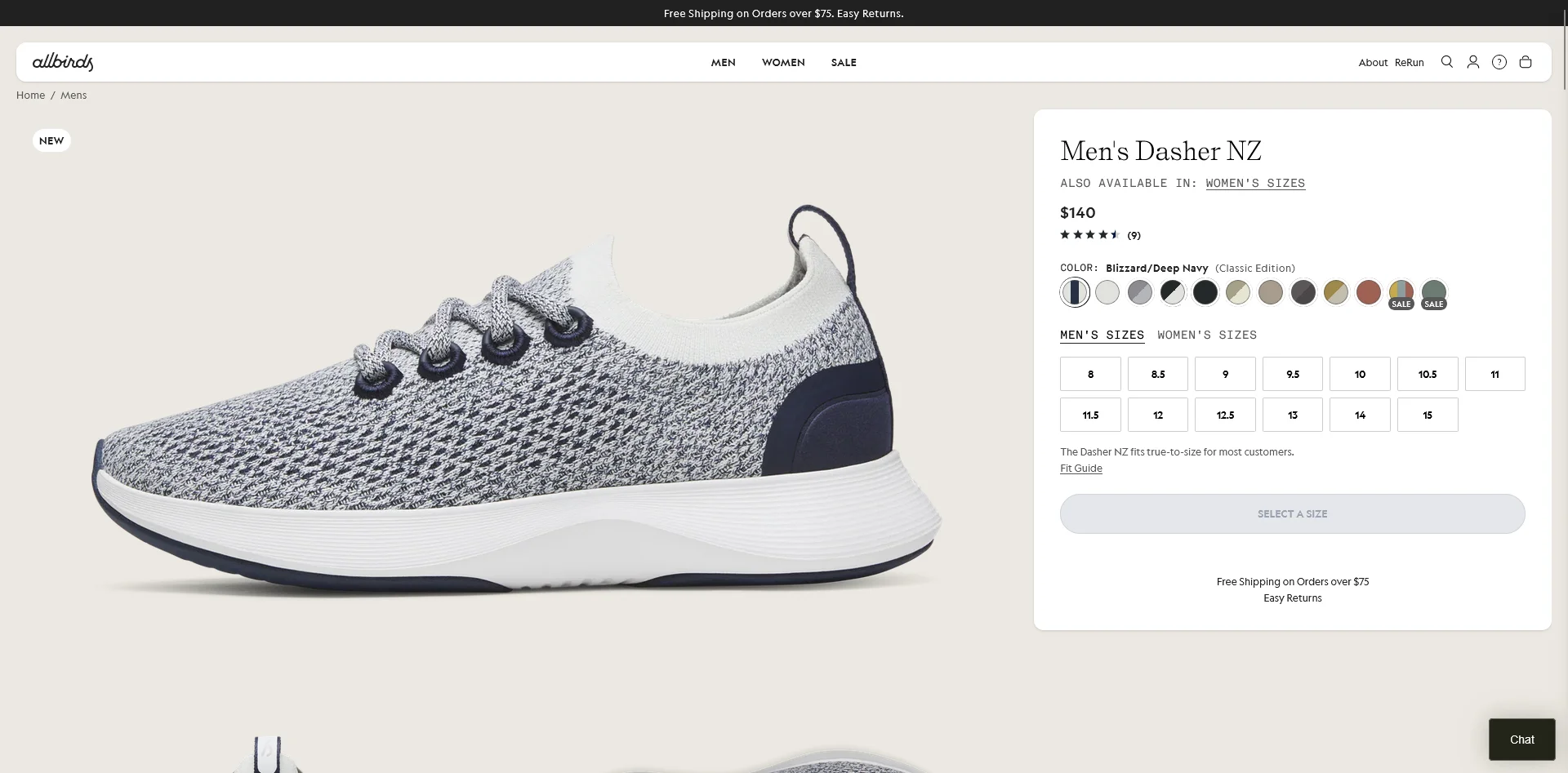
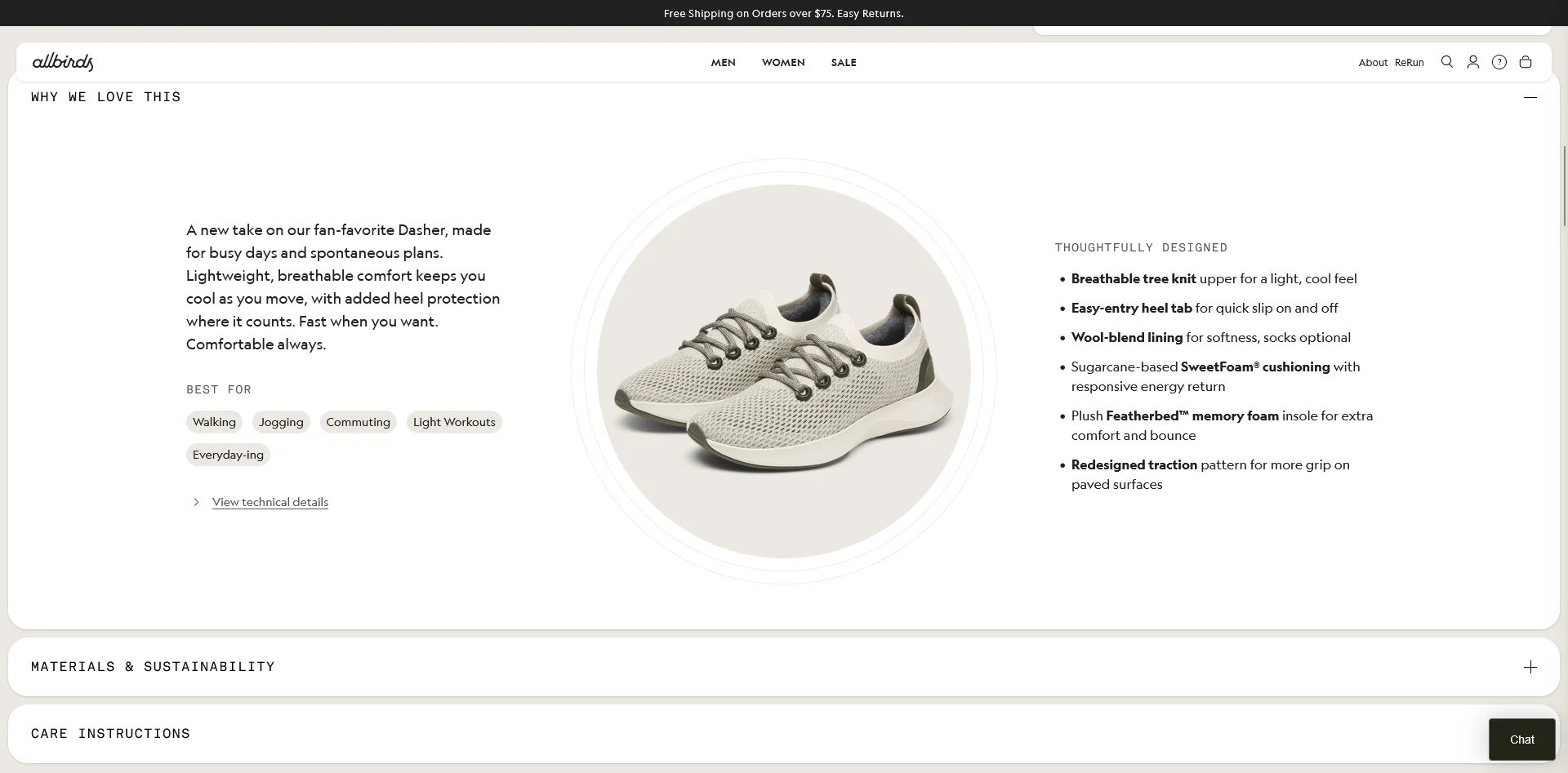
    Allbirds keeps their PDPs clean and focused. Highlights: sustainability messaging woven into the product story; customer reviews with fit feedback (“Runs true to size”); a “Find Your Size” tool; and a limited, curated color palette that reduces decision fatigue. They lead with benefits (comfort, sustainability) rather than specs.

    Glossier

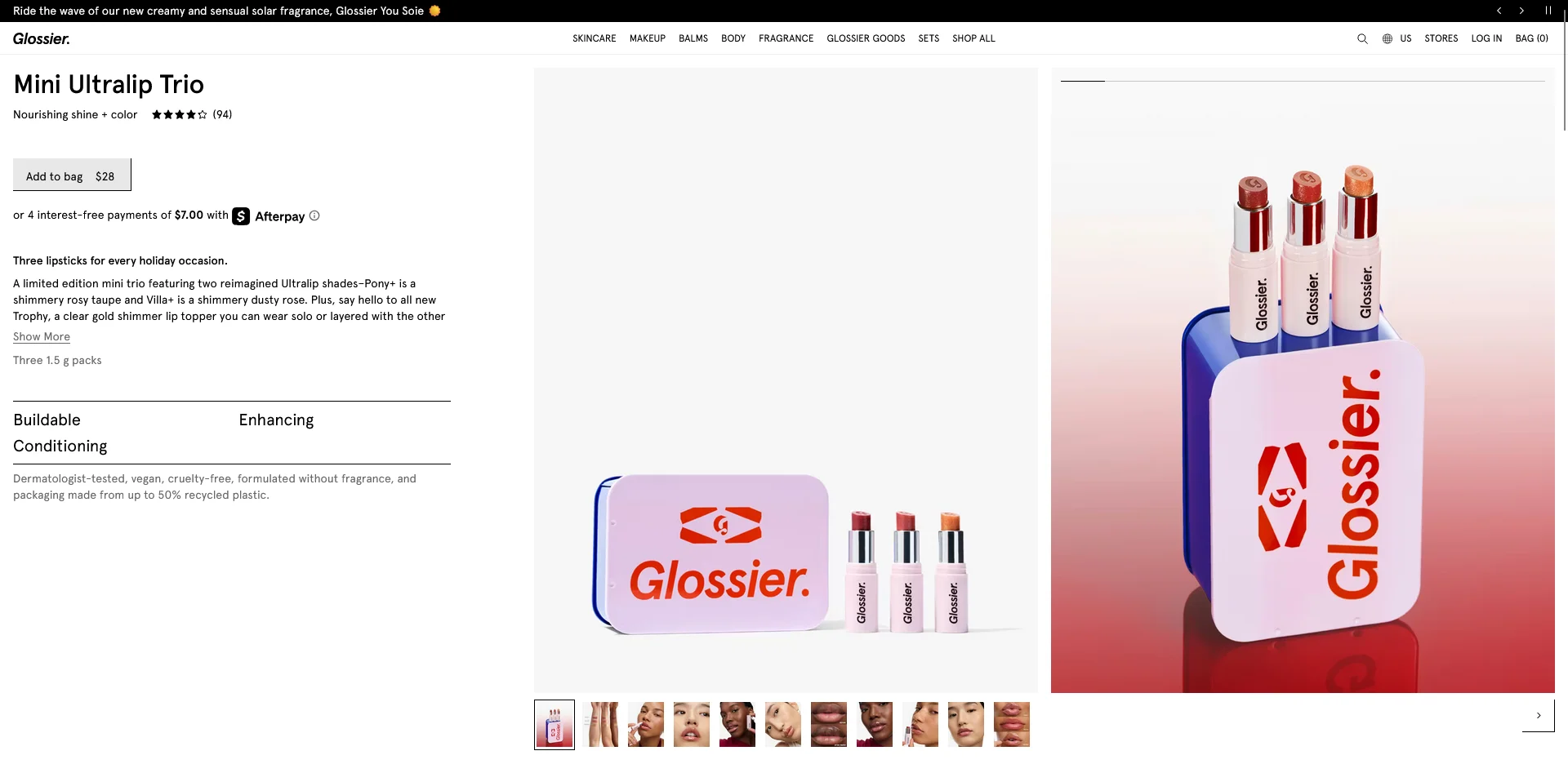
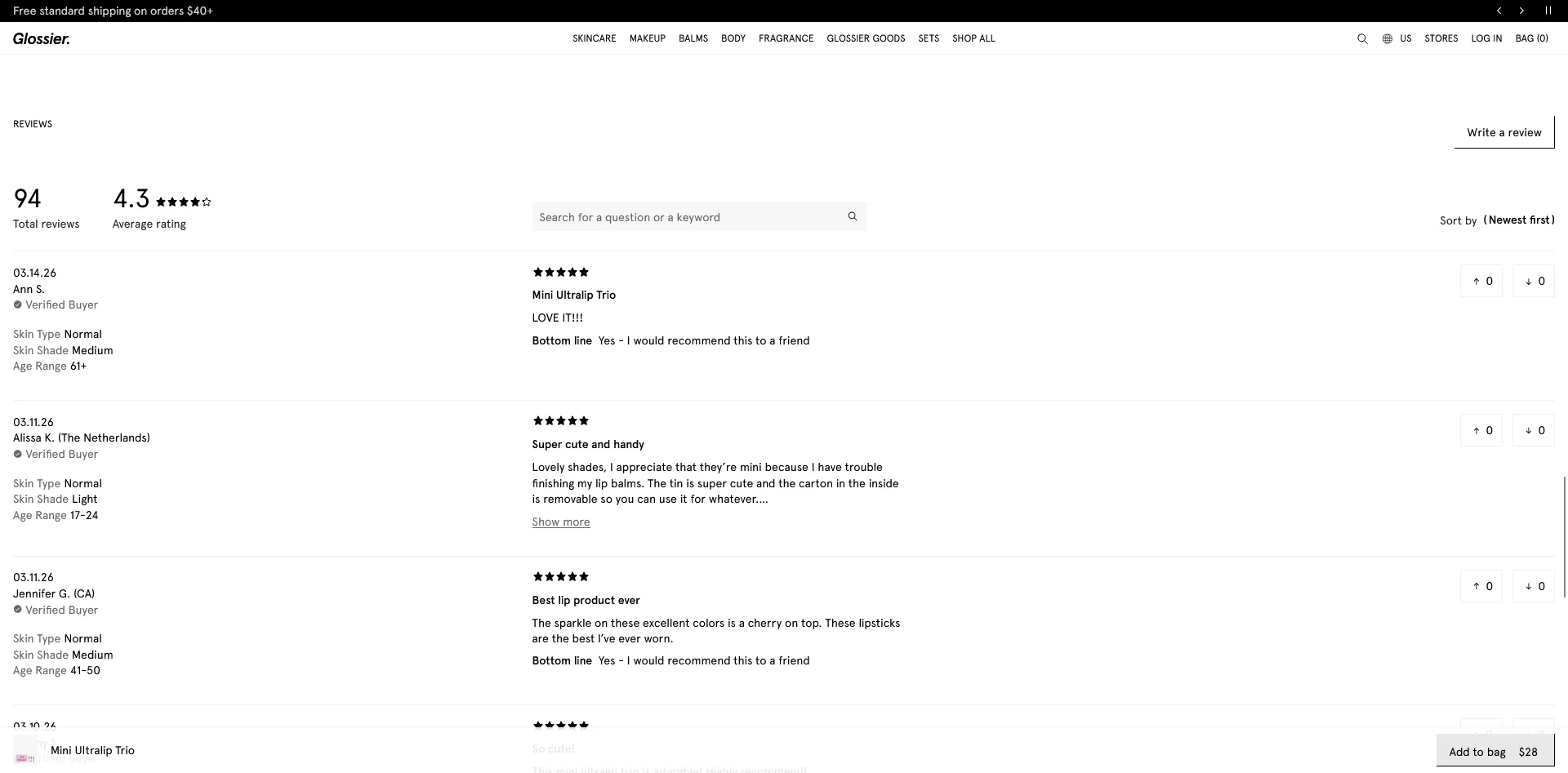
    Glossier’s PDPs showcase the power of community-driven social proof. Their review section lets shoppers filter by skin type and concern, making reviews personally relevant. They bundle products with clearly communicated savings and embed lifestyle UGC throughout the page.

    PDP Optimization Checklist

    Use this checklist to audit your own product pages:

    Visuals

    • 6+ product images including multiple angles
    • Lifestyle/in-use photos
    • Zoom functionality
    • Product video (demo, 360-view, or styling)
    • Descriptive alt text on all images

    Product Information

    • Descriptive product title with key attributes
    • Benefit-driven description (100-200 words)
    • Scannable specs in bullet format
    • Size chart or fit guide (apparel)
    • Expandable sections for detailed info

    Pricing and Payment

    • Clear pricing above the fold
    • Sale price with savings shown
    • BNPL/installment options displayed
    • Shipping cost or free shipping threshold visible

    Trust and Social Proof

    • Star rating and review count near the top
    • Filterable, sortable reviews
    • Customer photos/UGC
    • Return policy on or near the PDP
    • Security/payment badges near CTA

    Conversion

    • Prominent, high-contrast CTA above the fold
    • Sticky CTA on mobile
    • Clear add-to-cart confirmation
    • Cross-sell/recommendation section (4-6 products)
    • Wishlist option

    Technical

    • Product schema markup (validated)
    • LCP under 2.5 seconds
    • No layout shift on images or dynamic content
    • Unique meta title and description
    • Breadcrumb navigation
    • Canonical tags set correctly
    • Keyboard-navigable interactive elements

    Bringing Your PDP Experience into a Native App

    You’ve been through this whole guide, and put together bulletproof, high-converting PDPs that have totally transformed your business.

    But your website isn’t the only surface where people buy from you. Another crucial channel: your mobile app.

    The problem? With most mobile apps, all the painstaking work to optimize your website’s PDPs don’t carry over to your app.

    If you’re using a classic Shopify mobile app builder, for example, your app exists as a separate storefront, and your highly optimized PDPs turn into stock, templated PDPs for app users.

    The solution? Vendrux.

    Vendrux directly converts your entire site into a mobile app. That means all your PDP optimizations carry over, automatically.

    When you make changes to your site, your app updates with it. No extra work, no juggling separate platforms.

    It’s by far the best way to launch a mobile app, if your site relies on a lot of in-depth customizations and improvements that have stacked up over years of work.

    Want to see what your app could look like? Get in touch and book a free consultation and we’ll show you, along with a full breakdown of how Vendrux can help you go live with the perfect, low-lift mobile app, in just 30 days.

  • Ecommerce Platform Market Share in the USA [Updated 2026]

    Ecommerce Platform Market Share in the USA [Updated 2026]

    US ecommerce revenue hit $1.2 trillion in 2025, up from around $875 billion just a couple of years ago. That growth has turned the question of which platform merchants choose into a meaningful market dynamic. Every percentage point of platform market share represents billions in processed transactions.

    This article breaks down current ecommerce platform market share data in the United States, with comparisons across traffic tiers (top 10K, top 1M, and all sites), global context, and a closer look at the biggest platforms driving online commerce today.

    All data is sourced from BuiltWith, StoreLeads, and Statista unless otherwise noted.

    What Are the Biggest Ecommerce Platforms by Market Share in the US?

    Shopify has a strong grip on the position as the most popular ecommerce platform in the United States.

    Based on the latest tracking data, here’s how the US market breaks down:

    Rank Platform US Market Share Est. US Sites
    1 Shopify ~30% ~2,830,000
    2 Wix Stores ~23% ~1,013,000
    3 Squarespace ~16% ~426,000
    4 WooCommerce ~14% ~245,000+
    5 Ecwid ~4% ~293,000
    6 Square Online ~289,000
    7 Big Cartel ~192,000
    8 OpenCart ~172,000
    9 PrestaShop ~165,000
    10 Magento ~113,000

    Sources: Soax Research, StoreLeads, BuiltWith

    A few things stand out.

    • Shopify and Wix together account for more than half of US ecommerce sites.
    • Wix’s rise to second place reflects its growth as a general-purpose website builder that now includes solid ecommerce functionality. 
    • WooCommerce, despite dominating the global market, sits in fourth place in the US, behind both Wix and Squarespace.
    • The United States alone accounts for roughly 3.17 million ecommerce stores out of the 13.4 million tracked globally, making it the largest single-country market by a wide margin.

    How Market Share Changes at Different Traffic Tiers

    Raw market share numbers tell one story. But the picture shifts significantly when you look at higher-traffic, more established ecommerce sites.

    All Ecommerce Sites

    When you count every detectable ecommerce site, including small stores, hobby shops, and side projects, the data looks like what you see in the table above. Shopify’s 30% share, Wix at 23%, and so on. 

    But many of these sites generate minimal revenue or traffic.

    Top 1 Million Ecommerce Sites

    Once you filter for the top 1 million sites by traffic, the rankings change:

    Platform Market Share (Top 1M)
    Shopify 28.8%
    WooCommerce 18.2%
    Magento/Adobe Commerce ~9%
    PrestaShop ~3.5%
    Salesforce Commerce Cloud ~2.7%

    Source: BuiltWith, Yaguara

    WooCommerce jumps ahead of Wix and Squarespace in this tier because more established businesses tend to run WordPress-based stores. 

    Magento also becomes a significant player here, despite barely registering in the overall count. 

    And Salesforce Commerce Cloud shows up, which doesn’t even appear in the “all sites” data because it powers a small number of very large enterprise operations.

    Top 10,000 Ecommerce Sites

    At the very top of the market, the landscape shifts again:

    Platform Market Share (Top 10K)
    Custom/Proprietary ~45%+
    Shopify ~22%
    Salesforce Commerce Cloud ~8%
    Magento/Adobe Commerce ~7%

    Among the largest ecommerce sites in the US, nearly half run on custom or proprietary platforms. These are retailers like Amazon, Walmart, and Target, companies large enough to build and maintain their own technology stacks.

    Shopify still holds the largest share among identifiable third-party platforms, but its dominance is less pronounced at the enterprise level.

    US vs Global Ecommerce Platform Market Share

    The US and global markets look quite different. While Shopify leads domestically, WooCommerce is the clear global leader:

    Platform US Share Global Share Global Stores
    WooCommerce ~14% ~33-39% 4,316,000
    Shopify ~30% ~10.3% 2,830,000
    Wix Stores ~23% ~4-9% 1,013,000
    Squarespace ~16% ~5% 426,000

    Sources: StoreLeads, Soax Research, Red Stag Fulfillment

    Why such a big gap? 

    WooCommerce is free, open-source, and works in any language or currency out of the box. That makes it the default choice in many markets outside the US, especially in Europe and Asia where WordPress adoption is high. 

    Shopify’s strength is concentrated in English-speaking markets, particularly the US, Canada, UK, and Australia.

    According to StoreLeads, the top countries by total ecommerce store count are:

    1. United States – 3,168,000 stores
    2. United Kingdom – 654,000
    3. Germany – 448,000
    4. Brazil – 395,000
    5. Canada – 353,000
    6. India – 351,000
    7. Australia – 332,000

    Ecommerce Platform Trends: What’s Changing

    The ecommerce platform market isn’t static. Here are a few trends worth watching:

    Record new store creation

    Q4 2025 saw 1,067,000 new ecommerce stores created globally, the highest quarter on record. Ecommerce is still growing, and new merchants are entering the market at an accelerating pace.

    Shopify’s increasing enterprise push

    Shopify has been steadily moving upmarket with Shopify Plus, its enterprise tier. While Shopify’s overall share has held relatively steady (around 10% globally, 28-30% in the US), its share among higher-traffic sites has been climbing as larger brands adopt the platform.

    WooCommerce’s long tail

    WooCommerce’s global dominance is largely driven by the sheer number of WordPress sites worldwide. But many WooCommerce stores are small operations. Among the top 1 million sites, WooCommerce’s share (18.2%) is closer to Shopify’s (28.8%) than the global “all sites” numbers would suggest.

    Square Online’s quiet rise

    Square Online has accumulated nearly 289,000 stores, largely through Square’s existing base of POS merchants adding online storefronts. It’s one of the fastest-growing platforms by percentage, though most merchants are micro-businesses.

    Enterprise platforms holding steady

    Salesforce Commerce Cloud and Adobe Commerce (Magento) serve relatively few stores by count, but those stores tend to be among the largest merchants in ecommerce. Their market share by revenue processed would look very different from their share by site count.

    The Most Popular Ecommerce Platforms: A Closer Look

    Here’s a brief overview of each major platform and what it’s known for.

    Shopify

    Shopify is the largest ecommerce platform in the US by market share, powering roughly 2.8 million US stores and 4.8 million globally. Founded in 2006, it has grown from a simple online store builder into a full commerce operating system.

    It’s known for ease of use, an extensive app ecosystem (thousands of third-party apps), and a managed hosting model where merchants don’t need to worry about servers or security updates.

    Best for: Merchants who want a fully hosted, all-in-one solution without managing their own infrastructure. Shopify works well across the range, from first-time store owners to large DTC brands.

    Learn more: How to Turn Your Shopify Store into a Mobile App

    WooCommerce

    WooCommerce is an open-source ecommerce plugin for WordPress, and it’s the most widely used ecommerce platform globally by site count, with roughly 4.3 million active stores.

    It stands out for flexibility and control. Because it runs on WordPress, merchants can customize essentially everything. There are thousands of plugins and themes available. The tradeoff is that merchants are responsible for their own hosting, security, and updates.

    Best for: Merchants who already use WordPress, want full control over their store, or need highly customized functionality that a hosted platform can’t easily provide.

    Learn more: Build a Mobile App For Your WooCommerce Store

    Wix Stores

    Wix has grown from a general-purpose website builder into a serious ecommerce contender, now holding roughly 23% of the US market. With over 1 million ecommerce stores, it’s the second-largest platform in the US.

    It offers a drag-and-drop visual editor that makes it easy for non-technical users to build attractive storefronts. Wix includes hosting, payments, and basic marketing tools in one package.

    Best for: Small businesses and entrepreneurs who want an easy-to-use, all-in-one platform. It’s particularly popular among brick-and-mortar businesses adding an online sales channel for the first time.

    Learn more: How to Launch Mobile Apps with Wix

    Squarespace

    Squarespace holds about 16% of the US ecommerce market, powered by its reputation for design-forward templates and a polished visual editing experience.

    Squarespace is a no-code platform with hosting included, and provides beautiful, design-focused templates that require minimal customization to look professional. 

    Best for: Creative businesses, artists, and brands where visual presentation is a priority. It’s also popular with service-based businesses that sell a small number of products alongside their main offering.

    Learn more: Launching a mobile app for your Squarespace store

    BigCommerce

    BigCommerce holds a smaller slice of the overall market (roughly 38,000 stores globally), but it punches above its weight among mid-market and larger merchants.

    It’s most well-known for a robust set of built-in features that competing platforms often require paid apps to match: multi-currency, multi-storefront, B2B functionality, and advanced SEO tools are included out of the box.

    Best for: Growing businesses that need advanced functionality without relying heavily on third-party apps, and B2B sellers who need features like quote management and customer groups.

    Learn more: Turn your BigCommerce Store into a mobile app

    Magento / Adobe Commerce

    Magento (now Adobe Commerce) powers roughly 113,000 stores globally, but its true significance shows up in the top-tier traffic data, where it holds ~9% of the top 1 million sites and ~7% of the top 10,000.

    It comes with enterprise-grade flexibility and scalability. Magento can handle catalogs with hundreds of thousands of SKUs, complex pricing rules, and multi-store architectures. It requires significant development resources to set up and maintain.

    Magento Open Source is free, while Adobe Commerce (the managed cloud version) starts at roughly $22,000/year, with pricing scaling based on revenue.

    Best for: Large retailers and enterprises with dedicated development teams, complex catalogs, and the budget for a custom-built commerce experience.

    Learn more: Launch a fast, low-maintenance mobile app for your Adobe Commerce store

    Ecwid

    Ecwid takes a different approach: rather than being a standalone platform, it’s an ecommerce widget you can add to any existing website, social media page, or marketplace listing.

    It stands out for the ability to add a shopping cart to any website without rebuilding it. Ecwid works with WordPress, Wix, Squarespace, and essentially any site where you can embed code.

    Best for: Businesses that already have a website on another platform and want to add ecommerce capability without migrating to a new platform entirely.

    PrestaShop

    PrestaShop is a free, open-source ecommerce CMS with roughly 165,000 stores globally. It has a stronger presence in Europe (particularly France and Spain) than in the US.

    Its open-source model is similar to WooCommerce but purpose-built for ecommerce rather than being a plugin. PrestaShop has a large module marketplace and active community.

    Best for: European merchants who want an open-source solution with a strong community and don’t want to run WordPress.

    Learn more: Turn your PrestaShop store into a mobile app

    Salesforce Commerce Cloud

    Salesforce Commerce Cloud doesn’t rank in overall site count, but it’s a major player among enterprise retailers. It holds roughly 2.7% of the top 1 million sites and an even larger share among the top 10,000.

    It’s a fully managed cloud platform designed for large-scale B2C and B2B commerce, with deep integration with the Salesforce ecosystem (CRM, marketing automation, service cloud). 

    Best for: Large enterprises already invested in the Salesforce ecosystem, or retailers that need tight integration between commerce, CRM, and marketing automation.

    Learn more: How Jack & Jones, John Varvatos and more launch low-maintenance mobile apps for their Salesforce Commerce Cloud Store

    What This Means for Ecommerce Brands

    Let’s finish with a few takeaways from the data:

    Platform choice depends on your stage and needs

    There’s no single “best” platform.

    Shopify dominates the US market because it balances ease of use with scalability.

    WooCommerce leads globally because it’s free and flexible.

    Magento leads among enterprise retailers because it can handle complexity that other platforms can’t.

    The long tail is real

    Most ecommerce sites on any platform are small operations. The platforms that look dominant by site count aren’t necessarily the ones processing the most revenue. 

    A handful of Salesforce Commerce Cloud sites likely process more total GMV than hundreds of thousands of Ecwid stores.

    Mobile is where it’s happening

    Across all platforms, mobile commerce continues to grow as a share of total ecommerce. 

    Regardless of which platform a brand chooses, having a strong mobile experience, whether through a responsive site, a progressive web app, or a native mobile app, is increasingly important for conversion and retention.

    For brands already running on any of these platforms and looking to improve their mobile conversion rates, a native mobile app can complement your ecommerce platform by adding push notifications, faster load times, and a more app-like shopping experience. 

    And Vendrux is the single best way for ecommerce brands – from DTC Shopify brands to enterprise brands on Salesforce Commerce Cloud or Adobe Commerce – to launch their own mobile shopping apps.

    Book a free strategy call to see how to extend your existing store (no matter the platform) into a fast, revenue-driving mobile app.

  • Ecommerce Share of Retail Sales [Updated 2026]

    Ecommerce Share of Retail Sales [Updated 2026]

    Ecommerce is booming, but that’s nothing new. Global ecommerce sales add up to nearly $5.8 trillion, according to eMarketer. The ability to shop and buy pretty much anything online has been a fixture in our lives for a while now. In this article we’ll put that into context and share what percentage of retail sales are online sales.

    We’ll show the latest data for both the US and global markets, then break down how prevalent online shopping is in different countries and for different product categories.

    What Percentage of Retail Sales Are Online?

    Worldwide, ecommerce sales make up 19.5% of the $29.7 trillion retail industry.

    This number is slightly lower in the in US, where the ecommerce share of total retail sales is 16.4%.

    The market share of ecommerce has increased both worldwide and in the US since 2022, with the previous year’s figures standing at 18.9% worldwide and 15% in the US. 

    Sources: Statista/eMarketer

    Projected Growth of Ecommerce Market Share

    Experts project that ecommerce will continue to grow and steadily take over more of the overall retail market in the coming years.

    Worldwide, the ecommerce share of retail sales is expected to reach 23% by 2027. Here are the year-by-year projections until then:

    • 2023: 19.5%
    • 2024: 20.3%
    • 2025: 21.2%
    • 2026: 22.2%

    Projections for the US ecommerce market share stand at:

    • 2023: 16.4%
    • 2024: 17.8%
    • 2025: 19.4%
    • 2026: 21.2%

    While both markets are still growing, their growth has leveled off somewhat compared to the latter half of the 2010s.

    Ecommerce Sales Growth vs Total Retail Sales Growth

    To get a better understanding of how ecommerce has been taking a bigger and bigger market share over roughly the last decade, let’s see the year-by-year growth of both ecommerce and the overall retail industry.

    Aside from the aberration of 2020 due to the pandemic, retail has been steadily growing in the single digits, slightly declining in growth most years.

    Prior to 2020, however, the ecommerce market was growing between 20-30% each year. Post-pandemic, this has leveled off into the high single digits, though ecommerce continues to grow at more than 2x the rate of retail as a whole.

    Source

    Ecommerce Penetration by Country

    According to eMarketer’s Global Retail Ecommerce Forecast, China is the country with by far the highest ecommerce market share, at 47%, nearly half of all retail sales in the country.

    Two other Asian markets come in the top 4, at which point the averages drop off steeply. 

    The top ten countries for ecommerce penetration are as follows:

    1. China: 47.00%
    2. Indonesia: 31.90%
    3. UK: 30.60%
    4. South Korea: 30.00%
    5. US: 15.80%
    6. Mexico: 14.20%
    7. Singapore: 14.00%
    8. Japan: 13.70%
    9. Russia: 13.20%
    10. Canada: 11.70%

    China’s ecommerce market is the largest in the world, believed to be worth just over $3 trillion in 2023, nearly three times that of the US, the world’s second largest ecommerce market.

    Ecommerce Penetration by Category

    Finally let’s look at the share of ecommerce sales for a number of popular product categories.

    Insights from Cowen show us the latest ecommerce penetration by product category in the US market.

    Media (not including video games) is number one, with a huge 78% of sales in this category coming online.

    Toys/Hobby Goods/Games is second at 59%, while Office Equipment & Supplies and Electronics both have 54% ecommerce penetration.

    On the lower end, Food & Beverage, Auto and Garden Equipment/Supplies/Building Materials are all below the US average ecommerce share of retail sales, while all other categories also have a very low percentage of ecommerce sales.

    Trends to Watch

    Though the initial explosion is over, ecommerce is still growing, and taking more of the overall retail market little by little.

    Projections say the worldwide ecommerce share of retail sales will grow from 19.5% to 22.2% from 2023 to 2026, and from 16.4% to 21.2% in the US.

    We expect this trend to be steady and unspectacular. There are a couple of more interesting trends to keep an eye on.

    One is the growth of ecommerce in developing markets. Ecommerce is growing faster in these areas of the world than any other, and at a much faster rate than retail overall.

    Southeast Asia leads the way, with ecommerce rising 18.6% in 2023 vs 7% for retail overall. The Middle East and Africa is close behind, with 16% ecommerce growth vs 6% overall.

    The Latin America and Central and Eastern Europe regions are also seeing growth of >10% in ecommerce sales, with the latter experiencing almost zero growth at all in overall retail sales.

    The second is the growth of mobile commerce. As e-commerce once exploded as a subset of the retail industry, m-commerce is doing the same as a subset of e-commerce.

    More people each year are choosing to shop online from their mobile phones, with retail m-commerce sales in the US currently sitting at $431 billion per year, and projected to reach $710 billion by 2025.

    That puts mobile commerce’s market share at 38% that of the total e-commerce market in the US. This is projected to increase to 48% within just a couple of years.

    Watch for this number to cross 50% before long, as more and more opt for the ultimate convenience of shopping on mobile.

  • A Full Guide to Owned Channels for Ecommerce (Why Owning is Better than Renting)

    A Full Guide to Owned Channels for Ecommerce (Why Owning is Better than Renting)

    While essential for growth, the harsh reality is that as long as you rely on paid channels like Meta and Google Ads, you’re always renting your audience.

    The traffic faucet can be turned off at any time. Or, like it is now, acquisition costs can go up and you’re left to deal with the cut into your margins.

    Every brand needs to invest in building owned channels.

    Owned channels are cost-effective, sustainable, and compound over time.

    If you want to be profitable long-term, owned channels are a must. You don’t need to stop running ads; but a diversified media strategy is the only way to build a brand that lasts.

    Want the latest insights into how 7, 8 and 9-figure brands are driving sustainable growth? That’s what you get with our weekly newsletter, The Retention Edge. Subscribe for free today.

    The Three Types of Media: Paid, Owned, and Earned

    All of your acquisition falls under one of three media types:

    Let’s understand a little more about each channel.

    Paid Media (The “Rented” Growth Model)

    Paid media (Facebook, Google, TikTok Ads, and influencer partnerships) buys you attention at scale. These channels offer massive reach and rapid scalability, but they come with trade-offs.

    Algorithm shifts, platform changes, and creative fatigue mean your winning campaign today can flop tomorrow. Testing is required, and results aren’t guaranteed.

    The moment you stop spending, traffic stops. Unlike organic or owned channels (email, SMS, community), paid media has zero residual value; you pay to play.

    With increased competition and privacy changes squeezing tracking efficiency, CAC is only going up. Profitability depends on strong AOV and LTV.

    The takeaway? Paid media is an essential growth engine, but it’s a leaky bucket if you’re not turning new customers into repeat buyers. 

    Scale with discipline. Optimize landing pages, boost retention, and diversify into owned channels before the ad dollars stop flowing.

    Earned Media (Word-of-Mouth & Virality)

    Earned media gets you traffic without paying per click or impression, but it’s not truly free. You still have to put in the work.

    Common earned media sources include:

    • Press & PR (news features, blog mentions, podcast shoutouts)
    • Organic social shares (people sharing your content without paid incentives)
    • User-generated content (UGC)
    • Referral & word-of-mouth
    • SEO & organic search
    • Organic visibility in Amazon search & marketplaces

    The catch is you can’t fully control it. Unlike paid media, you’re at the mercy of algorithms, journalists, and customer enthusiasm.

    It takes investment. Great PR, strong content, and top-tier products don’t just happen. They require time, effort, and sometimes money (e.g., sending out product samples, PR outreach).

    It’s also tough to measure. You can track referral traffic, SEO, and UGC engagement, but tying it all back to revenue? Not always clear-cut.

    Earned media is a trust-builder that amplifies paid and owned efforts. It won’t scale predictably, but when it hits? It drives some of the highest-intent, most cost-effective traffic you can get.

    Owned Media (The Profitable & Predictable Growth Engine)

    Owned media is where you control the content, audience, and messaging. 

    Unlike paid media, where you’re constantly renting attention, owned media compounds over time, making it one of the most profitable growth levers.

    Owned media channels include:

    • Your website
    • Email & SMS lists
    • Mobile apps & push notifications
    • Social media accounts

    Owned channels are profitable and scalable. You aren’t at the mercy of ad costs or shifting algorithms.

    The ongoing costs are low; ESP fees, website hosting, and app maintenance are minor compared to paid media burn rates.

    It also compounds over time. More subscribers, more returning traffic, more revenue, without constantly refueling the ad budget.

    These channels take time to build, but your work pays off.

    It’s worth noting that not all channels fall exclusively into one category.

    Some are a mix of earned and owned. 

    Your website is owned, but your SEO traffic? That’s earned, and Google’s algorithm ultimately decides how much you get.

    Social media is owned by the platform, not you. They can limit reach, ban accounts, or disappear overnight.

    Ultimately, owned media is your profit moat. It shields you from rising ad costs and volatile algorithms. The earlier you build it, the less dependent you are on rented growth.

    Why Owned Channels Are the Most Profitable & Scalable Growth Strategy

    Paid, earned and owned media are all important for your brand. But owned media is the most profitable and sustainable way to build long-term.

    Here are three reasons why owned channels are so powerful.

    CAC vs LTV: The Profit Equation

    The CAC vs LTV equation determines whether your business thrives or bleeds cash. The math is simple: does the revenue from each customer (LTV) exceed the cost to acquire them (CAC)?

    With paid ads, your only way to improve CAC vs LTV is to lower acquisition costs… which has a floor. You can use Facebook ads reporting tools to optimize creative, refine targeting, and improve conversion rates, but eventually, you hit a wall.

    Owned is low-cost, high-upside. Once a customer is in your ecosystem (email, SMS, loyalty programs), you own the relationship.

    Recurring revenue shifts unit economics. Instead of constantly paying to acquire new customers, you monetize existing ones.

    Control = Freedom (No Algorithm, No Arbitrary Fees)

    If you rely entirely on rented platforms (Facebook, Shopify, Amazon), you’re playing on someone else’s turf.

    You risk ad account bans, algorithm changes, suspensions, or simply seeing your reach disappear.

    With owned channels, you own pricing, messaging, and the customer experience. No one can throttle your reach, slap on hidden fees, or shut you down overnight.

    Longevity: Paid Stops, Owned Keeps Working

    Turn off paid ads? Traffic vanishes.

    Turn off owned media? Revenue still flows.

    Owned media is a compounding growth engine. Email, SMS, SEO, and brand loyalty don’t just disappear when you stop spending. The sooner you invest, the bigger the long-term payoff.

    How to Build a Powerful Owned Media Strategy

    By investing more into owned channels, you can mitigate rising acquisition costs, and take more control over your revenue.

    Here are the best places to start.

    Email & SMS

    If you’ve been in business for a while, you already have a valuable asset in your email list. But if it’s just sitting in Klaviyo gathering dust, you’re leaving free money on the table.

    Yes, email deliverability is getting worse. Yes, email isn’t as powerful as it once was.
    But guess what? It’s still one of the highest-margin revenue channels you have.

    • Dirt cheap to send – No rising CPMs or platform taxes.
    • Automations do the work for you – Set it up once, let it generate revenue forever.

    SMS is similar to email, with high ROI potential. Open rates are higher, but there’s also a higher cost, making execution more important.

    At a bare minimum, these flows should be running 24/7, making money in the background:

    • Welcome Series → Converts new subscribers into buyers.
    • Abandoned Cart Flow → Recovers 30-50% of lost revenue.
    • Post-Purchase Flow → Nurtures customers, cross-sells, and reduces churn.
    • Win-Back Campaigns → Re-engages inactive buyers, increasing repeat purchase rates.
    • VIP/Loyalty Flows → Rewards high-value customers, boosting LTV.

    The bottom line, email & SMS are high-margin, always-on profit centers. Set them up, optimize them, and let them run.

    Action Steps:

    • Build email & SMS lists (if you’re not already)
    • Regularly engage your list
    • Set up automated campaigns (as shown above)
    • Segment & personalize – Tailor content based on behavior (e.g., first-time vs. repeat buyer)
    • Constantly test different approaches (e.g. subject lines and CTAs)

    Push Notifications & Mobile Apps

    Mobile apps are a retention powerhouse. 

    A mobile app puts your brand front and center on your customer’s home screen, driving more frequent purchases and higher AOV.

    Apps are the most underrated, underutilized owned channel there is.

    • Direct access to your best customers – No fighting inbox clutter or social algorithms.
    • Higher purchase frequency & bigger basket sizes – App users spend more and buy more often than mobile web users.
    • More control, fewer platform dependencies – Unlike Facebook or Google, you own this audience.

    Most importantly, apps also give you access to push notifications, which can be used to drive low-cost traffic at the push of a button.

    • Engagement rates like SMS – But without the cost.
    • Cheap like email – But with way better visibility.
    • Automated & scalable – Perfect for abandoned cart nudges, back-in-stock alerts, and personalized promos.

    A mobile app is a high-margin revenue channel that keeps customers coming back. It’s one of the best owned channels your brand can have.

    Action steps:

    • If you don’t have a mobile app already, check out Vendrux to see how to do it with minimal work and low overhead
    • Leverage your email list, and app-exclusive offers to grow your app
    • Set up automated push notification campaigns, and regularly message your subscribers with offers, new product drops, and general engagement pushes
    • Run app-exclusive campaigns (e.g. early access to new products for app users) to incentivize people to use your app, boosting retention

    Don’t have an app yet? Vendrux makes it easy. If your site already works great on mobile, you’re 90% of the way there. Book a free consultation to learn more about how we can help you launch your app.

    SEO & Content Marketing

    SEO isn’t fully owned, but it aligns with an owned media strategy. And most DTC brands are massively underutilizing it.

    Despite the usual “SEO is dead” talk, the landscape is actually getting better for brands. 

    Google is favoring real brands over affiliate and content farms, making ecommerce product pages easier to rank.

    Ultimately, SEO is a low-cost, high-impact growth play, and can totally transform your business if it takes off.

    Action steps:

    • First, ensure your product pages are optimized to show up in Google search (as well as AI searches)
    • Explore SEO opportunities for longer-form content (product guides, comparisons, problem-solving content)
    • Set up a lead capture system to get organic visitors into your funnel, and nurture them using email/SMS

    Loyalty, Community & Owned Social

    Loyalty programs can be super impactful. However, point-based rewards are becoming played out. The next evolution of loyalty is:

    • Tiered benefits (exclusivity drives repeat purchases).
    • Experiential perks (early access, VIP events, behind-the-scenes content).
    • Referral loops (customers bringing in customers = free CAC).

    Community is another avenue that many brands haven’t explored, but can have a big payoff.

    Peloton, Lululemon, and Figs built tribes, not just customer bases. Whether it’s Facebook Groups, Discord, or brand-owned forums, brands that foster connection unlock:

    • Insane organic word-of-mouth.
    • Higher retention & purchase frequency.
    • UGC at scale (your customers market for you).

    Your best marketers are your customers. Incentivize them to post about your brand with:

    • Shoutouts – Feature them on socials.
    • Rewards – Points, discounts, or surprise gifts.
    • Reposts – Build credibility by amplifying real customer love.

    Action steps:

    • Build and nurture your loyalty program, and test different approaches to the basic points-based system
    • Focus on building connections via social media; not just selling
    • Leverage UGC to make customers feel part of a community

    Transition from Paid Dependence to Owned Growth

    No one’s saying you should turn off all your paid ads today.

    But if you’re paying for every customer, every sale, every time, you’re setting up to fail.

    Early on, you need paid traffic to fuel initial growth. But long-term? Owned and earned should drive 60%+ of your revenue.

    Paid is a short-term lever that scales fast, but eventually you’ll need long-term assets for your brand to be safe and sustainable.

    Start with an audit.

    Where does your revenue come from today?

    • Paid (FB, Google, TikTok, etc.)?
    • Owned (email, SMS, push, organic direct traffic)?
    • Earned (UGC, referrals, PR, SEO)?

    Once you have a baseline, set quarterly goals to shift the mix.

    From there, work to increase your owned revenue %:

    • Dial up email & SMS – More flows, better segmentation, consistent campaigns.
    • Drive organic traffic – SEO, content, and social that converts.
    • Build a mobile app & push strategy – Retarget without ad costs.
    • Strengthen referral loops & loyalty – Get customers selling for you.

    The Brands That Win Tomorrow Are Investing in Owned Today

    Paid will always have a role, but owning your traffic means owning your profit.

    The sooner you build owned channels, the sooner you outlast and outprofit competitors.

  • Ecommerce App ROI: Why Mobile Apps Pay For Themselves

    Ecommerce App ROI: Why Mobile Apps Pay For Themselves

    Wondering if building your own ecommerce mobile app is worth it?

    In 2026, with the rising cost to acquire new customers, brands need to prioritize building their own sales channels and assets, rather than relying on rented channels like social media.

    And with the steady growth of mobile shopping, apps are the perfect fit.

    But the value of having your own mobile app is not just theory – there are plenty of data-backed reasons to launch an app.

    Countless retail & DTC brands have seen the ROI potential of ecommerce mobile apps first-hand. We’re going to break down this ROI for you and give you an idea of what’s possible when you launch your own app.

    Who Should Build a Mobile App?

    Apps can be a game changer for many brands. But for some, it doesn’t make as much sense.

    So what kind of brands should be building apps?

    In simple terms, any brands with high LTV and repeat purchase potential.

    Think – does it make sense for your audience to come back and buy with regularity? Or is your brand in an industry where people typically only buy once?

    Mobile apps may not provide as much benefit for high-price, low-frequency industries like furniture or electronics.

    Conversely, in some industries, mobile apps are a no-brainer:

    • Apparel
    • Beauty
    • Health & Wellness
    • Food & Beverages
    • Home & Garden
    • Pet Supplies

    These industries typically have high repeat purchase potential, with consumable products and/or a high number or variety of SKUs.

    Brands with a small number of products, at high prices, are unlikely to get the same benefits from an app (though there are always exceptions).

    Four Direct Benefits of Ecommerce Mobile Apps (Where Your ROI Comes From)

    Mobile apps help you drive more regular engagement from your existing customers – especially your loyal, high-frequency shoppers.

    In doing so, you can increase several key metrics by launching your own mobile app.

    To show you the potential of ecommerce apps, here are some real-world examples (some sourced from public case studies from popular Shopify app builders, some from our own internal data and case studies).

    Higher engagement in-app

    App users spend more than mobile website users.

    Part of this is because app users are inherently your most engaged customers – which is why they downloaded your mobile app in the first place.

    But it’s also due to the superior user experience of an app, even if the core design is not actually that different from your website.

    See these results for an idea of the higher engagement in mobile apps:

    • Sleefs: 40% higher conversion rate, 30% higher average order value in their app. (view case study)
    • Rainbow Shops: 2x higher conversion rate, 10% higher AOV vs their mobile website. (view case study)
    • Hobbiesville: 3x higher CVR in their app vs their website. 10% of all their customers are on their app, contributing 40% of their total revenue.
    • Brumate: 43% higher CVR in the app vs the website, 56% higher sales per session.
    • Beis: 67% higher CVR in the app vs their mobile website, 19% higher AOV.
    • Anatomie: 3x increase in CVR in the app, 1.2x AOV vs their mobile website.
    • Kyna: 2x CVR, 45% increase in user signups in their app vs their website.
    • Snitch: 2.5x CVR, 1.3x AOV in their app vs website.
    • The Oodie: 135% higher CVR, 37% higher AOV, 193% higher GMV in the app vs website.
    • Obvi: 2x higher CVR on their app vs the mobile website.
    • Kaged: 4.5x higher CVR, 19% higher AOV on app vs the website.
    • Art of Tea: 3.4x higher CVR, 4.6x higher order value per session than their mobile website.
    • Primitive Skate: 1.9x increase in CVR vs their app vs the mobile website.
    • Bailey’s Blossoms: 4x higher CVR in their app (9.73% app conversion rate, compared to 2.48% on the mobile website, 2.60% for their website overall). 105% increase in AOV.
    • Recode Studios: 7% total CVR in their app (only 1% on their mobile website).
    • elo: 9.9% CVR in their app (4x higher than their website).
    • CharlesTed: 12.08% CVR in their app (10x their mobile website and 7x compared to desktop).
    • Vosges: 227% higher CVR, 30% higher AOV in their app, compared to their mobile website.
    • HOP WTR: 139% higher CVR, 40% higher AOV in their app vs website.

    Summary: Many brands achieve a 10% to 120% increase in average order value and 40% to 1,000% higher conversion rate in their mobile apps.

    Increased retention and LTV

    Mobile apps boost loyalty, retention and customer lifetime value.

    By offering an app, you make it easy for your top customers to return and shop over and over again.

    You also have real estate on your customer’s mobile device, plus push notifications, to keep your brand top-of-mind and drive more repeat visits.

    See the following examples of LTV from brands with mobile apps:

    • BoozeBud: app users have 5x customer lifetime value, 4x average revenue per user. (view case study)
    • Sleefs: 3x more visits per app user.
    • Rainbow Shops: 7x higher LTV on their mobile app vs the mobile website.
    • Relink: 4x LTV, 7x ARPU from app users.
    • Anatomie: 5x LTV on their app, compared to the mobile website.
    • HOP WTR: 1.2x LTV on their app vs the website.

    Summary: There are examples of brands generating anywhere from 120% to 700% LTV from mobile app shoppers, as a result of more total visits and more repeat purchases.

    Incremental revenue at lower CAC

    Mobile apps offer an owned channel to drive low-cost sales.

    Sales made through the app are essentially free – and mobile push notification, in particular, are a highly-effective, low-cost promotional channel.

    Driving more sales through your app can not only provide incremental revenue, but at a lower overall cost, for higher profit margins.

    See these stats related to apps and push notifications as a sales channel:

    • Sleefs: Over 50k push notification subscribers built through their app.
    • Snitch: 60% of their DTC business happens through the mobile app.
    • The Oodie: 50.6% push notification opt-in rate.
    • Obvi: 40k+ app downloads, 21.8% of their total revenue comes from the app.
    • Recode Studios: 16.9% conversion rate from their abandoned cart notification sequence.
    • Kaged: 15k+ app downloads, 97.5% in-app user retention.
    • Patta: 8x revenue spike within two hours of a push notification campaign.
    • Bailey’s Blossoms: 160,000+ app installs in 6 months, over $2m driven through the app.
    • elo: 35% of their annual sales coming through the app.
    • CharlesTed: 83.5% opt-in rate for push notifications, from nearly 4,200 app installs (~3,500 push subscribers) generated in the first month.
    • Volcom: 127.2% higher purchase rate from push notifications than paid ads, 124.8% higher purchase rate than email, 20.7% higher purchase rate than SMS.
    • BoozeBud: 10% of their total revenue driven through their app.

    Summary: Many brands see 10% or more of total revenue coming from their mobile app. Push notifications can be 1.2-2x as effective as other channels, at a lower cost.

    How Many Customers Will Download and Use Your Mobile App?

    In general, you can expect 2-5% of your customers to download your app.

    Download rate varies by industry – which is again why industries with a low repeat purchase rate will be less likely to benefit from an app.

    Categories like Food & Drink, Beauty and Apparel, where repeat purchases are more common, have higher average download rates.

    It also depends on the percentage of your customers who shop on mobile, as well as the effort you put into promoting your mobile app.

    How Much Does a Mobile App Cost?

    Cost is half the equation when calculating the ROI of your ecommerce app. 

    So how much does it take to launch your own app?

    Today, you can create your own app for roughly $1,000-$2,000 upfront, and $500-$1,000 per month after, with a no-code solution like Vendrux that leverages what you’ve already built on your website.

    (We’ve come a long way from having to spend $100k+ (plus ongoing maintenance costs) to build a custom native app.

    Click here to learn more about building your own app (without spending six figures).

    What’s the Average ROI of a Mobile App for an Ecommerce Brand?

    The average ROI for ecommerce apps can vary greatly from brand to brand, depending on the platform used, the brand’s model (high-frequency vs low-frequency), and how much they promote the app.

    Our users see as much as 53x ROIs in some cases. Generally – as long as you don’t overpay for a custom app – you can expect at least 10x ROI, just by getting a small percentage of your shoppers (you most engaged and loyal customers) to download the app.

    Summing Up: Calculating the ROI of Your Mobile App

    We now have a rough idea of the:

    • Key metrics attainable by launching a mobile app.
    • Percentage of your customers that will download the app.
    • Cost to build your app.

    With that, we can estimate the ROI for your mobile app.

    (Keep in mind that none of these estimates are guarantees – these are based on aggregated data from real-world examples, but actual results may vary)

    Let’s look at a Fashion brand as an example. This brand has the following website metrics:

    • 100,000 monthly visits
    • 2% conversion rate
    • $100 average order value

    Brands in this category see the following averages from their apps:

    • 33% higher conversion rate
    • 16 increase in average order value
    • 3x increase in monthly visits from app users
    • 4.5% of website visitors downloading the app

    That comes out to the following app metrics:

    • 4,500 active app users
    • 2.66% conversion rate in the app
    • $110 average order value in the app
    • $41,656 monthly revenue from app users

    We can estimate that this brand generates $32,656 per month in incremental revenue (additional revenue, above what they would make through their website) from their mobile app.

    On the other side of the equation, they pay $2,000 upfront for their app, and $550 per month thereafter.

    Over time, you anticipate revenue will scale, while your costs will stay more or less the same.

    You can use our App Revenue Calculator to get an accurate estimate of your app’s revenue, using your industry and website metrics as a guide.

    Next Steps

    As you’ve seen above, it’s not hard to see how mobile apps can deliver an amazing ROI for ecommerce brands.

    The next step is to begin the process of building your own app.

    Vendrux helps you do it with minimal effort, and at a low cost, for the best chance of achieving a positive ROI within just a few months (or less).

    You’ll keep everything from your website, and spend zero time rebuilding. The whole process is managed for you, giving you a working app in less than a month.

    There’s no lift for your team, no new work to add to your day-to-day. 

    We maintain the technical side of your apps, while the content in the apps sync with your website, so you can make changes at any time just by updating your site.

    Some of the brands we’ve helped have seen as much as 53x ROI from their apps!

    Book a consultation to discuss the process and how we can help you build an app that’s almost guaranteed to turn a profit.

  • Ecommerce Market Size by Country (2026 Update)

    Ecommerce Market Size by Country (2026 Update)

    Global ecommerce continues its expansion, with sales projected to reach $6.88 trillion in 2026 — up from $6.4 trillion in 2024. That’s 21% of all retail sales happening online.

    But the story isn’t just about growth. It’s about where that growth is happening, who’s leading, and where the opportunities are.

    This guide breaks down ecommerce market size by country, including the largest markets, fastest-growing regions, and penetration rates that reveal how much runway each market still has.

    Want weekly insights into how 7, 8 and 9-figure ecommerce brands are driving sustainable growth? That’s what you get with our value-packed newsletter, The Retention Edge. Subscribe for free today.

    The Global Ecommerce Market at a Glance

    Metric 2025 2026 (Projected)
    Global ecommerce sales $6.8 trillion $6.88 trillion
    Share of total retail 20.1% 21.1%
    Online shoppers worldwide 2.77 billion 2.9+ billion
    Year-over-year growth 8.3% 7.2%

    The 10 Largest Ecommerce Markets by Revenue

    Here’s an up to date list of the world’s top ecommerce markets, along with their value, and the relative dominance of ecommerce in each country:

    Rank Country Revenue Penetration
    1 China $3.45 trillion 47%
    2 United States $1.38 trillion 15.8%
    3 United Kingdom $195 billion 30.6%
    4 Japan $169 billion ~15%
    5 South Korea $147 billion 30%
    6 Germany $140 billion ~18%
    7 India $136 billion ~5%
    8 Indonesia $94 billion 31.9%
    9 France $92 billion ~17%
    10 Canada $88 billion ~12%

    1. China ($3.45 trillion)

    China isn’t just the largest ecommerce market; it’s larger than the next several markets combined.

    Chinese consumers generated over $3.4 trillion in online sales in 2025, representing roughly 50% of global ecommerce.

    • Ecommerce penetration: 47%
    • Mobile commerce share: 92% of online shoppers use smartphones
    • Key platforms: Taobao, Tmall, JD.com, Pinduoduo

    What sets China apart isn’t just scale, it’s integration.

    Social commerce, livestream shopping, and super-apps have blurred the lines between entertainment and shopping in ways Western markets are only beginning to adopt.

    2. United States ($1.38 trillion)

    The US ecommerce market continues steady growth, projected to reach $1.88 trillion by 2029.

    While penetration remains lower than China or the UK, the sheer size of the American consumer market makes it the world’s second-largest.

    • Ecommerce penetration: 15.8%
    • Mobile commerce share: 76% of adults purchase via smartphone
    • Growth rate: 10.5% YoY
    • Key platforms: Amazon, Walmart, eBay, Shopify merchants

    The US market is mature but far from saturated. With penetration below 16%, there’s significant room for growth, particularly in categories like grocery and B2B that have been slower to move online.

    3. United Kingdom ($195 billion)

    The UK is Europe’s largest ecommerce market and ranks third globally. British consumers have embraced online shopping at rates exceeding most Western countries.

    • Ecommerce penetration: 30.6%
    • Mobile commerce: Projected to hit £100 billion ($125B) in 2025
    • Key platforms: Amazon UK, ASOS, Tesco, Argos

    The UK’s high penetration rate means growth is slowing compared to emerging markets, but the market remains highly attractive for established brands.

    4. Japan ($169 billion)

    Japan’s ecommerce market is expected to grow at 9.2% CAGR, reaching $263 billion by 2029. The market is characterized by sophisticated consumers and strong domestic platforms.

    • Ecommerce penetration: ~15%
    • Key platforms: Rakuten, Amazon Japan, Yahoo! Shopping

    Japan presents unique challenges for foreign brands, including language barriers and preference for domestic platforms, but offers strong purchasing power.

    5. South Korea ($147 billion)

    South Korea punches above its weight in ecommerce, with one of the highest mobile commerce adoption rates globally.

    • Ecommerce penetration: 30%
    • Mobile share: 77% of ecommerce sales expected via mobile by 2026
    • Key platforms: Coupang, Gmarket, 11Street

    Korean consumers are early adopters of new commerce trends, making the market a testing ground for innovations like quick commerce and social shopping.

    6. Germany ($140 billion)

    Germany is the largest ecommerce market in continental Europe and a gateway for brands expanding across the EU.

    • Ecommerce penetration: ~18%
    • Growth rate: 4-5% annually
    • Key platforms: Amazon.de, Otto, Zalando

    German consumers prioritize quality and sustainability, and have strong preferences for local payment methods (invoice payment is common).

    7. India ($136 billion)

    India is the fastest-growing major ecommerce market, with projections showing it could reach $345 billion by 2030. The market has grown from 140 million online shoppers in 2020 to 260 million in 2024.

    • Ecommerce penetration: ~5%
    • Growth rate: 17-22% annually
    • Mobile share: 88% of online shoppers use smartphones
    • Key platforms: Flipkart, Amazon India, Myntra, Meesho

    India’s low penetration rate represents enormous opportunity. As internet access expands beyond major cities and digital payment adoption increases, growth will accelerate.

    8. France ($92 billion)

    France rounds out the top European markets with steady growth and strong domestic platform presence.

    • Ecommerce penetration: ~17%
    • Key platforms: Amazon.fr, Cdiscount, Fnac, Veepee

    9. Canada ($88 billion)

    Canada benefits from proximity to US supply chains while maintaining its own distinct consumer preferences.

    • Ecommerce penetration: ~12%
    • Key platforms: Amazon Canada, Walmart Canada, Canadian Tire

    10. Indonesia ($94 billion)

    Indonesia is Southeast Asia’s largest ecommerce market and one of the fastest-growing globally.

    • Ecommerce penetration: 31.9%
    • Growth rate: 20%+ annually
    • Key platforms: Tokopedia, Shopee, Bukalapak, Lazada

    Fastest-Growing Ecommerce Markets

    While China and the US dominate in absolute size, the fastest growth is happening elsewhere.

    Southeast Asia is growing at a particularly fast rate, as are several markets in Latin America.

    Top 10 by Growth Rate (2025)

    Country Growth Rate Market Size
    Philippines 24.1% $18B
    India 22% $136B
    Indonesia 20% $94B
    Malaysia 18% $15B
    Thailand 16% $25B
    Vietnam 15% $28B
    Mexico 14.5% $85B
    Argentina 12%+ $25B
    Brazil 11% $81B
    United States 10.5% $1.38T

    Regional Highlights

    Southeast Asia is the fastest-growing region for ecommerce, with 18.6% growth and a path to $230 billion GMV by 2026.

    By 2027, 88% of the region’s population (402 million users) is expected to shop online.

    Latin America has reclaimed its position as the fastest-growing regional market at 12.2% growth in 2025.

    Brazil, Mexico, and Argentina account for 84.5% of regional sales. Mexico is on track to surpass US ecommerce penetration levels by 2026.

    India remains the standout emerging market opportunity. With only 5% ecommerce penetration in a country of 1.4 billion people, the addressable market for growth is massive.

    Ecommerce Penetration by Country

    Penetration rate (the percentage of total retail sales happening online) reveals how dominant ecommerce is in each country – as well as how much room each market has to grow.

    Let’s take a look at several notable markets, and how dominant online shopping is in each one.

    Country Penetration Rate What It Means
    China 47% Near-saturation in urban areas
    Indonesia 31.9% Leapfrogging traditional retail
    UK 30.6% Mature, steady market
    South Korea 30% Mobile-first consumers
    Germany 18% Room for growth
    US 15.8% Surprisingly low for market size
    Japan 15% Traditional retail still strong
    Latin America 12% avg Significant opportunity
    India 5% Massive upside potential

    What Penetration Rates Tell Us

    High penetration markets (30%+) like China, South Korea, and the UK offer less growth upside but stable, predictable demand. Competition is fierce.

    Mid-penetration markets (15-25%) like the US, Germany, and France have room to grow but face structural challenges (established retail, logistics complexity).

    Low penetration markets ( like India, Latin America, and parts of Southeast Asia offer the highest growth potential but also higher execution risk (infrastructure, payments, logistics).

    Mobile Commerce: The Dominant Channel

    Mobile commerce (mcommerce) accounts for 59% of global ecommerce sales – that’s $4 trillion in 2025. In some markets, it’s even higher.

    Mobile Share by Country

    The mobile-first trend is irreversible.

    In emerging markets especially, consumers are skipping desktop entirely and shopping exclusively on smartphones.

    In the near future, we can only expect mobile shopping to become more dominant.

    What This Means for Ecommerce Brands

    Let’s take a look at the practical implications of these statistics if you’re running an ecommerce company – whether it’s in the US, UK, or any other part of the world.

    If you’re targeting growth markets:

    1. Prioritize mobile. In India, Indonesia, and Latin America, mobile-first isn’t a strategy; it’s a requirement.
    1. Understand local payment preferences. Credit cards aren’t universal. Digital wallets, bank transfers, and even cash-on-delivery dominate in many markets.
    1. Invest in localization. Language, currency, and cultural preferences vary dramatically. A US-centric approach won’t work.
    1. Consider marketplace presence. In most emerging markets, local marketplaces (Mercado Libre, Shopee, Flipkart) have stronger consumer trust than independent stores.

    If you’re in mature markets:

    1. Focus on retention over acquisition. Growth is slowing. LTV matters more than CAC in saturated markets.
    1. Mobile app investment pays off. With mobile commerce growing even in mature markets, a native app creates stickier customer relationships.
    1. Differentiation through experience. When price competition is fierce, experience becomes the differentiator.

    Vendrux and Global Ecommerce

    For ecommerce brands expanding globally or looking to capture mobile commerce growth, having a native mobile app is increasingly essential; particularly in mobile-first markets like India, Southeast Asia, and Latin America.

    Vendrux lets ecommerce brands extend their existing website into native iOS and Android apps without rebuilding their tech stack. Your website powers the app; we add native app capabilities on top.

    This approach is particularly valuable for:

    • Brands entering mobile-first markets where app usage exceeds mobile web
    • Established stores wanting to increase retention through push notifications
    • Multi-market brands who don’t want to build separate apps for each region

    Vendrux has an extended track record helping multi-language and multi-country brands launch mobile apps. Our process makes it far more affordable, and far easier than legacy development methods or other mobile app solutions that aren’t set up to handle complex, global storefronts.

    Ready to see what’s possible?

    Get a free preview of your app now.

    Data Sources

    This article synthesizes data from multiple industry sources including Statista, eMarketer, Shopify Enterprise, Trade.gov, and regional market research firms. Figures represent 2025 estimates and 2026 projections as of February 2026.