Category: Blog

  • 10 Reasons Your Magento Store Needs a Mobile App

    10 Reasons Your Magento Store Needs a Mobile App

    Every Magento merchant has a powerful, flexible website. But very few have a mobile app.

    That’s a missed opportunity. Your best customers want a more convenient, mobile-first way to interact with your brand, get instant updates on sales and new products, and jump into your store to browse on the go.

    A mobile app is a new layer for your business, a new asset, and one that more merchants need to think about adding to the mix. 

    An app gives your most engaged customers a faster, more direct way to come back. That’s where the real ecommerce economics live: not in the next acquisition, but in what happens after.

    Keep reading and learn the top ten reasons a mobile app is worth building for your Magento store.

    Key takeaways

    • A mobile app holds onto your most valuable repeat customers, the cohort driving most of your revenue.
    • App users open more often, browse longer, and place larger orders than the same customers on mobile web. Tadashi Shoji, a luxury fashion brand on Magento, sees their app drive 10x revenue per user and 8.3x higher conversion vs. mobile web.
    • Push notifications give you an owned channel that bypasses the inbox, ad cost inflation, and per-send SMS budgets, and they’re the highest-ROI cart recovery play in ecommerce.
    • The app is the natural home for your loyalty program, your BFCM strategy, and your first-party customer data.
    • For B2B Magento stores, the case is stronger still: account-specific catalogs, one-tap reorders, and a buying flow built around recurring purchase patterns.

    1. An app keeps your best customers close

    Most of the revenue in a mature Magento store comes from repeat buyers. The people who already know your brand, already bought once, and will buy again if you stay in front of them.

    The hard part is staying in front of them.

    Email gets filtered into the Promotions tab. Retargeting ads compete with everyone else’s retargeting ads. Organic visits depend on the customer remembering to search for you. Each one of those steps is friction, and each one is a chance for a competitor to win the visit.

    A mobile app lessens the distance between the brand and the customer. Your icon is on the home screen. Your push notifications land on the lock screen. Sign-in persists across sessions, so the cart and preferences are still there when they come back. 

    None of those mechanisms are individually huge. Together they make it harder for your best customers to drift away, and easier for them to keep buying.

    For a Magento merchant, this matters more than for most. Magento builds usually serve operationally complex brands with deeply loyal customers. The app is where those segments live.

    2. App users buy more often and spend more per order than mobile web visitors

    When a customer downloads your app, their pattern of purchase changes. They open more often, browse longer, and place larger orders than the same customer on the mobile web.

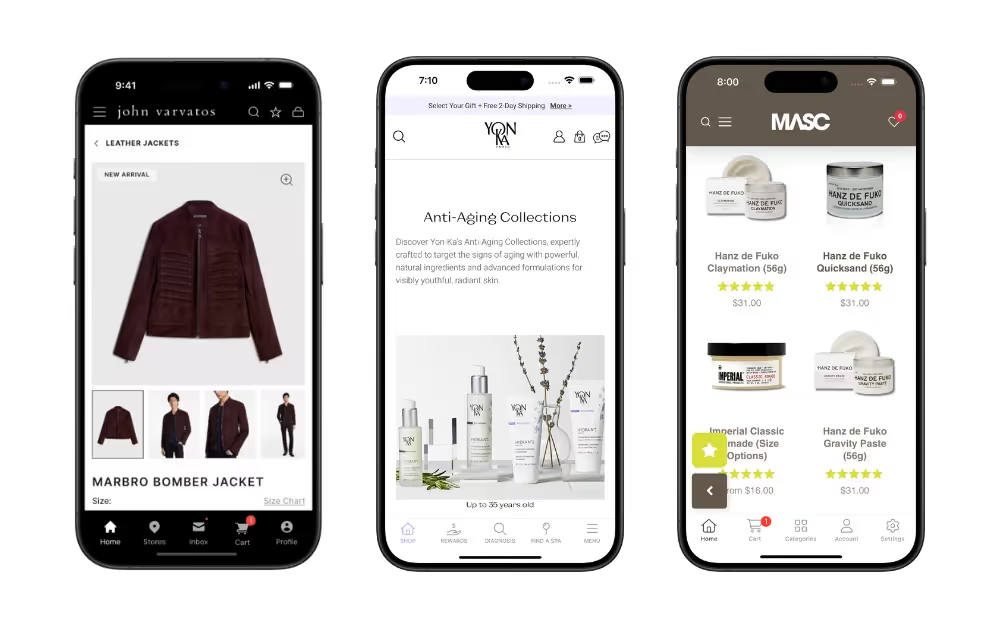
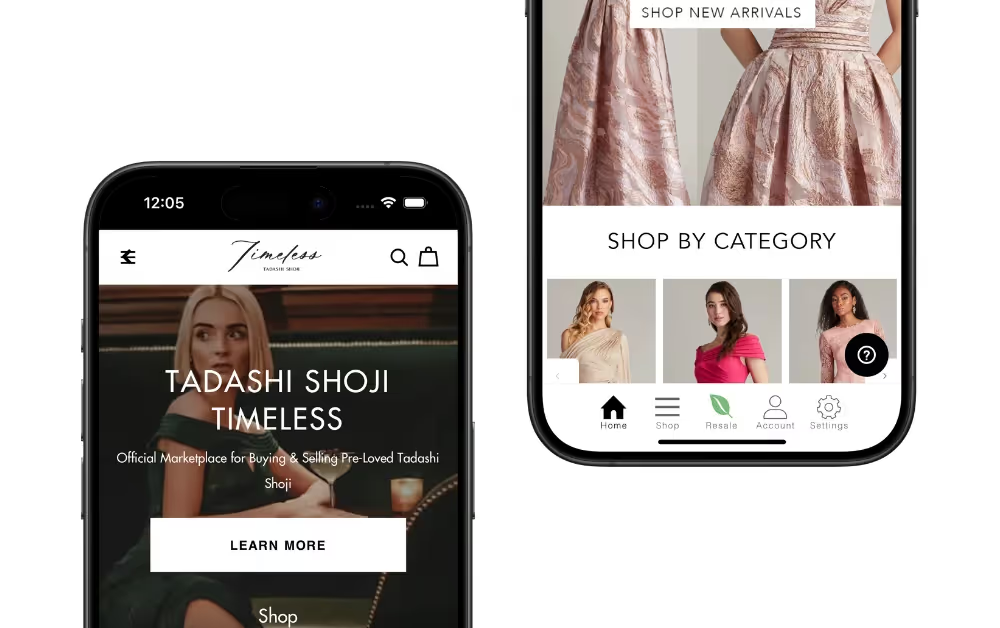
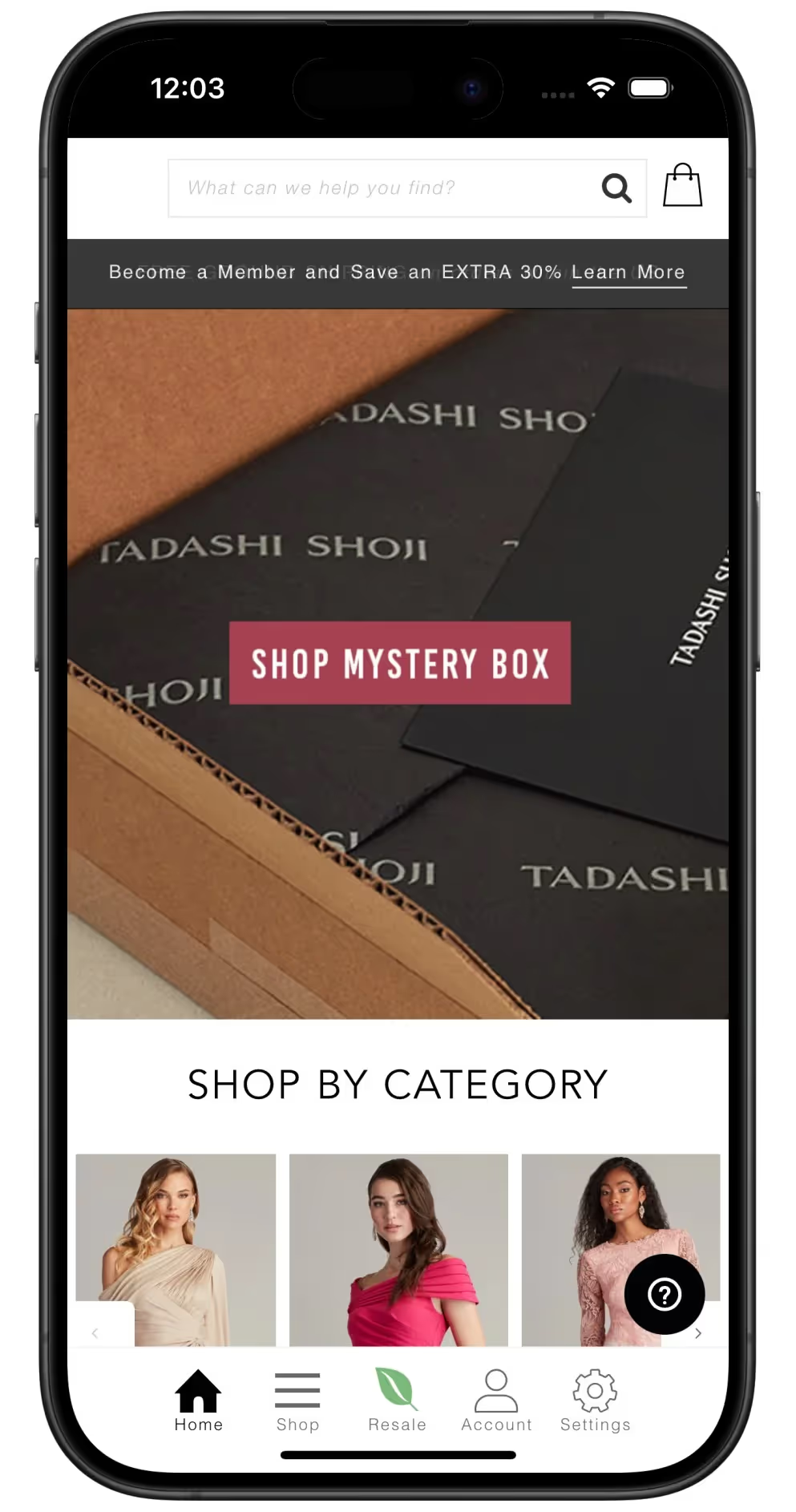
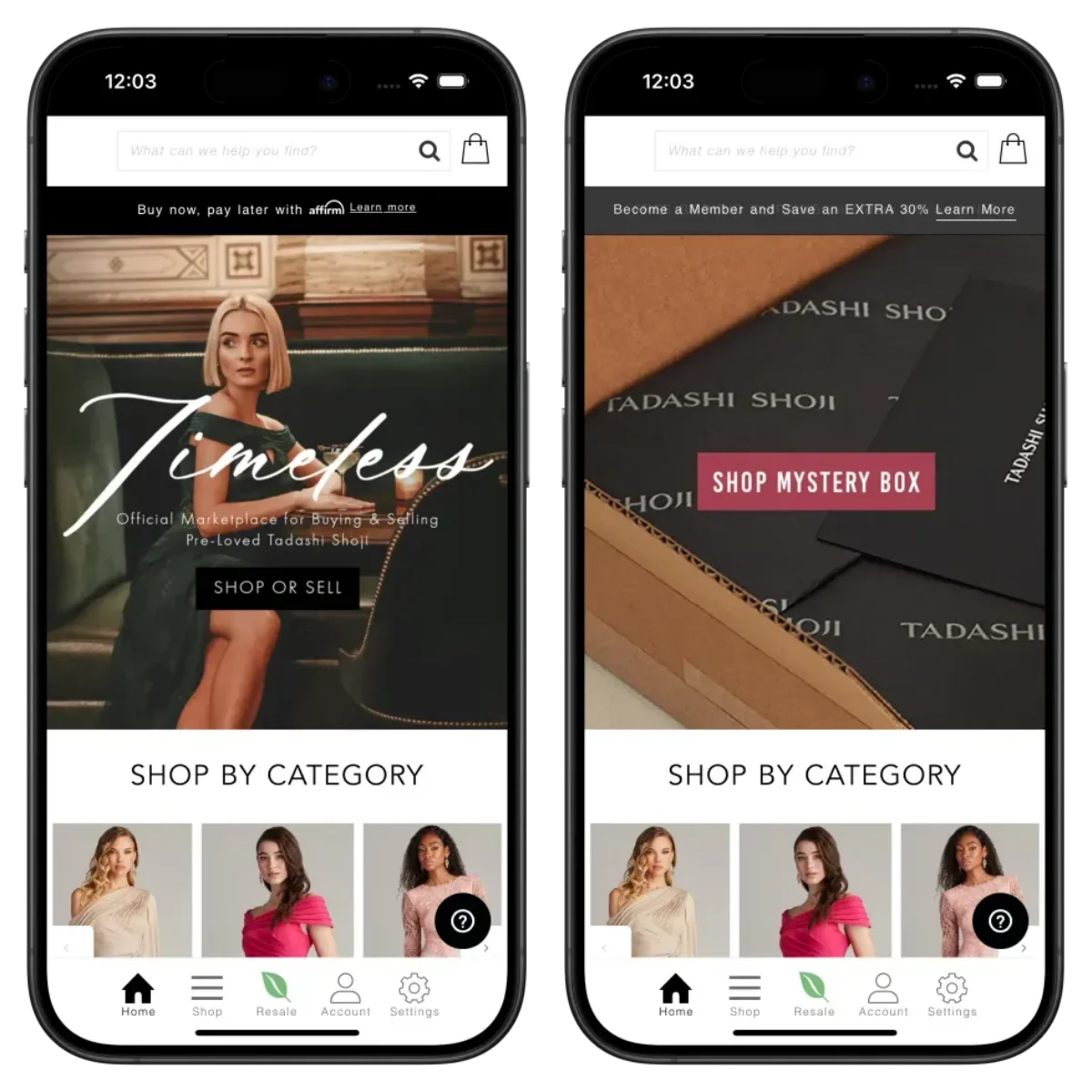
    Take Tadashi Shoji, a luxury Magento brand we built an app for. Their app drives 10x revenue per user vs. mobile web, 8.3x higher conversion rate, 3.8x more frequent sessions, and 18% of their total online revenue

    The app accounts for 30% of all mobile revenue, and 18% of their total online revenue.

    Tadashi Shoji’s mobile app – launched with Vendrux

    Apps don’t provide a magic lift across all your traffic. The lift comes from the segment that downloads, which is by definition your more engaged customers. What an app does is give that segment a higher-performing environment to keep buying in. That’s where the AOV, repeat purchase, and LTV gains compound.

    For a Magento brand, this is the cohort you’re paying the most to acquire. An app makes them worth more.

    Learn more about the revenue impact of mobile apps in Vendrux’s Ecommerce Mobile App Benchmark Report.

    3. A mobile app cuts the impact of rising CAC

    Customer acquisition costs are climbing across every paid channel. Meta and Google ad costs are up, iOS attribution is degraded, and the cost of winning a new customer is constantly getting higher.

    You’ll pay roughly the same to acquire a customer whether or not you have an app. An app is not a tool to reduce CAC. It’s to lessen the impact of CAC.

    A mobile app increases your overall average LTV, and the average revenue you get from each customer. A certain share of your customers will download the app, and those customers will spend significantly more revenue, boosting the average return you get from every dollar spent on acquisition.

    That changes the unit economics in two directions: it makes your existing spend more profitable, and it gives you room to bid more aggressively for acquisition without breaking the LTV:CAC ratio.

    If your acquisition costs are flat or climbing and you don’t have a way to pull more value out of the customers you already have, you’re losing ground. An app is one of the few levers that meaningfully moves the LTV side. 

    Learn more on reducing CAC for ecommerce.

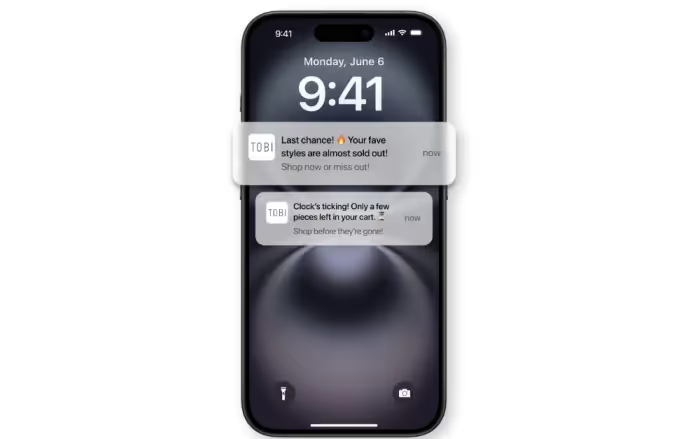
    4. Push notifications give you a direct line to your best customers

    Push notifications go straight to the lock screen. They don’t sit in the Promotions tab. They don’t depend on a per-send SMS budget. They reach an opted-in audience that already chose to install your app.

    The numbers behind push are stronger than email on every comparable metric: visibility, delivery, click-through. We’ve written extensively on push notifications for ecommerce and push vs email specifically if you want the full numbers.

    It’s not that email is a bad channel, or SMS either. It’s that they have holes, like any channel, and they’re areas that push excels at: immediacy, visibility, and engagement.

    And they do so with zero cost to send, making push the highest-ROI direct marketing channel you have.
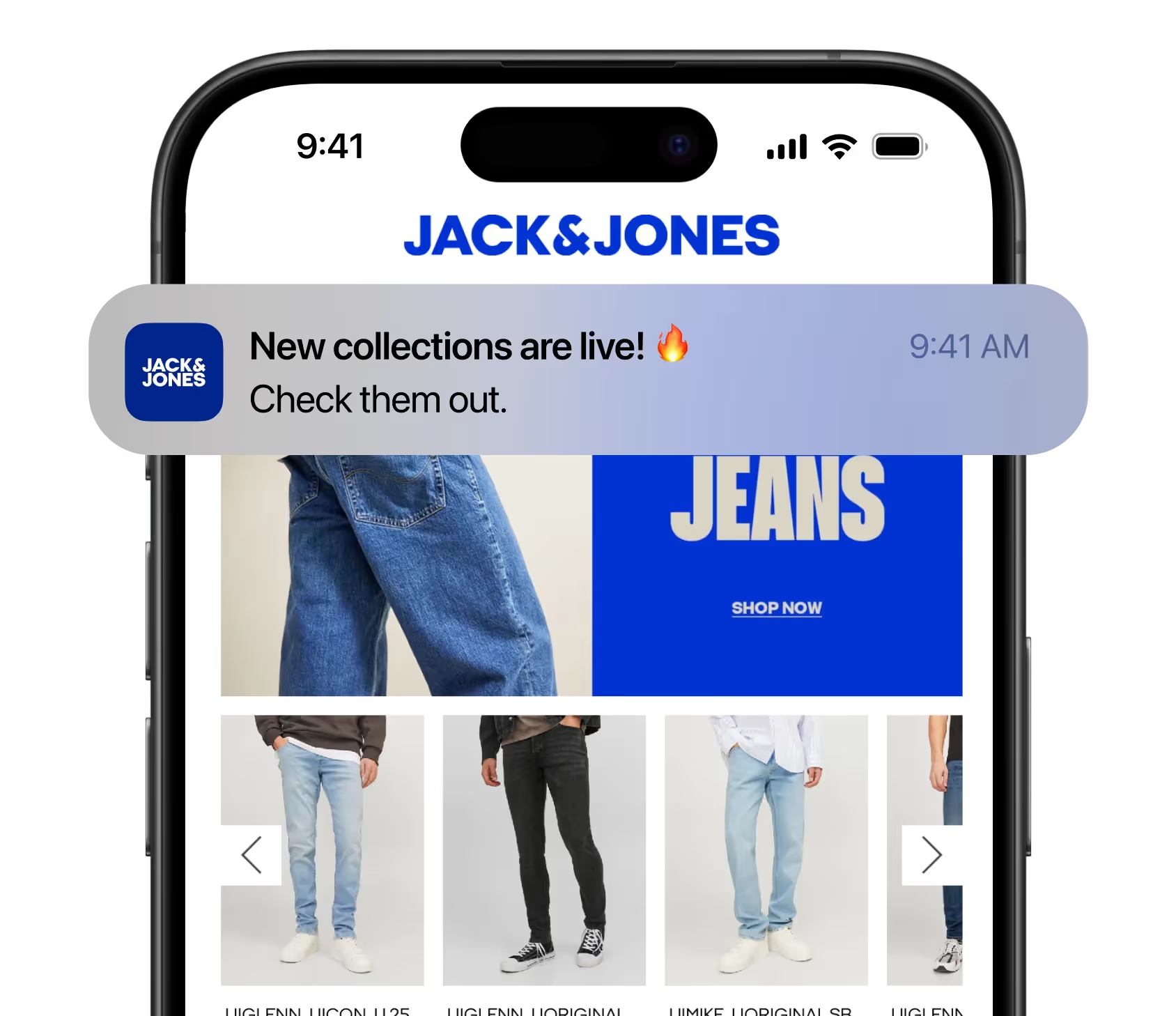
    Push notifications are the most powerful retention marketing channel for ecommerce brands

    5. Abandoned cart push notifications recover sales email never reaches

    The single highest-ROI use of push for most Magento merchants is abandoned cart recovery.

    Push is the best channel for abandoned carts, hands down. For most of the reasons we mentioned above – it’s fast, highly visible, and zero cost to send – which are so much more impactful for abandoned cart situations.

    Here’s a scenario to illustrate the difference:

    Without an app: Customer adds items to cart. Customer gets distracted. An hour later, an abandoned cart email lands in the Promotions tab. The customer doesn’t see it. The next email tries again 24 hours later, with progressively diminishing returns.

    With an app: Customer adds items to cart. Customer leaves the app. A push notification lands on the lock screen within five minutes, while purchase intent is still warm. One tap, and they’re back in the cart, signed in, with the items still there.

    We’ve seen brands driving hundreds of thousands in revenue per month, just from abandoned cart notifications.

    That’s net-new revenue. And it’s enough to pay for the cost of your app, from this one automation alone.

    Learn more about the benefits of abandoned cart push notifications in this post on our free weekly newsletter, The Retention Edge: The highest-ROI automation in ecommerce

    6. One-tap home-screen access shortens the path from impulse to purchase

    There’s a structural difference between “I want to buy from this brand” and “I’m going to buy from this brand right now.” The gap between the two is friction, and most of it lives in the steps a customer has to take to get to your storefront and complete their checkout.

    For a mobile web shopper, those steps look like:

    • Remember the brand name
    • Open a browser
    • Type or search
    • Scroll past competitors
    • Click through and wait for the site to load
    • Log in (if you can find your password)

    Each one is an exit point.

    For an app user, it’s one tap.

    That’s not a metaphor. It’s the reason apps drive higher repeat purchase frequency: the cost of acting on an impulse drops to near zero. You don’t have to convince a customer to come back when your icon is one swipe away every time they unlock their phone.

    For a Magento merchant with a returning customer base, this matters more than for a brand selling mostly first-time purchases. The repeat behavior is already there. The app makes it easier to act on.

    7. Your app is the home for your loyalty program

    If you run a loyalty program (or want to), the app is the natural place for it to live.

    VIP tiers, points balances, member-only product drops, early access to launches, exclusive pricing tiers, and referral programs all work better when there’s a dedicated, signed-in surface for the customer to check status, claim rewards, and see what’s gated. 

    On the website, loyalty mechanics tend to get buried. In the app, they’re amplified.

    The app is a platform to give more visibility to your loyalty program, along with offering unique perks (extra points for app purchases, app-exclusive products and discounts) that increase engagement.

    This works so well because your app users are exactly the kind of people your loyalty program is for. Your regular buyers who spend 10x more than your average customer.

    8. First-party behavioral data flows to you without cookies or pixels

    Third-party tracking has been degrading for years. iOS 14.5 broke a lot of Meta attribution. Chrome’s cookie deprecation timeline keeps shifting, but the direction is set. Browser-based behavioral data is harder to capture and easier for the user to block.

    A mobile app sidesteps most of that. When a customer downloads your app, they’ve opted into an authenticated, first-party relationship with you. You get clean session data, browsing patterns, purchase history, push engagement, and segmentation signals, without depending on third-party cookies or fingerprinting.

    App-level attribution tools capture this data cleanly. From there, it feeds your personalization, your push targeting, and your retention programs directly. 

    A customer who browses men’s jackets and abandons gets a notification when the category goes on sale. A customer who buys a consumable every 60 days gets a reorder reminder at day 55.

    Those flows work because the data is yours, in your stack, attached to a known user. For a Magento brand that already runs sophisticated segmentation, an app extends that capability into the channel where your customers shop.

    9. Your app cuts through the noise during sales events like BFCM

    Every brand sends more emails and SMS during Black Friday week. Every brand spends more on ads. Every customer’s inbox overflows, social media feeds get saturated, and every dollar of attention is being competed for harder than at any other time of year.

    A push notification doesn’t compete with that pool. It lands on the lock screen of customers who already chose to install your app, with no inbox sorting and no algorithm in between. 

    During the loudest week of the year, you get a channel that goes straight to your most loyal audience, and bypasses the noise.

    The app is also the cleanest surface for the kind of plays that work best at BFCM: time-gated launches, member-only early access, exclusive bundles, and VIP pricing tiers. Those mechanics need a controlled environment, and the app provides one.

    The mobile app impact on BFCM shows across many brands: app traffic and revenue concentrate during sales events, and the brands with an app capture a disproportionate share. 

    For a Magento merchant, BFCM is often the single biggest revenue week of the year. An app changes how much of that you keep.

    Learn more: How to prepare for Black Friday as an ecommerce brand

    10. For B2B Magento stores, the case is even stronger

    Magento has one of the deepest B2B install bases in ecommerce, especially since Adobe Commerce B2B Edition consolidated the standard features into the platform: company accounts, requisition lists, custom catalogs, and quote management. The app case for these merchants is materially stronger than for D2C.

    B2B customers are, by definition, repeat buyers. They have account-specific pricing, account-specific catalogs, recurring orders, and dedicated buyer relationships. They don’t browse, they reorder. They don’t comparison-shop on every purchase. They place the same SKU mix on a schedule.

    An app fits that behavior cleanly. 

    • Customers reorder with one tap.
    • Account-specific catalogs and pricing tiers load automatically on sign-in. 
    • Push notifications notify customers of back-in-stocks, new product launches, and rep-driven promotions. 
    • Saved payment and shipping defaults shave seconds off every reorder, and buyers placing the same SKU mix weekly get a flow built around that behavior rather than a generic mobile checkout.

    For sales reps in the field placing orders on behalf of accounts, the app is also a better tool than a mobile browser. It’s faster, signed in by default, and built for the kinds of repeat workflows that a generic mobile experience doesn’t optimize for.

    If your Magento store has a meaningful B2B segment, an app is one of the highest-leverage tools you can give those accounts.

    Why Vendrux is the best way to launch your app

    If the case for a Magento mobile app makes sense, the next question is how to build one without the cost, timeline, and risk of traditional native development (or the limitations of many Magento mobile app builders).

    Vendrux converts your existing Magento store into native iOS and Android apps. Your products, checkout, customer accounts, extensions, integrations, and design carry over. The app is a real, custom native app that runs on your existing Magento backend, so everything that works on the website works in the app.

    A few things worth knowing:

    • Done-for-you build. Vendrux handles the design, configuration, native integrations, testing, and App Store / Google Play submission. You don’t need an internal mobile team.
    • Launch in around 30 days. Most Magento brands go from kickoff to live app in about a month.
    • Your Magento extensions carry over. All the extensions that run on your web storefront run inside the app.
    • No variable development costs. You get simple, predictable month to month (or yearly) pricing, that doesn’t spike because a new feature needed 100 dev hours to complete.
    • The app survives a replatform. If you ever decide to move off Magento, your app comes with you. Vendrux isn’t tied to the Magento backend, so if you move off Magento at any point in the future, you don’t need a complete app rebuild.

    David Chamberlin, Lead Developer at Tadashi Shoji, on the build experience:

    “I could continue developing the way I am used to. It was completely frictionless for me. I really have to applaud Vendrux for being so compatible so that we were able to do that.”

    If you want to see what your store’s app could look like, get in touch and book a free strategy call. We’ll walk you through the process, answer specific questions about your Magento setup, and break down the business case for your brand.
  • 9 Strategic Reasons Why Your WooCommerce Store Needs a Mobile App

    9 Strategic Reasons Why Your WooCommerce Store Needs a Mobile App

    If you run a WooCommerce store, you know the struggle. You’ve built a powerful, custom ecommerce site. You’ve carefully selected plugins for subscriptions, dynamic pricing, or complex product configurations.

    On mobile though, it often feels like your store is competing with everything else on your customer’s phone: browser tabs, social apps, notifications, and endless distractions.

    Mobile commerce already accounts for well over half of all online retail sales worldwide and continues to grow quickly, yet in many verticals mobile conversion rates still lag far behind desktop.

    Independent analyses of cross-device performance often show significantly lower conversion rates on smartphones compared with desktop traffic, particularly for more complex ecommerce experiences.

    It’s not that your site is “broken”, it’s that the context of the mobile browser makes it harder to buy and easier to drift away.

    The solution isn’t just “more optimization.” It’s moving your best customers out of the browser and into a dedicated mobile app where they can find you instantly, stay logged in, and return with a single tap.

    In this article, we’ll look at why a mobile app is the missing piece of your WooCommerce growth stack.

    1. Give Mobile Shoppers a Focused, One-Tap Experience

    WooCommerce is incredibly powerful and most serious stores lean into that power with a rich set of plugins and custom flows.

    On mobile, though, this power is constantly fighting for attention with other open tabs, the browser UI itself, and notifications and other apps a swipe away.

    A mobile app changes the context of the experience.

    • One-Tap Access: Instead of hunting for a bookmark or searching Google, your best customers tap your icon and they’re in.
    • Focused Environment: There’s no address bar, no search box at the top of the screen leading them away, and no pile of other tabs sitting next to your store.
    • Smooth Navigation: Core navigation (tab bar, main menus, account area) is native, so moving around the app feels grounded and consistent, even though the content comes from your existing WooCommerce site.

    As we cover in our own guide on mobile apps vs mobile websites, various industry studies suggest that users spend the vast majority of their mobile time in apps rather than the browser.

    This is often close to 85–90% of their total mobile time. That’s where your brand needs to live if you want to feel “always within reach” for your best customers.

    By offering your store in that same environment, you instantly elevate your brand above competitors who only exist inside a busy browser.

    2. Solve the “Plugin Compatibility” Nightmare

    Let’s address the elephant in the room.

    Most WooCommerce store owners are nervous about launching an app because they’re afraid it will break their existing setup.

    You’ve spent years building a custom flow. Maybe you use WooCommerce Subscriptions, Product Add-Ons, Wholesale Prices, or a complex Booking plugin.

    If you use a generic “drag-and-drop” app builder, that fear is justified. These tools usually connect via API and only pull in basic product data (image, title, price). They cannot easily replicate the complex logic of your plugins.

    Your product configurator disappears. Your subscription options vanish. You end up with a stripped-down, limited version of your store.

    This is where a solution like Vendrux is different. Instead of trying to rebuild your store from scratch in a separate system, it turns your existing, responsive WooCommerce site into a full-featured mobile app.

    That means:

    • You continue to manage your store in WordPress and WooCommerce.
    • The same pages, flows, and plugins that work on your mobile site today work the same way inside your app.

    For WooCommerce stores, this is a game-changer. You get all the benefits of an app (push notifications, home screen icon, app store presence) without sacrificing the custom functionality that makes your business unique.

    Kazderni, a Lebanon-based travel and booking marketplace built on WordPress and WooCommerce, took this route.

    Instead of rebuilding their complex mix of listings, availability, and booking plugins from scratch, they used Vendrux to turn their existing site into fully native iOS and Android apps.

    They kept all their plugins and custom flows intact while driving hundreds of thousands of downloads and becoming one of the leading travel and tourism apps in Lebanon.

    3. Supercharge WooCommerce Subscriptions & Memberships

    If you run a subscription box, a membership site, or sell consumable goods, an app isn’t a nice-to-have, it’s a retention engine.

    Churn is the enemy of subscription businesses. And churn often happens simply because managing the subscription is a hassle.

    Logging into a mobile website, finding the “My Account” page, and dealing with a fiddly interface is enough friction to make a user put it off indefinitely.

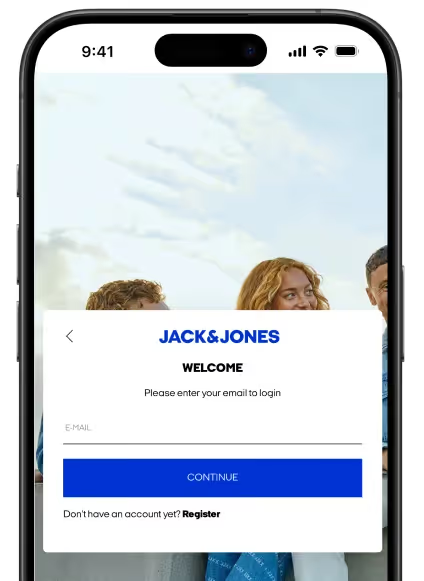
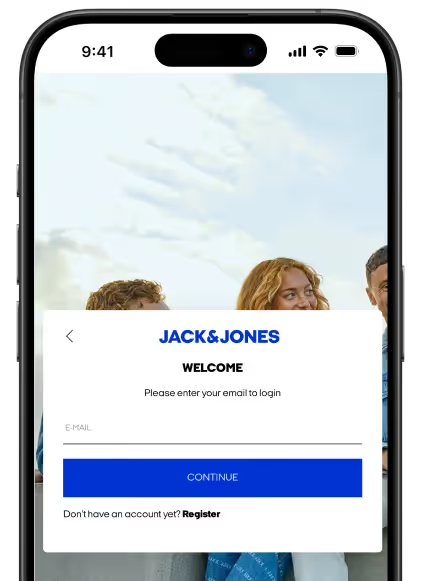
    A straightforward login page of a native movile ecommerce app.

    An app removes a lot of that friction:

    1. Persistent Login: Users are far more likely to stay logged in between sessions, so managing their account doesn’t start with “forgot your password?”
    2. Instant Management: One tap to skip a month, swap a product, or upgrade a plan.
    3. Push Notifications for Renewals: Instead of an email that gets buried, send a push notification: “Your box ships tomorrow! Tap to add extra items.”

    This convenience keeps subscribers active longer and increases customer loyalty. It turns a passive “set and forget” billing relationship into an active, engaging experience where customers feel in control.

    4. True Ownership of Your Audience

    WooCommerce users choose the platform for a reason: ownership.

    You didn’t want to rent your store from a fully hosted ecommerce platform. You didn’t want to be at the mercy of marketplace fees and rule changes.

    You wanted to own your data, your code, and your destiny.

    A mobile app is the natural extension of this philosophy.

    When you rely on Facebook or Google Ads to reach your customers, you’re renting access to an audience. When you rely on SEO, you’re one algorithm update away from a bad month.

    An app is an owned channel.

    When a customer downloads your app, you have a direct line to them. You can send a push notification whenever it makes sense, without going through an ad auction or hoping an algorithm gives you reach.

    This “first-party data” is becoming critical as privacy laws tighten and ad tracking becomes less effective.

    An app gives you a sanctuary of clean, owned user data: interactions, purchases, and preferences that live in your ecosystem instead of someone else’s.

    5. Push Notifications: The “Direct Line” to Customers

    We touched on this already, but it deserves its own section. Push notifications are one of the most powerful retention channels available to ecommerce brands today.

    Email and SMS are still essential, but they’re under pressure:

    • Email open rates often hover below 20% and messages can get buried in crowded inboxes.
    • SMS can be effective but becomes expensive at scale and can feel intrusive if overused.

    Push notifications fill a different role:

    • High Visibility: They land right on the lock screen of your customer’s device.
    • High Engagement: Benchmarks show that top mobile apps can reach ~19% direct open rates on push, while targeted transactional and personalized notifications commonly deliver 16–35% CTR.
    • Real-Time Relevance: You can trigger messages based on behavior, timing, and events inside your store.

    Push notifications are seen by almost everyone who has the app installed, giving you a reliable way to reach your most valuable customers between campaigns.

    On your mobile site, if a user leaves, they’re gone. You might send an email reminder, but they’ll see it (if at all) hours later.

    With an app, you can trigger a push notification 30 minutes later: “You left something behind! Tap to complete your order.”

    Because they’re already logged in inside the app, tapping that notification can take them straight back to their cart or checkout, with their details already in place. The friction drops dramatically, which helps reduce cart abandonment.

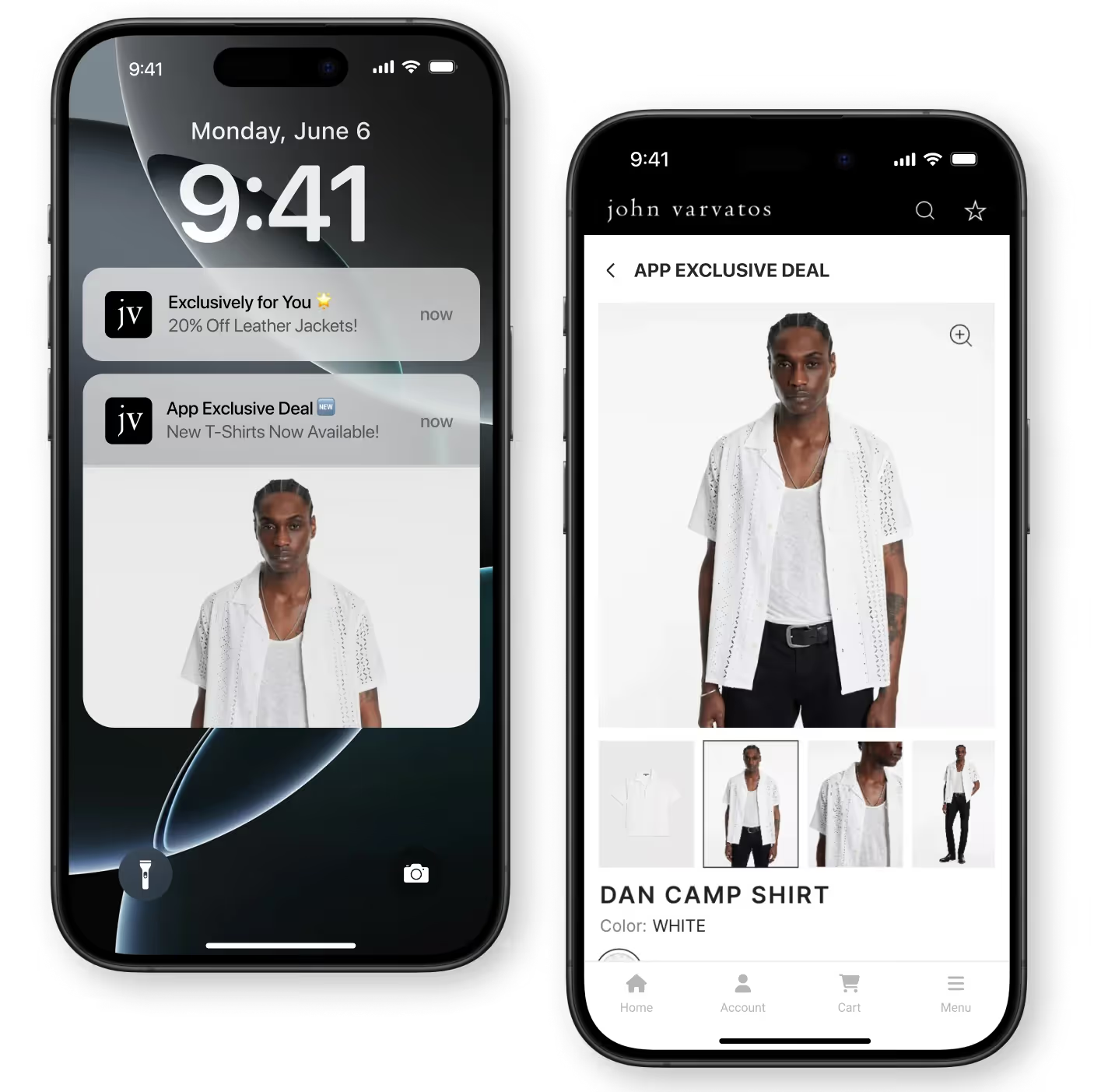
    Product page of Varvatos’ app shown alongside its mobile push notification preview.

    Luxury fashion brand John Varvatos uses push notifications and a dedicated app experience to bypass the noisy email inbox and engage customers directly on their devices.

    Their app users generate significantly higher revenue per user than their mobile web visitors. It’s up to 10x more in some cases, along with more frequent sessions and longer average session times.

    6. Higher LTV & AOV

    Ultimately, the investment in an app has to make financial sense.

    The data is clear: app users tend to become your most valuable customers. They buy more often, and they spend more when they do.

    In our 2025 Ecommerce Mobile App Benchmark Report, we found that ecommerce apps typically contribute 10–30% of total online revenue (and up to 60% for top performers), while outperforming mobile web with 3.5–7x higher ARPU, 1.7–3x higher conversion rates, and 10–50% higher AOV.

    • Higher Conversion: In many ecommerce verticals, mobile apps convert several times better than mobile websites, thanks to better UX, faster navigation, and persistent login.
    • Higher AOV: In a focused, app-based experience, users tend to browse more categories and add more items to their cart.
    • Higher LTV: The “Home Screen Effect” keeps your brand top of mind, leading to more frequent repeat purchases and better mobile app ROI.

    The metric that matters most here is revenue per user.

    Your app isn’t just another front-end for your store, it’s the place where your most engaged, highest-value customers naturally gravitate.

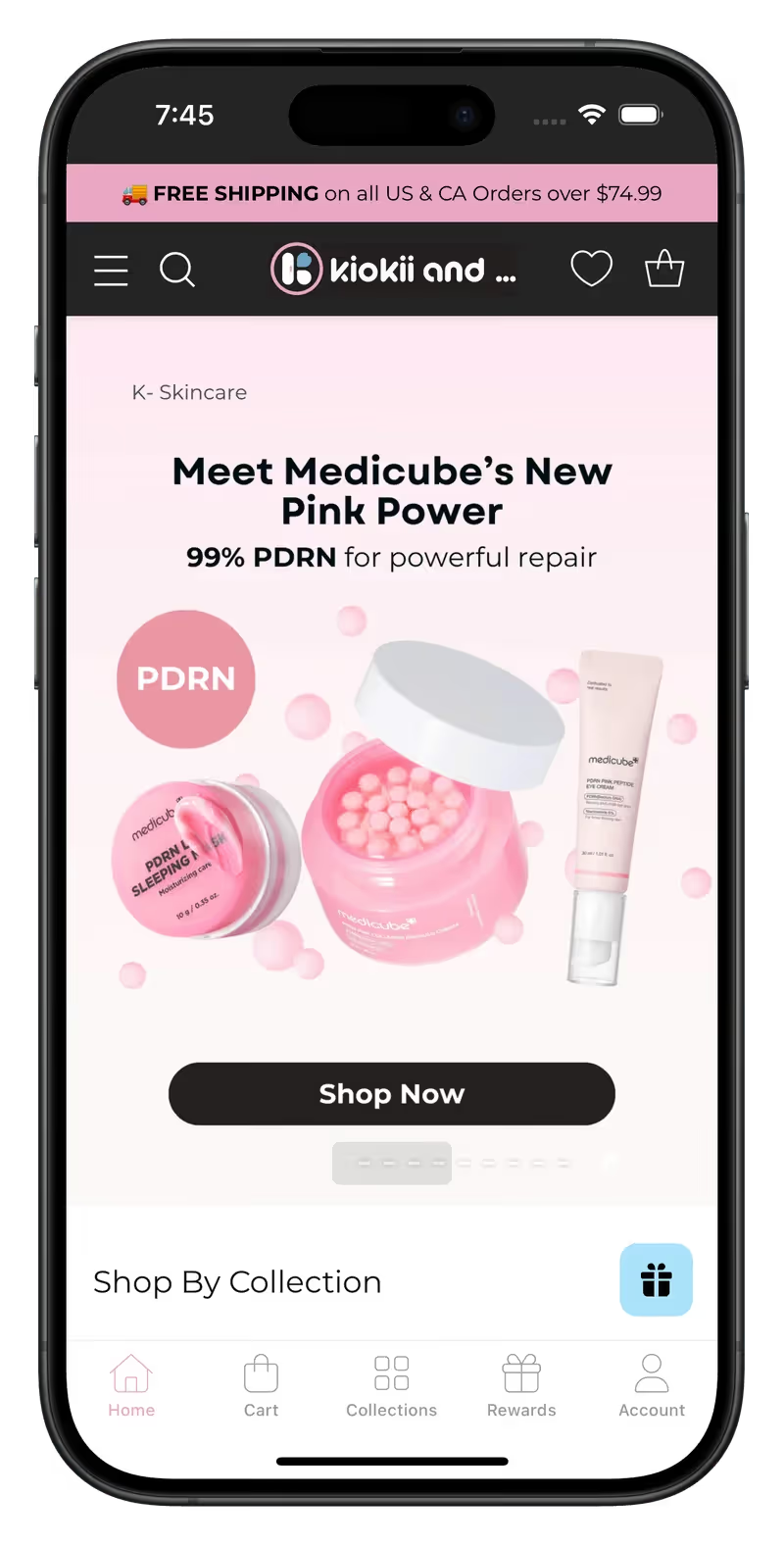
    Kiokii mobile app interface.

    For beauty retailer Kiokii, the app isn’t just a side channel as it drives around 35% of their total online revenue. The people using it aren’t casual, one-off shoppers; they’re loyal superfans who prefer the app to the website and keep returning to buy.

    7. A New Acquisition Channel (App Store Visibility)

    You likely invest heavily in SEO and paid ads to drive traffic to your website. But you might be overlooking a massive, high-intent search engine: the app stores.

    Millions of users search the Apple App Store and Google Play every day. By having a presence there, you create a permanent “digital billboard” for your brand.

    • Brand Legitimacy: Just being on the App Store and Google Play signals that you’re a serious, established business.
    • Organic Discovery: Users searching for keywords related to your niche can find your app organically.
    • Competitor Defense: If your competitors have apps and you don’t, they’re capturing that search traffic and those top-of-mind moments.

    Launching an app isn’t just about retention; it opens up a completely new funnel for acquisition.

    If you want a deeper dive, check out Vendrux’s guide to the best channels for mobile app user acquisition.

    8. Streamline B2B & Wholesale Ordering

    If you use WooCommerce for B2B or wholesale, you know that business buyers have different needs.

    They aren’t browsing for fun, they’re working. They want speed, efficiency, and reliability.

    Research into B2B ecommerce behavior suggests that a very large majority of B2B buyers now use a mobile device at some stage of their purchase journey, whether to research, compare prices, check inventory or place orders on the go.

    Forcing those buyers to pinch-and-zoom on a mobile website to fill out a bulk order form is a friction point that costs you sales.

    A mobile app transforms the wholesale experience:

    • One-Tap Reordering: Buyers can view their order history and repeat a past bulk order in seconds.
    • Push Notifications for Order Status: Keep buyers updated instantly on shipping and delivery, reducing support tickets and “where is my order?” calls.
    • Barcode Scanning: Where supported by your plugins and flows, buyers can use the camera to scan products for quick restocking.

    By giving your wholesale clients a dedicated “ordering portal” on their phone, you make it easier for them to buy from you than from anyone else.

    For broader context on how mobile fits into the B2B ecosystem, see Vendrux’s guide to the best B2B mobile app builders.

    9. Bridge the Gap from Social Media (Deep Linking)

    Social commerce is exploding. You’re likely running ads or organic campaigns on Instagram, TikTok, or Facebook.

    But there’s a technical speed bump: the in-app browser.

    When a user taps an ad on Instagram, the link opens in Instagram’s own browser. It often doesn’t have their login saved, can feel slower, and sits inside yet another layer of UI. This extra friction quietly kills off a portion of your paid and organic traffic.

    A mobile app with deep linking changes that.

    When a user taps a link and already has your app installed, deep linking can take them directly to that specific product page inside the app.

    Because your existing WooCommerce site and checkout (including any saved details and payment options) power the app experience, repeat purchases feel almost instant, just like they do for returning customers on your mobile site today.

    If you’re working on social-led growth, it’s worth also understanding the broader social commerce trend, where platforms like Instagram, TikTok and Facebook increasingly blur the line between “scrolling” and “shopping.”

    A mobile app with deep linking and saved payment details lets you capture more of that intent when people jump from social to your brand.

    That seamless transition from “scroll” to “shop” makes your social marketing and paid campaigns more efficient and can significantly improve your Return on Ad Spend (ROAS).

    Final Thoughts

    For WooCommerce stores, the “mobile gap” is real. Your mobile traffic is high, but your mobile conversion and retention might not be where they should be.

    You don’t need to rebuild your business to fix this. You just need to meet your best customers where they already spend their time: on their phones, inside apps.

    A WooCommerce mobile app lets you:

    • Keep your existing site and plugins.
    • Give your best customers one-tap, always-logged-in access.
    • Own your audience through push notifications and first-party data.
    • Turn casual shoppers into high-LTV superfans.

    At Vendrux, we help WooCommerce stores do exactly that. We take your existing site and all its plugins, checkout flows, and custom logic, and turn it into fully branded iOS and Android apps.

    We handle the app build, publishing, and ongoing updates, while you stay focused on your products, customers, and marketing.

    Ready to see your WooCommerce store as an app? Get a free app preview of your website today!

  • What It Really Costs to Turn a Magento Store into a Mobile App

    What It Really Costs to Turn a Magento Store into a Mobile App

    Building a custom native ecommerce app generally requires an investment of $50,000 to $100,000 or more for the initial release.

    Even cross-platform approaches like React Native or Flutter tend to land in the mid–five-figure to low–six-figure range once integrations, testing, and refinement are factored in.

    But at the same time, native apps are usually one of the highest-ROI channels you can invest in. Independent benchmarks regularly show ecommerce brands getting significantly higher conversion rates and revenue per user in apps compared to mobile web.

    Once you’re on the customer’s home screen, you unlock retention levers like push notifications and one-tap re-entry that can dramatically increase how often people come back and buy.

    So the real question isn’t “can we build an app?” It’s: “What’s the smartest way to get a high-quality Magento app without lighting $50k+ on fire?”

    In this guide, we’ll break down what it actually costs to turn a Magento site into an app in 2026.

    Option 1: Custom Native App Development

    This is the route most people think of first. You hire a specialized mobile app agency to build two separate native apps from scratch, one for iOS (Swift) and one for Android (Kotlin).

    It’s the “Nike approach.” You get a completely bespoke product, but you pay a premium price for it.

    The Upfront Cost: $50,000–$200,000+

    Building a custom native app for a Magento store is a major software project. You’re not just designing a new UI, you’re building and maintaining an additional frontend that needs to talk cleanly to your Magento backend via APIs.

    If you browse app pricing data in places like Clutch’s Mobile App Development Pricing Guide, you’ll see most professionally built apps falling into the tens of thousands of dollars, with an average project cost around $90k and timelines close to a year.

    GoodFirms’ dedicated analysis of ecommerce mobile app development cost shows native ecommerce apps frequently falling in the $50,000–$200,000+ range, with cross-platform builds somewhat cheaper but still firmly in five figures once you add in real-world features.

    For a bare-bones custom app, you might scrape by closer to $50k. For a polished, feature-rich ecommerce experience with parity to your Magento site, $75k–$200k+ is very common, and firmly in line with ecommerce-focused estimates from GoodFirms and other app cost guides.

    Dig deeper into how this compares with broader ecommerce app costs: we break that down in more detail in our guide on the cost to build an ecommerce app.

    The Timeline: 6–12 Months

    Custom development is thorough, but it’s slow.

    Serious ecommerce builds commonly take 6–12 months, and often close to a year when you factor in revisions and store approvals.

    In ecommerce, that’s a long time to wait before you can prove ROI or start sending push notifications.

    Maintenance (The “Silent Killer”)

    The launch bill is only the beginning. To keep a custom app healthy, you need to budget for ongoing maintenance:

    • OS updates: New versions of iOS and Android every year.
    • Device changes: New devices, screen sizes, and hardware quirks.
    • Magento updates: Changes to your store’s theme, checkout flow, or extensions that need to be reflected in the app.
    • New features: Any new payment methods, loyalty programs, bundles, or merchandising logic you add to your site must be rebuilt for the apps.

    Most app maintenance guides recommend budgeting around 15–20% of your initial development cost per year just for maintenance and updates.

    If you spend $80k to build, that’s roughly $12k–$16k/year just to keep things running.

    Option 2: DIY App Builders

    DIY Magento app builders promise to turn your store into a mobile app in a fraction of the time of a custom build. You usually get a dashboard, some templates, and a promise that “no code” is required to launch on iOS and Android.

    Subscription Costs: $100–$600+/month

    Pure DIY Magento 2 app builders often sell one-time licenses in the low–mid hundreds of dollars.

    Bare-bones tools can start around $29 as a one-off purchase, while more complete native app builders typically sit in the $299–$999 range, especially when they include app store submission help and 12 months of updates.

    For serious mid-market brands, the real spend is usually in the monthly plans.

    Most Magento app builders and app-as-a-service platforms aimed at growing stores fall into the low- to mid-three figures per month, and some more managed tiers creep toward $1,000+/month once you factor in higher order volumes, premium support, or extra features.

    If you want a detailed rundown of specific options and pricing, take a look at our guide on Magento Mobile App Development.

    The Cost You Don’t See

    The real cost of DIY builders is rarely the subscription itself. It’s the combination of limitations and the time your team has to spend wrestling with them.

    1. The “Cookie-Cutter” Look

    DIY builders rely heavily on templates and pre-built blocks. That means:

    • You’re constrained to their layouts and navigation patterns.
    • It’s hard or impossible to fully mirror your Magento theme.
    • Your app will look and feel similar to hundreds of others.

    For brands that have invested significantly in custom design, this jump to a generic template can feel like a downgrade.

    2. Incomplete Support for Extensions & Customizations

    Most serious Magento stores rely on essential extensions.

    Reviews from tools like Yotpo or Judge.me play a crucial role. Loyalty platforms such as Smile.io or LoyaltyLion help keep customers engaged.

    Powerful search engines like Klevu or Algolia ensure shoppers find what they need. Add in bundles, upsells, custom promotions, and specialized checkout flows, and you have the features that make the experience truly work.

    DIY builders, on the other hand, depend on basic Magento APIs that rarely expose the full behavior of these extensions. They offer only limited or partial integrations with the tools you already use, and often break down when custom logic or edge cases come into play.

    The result is a watered-down version of your store, missing the very features that drive revenue and loyalty on the web.

    3. You Own the Project (and the Risk)

    Because these tools are self-service, you end up handling the app configuration, content, and troubleshooting yourself.

    You also become responsible for dealing with App Store and Play Store rejections. When a Magento or OS update breaks something, you’re stuck waiting on the builder’s team for a fix.

    What starts as a cheap subscription often turns into a major time sink for your team, with a mediocre app as the final result.

    Option 3: Vendrux

    So, is there a middle ground? A way to get a high-quality, native app experience without a six-figure build and ongoing maintenance headaches?

    That’s where Vendrux comes in.

    Vendrux is a website-to-app platform built specifically for brands that already have a strong mobile site.

    Instead of rebuilding your store from scratch, we use your existing Magento site as the foundation and turn it into a native app. It’s that simple.

    The Cost: Setup + Subscription

    Vendrux’s cost is subscription-based, with a one-time setup fee that covers the build and launch.

    The cost starts at $1,499 per month, with custom enterprise pricing for brands with particular requirements.

    The price covers virtually everything to do with your app – configuration, build, testing, design adjustments, app store submission, and ongoing updates.

    It’s the kind of thing you’d pay $100K+ per year (at least) for a typical agency to handle, with significantly higher lead time.

    Vendrux does it faster, and cheaper – with the end result practically the same.

    Why Vendrux?

    1. No Rebuilding: You Keep Your Magento Frontend

    Because Vendrux uses your existing mobile site, your theme, layout, and branding carry over seamlessly. Your checkout flow and any custom logic remain intact, and if an extension or integration works on your mobile website, it will work in the app as well.

    You don’t pay twice for the same work. When you update your website, those changes flow through to the apps automatically, without requiring another development project.

    2. Fast Time-to-Market

    We typically launch Magento apps in about four weeks, end to end. You connect your site, we configure and style the app, and you review it on real devices.

    From there, we handle the full submission process with Apple and Google. While a custom app is still stuck in discovery and design, you’re already live and getting users.

    Luxury fashion brand Tadashi Shoji is a good example. With a lean dev team on Magento, they skipped a long native build and used Vendrux to turn their existing mobile site into a fully native app in about four weeks.

    The app now drives around 18% of total online revenue (about 30% of mobile revenue) and generates roughly 10x more revenue per user than their mobile website. And they kept full design control with virtually zero ongoing native app maintenance for their team.

    Summary Comparison Table

    Here’s how the three main options compare side by side:

    Feature Custom Agency Build DIY App Builder Vendrux
    Upfront Cost $50k – $200k+ $299 – $999+ ~$5K
    Ongoing Cost $10k – $40k/yr (15–20% annual maintenance) $100 – $600+/month from $1,499/month
    Time to Launch 6–12 Months 1–3 Months (your time) 6-8 Weeks
    Effort Required High (managing agency) High (building it yourself) Minimal (fully managed)
    Feature Support Full (but costs extra to build) Limited (templates only) Full (mirrors website)
    Maintenance You pay hourly for fixes You manage updates Included

    Final thoughts

    For a long time, Magento merchants have faced an uncomfortable choice: spend six figures on a custom native app that takes most of a year to ship or you could settle for a generic template app.

    That trade-off just doesn’t make sense anymore. If you’re a serious brand focused on retention, repeat purchases, and lifetime value, you don’t need to rebuild everything from scratch.

    You need a high-quality mobile experience that lives on your customers’ home screens and doesn’t saddle you with a second product roadmap and dev team.

    That’s exactly what Vendrux is for.

    We give you the presence and retention power of a native app, the speed and affordability of a website-to-app platform, and the support and reliability of a fully managed service.

    Instead of gambling $50k–$100k+ on a risky custom build, you can launch a better-aligned app in a number of weeks, for a fraction of the cost, fully tailored to your brand and optimized for growth.

    Ready to see what your Magento site looks like as an app? Get a free app preview today.

  • The Real Cost of Turning a WooCommerce Store into a Mobile App

    The Real Cost of Turning a WooCommerce Store into a Mobile App

    WooCommerce is one of the workhorses of modern ecommerce, powering millions of stores and sitting on top of the vast WordPress ecosystem of themes and plugins.

    That flexibility is one of the main reasons why people choose it: you can layer subscriptions, bundles, upsells, loyalty programs, custom checkouts, and more on a theme that fits your brand.

    Once you start looking at turning your WooCommerce store into an app, you’ll see pricing that’s all over the map.

    Some tools promise “instant apps” for a few dozen dollars a month, while agencies quote five- or six-figure projects to rebuild your storefront.

    The bigger problem isn’t just how far those price points are from each other, it’s how different the outcomes are.

    At one end, you get lightweight apps that struggle with real-world themes, plugins, and custom checkouts.

    At the other, you pay a premium to recreate the WooCommerce experience you already have, then take on the ongoing cost of keeping it all in sync.

    This guide cuts through the noise with a WooCommerce-first look at the real cost of turning your site into an app.

    Option 1: Custom Native Development

    This is the traditional route: you pay an agency or in-house team to architect and build custom apps from scratch that talk to your WooCommerce backend.

    The Upfront Cost: $50,000–$200,000+

    Modern app development pricing guides typically put simple apps in the $5,000–$50,000 range, medium-complexity apps around $50,000–$120,000, and complex apps starting at $120,000 and easily exceeding $200,000, depending on features and integrations.

    A serious WooCommerce app rarely lands in the “simple” category. You’re rarely just listing products; instead, you’re reproducing:

    • Your full WooCommerce catalog and categories
    • Variable products, attributes, and filters
    • Coupons, taxes, and shipping logic
    • Subscriptions, memberships, bundles, and other plugin-driven features

    By the time an agency has recreated all of that, $50,000–$100,000+ for a robust WooCommerce app (iOS + Android) is very normal. From their vantage point, they’re effectively building you a second ecommerce frontend.

    If you want more insights to ecommerce app costs, check out our breakdown.

    The Timeline: 6–12 Months

    Custom WooCommerce apps aren’t quick to ship.

    Most modern app cost guides tie cost bands directly to timelines: simple apps taking 2–4 months, medium apps 4–8 months, and complex builds 9–18 months. Ecommerce apps typically fall into the medium-to-complex category.

    When you add WooCommerce-specific API work, plugin integration, and the need to support both iOS and Android, you’re realistically looking at 4–9+ months of work before you have a production-ready app tied closely to your store.

    During that time, your WooCommerce site continues to evolve, but your app is locked behind phases, backlogs, and sprints.

    The Hidden Costs

    This is where WooCommerce merchants really feel long-term pain:

    • Maintenance & OS Updates: Every year, iOS and Android ship major updates. Guides like this app development cost overview highlight that the “true cost of ownership” includes post-launch updates, bug fixes, and compliance work that can add thousands (or tens of thousands) per year.
    • Two Platforms, Two Codebases: With separate iOS and Android apps, every new WooCommerce feature you want to surface like wishlists, subscriptions, loyalty enhancements must be implemented and tested twice.
    • Rebuilding WooCommerce Plugins: WooCommerce’s power comes from plugins and extensions: Subscriptions, Memberships, Smart Coupons, advanced shipping, specialist gateways, and more. When you go fully custom, those don’t simply “carry over.” Each one usually needs a dedicated integration, or a partial reimplementation of its logic inside the app.

    That’s why a WooCommerce app project is rarely “one and done.” Once you own those codebases, you also own the long-term upkeep.

    Option 2: DIY App Builders

    DIY app builders typically promise to generate an app from your WooCommerce store in minutes. But once you’re a serious, mid-market merchant, you don’t stay on the cheapest tier for long.

    Subscription Costs: $70 – $600+/month

    Most SaaS-style builders don’t charge a mandatory setup fee at all. You typically just pay your first month plus the app-store accounts: about $99/year for the Apple Developer Program and a $25 one-time registration fee for Google Play. 

    On the more “plugin/lifetime license” side, WooCommerce-specific builders are usually sold as one-time licenses in the low–mid hundreds of dollars per app

    In practice, the plans aimed at growing brands tend to land in the low-to-mid three figures per month.

    Popular ecommerce app builders offer WooCommerce and webstore plans that start around $70/month and climb into the $200–$600/month range for “growth” or “pro” tiers.

    Sometimes they offer an extra percentage of in-app sales on top or optional multi-year “one-time” licenses running into the thousands.

    Check out a more in-depth review of these tools in our guide to WooCommerce mobile app builders.

    The Hidden “Time Tax”

    The real cost of a DIY WooCommerce app isn’t the monthly fee, it’s the time you spend battling limitations and edge cases.

    With a builder, you are:

    • Configuring navigation, menus, product feeds, and categories.
    • Tracking down why certain product variations or categories don’t appear correctly.
    • Troubleshooting broken coupons, shipping rules, or tax calculations that work perfectly on your main WooCommerce site.
    • Dealing with App Store and Google Play submissions and rejections yourself.

    If your time is worth $100/hour, and you invest even 30–50 hours into setup, adjustments, and app store back-and-forth, that’s $3,000–$5,000 in hidden cost before factoring in ongoing tweaks as your store evolves.

    Every theme change, checkout optimization, or new plugin can mean revisiting your builder setup.

    Option 3: Vendrux

    Vendrux exists specifically for this use case: WooCommerce merchants who want a serious app, without rebuilding their store from scratch.

    Instead of trying to recreate WooCommerce in native code, we use your existing site as the engine for your iOS and Android apps.

    That means:

    • Your theme, layout, and brand carry into the app.
    • All your WooCommerce plugins and extensions like subscriptions, memberships, coupons, advanced gateways, shipping rules work the same way they do on your website, because the app is powered by it.
    • You keep managing everything from the WordPress/WooCommerce dashboard you already know.

    Change a product, promotion, or checkout flow on your WooCommerce site and your apps reflect that automatically. No double maintenance, no second catalog, no separate CMS.

    The Cost Structure

    Vendrux is billed as a recurring subscription, with a one-time setup fee covering the upfront build and publishing of your app.

    It’s a predictable, flat cost. The subscription starts at $1,499 per month, with a $5K setup cost. That’s a premium price, compared to simple no-code app builders; but Vendrux is a premium service, for brands that can’t fit within a simple template.

    The cost reflects the ongoing, managed service you get from us. Vendrux isn’t just a tool or a platform; we’re a partner, just as invested as you in the success of your app.

    The “Done-For-You” Value

    Vendrux is more expensive than most DIY mobile app builders. But that’s because we aren’t a DIY app builder.

    • We build your app: Our team does all the technical work to bring your app to life.
    • We submit it: We handle the submission & publishing process to the App Store and Google Play Store.
    • We maintain it: We handle the regular maintenance required to keep your app fast and up to date.

    This is value that goes above and beyond the cost you see on a pricing table. Instead of spending hours of your team’s time managing your app, you get an expert team taking care of everything app-related for you.

    Summary Comparison Table

    Here’s how the first year usually looks for a WooCommerce store:

    Feature Custom Agency Build DIY App Builder Vendrux
    Upfront Cost $50k – $200k+ $0 – $400+ ~$5K
    Ongoing Cost $10k – $40k/yr (15–20% annual maintenance) $70 – $600+/month From $1,499/month
    Time to Launch 6–12 Months 1–3 Months (your time) 6-8 Weeks
    Effort Required High (managing agency) High (building it yourself) Minimal (fully managed)
    Feature Support Full (but costs extra to build) Limited (templates only) Full (mirrors website)
    Maintenance You pay hourly for fixes You manage updates Included

    Final Thoughts

    When you zoom out, the real cost picture is pretty clear.

    Commissioning a custom native WooCommerce app means committing $50,000+ just to get to launch, then signing up for an ongoing maintenance burden. You get power and flexibility, but you pay for it in capital, complexity, and time-to-market.

    DIY builders can look inexpensive at first, but the real cost shows up in the time you spend managing them and in the compromises your best customers feel in the experience.

    A strong app should convert mobile traffic and help you drive more repeat purchases and higher lifetime value from your core audience.

    Entry-level plans may start at a few dozen dollars per month, yet every limitation, workaround, and broken integration chips away at your brand.

    Vendrux takes a different path.

    Instead of rebuilding WooCommerce, we turn the store you’ve already proven into iOS and Android apps in a matter of weeks. You keep your existing theme, plugins, checkout flows, and growth experiments and we handle the heavy lifting.

    The result is a fully featured ecommerce app at a fraction of custom development costs and without the DIY time tax.

    You don’t need to rebuild WooCommerce in a separate codebase. You need a partner that can take the store you already know converts and make it instantly accessible from your customers’ home screens.

    Ready to see what your WooCommerce store looks like as a top-tier app? Book a demo with Vendrux today.

  • Why Your BigCommerce Store Needs a Mobile App

    Why Your BigCommerce Store Needs a Mobile App

    BigCommerce merchants already compete hard on product, experience, and retention. But as mobile has become the default way customers browse and buy. And one channel consistently outperforms everything else for conversion, purchase frequency, and lifetime value: your own mobile app.

    A BigCommerce storefront can be fast, optimized, and well-designed,  but it still lives inside the browser, competing with distractions, session loss, and limited re-engagement options. 

    A mobile app changes that. 

    It creates a direct, persistent, higher-intent shopping channel that helps you retain more customers and grow LTV faster.

    Below are the clearest reasons why your BigCommerce store needs a mobile app

    1. Mobile Web Leaks Revenue; Apps Don’t

    Mobile shoppers are quick. They bounce easily, get distracted, and switch contexts throughout the day. Even the best-optimized mobile site competes with tab switching, lost sessions, and checkout friction.

    Your app breaks that pattern immediately.

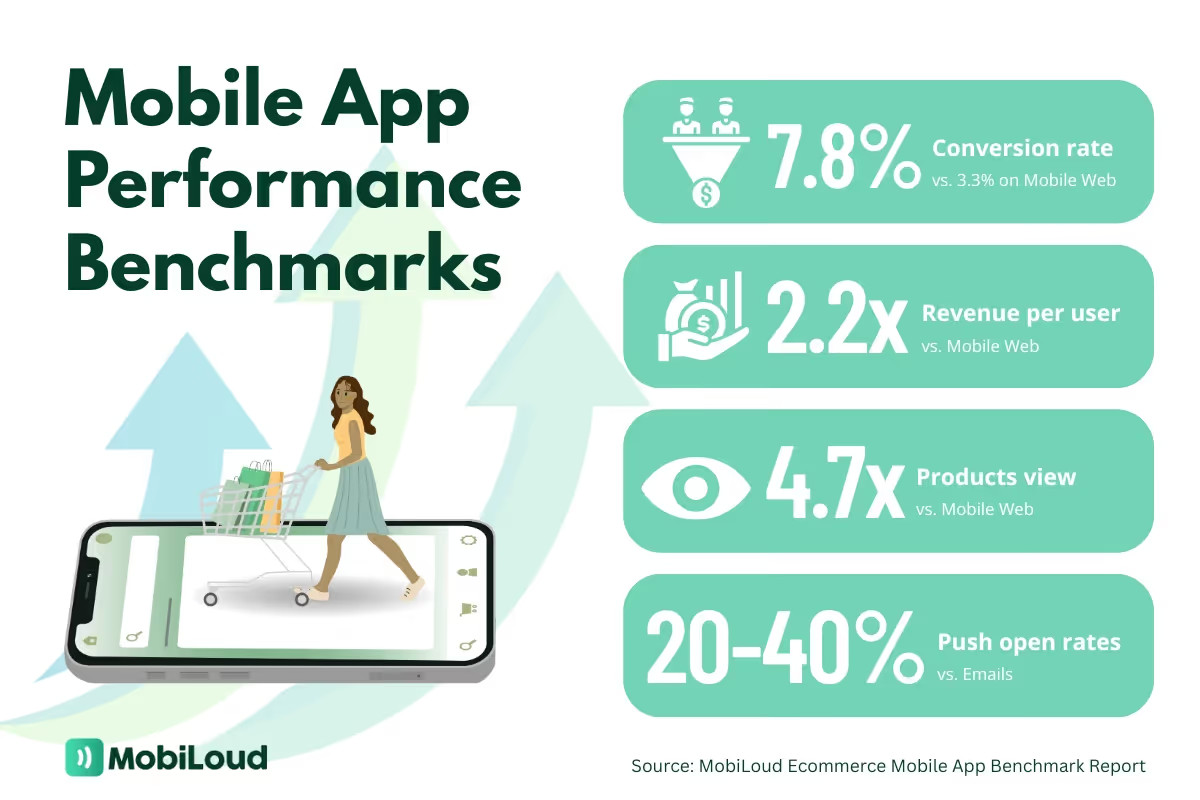
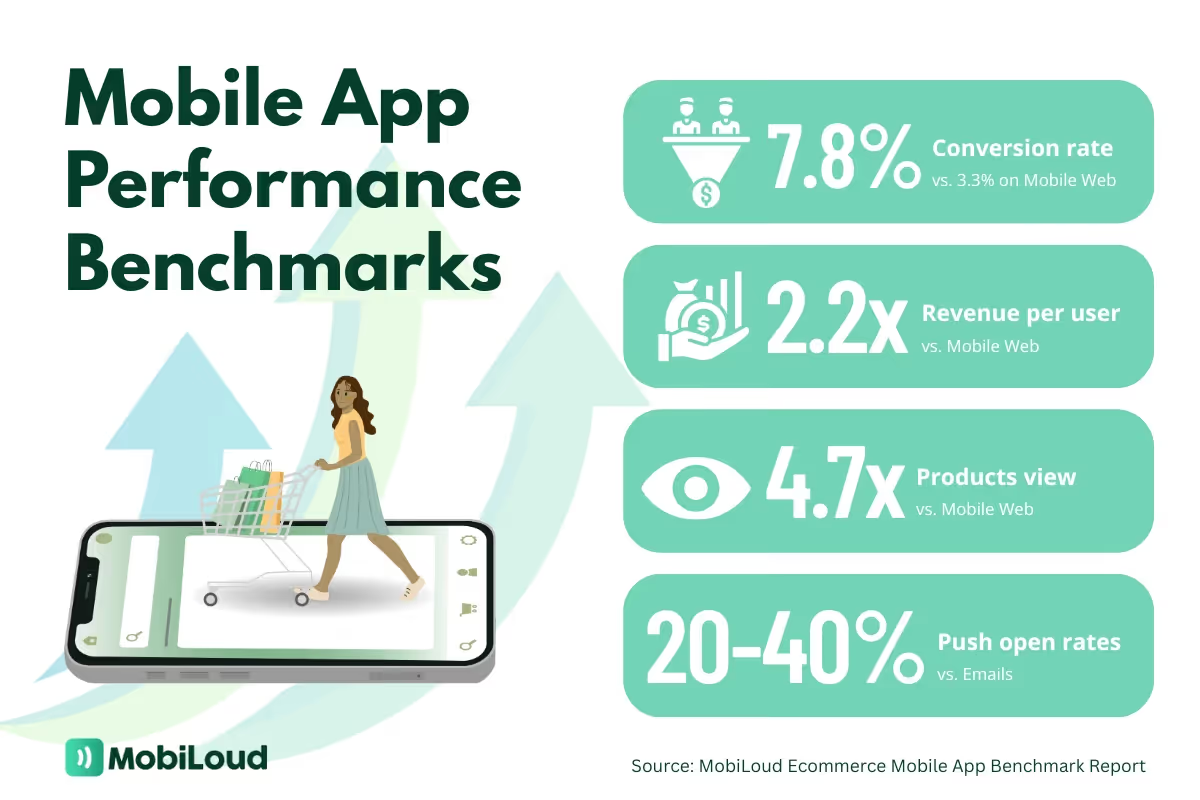
    From our Ecommerce Mobile App Benchmark Report:

    And BigCommerce’s own numbers show the same shift. During Cyber Week, 35% of all BigCommerce orders came from mobile devices, with mobile order volume up 7% year over year.

    Your customers are already buying on mobile; apps simply help you capture more of that demand with deeper sessions and higher intent.

    With an app, shoppers get:

    • One-tap entry
    • Saved login and payment details
    • No browser interruptions
    • A direct path back to your store

    These behaviors compound into longer sessions, higher AOV, and stronger repeat buying. For many BigCommerce brands, this alone justifies launching an app.

    2. Apps Unlock Push Notifications; Your Highest-ROI Retention Channel

    Every BigCommerce brand deals with rising acquisition costs and noisy communication channels:

    • Email is crowded
    • SMS is expensive
    • Paid ads get less efficient every quarter

    Push notifications give you a free, unlimited, high-intent channel that goes straight to your customers’ home screens.

    In our benchmark data:

    • Abandoned cart pushes converted at 10–22%
    • Campaign pushes converted at 6%+
    • Push-driven return sessions increased 3–5x

    Push notification for your BigCommerce store alone often covers the entire ROI of launching an app. It’s one of the rare channels that gets more powerful as your list grows, without increasing costs.

    3. Apps Dramatically Increase Purchase Frequency

    Repeat purchases are where BigCommerce brands win: beauty, supplements, apparel, home goods, lifestyle products, and subscription-driven categories all rely on ongoing engagement.

    Your app helps deliver that by:

    • Living on the customer’s home screen
    • Building habitual usage
    • Making browsing frictionless
    • Pulling customers back without ads

    Across verticals, app users return 3–5x more often than mobile web users. And because your app removes friction across login, browsing, and checkout, it consistently moves customers toward more frequent buying behavior.

    This is one of the strongest LTV levers available to BigCommerce merchants.

    Get deeper data on how apps beat mobile web for conversion and retention; download the Ecommerce Mobile App Benchmark Report.

    4. Apps Give Your Brand a Controlled, Premium Shopping Environment

    BigCommerce storefronts are strong, but browsers still limit what you can control inside the customer’s session. A mobile app gives you a clean, focused, branded space that feels closer to a native retail experience.

    This matters most for brands that:

    • rely on high-impact merchandising
    • manage loyalty or subscriptions
    • run large, complex catalogs
    • care about discovery and repeat browsing

    In the benchmark report, app users viewed nearly 5x more products, which directly supports catalog-rich stores. For beauty, apparel, and lifestyle brands, this deeper browsing behavior has a meaningful impact on retention and AOV.

    5. Your Competitors Already Have Apps, and Customers Expect Them

    Across most BigCommerce categories, the top-performing brands already use apps as part of their retention strategy. Customers have adopted the behavior, and the expectation is clear: if they’ve bought from you more than once, many assume there’s an app waiting for them.

    Recent buyer data reinforces this shift.

    According to the SCAYLE U.S. Shopper Survey, 

    • 63% of shoppers prefer brands with a mobile app, and 
    • 60% expect personalized offers inside it. 

    Customers now see apps as a normal part of the buying experience, especially in categories with strong loyalty or repeat purchasing.

    If you don’t offer an app:

    • Customers stay on lower-converting mobile web
    • You lose a high-intent push channel
    • Competitors with apps earn more repeat purchases
    • Loyalty engagement declines

    For high-growth BigCommerce brands, not offering an app has become a competitive disadvantage.

    6. BigCommerce Stores Scale Best When They Own Their Channels

    Scaling on BigCommerce is about controlling more of your customer relationships. Apps help you do that by giving you:

    • A durable owned channel (push)
    • A permanent presence on your customer’s device
    • Direct re-engagement that doesn’t rely on CPMs or algorithms
    • Richer behavioral and lifecycle data

    As acquisition costs rise and attribution gets harder, owning a high-intent, zero-cost channel becomes a major advantage. An app gives BigCommerce brands a long-term, sustainable way to grow retention and LTV.

    7. Apps Strengthen Your Omnichannel Footprint

    Many BigCommerce merchants sell across multiple touchpoints: 

    • Online storefronts, 
    • Marketplaces, 
    • Retail locations, 
    • Fulfillment channels, 
    • Loyalty programs, and 
    • Customer support.

    A mobile app brings these together into a single, consistent customer experience.

    A customer can:

    • Browse and buy
    • Track orders
    • Access loyalty rewards
    • Manage subscriptions
    • Receive updates

    All these without jumping between channels.

    This aligns perfectly with how omnichannel BigCommerce merchants operate. An app becomes the “home base” for the customer experience, strengthening retention across every touchpoint.

    8. Apps Provide Faster Reordering and Account Management

    A significant portion of BigCommerce stores also serve B2B buyers, and these customers expect consumer-grade convenience.

    A mobile app makes daily purchasing smoother with:

    • Fast catalog access
    • Two-tap reordering
    • Past order lookups
    • Saved carts and lists
    • Mobile-friendly approvals
    • Invoice and payment access

    Reports show that companies investing in streamlined digital workflows outperform peers in customer satisfaction and operational speed.

    If you’re a B2B or B2B2C merchant on BigCommerce, an app makes buying easier for your customers who are often working on-the-go.

    Conclusion: The Fastest Way to Launch an App for BigCommerce

    Apps consistently outperform mobile web across conversion, session depth, purchase frequency, and long-term value. BigCommerce merchants feel this lift even more because of their repeat-purchase models, product discovery needs, and strong mobile traffic.

    Vendrux gives BigCommerce brands the simplest, fastest way to launch a high-quality mobile app:

    • No rebuild
    • Full connection to your existing BigCommerce storefront
    • Launch in ~4 weeks
    • Unlimited push notifications
    • All maintenance included

    See your BigCommerce store as a real mobile app with a free preview.

  • Shopify Plus Mobile App Development: How to Build a Mobile App for Your Shopify Plus Store

    The case for launching a mobile app is clear: app users come back more often, spend more per order, and cost less to reach than customers on the mobile web.

    An app is a powerful, owned asset. It’s a direct line to your best customers. Yet many brands still don’t have their own app.

    If you run a Shopify Plus store, the scale of your business demands that you have a mobile app. You just need to find a way to do it that doesn’t blow out your budget, or drag your team into a lingering, never-ending project that slows everything down.

    It can feel difficult with all the moving parts below the surface of a Shopify Plus store. But it’s far from impossible.

    Keep reading and we’ll explain, in-depth, all you need to know about Shopify Plus mobile app development.

    What Your Mobile App Is (and Isn’t)

    To understand the unique challenges for Shopify Plus brands, you need to first understand the ideal outcome for your mobile app.

    An ecommerce mobile app should be an extension of your web storefront. It’s one piece of your multi-channel, digital presence.

    It should run off the same backend as your website (inventory, accounts, product details, etc) and, ideally, should carry over the same features that customers find on your website.

    David Cost, VP of Ecommerce and Marketing at Rainbow Shops, put it this way when we talked with him:

    “Our apps never had any functionality or usability beyond the web experience. The reason to have an app is not to have something that isn’t on the website, but for people who prefer that way to access Rainbow content.”

    He outlined a crucial misconception with mobile apps: that it has to be a completely new, completely unique surface.

    That’s not what you need. You just need a more convenient way for customers to access your store.

    In trying to create a mobile app that’s fundamentally different from their website, many brands fall into one of the biggest traps that David pointed out to us:

    “The app needs to be at least as functional as the website. It doesn’t need to be better than the website, but the user experience can’t be worse.”

    That’s the bar every mobile app should clear. If you offer mobile app users a worse experience than website users, there’s no reason for them to use the app – and there’s no reason for it to exist.

    But that’s where it gets a little more complicated for Shopify Plus brands than your standard Shopify Store.

    The Feature Parity Problem for Shopify Plus Brands

    With all the power and customization going on under the hood, carrying all of this over into a mobile app becomes tricky.

    We’re talking things like:

    • Custom checkout (Checkout Extensibility, Shopify Functions, and the Branding API)
    • Native B2B for wholesale buyers
    • Shopify Markets or Expansion Stores for international, 
    • Headless frontends (Hydrogen, Oxygen, or a custom Next.js build)
    • Heavily customized themes
    • Shopify Flow automation
    • Custom-built features
    • Granular CRO & AOV improvements

    You may have a site that’s barely recognizable to a regular Shopify store under the hood.

    Launching a mobile app that strips away all of this is not an option. It defeats the purpose of launching a mobile app in the first place.

    That’s why the biggest challenge with Shopify Plus mobile app development is feature parity. Can you get your mobile app to at least deliver the same features and functionality that you have on your website?

    With certain approaches, that’s difficult (if not impossible).

    How to Build a Mobile App for a Shopify Plus Store

    Shopify has the largest ecosystem of mobile app builder software of any ecommerce platform. Nearly 100 apps on the Shopify App Store, which let you compile and launch a mobile app with relatively low effort and cost.

    The problem? Off-the-shelf app builders typically can’t keep up with everything your Shopify Plus store does.

    They’re built using pre-built templates, and powered by Shopify’s APIs, which only expose a limited set of data.

    For any mildly complex Shopify Plus store, you’re almost guaranteed to get a mobile app that’s a stripped down version of your website – as mentioned, not what you’re looking for.

    What About Custom Development?

    On the other hand, you could hire devs, or an agency, to build your custom app from scratch.

    That gets around the feature parity problem, since you can build custom integrations for all the custom features on your website.

    But that gets expensive, fast. It gets more expensive the more unique features you need to rebuild in the app.

    Worse than that, once you go through the long and costly process (likely 6-12 months, and hundreds of thousands of dollars) to launch your app, you’re stuck with a platform that exists separate from your website, and requires a whole team and six figures per year to maintain.

    It’s a mountain of a project – and the work never stops.

    Alternatively, there’s Vendrux: another way to build a mobile app, one that lets you get a custom app without the limitations of an app builder, and without the cost and operational overhead of a “from scratch” build.

    How Vendrux Handles the Complexity of Shopify Plus Stores

    Vendrux lets you launch a custom mobile app, powered by your existing website.

    All your Shopify Plus features, integrations, and even custom features, work in your app by default.

    This is because Vendrux’s approach starts with your website – not from scratch.

    It’s a full-featured mobile app, but the underlying content and functionality comes from your existing web platform.

    You build features, customize your design, integrate with third-party tools, through your website, and Vendrux lets you ship that as a custom mobile app.

    It’s a fundamentally different architecture to the app builder approach, which means virtually no limitations. The only limitation is what you can build in Shopify Plus – and you should know that that’s really not much.

    You can build and iterate on the web and on your mobile app, all through one platform.

    A few examples of mobile apps built with Vendrux – see more here

    The Hidden Cost of Building It Any Other Way

    With a templated builder or a custom build, the app is a separate product. Even if it works perfectly on day one, you’ve now got a second storefront to maintain. 

    Every time you make a design change, add a new feature, a new integration, run a promo, you need to do the work twice.

    Development, testing, bug fixes – twice the work on everything.

    An app is never a one-time launch cost. It’s not something you can build once, and then just sit on forever. It’s a permanent operational weight on your team.

    Aside from the cost, it slows you down, and stops you from iterating on your website or implementing new features, because you know it will just create more work to ship these changes in your app.

    It tends to go one of two ways. Either your team drowns under the work, and you realize that the app is adding too much overhead to your business – or you cut corners, stop maintaining the app, and soon the app and website drift apart, and no one uses the app because it’s consistently out of date.

    Launch your Shopify Plus app without the operational drag.

    You’ve already built a Shopify Plus store with custom checkout, native B2B, Markets, headless storefronts, and everything else that makes your setup yours. There’s no reason to rebuild it in a second environment.

    Vendrux turns your existing storefront into a native iOS and Android app, handles the full build and submission, and keeps the app in sync with your site automatically. Launch in around 30 days, on a flat monthly fee.

    Book a Free Strategy Call

    Why Shopify Plus Brands Choose Vendrux

    At Vendrux, we’ve built more than 2,000 apps over the last decade. A growing share are for Shopify Plus brands, and other enterprise-level ecommerce brands, who want to have a custom mobile app, without the long-term overhead of maintaining a separate platform.

    Every Shopify Plus feature works on day one

    Everything that you can build on the web works in your app.

    With a “from scratch” build, whether it’s custom dev or an app builder, you’re putting untold effort into recreating what already works.

    With Vendrux, there’s none of that. No feature gaps, no duplicate work.

    A real custom app, not a template

    You’re not squeezing your website into a stock template. You’re getting a real custom app.

    The app is custom-built for your requirements. You can create app-exclusive experiences, pricing and discounts, app-only screens, and other tweaks and customizations to ship the app you want, without the tax of custom development.

    A managed service, not a tool you have to run

    A key difference between Vendrux and traditional app builders is that Vendrux is a managed service, not a SaaS app.

    Vendrux handles the whole setup and launch for you – design, configuration, App Store and Google Play submission, QA, push notification setup. 

    After launch, the Vendrux team handles technical app maintenance, keeping your app running through Shopify updates, OS updates, and new feature additions or design changes.

    Your team doesn’t have to learn a new tool, run a new platform, or maintain a second codebase. You keep running your website, as you normally do.

    Predictable pricing, no revenue share

    Vendrux can be a slightly higher cost than a SaaS app builder – but that reflects the extra service you get vs a self-serve tool.

    Pricing is customized to your requirements, but is generally in the low-four figure range per month. That makes launching an app significantly more viable compared to a six figure upfront cost for a from-scratch build.

    There aren’t the variable costs that come with custom development, or app builders that offer customizations, which can spiral out of control for difficult features.

    And unlike some app builders, there’s no revenue share taking a cut of your profits. It’s a predictable cost that lets you scale app revenue freely.

    Launch (and payback) in weeks, not months

    You can go live in around 30 days – not the months (or years) it typically takes to launch a custom app.

    This means you can see the impact of your app much quicker. And, combined with the lower upfront cost, the time it takes to pay back the cost of building your app is significantly shorter.

    A proven track record at Shopify Plus scale

    We work with multiple high-end enterprise brands, across fashion, retail, lifestyle and more, with complex tech stacks that no off-the-shelf app builder can adequately support.

    Bestseller uses Vendrux for multiple apps, including Jack & Jones, Vero Moda, and ONLY. John Varvatos launched their app with a lean internal team and saw 10x revenue per user from app users versus mobile web. 

    Svend Hansen, Product Owner at Bestseller, put it this way:

    “We couldn’t find another company that could offer the same features at the same price point, same time to market, and make it as easy as Vendrux could.”

    And Nick Barbarise, Director of IT at John Varvatos:

    “There is no real business case for building an app from scratch for $1M+ when our mobile website is already good enough.”

    The Bottom Line on Shopify Plus Mobile App Development

    Almost every Shopify Plus brand should have a mobile app. At this scale, the potential revenue from launching an app, even if you get a relatively small share of users to adopt it, is too much to ignore.

    The blocker: finding a mobile app development solution that’s compatible with your setup, and that doesn’t come with a $250K+ price tag, just for the first version (which won’t even see the app store until a year from now).

    Vendrux is built for the Shopify Plus brand that wants to skip the templates, skip the stripped-down, simplified mobile apps, and doesn’t want to deal with the tax of a “from-scratch” build.

    Vendrux turns the store you already run into a native iOS and Android app, in about 30 days, with no rebuild and no parallel codebase to maintain.

    If your website is doing the work, your app should build on that, not alongside it.

    Get a free app preview and we’ll show you exactly what your store would look like as a native app.

  • Why Your Salesforce Commerce Cloud Store Needs a Mobile App

    Why Your Salesforce Commerce Cloud Store Needs a Mobile App

    Salesforce Commerce Cloud (SFCC brands) operate at a different scale:

    • High-volume, 
    • Omnichannel, 
    • Global. 

    They care about retention, loyalty, and long-term customer value. 

    A mobile app isn’t a vanity project for these teams. It’s a performance channel that compounds over time and gives them an advantage their competitors can’t match on the mobile web.

    If your store is on SFCC, below are the clearest reasons why your SFCC store needs an app.

    1. Your Customers Already Shop on Mobile, and Apps Convert Far Better

    Most SFCC brands see the majority of their traffic coming from mobile. But even a strong mobile site still competes with friction that apps don’t face: 

    • Taps close tabs, 
    • Browser sessions expire, and 
    • Distractions pull shoppers away.

    Apps flip that behavior.

    From our latest findings in the Ecommerce Mobile App Benchmark Report:

    • App users convert at 7.8%, compared to 3.3% on mobile web
    • They view 4.7x more products per session
    • They drive 2.2x more revenue per user

    That lift alone explains why so many SFCC launch an app and treat apps as a core revenue engine, not an experiment.

    2. Retention Is a Priority, and Apps Strengthen Repeat Purchase

    SFCC merchants depend on repeat buyers. Beauty, fashion, luxury, lifestyle, CPG are just some of the categories that win through purchase frequency, loyalty program engagement, and second/third purchases.

    Apps drive that behavior by:

    • Living on the home screen
    • Saving login and payment details
    • Creating habitual browsing
    • Making loyalty and subscriptions easier to engage with

    Across categories, app customers come back more often, browse longer, and spend more. For brands with strong repeat potential, this compounds quickly.

    3. Push Notifications Give You an Owned Channel With No CPMs Attached

    Every SFCC brand faces the same pressure:

    • Email is crowded
    • SMS is expensive
    • Paid media costs rise every year
    • Algorithms limit reach

    Push notifications cut through all of it.

    They’re instant, free, and unlimited. That’s perfect for:

    • Product drops
    • Back-in-stock alerts
    • Abandoned carts
    • Replenishment reminders
    • Personalized offers

    In our benchmark, push notifications reached 28% average open rates, far higher than email or SMS. 

    So if you’re already using Salesforce CRM, Loyalty, or Einstein, push notifications in your SFCC store becomes one of the most effective extensions of their existing personalization stack.

    “See how push notifications perform across industries in our Ecommerce Mobile App Benchmark Report.”

    4. Personalization Hits Harder in an App Environment

    SFCC brands invest heavily in segmentation and 1:1 journeys. An app gives them the perfect environment to execute those plays:

    • A fully branded, controlled space
    • First-party behavioral data they own
    • Clear pathways for personalized merchandising
    • Support for in-app messaging, dynamic content, and micro-intent triggers

    According to the SCAYLE U.S. Shopper Survey, customers are:

    • 63% more likely to buy again from a brand with an app
    • 60% more likely to engage with personalized experiences inside an app

    Apps take the personalization your SFCC teams already build and make it land better.

    5. Your Competitors Already Have Apps, and Customers Expect It

    The following SFCC-heavy verticals already use apps:

    • Top beauty brands 
    • Top apparel brands
    • Top luxury brands 
    • Leading omnichannel retailers

    Customers have already formed the habit. If a shopper buys from you more than once, they expect to find your app in the store.

    Without one, you give up:

    • Daily home-screen presence
    • Free communication via push
    • Stronger loyalty touchpoints
    • Deeper brand recognition

    This is one of the clearest competitive gaps SFCC brands run into.

    6. Apps Keep Up With How Customers Actually Shop Now

    Customers like fast and worry-free shopping, and apps make it possible for them. 

    • In-app checkout is faster.
    • In-app browsing is smoother.
    • In-app loyalty sticks better.

    And as AI-led shopping accelerates, apps are becoming the natural home for these experiences.

    With Agentforce Commerce, Salesforce introduced a new generation of AI-driven shopping. These agents can answer product questions, recommend items, and guide customers through buying decisions. Salesforce said AI-driven features can influence 22% of all orders, making them a major lever for relevance and conversion.

    Apps are the best environment for these interactions because they:

    • Keep customers logged in
    • Maintain state between steps
    • Offer more consistent UI layers
    • Support deeper personalization

    If you’re planning to adopt Agentforce in your SFCC, a mobile app makes the experience smoother, more stable, and more effective from day one.

    7. Apps Help SFCC Brands Deliver Consistent UX Across Markets

    Many SFCC brands operate across:

    • Multiple regions
    • Multiple languages
    • Multiple currencies
    • Multiple catalogs

    Mobile web fragmentation creates friction. Apps simplify it.

    A mobile app lets you:

    • Centralize the experience
    • Maintain consistent branding
    • Deliver faster Ux across regions
    • Reduce confusion and drop-off for international customers

    If you run a global SFCC team, this reduces operational load while improving customer experience.

    Vendrux syncs your SFCC languages, currencies, and catalogs automatically. You manage everything once in SFCC and the app updates itself.

    8. Apps Provide Faster Reordering and Account Management

    Many SFCC merchants run B2B or B2B2C channels, where buyers order on the job and expect consumer-grade speed. They need fast access to catalogs, negotiated pricing, past orders, invoices, and account-specific rules, without friction.

    A mobile app makes everyday purchasing smoother with:

    • Two-tap reordering
    • Quick access to past orders
    • Invoice and payment management
    • Saved carts and lists
    • On-the-go approvals

    According to the IBM State of Salesforce report, companies investing in streamlined digital workflows outperform peers in both customer satisfaction and operational speed.

    If you’re a B2B merchant on SFCC, an app makes daily purchasing easier and more reliable for your buyers who work primarily on mobile.

    Give your buyers a faster way to reorder and manage accounts with a B2B app powered by your SFCC site. All your pricing, rules, and workflows work exactly as they do today.

    9. Apps Fit Naturally Into the Omnichannel Retail Ecosystem

    Most SFCC brands don’t live in a single channel. They operate across stores, ecommerce, service, fulfillment, and loyalty, and customers jump between these touchpoints all the time.

    A mobile app brings all of that together in one place.

    Salesforce’s State of Service report notes that companies with connected channels are 1.4x more likely to deliver effective digital and AI-driven customer interactions. An app strengthens that by giving shoppers a single, consistent hub for:

    • Browsing and buying
    • Tracking orders and deliveries
    • Accessing loyalty rewards
    • Booking services or appointments
    • Managing profiles and preferences
    • Receiving updates and alerts

    Instead of moving between sites, emails, and store systems, customers get a seamless flow, which is exactly how SFCC is designed to operate.

    Conclusion: The Fastest Way to Launch an App for SFCC

    Apps outperform mobile web across conversion, engagement, and long-term value, and SFCC brands feel that lift more than most because of their scale and customer expectations.

    Vendrux gives SFCC merchants the simplest, fastest path to launch a high-performance mobile app:

    • No rebuild
    • Full connection to your existing SFCC site
    • Launch in ~4 weeks
    • Unlimited push notifications
    • All maintenance included

    See how your SFCC storefront would look and feel as a real app with a free preview.

  • How to Recover Abandoned Carts on Shopify (5 Proven Strategies)

    How to Recover Abandoned Carts on Shopify (5 Proven Strategies)

    Cart abandonment is the most frustrating metric in e-commerce. You pay for the traffic. You get them to your site. They browse, they click, they add to cart. And then… silence.

    They leave.

    If you’re a Shopify store owner, you know this pain well. You aren’t just losing a single sale; you’re losing the acquisition cost (CAC) and the potential lifetime value (LTV) of that customer.

    The reality is stark: Research from the Baymard Institute shows that the average cart abandonment rate sits at nearly 70%.

    That means for every 10 shoppers who add an item to their cart, only three complete the purchase. But here’s the good news: a significant chunk of that revenue is recoverable. You just need the right blueprint.

    This guide isn’t just about “saving” a few sales. It’s about building a retention engine that automatically captures lost revenue and increases revenue per customer over time, using a mix of fundamental best practices and advanced strategies that most of your competitors are ignoring.

    Why Shoppers Abandon Carts

    Before we fix the problem, we have to understand the bleeding. Why do 7 out of 10 people walk away at the finish line?

    According to Statista, abandonment rates have been climbing steadily. But why? It’s rarely just one thing. Usually, it’s a combination of friction points that cause a shopper to hesitate and eventually leave.

    • Unexpected Costs (48%): Shipping, taxes, and fees that appear only at checkout are the #1 conversion killer.
    • Forced Account Creation (25%): Friction is the enemy. If you force a user to create a password before they pay, they will leave.
    • Complicated Checkout Process (18%): Too many fields, too many pages, or a confusing layout.
    • Trust Issues (19%): If the site looks sketchy or doesn’t show security badges, credit cards stay in wallets.

    There’s a hidden fifth reason that’s often overlooked: The Mobile Web Experience. Mobile commerce (m-commerce) is growing, but it has a problem: conversion rates on mobile web are significantly lower than on desktop.

    Navigating a store on a mobile browser can be clunky. The browser UI competes for space, forms are harder to fill out on a small touch keyboard, and tabs get lost. This friction is a major driver of cart abandonment.

    Reduce abandonment before you ever send a reminder. Steal 15 more ways to cut cart abandonment in your store

    Strategy 1: Optimize the Checkout Experience

    The best way to recover a cart is to prevent it from being abandoned in the first place. You need to remove every possible barrier between “Add to Cart” and “Pay Now.”

    1. Guest Checkout is Non-Negotiable

    Don’t force users to create an account. Period. Enable guest checkout on Shopify. You can always ask them to save their info after the purchase is confirmed.

    2. Be Transparent with Pricing

    Surprise costs are the top reason for abandonment.

    Show estimated shipping and tax costs on the cart page, not just the checkout page. Better yet, offer a “Free Shipping” threshold and display a progress bar (e.g., “Add $15 more for free shipping”).

    This boosts Average Order Value (AOV) while reducing abandonment.

    3. Offer Express Payment Options

    Typing out a 16-digit credit card number on a smartphone is a nightmare.

    Familiar payment badges do more than decorate your checkout, they lower friction and hesitation in one move.

    Enable digital wallets like Shop Pay, Apple Pay, Google Pay, and PayPal. These allow users to checkout in seconds with a fingerprint or face scan, bypassing the tedious form-filling process.

    4. Flash Trust Signals

    Place security badges (Norton, McAfee, or simple “Secure Checkout” icons) near the “Place Order” button. It sounds small, but it reassures first-time buyers.

    Strategy 2: The Perfect Abandoned Cart Email Sequence

    Email marketing is the classic recovery method. It’s reliable, cost-effective, and familiar to customers. A well-structured email sequence can recover a significant portion of lost sales.

    To actually move the needle, you need a strategic sequence.

    Open Rates Reality Check: While effective, email has its limits. Average open rates for ecommerce emails hover around 20-25% according to Klaviyo benchmarks. Abandoned cart emails perform better (often 40-45%), but you’re still missing more than half of your audience.

    Here is the 3-part sequence that works best:

    Email 1: The Helpful Nudge (1-4 Hours Later)

    • Goal: Customer service, not sales.
    • Tone: Helpful, casual. “Did something go wrong?”
    • Content: Show the item they left. Provide a direct link back to the checkout.
    • Do Not: Offer a discount yet. You don’t want to train customers to wait for a coupon.

    Email 2: Social Proof & Objection Handling (24 Hours Later)

    • Goal: Remind them why they wanted it.
    • Tone: Excited, confident.
    • Content: “Still thinking about it?” Include 2-3 reviews or testimonials specifically about the product in their cart. Remind them of your easy return policy or satisfaction guarantee.

    Email 3: The Closer (48-72 Hours Later)

    • Goal: Create urgency.
    • Tone: Urgent, final.
    • Content: “Last chance.” This is where you drop the incentive. Offer 10% off or free shipping, but put a time limit on it (e.g., “Expires in 24 hours”).

    Want ready-made timing and copy ideas? Use this high-converting abandoned cart sequence across email, SMS, and push

    Strategy 3: SMS and Messenger Marketing

    If email is the workhorse, SMS is the racehorse.

    It’s fast, direct, and almost impossible to ignore. SMS marketing is powerful because it’s immediate, but that immediacy comes with a catch: it’s intrusive.

    You have to be careful not to annoy your customers, or they’ll unsubscribe just as quickly as they opted in.

    The best cart reminders don’t shout “buy now”; they quietly reopen the door you almost walked through.

    When you use SMS for cart recovery, keep each message short and to the point as you’ve got roughly 160 characters, so every word has to earn its place.

    Always include a link, ideally using a URL shortener, that takes shoppers straight back to their pre-filled checkout so they can complete their purchase with minimal friction.

    Make sure you’re compliant with regulations like TCPA and GDPR, and only send SMS to people who’ve given explicit consent.

    In terms of timing, a good rule of thumb is to send the message about one hour after abandonment, or to use SMS as a final “last call” alongside your email sequence.

    To execute all of this effectively, you can lean on tools like Yotpo, Klaviyo, or Postscript, which are built to handle SMS flows and Shopify integrations.

    Strategy 4: Retargeting Ads

    Sometimes, you don’t have their email or phone number. This is where retargeting ads come in. You can “follow” users who visited your cart page to Facebook, Instagram, and Google.

    Retargeting ads on platforms like Facebook, Instagram, and Google allow you to “follow” shoppers around the web.

    You can show them the exact products they left behind. Shopify notes that retargeting is a key strategy for keeping your brand top-of-mind.

    Strategy 5: Push Notifications

    Here is the new reality: Email and SMS are incredibly valuable channels, but they’re also more saturated than ever.

    Inboxes are overflowing. “Promotions” tabs hide your best emails. SMS filters are getting aggressive.

    If you want to cut through the noise in 2026, you need a channel you control.

    It should be free to send and show up right on your customer’s lock screen or notification tray for people who’ve installed your app and turned notifications on.

    That channel is push notifications.

    Why Push Wins on Retention

    • High Visibility for Engaged Customers: Unlike emails that can get buried in the “Promotions” tab or ads that get scrolled past, push notifications can appear directly on the lock screen for customers who have your app installed and have opted in to notifications.
    • Higher Engagement: Push notifications often see higher click-through rates than email, especially for time-sensitive offers and recovering abandoned carts, where average cart abandonment rates are over 70%.
    • Deep Linking: You can deep-link a notification directly to the user’s cart in the app, so with one tap they’re back where they left off and ready to check out.
    • Cost: Unlike ads or SMS, push notifications are generally free and unlimited.
    • Speed: They are instant. A user taps the notification, and the app opens right to the checkout flow.

    In our 2025 Ecommerce Mobile App Benchmark Report, we found that ecommerce apps recover 17% more abandoned carts when push is added on top of email and SMS flows.

    The Barrier (and the Solution)

    To send native push notifications, you need a mobile app. This is where Vendrux comes in.

    Many Shopify owners stop here. They assume an app costs $50k and takes six months to build. That is no longer true.

    Vendrux lets you turn your existing Shopify store into a premium native iOS and Android app in just a few weeks.

    You do not rebuild anything. Your current website is the base, so your plugins, themes, and checkout flow still work.

    You also get a real native app experience with smooth navigation and a focused environment that keeps your store front and center.

    With Vendrux, your Shopify store stops whispering from the inbox and starts speaking from the lock screen.

    The “Abandoned Cart Push” Playbook

    With a Vendrux app, you can set up an automated flow just like email, but with higher engagement:

    1. User adds to cart in the app.
    2. User leaves.
    3. 1 Hour Later: A push notification is sent to users who have installed your app and enabled notifications: “You left something behind! 🛒”
    4. Tap: The app opens instantly to the checkout page with their cart ready to go. In just a couple of taps, they can complete their purchase using the same payment methods they already use on your site (for example, Apple Pay or Google Pay where available).

    This kind of low-friction experience is a powerful driver of ROI for top brands, especially among their most loyal customers.

    Top Shopify Apps for Recovery

    To build this ecosystem, you need the right tech stack. Here are the heavy hitters:

    • Klaviyo / Omnisend: The gold standards for Email and SMS automation. They integrate deeply with Shopify and allow for complex segmentation.
    • PushOwl: A popular web push notification app. (Note: Web push is less effective than native app push, as it doesn’t work on iOS in the same way).
    • Recart: Excellent for Facebook Messenger marketing.
    • Vendrux: A powerful solution for native app push notifications. It integrates with tools like Klaviyo and OneSignal, so you can manage your app push campaigns right alongside your email flows.

    Turn cart recovery into a scalable retention channel. Download the Push Notifications for Ecommerce Guide and build a high-ROI push strategy

    Final Thoughts

    Recovering abandoned carts is not just about saving a single sale. It is about building a better customer experience and increasing the value of every customer over time.

    A smooth checkout, well timed emails, and the high visibility of push notifications can work together to boost both revenue and retention.

    Start by optimizing your checkout so customers do not drop off at the last step.

    Use email for detailed, persuasive follow ups that answer questions and remove doubts. Use SMS when you need a quick, urgent nudge that is hard to miss.

    Add retargeting ads to bring back people who left without giving you their email or phone number.

    If you want to truly future proof your store and maximize LTV, you need to own your main engagement channel.

    That means having your own app.

    Turning your Shopify store into a native app with Vendrux gives you a powerful retention tool: a direct line to your customer’s pocket through push notifications.

    Stop leaving money on the table. Get a live preview of your future app today to see the potential of your webstore.

  • Hiring an App Developer: Full Cost & Process Guide

    Hiring an App Developer: Full Cost & Process Guide

    As a business owner, you’re probably seeing more and more customers browsing and buying on their phones. Your mobile traffic is growing, and it’s starting to feel obvious: you should really have an app.

    Mobile apps drive 88% of all mobile time spent by users, giving you a direct line to customers from their home screens.

    But deciding to build an app is the easy part. The hard part is finding and hiring someone to do it.

    Should you go with a freelancer, an agency, or an in-house team? What will it cost, how long will it take, and what are the risks?

    With global app revenue hitting $535.8 billion in 2024, the market is booming, and so is the number of developers promising the world. Some deliver. Many don’t.

    The good news: you don’t need to be technical. You just need a clear picture of your options, realistic cost ranges, and what’s involved in a typical app project.

    In this guide, we’ll cover where to find mobile app developers, what to expect to pay, what goes into building an app, and how to evaluate your options, plus a simpler alternative that could help you launch an app without hiring developers at all, if you already have a website.

    Where to Find App Developers

    Finding mobile app developers is easier than ever, but finding good ones is another story. Here are the most common places business owners look.

    Before you talk to anyone, decide which of these four routes fits how you actually want to work.

    Freelance Platforms

    Sites like Upwork, Toptal, and Fiverr give you access to thousands of individual developers.

    • Pros: Lower cost, flexibility, fast turnaround
    • Cons: Harder to vet quality, no team support, risk of scope creep

    Freelancers work well if you have a clear spec and can manage the project yourself.

    Development Agencies

    Agencies offer full-service mobile app development: design, development, testing, and deployment.

    • Pros: Professional teams, established processes, accountability
    • Cons: Higher cost (typically $100K+), longer timelines

    Agencies work well for big budgets and polished products, but you’ll pay premium rates.

    Offshore Development Teams

    Hiring offshore: Eastern Europe, South Asia, Latin America, offers lower hourly rates. Developers in India charge $20–$50/hour, compared to $100–$150/hour+ in the US.

    • Pros: Significant cost savings, access to large talent pools
    • Cons: Time zone challenges, communication barriers, variable quality

    Offshore can work if you have strong project management and clear requirements. Without that, you risk delays and misalignment.

    In-House Teams

    Building an in-house app team means hiring iOS developers, Android developers, and designers.

    • Pros: Full control, aligned with your business
    • Cons: Expensive, slow to scale, ongoing salary costs

    Most businesses can’t justify the overhead unless apps are core to the business model.

    Understanding Mobile App Development Costs

    Let’s talk numbers. Mobile app development can cost anywhere from around $10,000 to over $500,000+ depending on complexity, platform, and who you hire, which is consistent with typical ranges for how much it costs to create an app in 2025.

    App Type Typical Budget (USD) Build Time Best For
    Simple Apps $5,000 – $50,000 2–4 months Basic login, simple data display, simple forms, MVPs, internal tools
    Medium Complexity $50,000 – $150,000 4–7 months Apps with payments, third-party APIs, geolocation, push, social logins
    Complex Apps $100,000 – $300,000+ 9–12+ months AI features, real-time data, custom backends, heavy customization

    Simple Apps: $5,000 – $50,000

    Think basic functionality like login, simple data display, maybe a form or two. These apps take 2–4 months to build and are fine for MVPs or internal tools.

    Medium Complexity Apps: $50,000 – $150,000

    Apps with integrations (payment gateways, third-party APIs), geolocation, push notifications, or social logins fall into this range. Expect 4–7 months of development.

    Complex Apps: $100,000 – $300,000+

    Advanced apps with AI, real-time data, custom backends, or heavy customization can easily hit six figures. Development can stretch 9–12+ months.

    What Drives Cost

    • Platform choice: Building for both iOS and Android costs more than one platform
    • Design complexity: Custom UI/UX is expensive; templates are cheaper
    • Developer location: US-based developers cost 3–5x more than offshore teams
    • Features: Every integration adds time and cost
    • Ongoing maintenance: Budget 15–20% of build cost annually

    When you factor in not just build costs but also maintenance, updates and your own time managing the project, the most cost-effective mobile app development options often aren’t the ones with the lowest headline price.

    What Goes Into Building a Mobile App

    When you hire a mobile app developer, here’s what you’re actually paying for.

    Discovery and Planning (1–4 weeks)

    This is where you define goals, map features, create wireframes, and outline the technical requirements. Skipping this step is how projects go off the rails.

    Design (UI/UX) (3–8 weeks)

    Designers create mockups, user flows, and prototypes. Good design makes or breaks user adoption, so don’t skimp here.

    Development (6–20 weeks)

    Developers write the code for your app, frontend (what users see) and backend (servers, databases, APIs).

    If you’re building for both iOS and Android natively, you need separate codebases. Cross-platform frameworks like React Native or Flutter can save time but come with trade-offs.

    Testing and QA (3–8 weeks)

    Quality assurance teams test the app across devices, operating systems, and edge cases. Bugs caught here are cheaper to fix than bugs caught by users.

    Launch and Deployment (1–2 weeks)

    Submitting to the Apple App Store and Google Play involves compliance checks, review processes, and sometimes rejections. Budget time for revisions.

    Post-Launch Maintenance (Ongoing)

    Apps need updates: bug fixes, OS compatibility, new features. Most businesses spend $5,000–$20,000+ annually on maintenance.

    Weigh months of custom dev against faster options using this website-to-app vs custom native vs DIY wrappers breakdown.

    Evaluating App Developers

    Once you’ve found a shortlist of candidates, how do you actually vet them?

    Review Their Portfolio

    Look for apps similar to what you want to build. Download them. Use them. Are they polished? Do they perform well?

    If a developer can’t show you live, published apps, that’s a red flag.

    Verify Technical Expertise

    Ask about their tech stack. Do they specialize in iOS, Android, or cross-platform? What frameworks do they use?

    You should understand their approach and why they recommend it.

    Assess Communication

    Poor communication kills projects. Ask how they handle updates and feedback. Do they use project management tools? How often will you hear from them?

    Check References

    Ask for references from past clients. Were deadlines met? Did the app work as promised?

    Testimonials on a website are nice. Conversations with real clients are better.

    Watch for Red Flags

    • Promises that sound too good to be true (“We guarantee your app will get 100,000 installs in the first month”)
    • No contract or vague scope documents
    • Upfront payment demands without milestones
    • Lack of clarity on ownership and intellectual property rights

    The Reality Check: Time, Effort, and Risk

    Even if you find a great developer, building a mobile app isn’t a “set it and forget it” process.

    The average app takes 4–6 months to build, and that’s if everything goes smoothly. Delays are common. Scope creep can blow budgets.

    You’ll need to stay involved, expect weekly calls, design reviews, and testing rounds.

    And the work doesn’t stop at launch. You’ll need to promote the app, gather feedback, fix bugs, and release updates.

    For many businesses, the full cost isn’t just the development, it’s the months of management and iteration. That’s before you even think about how you’ll retain users and bring them back to the app repeatedly.

    The Easier Alternative: Vendrux

    Here’s the thing: If you already have a mobile-optimized website, you may not need to hire a developer at all.

    Vendrux is a website-to-app service that converts your existing site into full-featured iOS and Android apps, no rebuild, no six-figure budget, no trial and error finding the right developer.

    All the work you’ve already put into your website like layouts, product pages, navigation, content, and checkout flows comes with you into the app instead of being rebuilt from scratch. What works on your site today continues to work inside your apps.

    Instead of starting from scratch, Vendrux turns your existing mobile site into fully native apps, using your website as the engine of the experience.

    Instead of funding a separate native build, Tadashi Shoji used Vendrux to let their website do double duty as an app.

    Everything that works on your mobile site, checkout, integrations, plugins, works in the app. You get:

    • No rebuild required: Your existing site becomes the app
    • Unlimited push notifications: Reach customers directly on their home screens
    • Fully managed service: Vendrux handles design, development, app store submission, and updates
    • Faster time to market: Typically live in around 30 days
    • Lower cost: A fraction of what custom development costs

    Vendrux works on a simple model: a one-time setup to get your apps launched, plus an ongoing subscription for hosting, updates, and support.

    Beyond saving time and budget, having your own mobile app is a retention and LTV play. Once customers install your app, you’re on their home screen with a direct line back through push notifications, which tends to drive more repeat visits, more sessions, and higher revenue per user compared to relying on mobile web alone.

    For ecommerce stores, publishers, and web-first businesses, Vendrux offers a proven path to launching high-quality mobile apps without the overhead of custom development.

    Turn your existing site into iOS and Android apps in about 30 days with this step-by-step website-to-app guide for Vendrux.

    Final Thoughts

    Hiring a mobile app developer is a significant investment.

    You’ll spend months searching, vetting, negotiating, and managing. You’ll pay anywhere from $50,000 to well over $300,000. And you’ll own the ongoing responsibility of updates, bugs, and feature requests.

    For some businesses, especially those with unique, complex requirements, custom development is worth it. If you need highly specialized functionality that your current site doesn’t support, a bespoke build can be the right choice.

    But if you already have a strong, mobile-optimized website, there’s a smarter way. Vendrux turns your site into native apps in weeks, not months, for a fraction of the cost.

    No hiring headaches. No scope creep. No $100K+ development budgets, and you preserve all the optimization work you’ve already done on your site.

    If you’re serious about launching a mobile app without the trial and error of hiring developers, book a demo with Vendrux and see how fast you can go from website to app, while also setting yourself up for better retention and higher lifetime value from your best customers.

  • What is Whatnot? The Live Shopping App Exploding in 2025

    What is Whatnot? The Live Shopping App Exploding in 2025

    If you haven’t heard of Whatnot yet, you are missing one of the biggest shifts in ecommerce since the rise of Shopify.

    While headlines focus on TikTok Shop, a dedicated marketplace app has quietly built a massive, hyper-engaged empire. It is not just another place to list products; it is a live, twenty-four-seven auction house that feels more like a video game than a store.

    Whatnot is growing fast. In November 2025 alone, downloads grew 541% versus November 2024, reaching 1.61 million new installs in a single month.

    It has evolved from a niche platform for Funko Pop collectors into a global live shopping juggernaut moving billions in gross merchandise value (GMV). For ecommerce founders, this signals a critical trend: the line between entertainment and shopping is gone.

    While livestream shopping has already exploded in markets like China and Southeast Asia, Whatnot shows how that model is now taking hold in the US and other Western markets, blurring the boundaries between ecommerce, social media, and entertainment.

    In this article, we will break down how the platform works, the numbers behind its rise, and whether you should treat it as a serious sales channel.

    What is Whatnot? (eBay Meets Twitch)

    At its core, Whatnot is a live shopping marketplace, a mashup of eBay’s auction mechanics and Twitch’s live streaming interactivity.

    Not just another marketplace and not just another stream, Whatnot lives in the overlap.

    Sellers go “live” on video to auction items in real-time. Unlike traditional ecommerce where a customer browses a static catalog, a Whatnot session is an event.

    The host might be cracking open packs of rare trading cards, showcasing vintage streetwear, or running “sudden death” auctions where items sell in seconds.

    From Niche to Mainstream

    The platform launched in 2019 with a focus on a single, obsessive community: Funko Pop collectors. The founders bet that enthusiasts didn’t just want to buy items; they wanted to verify authenticity and hang out with other fans.

    That bet paid off. Whatnot mastered the “trust” verification process for collectibles and quickly expanded. Today, it covers over 250 categories. While it is still huge for mobile app market statistics in the collectibles space, it has aggressively moved into:

    • Fashion and Beauty: Now one of its fastest-growing segments.
    • Sneakers and Streetwear: Where hype culture drives massive auction volumes.
    • Electronics: Reselling refurbished or overstock tech.
    • Luxury Goods: Authenticated handbags and watches.

    It creates a “FOMO” (fear of missing out) environment that static websites simply cannot replicate.

    How Does It Work? The Mechanics of Live Selling

    If you open the app, you don’t see a grid of product photos. You see a feed of live video streams. Here is how the mechanics drive sales volume that traditional retailers can only dream of.

    Live Auctions and Speed

    The heart of the app is the live auction. A seller holds up an item, starts a timer, and viewers bid in real-time.

    • Sudden Death: Sellers can run auctions that last just 10–15 seconds.
    • Bidding Wars: Every time a bid comes in late, the timer extends slightly, creating adrenaline-fueled wars.
    • Buy It Now: Sellers can pin items for immediate purchase, but the action is usually in the bidding.

    Breaks and Mystery Boxes

    In categories like trading cards, sellers host “breaks.” A buyer purchases a “spot” in the break, and the host opens sealed packs live on camera. The buyer gets whatever cards belong to their spot (e.g., a specific team or player). It turns shopping into a gamble and a spectator sport.

    Community and Chat

    This is the “social” part of social commerce. Viewers aren’t just buying; they are chatting with the host and each other. They follow their favorite sellers and get push notifications every time they go live.

    This creates a habit loop that is incredibly powerful for retention, something we often discuss when analyzing the benefits of mobile apps for DTC brands.

    The Numbers: Is Whatnot a Real Contender?

    It is easy to dismiss live shopping as a fad, but the data suggests otherwise. Whatnot has put up numbers that make it a serious player in the US ecommerce landscape.

    These are the kinds of numbers that move Whatnot from “interesting trend” to “channel you can’t ignore.”

    Revenue and Valuation

    The platform has attracted massive capital from top-tier investors like Andreessen Horowitz and Y Combinator.

    • In early 2025, Whatnot raised a Series E round at a $4.97 billion valuation.
    • By late 2025, reports indicated a valuation climbing even higher, reaching $11.5 billion.
    • TechFundingNews reports that the platform has secured nearly $1 billion in total funding.

    Sales Volume (GMV)

    • Estimates show Whatnot hitting $359 million in revenue in 2024, growing over 100% year-over-year.
    • The platform facilitated approximately $3 billion in Gross Merchandise Value (GMV) in 2024, according to data from Sacra.
    • The company targets $6 billion in sales in 2025.
    • During Black Friday 2025, the platform generated over $75 million in sales in a single day.

    User Growth and “Stickiness”

    The most impressive metric isn’t just the money; it’s the attention.

    • The average user spends nearly 80 minutes per day in the app.
    • Top sellers are generating millions in annualized revenue.
    • According to the U.S. Chamber of Commerce, this retention is driven by the community aspect, where small businesses act as micro-influencers.

    These ecommerce mobile app statistics outperform almost any traditional retail app on the market, showing that the gamification of shopping works.

    Get the numbers on how apps outperform mobile web in our mobile apps vs mobile websites breakdown

    Whatnot vs. TikTok Shop

    If you follow ecommerce trends, you are likely comparing Whatnot to TikTok Shop. Both are fighting for dominance in the US live shopping market, but they are fundamentally different beasts.

    The “Commerce-First” Difference

    TikTok started as an entertainment app and later layered in commerce. Most users still open it primarily to be entertained, and product discovery happens as part of that experience.

    • TikTok Shop leverages massive algorithmic reach. A video can go viral to millions of people who weren’t looking to buy anything.
    • Whatnot is a destination app. Users open it specifically to shop. The intent is commercial from the moment they click the icon.

    Different Audiences

    • TikTok skews broadly Gen Z and mainstream. It is great for low-AOV impulse buys, viral beauty products, and gadgets.
    • Whatnot dominates the “enthusiast” economy. It is for collectors, hobbyists, and people looking for specific, often higher-value items like rare sneakers, vintage luxury bags, or graded comic cards.

    As noted by eMarketer, while TikTok Shop is driving the “awareness” of live shopping, dedicated platforms like Whatnot are where deep, community-based commerce is thriving.

    Should Your Brand Sell on Whatnot?

    Today, Whatnot is still dominated by independent resellers and small businesses, rather than major retail brands. But that’s exactly what makes it interesting: it’s a glimpse of where mainstream ecommerce could be heading, as larger brands begin to experiment with live shopping the way they already have with TikTok Shop.

    If you are a DTC ecommerce brand, should you be rushing to set up a Whatnot account?

    The answer is: It depends on your product and your team.

    Benchmark your own app plans against the report on how many ecommerce stores actually have mobile apps

    The Case For “Yes”

    1. Inventory Liquidation: Running a “Mystery Box” or “Vault Sale” can clear thousands of units in an hour without degrading your site premium.
    2. Hype Launches: For streetwear or limited-run fashion, live drops create frenzy.
    3. Customer Intimacy: It puts a face to the brand, building deep loyalty.

    The Case For “No”

    1. Talent Intensive: It requires a charismatic host who can talk non-stop for hours. Without one, you will fail.
    2. Margin Compression: Between fees (roughly 8% + 2.9%) and auction deals, margins will be lower.
    3. Audience Mismatch: If you sell commodities or utility items, the auction format adds little value.

    The Strategy: Test It and Build Retention

    Right now, the smart move is to keep a close eye on Whatnot and run small tests if your brand fits live selling.

    If you sell collectibles, fashion, beauty, sneakers or hype-driven drops, it is worth trying a few shows and seeing how fees, discounts and host time stack up against the results.

    Whatnot could become the next major ecommerce channel in the same way TikTok Shop has taken off, but you should not rely on it for long term customer relationships. Use each sale to move buyers into your own ecosystem.

    Add inserts and QR codes to your packaging, invite people to join your email list or SMS program, and point them toward your own branded app for early access and perks.

    Get the mobile app loyalty and retention playbook to turn superfans into long term VIPs

    Final Thoughts

    Whatnot is a fascinating glimpse into the future of shopping. It shows that consumers are craving connection, entertainment, and “gamified” experiences, not just efficient checkout flows. Its 541% year-over-year download growth and 1.61 million new installs in November 2025 show that this trend is only accelerating.

    As more established ecommerce brands test live shopping, platforms like Whatnot could evolve from niche collector hubs into mainstream sales channels, much like TikTok Shop is becoming for social commerce. It’s part of a broader global trend where ecommerce, entertainment, and social media are merging into a single experience.

    However, for serious ecommerce brands, a third-party marketplace should never be your only strategy. While Whatnot offers reach, it also charges fees and owns the customer.

    The best brands use Whatnot to build hype and acquire new fans, while driving their most loyal customers to their own mobile app.

    A dedicated app gives you similar notification power, but with far fewer competitor distractions and full control over your customer relationships and first-party data.

    If you want to learn how to promote your ecommerce mobile app and build a retention channel you actually control, Whatnot is a great inspiration, but it shouldn’t be your only play.